13 Books, Read in Order: Dan Martell's Staged Reading Plan
Dan Martell's reading list is a sequence, not a pile: 13 books grouped by the job each one does, from fixing your money scripts to building a business that runs without you, each with an age window. The staging is the useful part. A few of his claims are overstated.
Mindset and money first, then productivity, then systems, then stewardship. A staged reading plan from a founder who says it took him from broke in his 20s to a business worth over a hundred million.
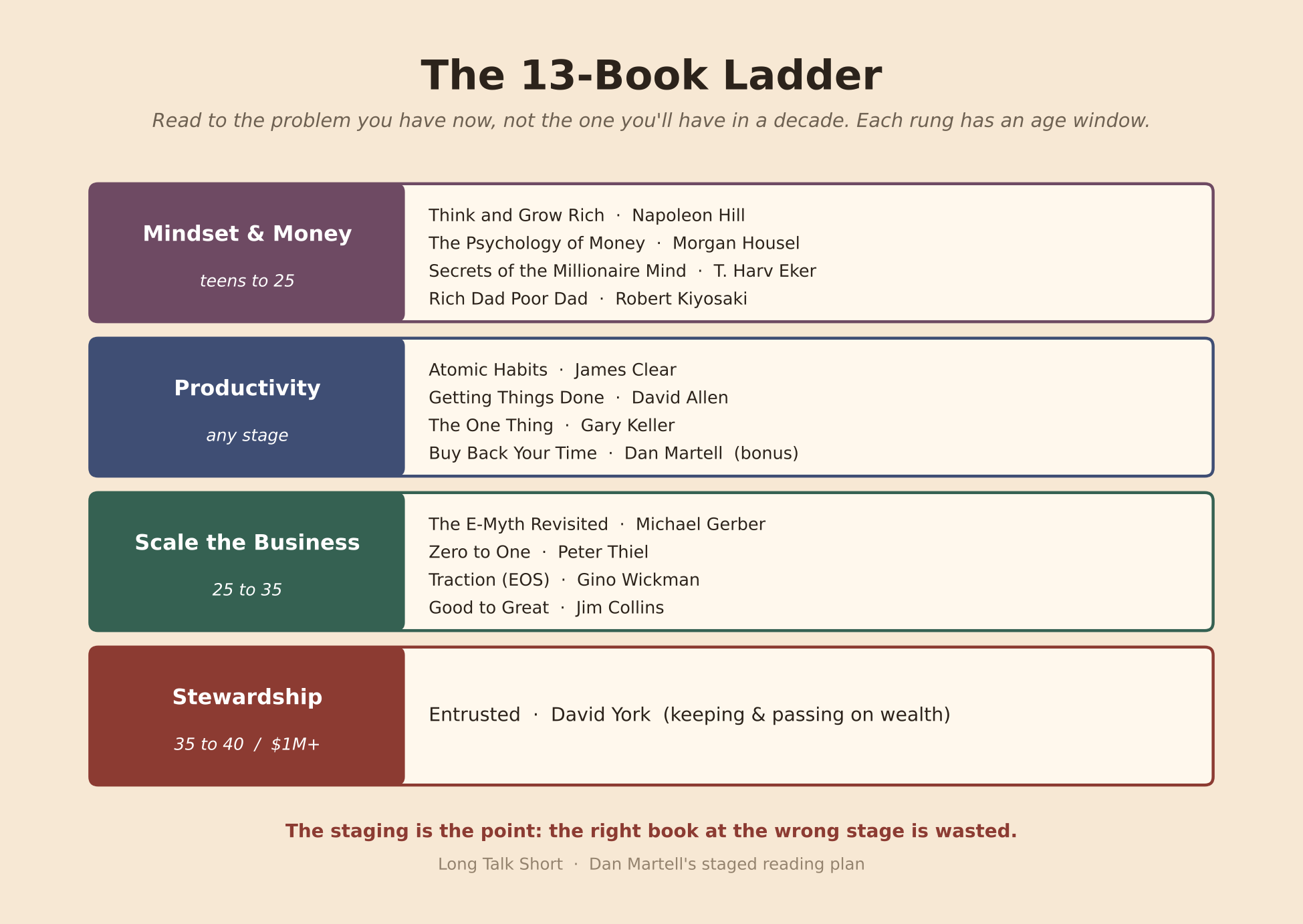
Dan Martell's reading list is less a list than a sequence. In under nine minutes he lays out 13 books, one of them his own, grouped by the job each is meant to do: rewiring how you think about money, getting more done, building a business that runs without you, and protecting wealth once it arrives. Each comes with a rough age window, on the premise that the right book at the wrong stage is wasted.
Start with belief, then money scripts
Martell hands Think and Grow Rich by Napoleon Hill to every teenager in his life, calling it a blueprint that starts with desire and Hill's idea of autosuggestion. Between 20 and 25 comes the money layer. The Psychology of Money by Morgan Housel is about the bad money scripts most people carry, and it favors consistent smart choices over flashy risk. Secrets of the Millionaire Mind by T. Harv Eker is about rewriting the money stories you inherited from your parents; Martell notes the book came bundled with seminar tickets, which he and his brother used, joined the program, and stayed in for three years. Rich Dad Poor Dad by Robert Kiyosaki covers the asset-versus-liability distinction and the shift from employee to investor, on the logic that until you learn to think like an investor, you stay a high-paid employee.
Systems beat willpower
The productivity block shares one idea: design your environment so you win by default. Atomic Habits by James Clear supplies the 1 percent compounding and the observation that you do not rise to the level of your goals, you fall to the level of your systems. Getting Things Done by David Allen adds that your mind is for having ideas, not holding them, so you empty everything out of your head and schedule time to process it. The One Thing by Gary Keller poses the focusing question: what is the one thing that would make everything else easier or unnecessary? Martell slips in his own Buy Back Your Time here as a bonus, with its core reframe that you do not hire to grow the business, you hire to buy back your time.
Work on the business, not in it
From 25 to 35 the list turns to scale. The E-Myth Revisited by Michael Gerber teaches the franchise prototype: document everything so the business works for you, and you move from self-employed to owner. Zero to One by Peter Thiel is the book Martell credits beneath his AI-first venture studio, for its case for creating new markets rather than fighting in crowded ones and building a moat. Traction by Gino Wickman lays out EOS, a lean operating system of vision, accountability, and meeting rhythms, with the claim that people need to hear a vision about seven times before it lands. Good to Great by Jim Collins adds the "level five" leader who pairs fierce determination with humility, and the idea of getting the right people on the bus before deciding where to drive. Martell's gloss on culture: it is what people do when nobody is watching, not the ping-pong tables.
Wealth needs a purpose
The final book, Entrusted by David York and others, is pitched for ages 35 to 40 or a net worth above a million, and it covers keeping wealth, passing it to family, and building a legacy. Martell's view is that wealthy people ultimately want impact through their team and family, and he closes with a warning worth keeping: "information without implementation is just wasting your time."
Weighing it
The staging is the genuinely useful part. It hands you an order instead of a heap, which is more than most reading lists do. The age ranges, though, are Martell's own rules of thumb, not prescriptions, and several of his claims are overstated. He says every properly run business uses EOS, that most large companies run it, and that Getting Things Done is used by all the top CEOs. None of that is supported, and EOS is primarily marketed to small and mid-sized firms. His read of Zero to One is shaky on two counts: the "blue ocean" and "red ocean" language actually comes from a different book, Blue Ocean Strategy, and his claim that a product needing ads or salespeople is simply not good enough runs against that book's own emphasis on distribution. The hundred-million figure and the seminar story are his own account, and the video doubles as a promotion for his book, newsletter, and coaching. The mindset-first titles (Think and Grow Rich, Secrets of the Millionaire Mind, Rich Dad Poor Dad) are motivating but thin on evidence and have long drawn criticism, so read them for framing, not financial fact.
Long Talk Short
The real takeaway is not the specific 13 titles but the method behind them: read to the problem you actually have right now, not the one you will have in a decade, and then do something with what you read.
- Martell orders 13 books by stage: mindset, money, productivity, scaling, and wealth stewardship.
- Fix your money scripts early. Consistency beats flashy risk.
- Build systems and defaults rather than leaning on willpower, and get your tasks out of your head.
- Use the focusing question to prioritize ruthlessly.
- To scale, document the business, align people on one vision, and hire for culture.
- Some claims (near-universal EOS adoption, his reading of Zero to One) are overstated.
- The signal worth keeping: match what you read to the problem in front of you, then act on it. Information without implementation is wasted.
Source: Dan Martell, "These 13 Books Made Me a Multi-Millionaire CEO." This is an independent summary of that video, not affiliated with Dan Martell. It is for general information only and is not financial, investment, or business advice; the recommendations and outcomes described reflect the speaker's personal experience. Consult a qualified professional before making financial decisions.