Adam Grant Was the Worst Diver in His School. That's the Point.
At 13, Adam Grant was afraid of heights and couldn't touch his toes. On Mel Robbins' show, he explains why starting ability is a weak predictor of potential, plus small research-backed fixes for overthinking, quitting and fading friendships.
At 13, Adam Grant was afraid of heights, couldn't touch his toes, and by his own account was "the worst diver in my school." Two and a half years later, he was a state finalist.
Today he's a Wharton organizational psychologist, and in a conversation with Mel Robbins he uses that story to make a bigger argument: most of us misjudge potential, overthink the wrong choices and misread our relationships. His fixes are small, specific and mostly drawn from research. Here's the five-minute version, with a candid look at which claims hold up.
In short: potential lies in motivation and trajectory, not starting ability. Better decisions come from pre-commitment and wider options. Better relationships come from knowing which kind of connection you're in.
1. Potential is a distance, not a starting line
Grant says we judge potential with too much weight on ability and too little on motivation and opportunity. Child prodigies rarely become adult geniuses.
In Benjamin Bloom's classic study of world-class musicians, artists, scientists and athletes, most weren't the best child in their neighborhood when they started. When they did stand out, it was for drive rather than talent.
Grant's diving coach, Eric Best, promised he would "never cut a diver who wants to be here."
"The greatest sign of potential is not where you start today. It's the distance you're capable of traveling tomorrow."
Two lessons follow:
- Action builds confidence, not the reverse. After Grant spent 45 minutes frozen on the board, his coach simply asked, "What are you waiting for?"
- Expectations often rise faster than accomplishments. His fix is "mental time travel": ask how proud a younger you would be of where you are now.
2. Turn the grind into a game
Instead of monotonous practice, Grant recommends "deliberate play": turn a skill into a game against your past self, not a leaderboard.
He treats feedback the same way. He asks collaborators to score him from zero to 10, pushes back on any 10, then asks: what one change would bring the score closer to 10?
3. Stop doubling down on a losing plan
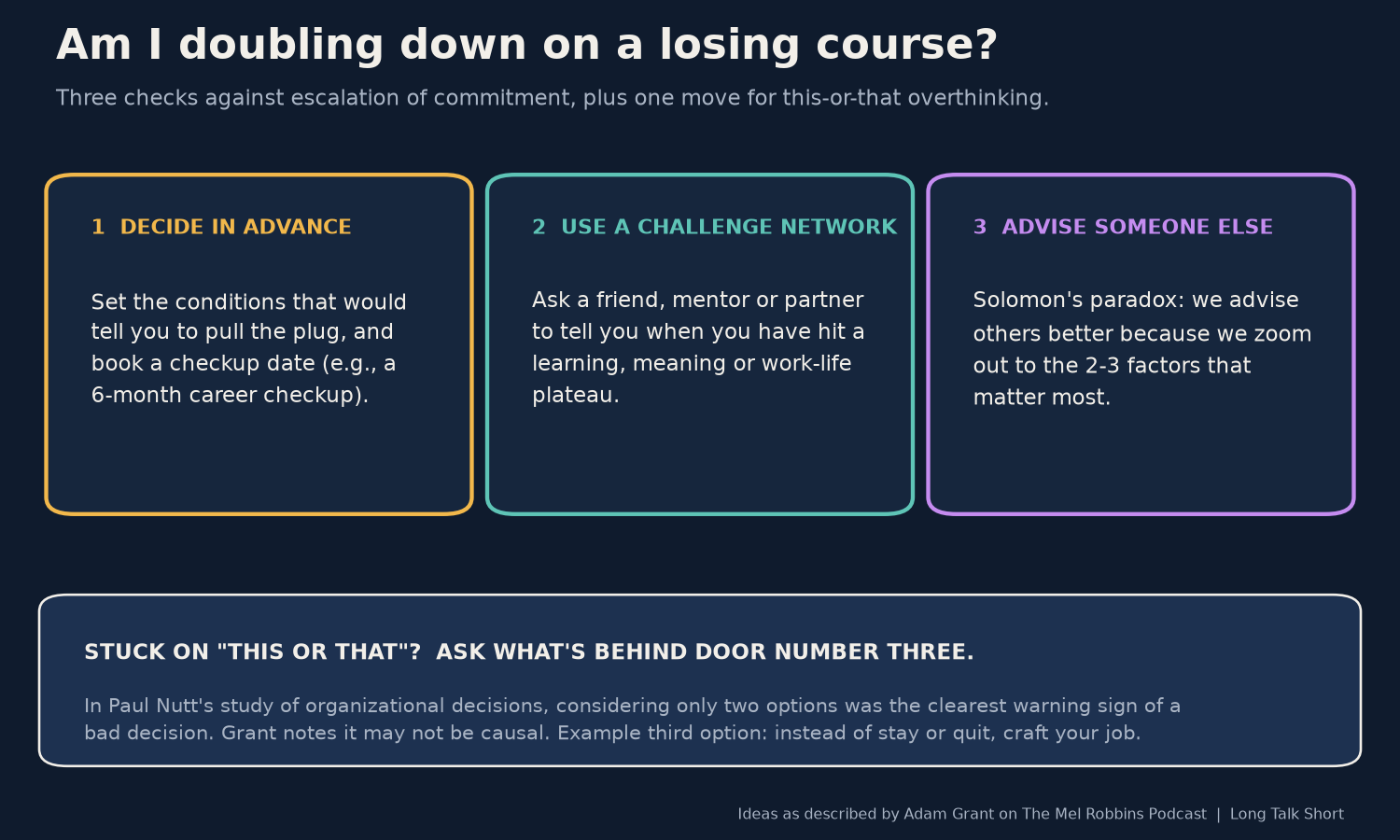
When a plan is failing, the trap is "escalation of commitment to a losing course of action," a term from Barry Staw's research. We invest more just to prove we were right.
Grant's reframe: it's better to admit you wasted the last two years than to waste the next 20. He offers three checks:
- Set exit conditions in advance, with a calendar checkup.
- Use a "challenge network" of people who'll tell you when you've plateaued.
- Advise someone else in your situation. This uses Solomon's paradox: we're wiser for others because we zoom out to the two or three factors that matter.
4. Overthinking is really underthinking
Rumination usually means bouncing between two options. Grant cites Paul Nutt's study of hundreds of organizational decisions, about half of which failed. The clearest early warning sign? Only two options had been considered. Grant admits this may not be causal.
Take "stay or quit." His colleagues Amy Wrzesniewski and Jane Dutton offer a third path: job crafting, reshaping your tasks and interactions.
Grant also describes a five-year study of thousands of Australian workers. Extremely dissatisfied workers who quit ended up unhappier on average, and even those who found better jobs typically needed at least a year to feel happy.
His rule of thumb: if your boss is abusive, leave. If the job is acceptable, try redesigning it first.
5. Your future friends are your old friends
Grant champions "pebbling," named after penguins that present pebbles to mates. The human version: a carefully chosen meme or article that says "I thought of you." He says studies show a small follow-up like this makes a new acquaintance feel closer.
Pebbling also revives "dormant ties": people you drifted from because life got busy. According to Grant, people enjoy reconnecting 90% of the time. And because dormant ties move in different circles, their information is less redundant, so their advice is often better.
6. Allies, pals and companions
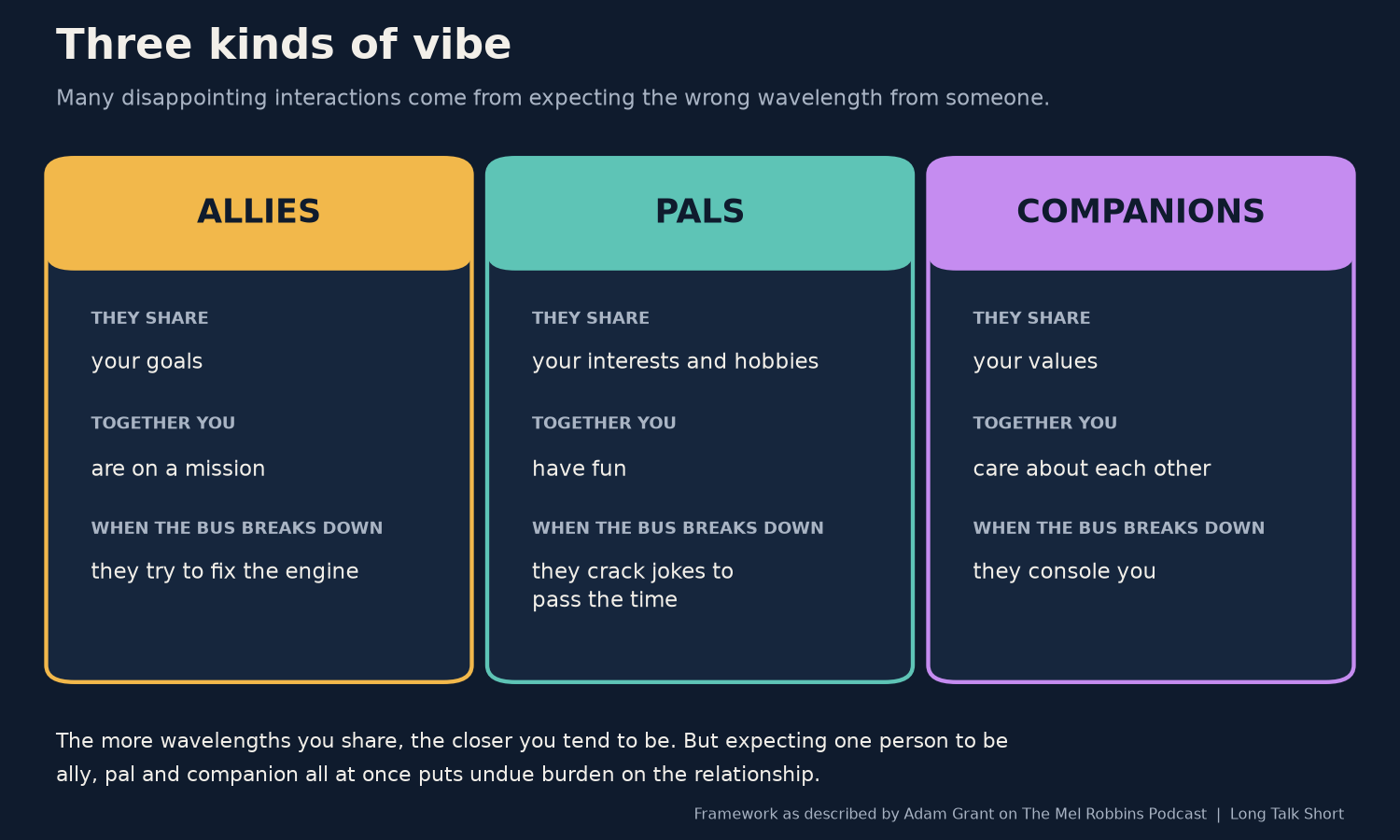
Grant's new book, Vibe, sorts connections into three kinds:
- Allies share your goals.
- Pals share your interests.
- Companions share your values.
He also says that when people vibe, their brain waves and heartbeats synchronize. Many disappointments, in his view, are wavelength mismatches.
During his wife Allison's chemotherapy, a friend responded perfunctorily and never followed up. Grant later realized that friend was a superb ally and pal, just not a companion.
The lesson: expecting one person, even a spouse, to be all three is linked to more stress. Spreading those needs across friends is linked to higher well-being.
7. At work: dots, agility, inverse charisma
Grant names three career skills: connecting dots over collecting facts, agility over ability, and human connection that machines can't easily copy.
That last one he calls "inverse charisma," a term he credits to E.M. Forster's biographer: making others more charismatic by asking sharp questions. Swap "How was your day?" for "What surprised you most today?"
To set priorities, ask: "If I weren't doing this job, who would be worse off?"
On gender, he cites Linda Babcock's research showing that women do a disproportionate share of "office housework" and are penalized more for saying no, and Ashley Rosette and colleagues on backlash against agentic women. His version of a good no: list your current load and ask your manager to help prioritize. Experiments by Babcock and Hannah Riley Bowles suggest asking for a raise in ways that show how it serves others.
Weighing it: what holds up
Solid ground: much of this rests on established research: escalation of commitment, Solomon's paradox, Nutt's decision studies, Bloom's work on talent, job crafting and Babcock's office-housework findings. Grant also flags limits himself, such as the Nutt correlation.
Plausible but unsourced: several claims arrive without a named source in the episode: the 90% reconnection figure, the Australian quitting study, the pebbling studies and the heartbeat synchrony. Treat them as leads, not settled fact.
Worth a caveat: Bloom's study looks backward from people who already succeeded, so it can't count the driven kids who never broke through. The diving and chemotherapy stories are anecdotes. The biggest overstatement is Robbins's: she suggests 95 to 99% of relationship frustrations come from seeking the wrong "language," a figure nobody supports. Inverse charisma driving success "in the AI era" is a prediction, not a finding.
Disclosure: the episode doubles as promotion for Vibe and Hidden Potential, with host-read ads for Expedia and IXL.
Long Talk Short
- Judge potential by motivation and trajectory, not starting ability.
- Act before you feel ready; confidence follows action.
- Set exit criteria in advance, use a challenge network, and advise yourself as you would a friend.
- Torn between two options? Find a third, such as crafting your job before quitting it.
- Send pebbles and revive dormant ties.
- Know whether someone is an ally, pal or companion, and don't ask one person to be all three.
The one thing to remember: the worst diver in the school made the state finals. Your starting point says little about your ceiling. Motivation, a coach who sees it, and leaping before you feel ready do most of the work.
Source: Mel Robbins, "How to Unlock Your Full Potential with #1 Professor Adam Grant". This is an independent summary of that episode and is not affiliated with the show.
This article is for general information only and is not professional, psychological, career or medical advice.