AI Isn't the Bubble. The Debt Behind It Might Be.
A company drowning in orders just saw its debt priced like it was in distress. French economics channel Grand Angle says the AI boom is three bubbles stacked up, and the one to watch isn't the tech. It's the money borrowed to build it.
CoreWeave has more orders than it can fill. Yet on October 14 it lost about 15% of its market value in a single session, and the next day, insuring its debt cost more than 10% a year, a level usually reserved for companies in distress.
How can a business be booming and look broke at the same time? That puzzle is the key to where the AI boom could actually break.
Grand Angle, a French-language economics channel, asks the question everyone is asking: is the AI bubble bursting? Its answer: it depends on which bubble you mean.
In short: the AI technology is not a bubble, listed tech valuations are stretched but defensible, and the real danger sits in a fast-growing pile of debt whose repayments may arrive before AI's profits do.
1. Not one bubble, three
The host refuses the yes-or-no framing.
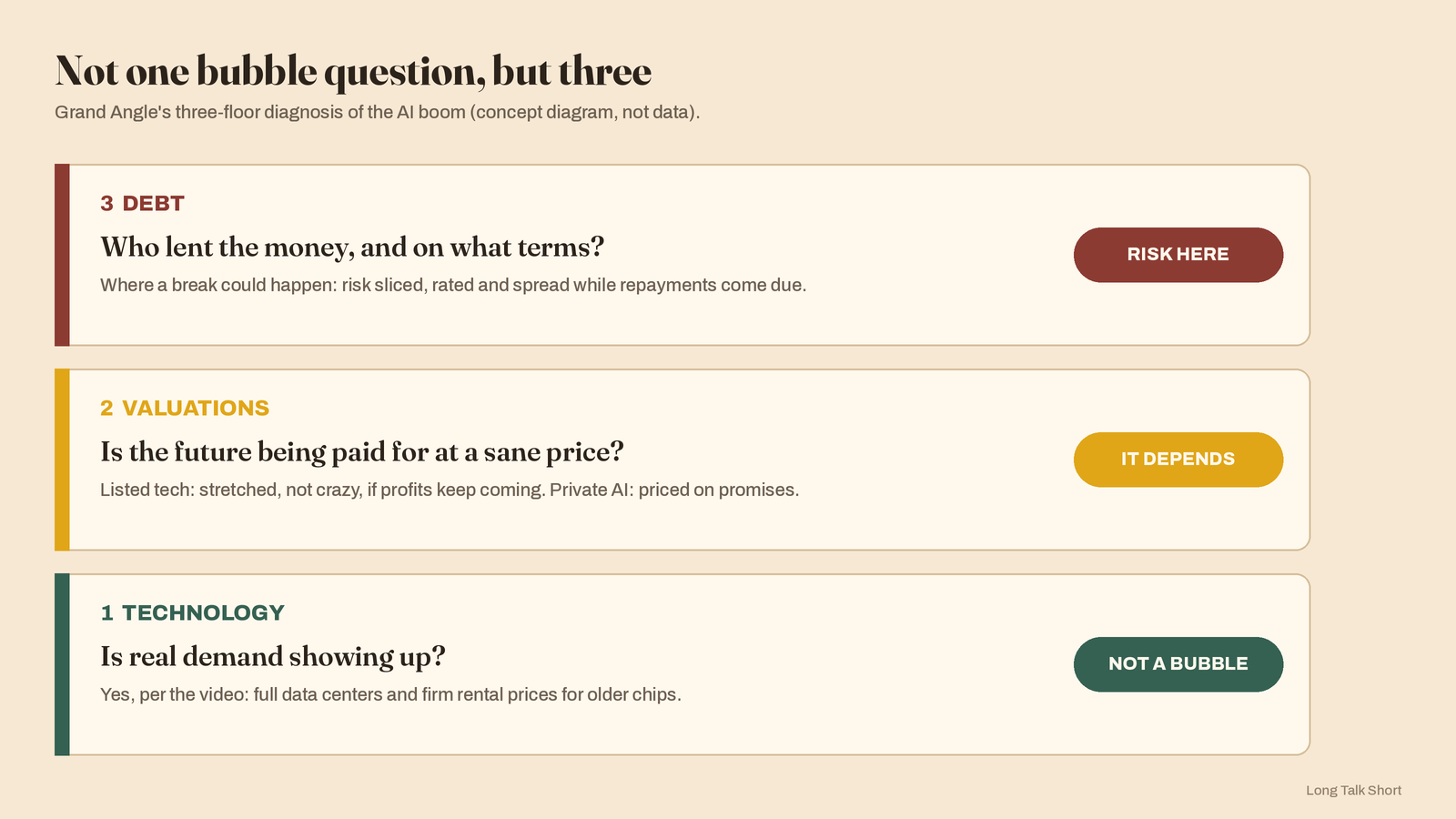
Asked like that, the question is a trap, because there isn't one possible bubble, there are three, stacked on top of each other.
The three floors (quotes translated from French):
- The technology: is real demand showing up?
- The valuations: is the future being bought at a sane price?
- The debt: who lent the money, and on what terms?
The stakes are big. AI investment alone is expected to explain about a third of U.S. growth. Yet while 69% of the 500 largest U.S. companies say they run AI in production, only 2% publish a metric tracking its effect over time.
We are building the factory well before production at scale is running.
So start at the bottom floor: is anyone actually using what's being built?
2. Floor one: the demand is real
A technology bubble, he says, means building huge capacity for demand that never comes. In 2000 that was fiber optic cable, laid on a claim that internet traffic doubled every 100 days.
Run that test today and it doesn't find a bubble:
- North American data center vacancy is around 1.4%.
- An Nvidia H100 chip rented for about $2.20 an hour in 2022 and rents for more than $2.60 now.
Demand is uneven, though. Citing McKinsey, he notes 88% of companies use AI somewhere, but only 39% see an effect on operating results. That "third of U.S. growth" mostly measures construction, not payoff, "exactly as railways inflated 19th-century GDP well before the lines turned a profit."
Real demand, then. But are investors paying a sane price for it?
3. Floor two: tense, not delirious
The reassuring numbers, as he presents them:
- The S&P 500 trades around 19 times expected earnings, unremarkable for the past decade.
- The seven tech giants' premium over the other 493 companies has shrunk to about 10%. Nvidia briefly traded at 18 times expected earnings in July.
- Tech stocks rose 22% from January to late August while earnings per share rose about 56%. Prices are lagging profits.
The worrying ones:
- Robert Shiller's CAPE ratio, based on ten years of inflation-adjusted earnings, passed 41 this summer, second only to the 44 of December 1999.
- Circular revenue. Chipmakers' record profits are simply the capital spending of Microsoft, Meta and Amazon. "One company's revenue is the other's check."
- Flattered profits. Several hyperscalers have stretched server depreciation to five or six years.
- Private-market froth. OpenAI reportedly seeks a valuation near $1.4 trillion while planning to burn close to $280 billion by 2030.
Stretched, in other words, but not 1999. To find the real danger, you have to go one floor down.
4. Floor three: the debt that walks downstairs
Alphabet, Amazon, Meta, Microsoft and Oracle are set to invest nearly $800 billion this year, close to double 2025 and roughly all their operating cash flow. Free cash flow could approach zero in 2027. So they borrow.
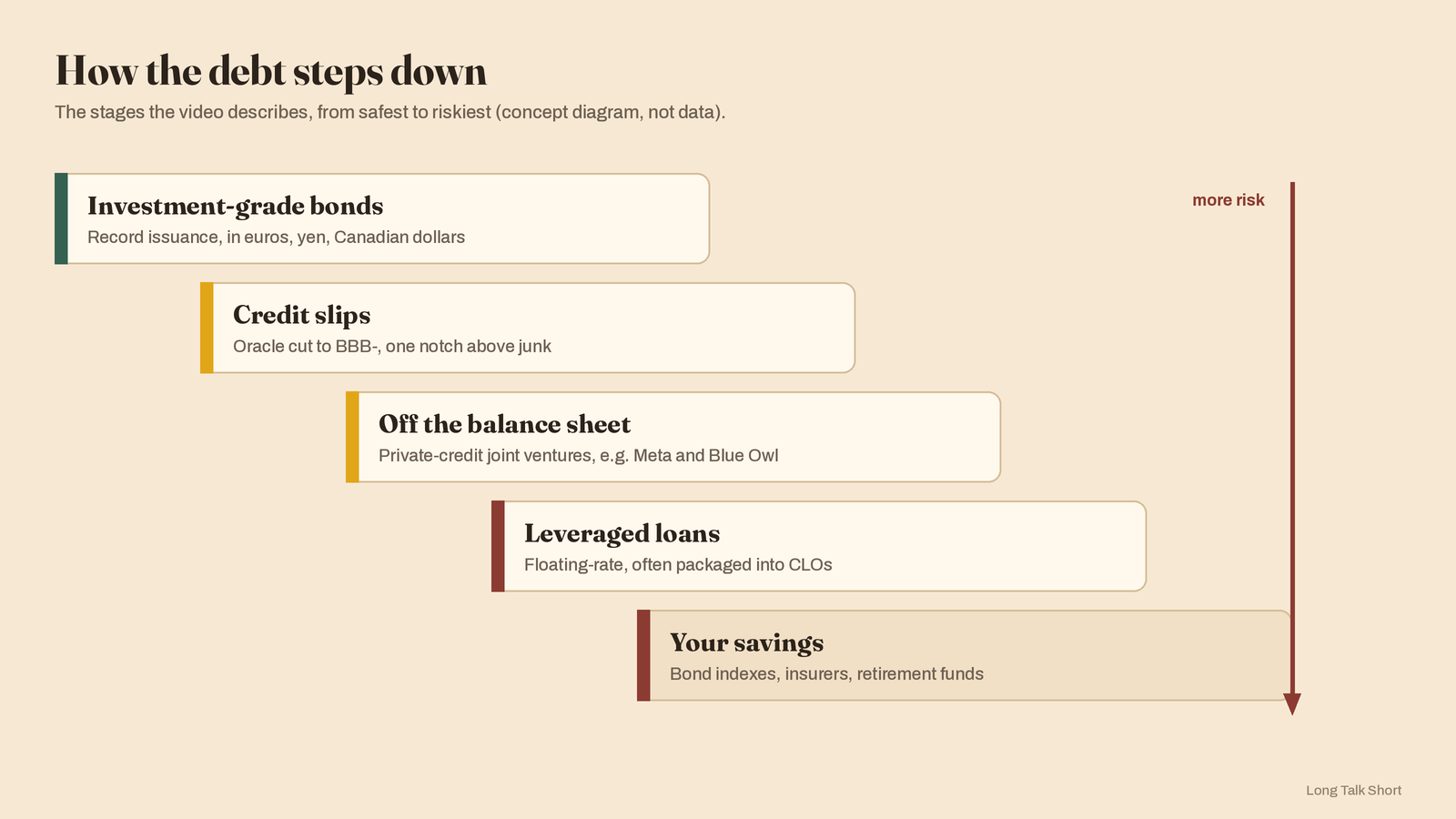
He traces that debt down a staircase, each step riskier:
- Investment-grade bonds: about $225 billion issued by hyperscalers and Nvidia in the first half.
- Slipping credit: S&P downgraded Oracle in July.
- Off the balance sheet: Meta's $27 billion Hyperion campus in Louisiana sits in a joint venture 80% owned by Blue Owl funds.
- Leveraged loans: floating-rate, often packaged into CLOs, bundles of hundreds of loans sliced into tranches and sold on.
5. Why a booming company can look broke
Spreading risk only works, he argues, with solid collateral and independent risks. What lenders really buy is the signature on a contract.
That solves the CoreWeave puzzle. In March, Moody's rated an $8.5 billion CoreWeave loan A3 because Meta must pay for the capacity whether it uses it or not. Seven months later, CoreWeave's own unsecured bonds traded at 77 cents.
The market doesn't rate CoreWeave, it rates, debt by debt, what's behind it.
And the signatures repeat:
- OpenAI is tied to roughly half of Oracle's contracts and is a big CoreWeave customer.
- In August, Nvidia agreed to guarantee up to $105 billion so OpenAI could lease an Ohio campus that will use only Nvidia chips. The IMF calls this circular financing.
- Banks such as Morgan Stanley, JPMorgan and SMBC are, per the Financial Times, trying to offload data center loans.
So is this 2008 all over again? He says no, and the reason is subtler.
6. The real risk is the calendar
In 2008 the chain ended in insolvent households. Now it starts with cash-rich firms on firm commitments. The problem is timing:
- The 10-year Treasury yield passed 5.2% in September, and the Fed raised rates.
- CoreWeave's bond yields jumped from about 9% to over 15%.
AI doesn't need to fail for things to jam.
Revenue just has to arrive slower than the debt payments. The IMF's downside scenario cuts U.S. output by 1.8% by 2028, and the debt already sits in bond indexes, insurers and retirement savings.
Weighing it: what holds up
The headline events check out. CNBC and Reuters report CoreWeave fell 15.5% on October 14 and its five-year credit default swaps topped 1,100 basis points the next day. The IMF's October 2026 reports did warn an AI correction could be global and model a 1.8% hit to U.S. output by 2028. CBRE puts North American primary-market vacancy at a record-low 1.4%, with about 80% of construction pre-leased. Nvidia's SEC filing confirms the $105 billion cap. Moody's A3 rating, the Fed's September hike, the 10-year above 5.2% and the FT's report on banks offloading loans are all on record.
Some details need correcting. The video says S&P cut Oracle to "BB-, the last notch before speculative grade." The July 9 cut was to BBB-, the lowest investment-grade rating; BB- would already be junk. Nvidia's guarantee is not a promise to pay OpenAI's rent: it covers any shortfall in the site's value after re-leasing or sale, and OpenAI must reimburse Nvidia. The OpenAI valuation is a target in talks, with later reports nearer $1.25 trillion before new money.
Some figures can't be verified. The H100 rental prices, the seven-giant premium, the 22% versus 56% comparison and the CAPE reading come from sources the video doesn't name, and we could not check them all.
Read floor one as his view. The host says plainly he "can't see a world where AI fails." Dismissing the CAPE because AI cycles are faster is a familiar boom-time argument. The debt analysis on floor three is the best-supported part.
Long Talk Short
- "Is AI a bubble?" is three questions: the technology, the valuations and the debt.
- Listed tech prices have risen slower than profits; private valuations like OpenAI's rest more on promises.
- Hyperscalers borrow because capex now eats nearly all their operating cash flow.
- The debt steps down from top-rated bonds to off-balance-sheet ventures to leveraged loans bundled into CLOs.
- Lenders price the contract signature, not the company, which is why one firm can have an A3 loan and distressed bonds.
The one thing to remember: a technology can win while the people who financed it lose. The danger is timing, not failure.
Source: Grand Angle (@grandangleeco), "Le premier domino de l'éclatement de la bulle IA est tombé" (The First Domino of the AI Bubble Has Fallen), a French-language video. Quotes are translated from French by Long Talk Short. This is an independent summary of that video and is not affiliated with the channel.
This article is for general information only and is not financial or investment advice.