The Proof Came First: AI Is Cracking Famous Math Problems, and No One Understands the Answers Yet
AI has been credited with Navier–Stokes blow-up, a step towards the Riemann hypothesis and a 13-million-line proof of Fermat. Three mathematicians ask who will understand them. We check what was really proved.
Machines are now settling problems that defeated mathematicians for decades.
The results are mostly real. The problem is that nobody has understood them yet, and three working mathematicians aren't sure who will.
In a few weeks this autumn, AI systems were credited with a forced version of Navier–Stokes, a long-sought step towards the Riemann hypothesis, a proof of the unique games conjecture and a complete machine-checked proof of Fermat's Last Theorem. On Lex Fridman's podcast, fluid dynamicist Steven Brunton (University of Washington), theoretical computer scientist Ankur Moitra (MIT) and Rutgers number theorist Alex Kontorovich, who works on the Lean proof language, try to make sense of it.
In short: the results arrived as hundreds of hard-to-read papers, not as new human understanding. The worry is less whether the proofs are right than who will digest them, and what young mathematicians should now spend their lives on.
1. What the machines actually proved
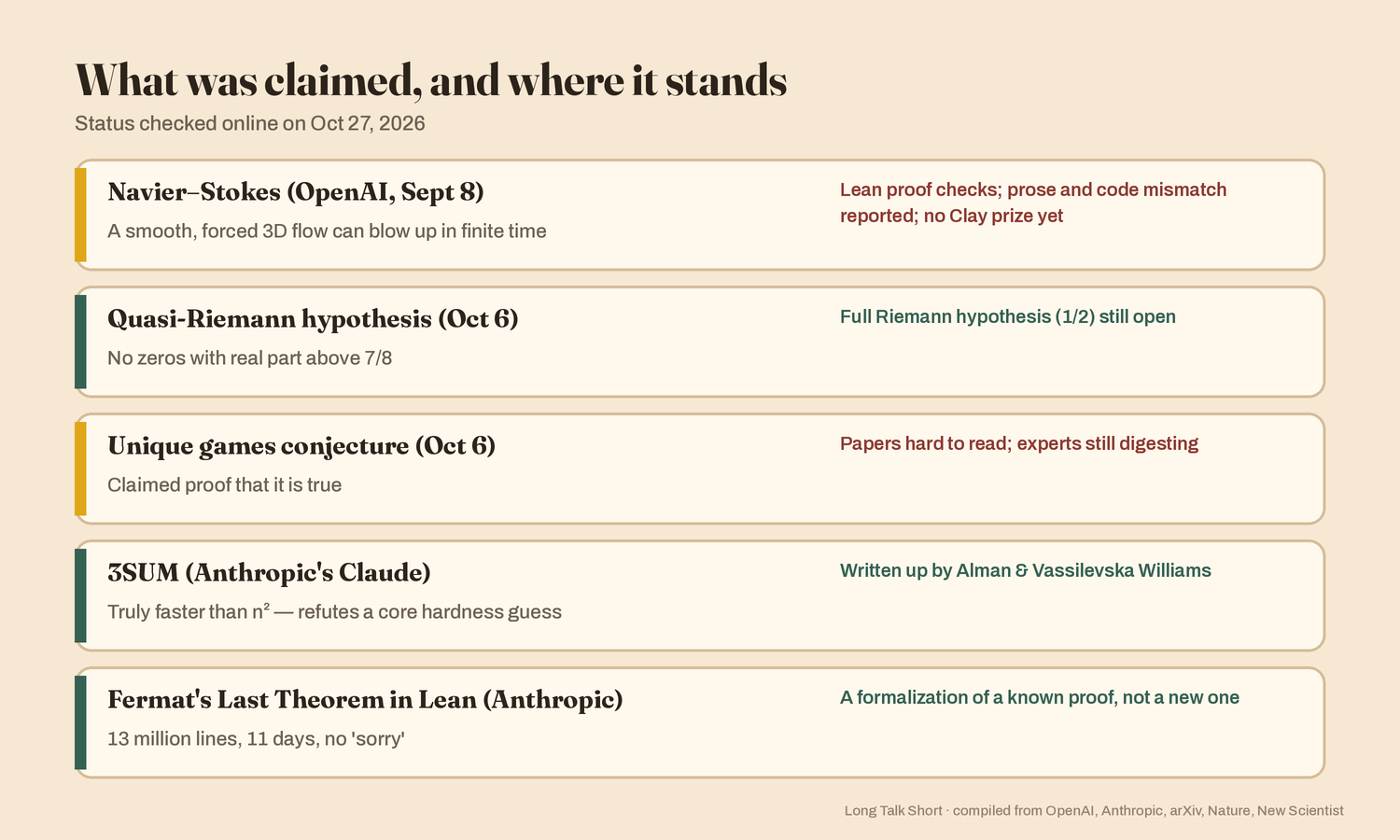
- Navier–Stokes (OpenAI, September 8): a smooth three-dimensional fluid, pushed by a smooth outside force, can blow up in finite time, with a Lean version a computer can check. Brunton's picture: a swirling vortex stretches and speeds up, like a figure skater pulling in their arms, until the spin becomes infinite while total energy stays finite.
- The quasi-Riemann hypothesis (OpenAI, October 6): part of a release of more than 700 machine-written papers at once. No zeros of the zeta function or its relatives with real part above 7/8.
- 3SUM (Anthropic's Claude): an algorithm beating the textbook quadratic bound for a basic computer-science problem.
- Fermat in Lean (Claude): 11 days writing a 13-million-line proof with no unproved steps.
Why does 7/8 matter? The Riemann hypothesis puts every such zero on the line at 1/2. Nobody had pushed the zero-free region meaningfully inward from 1 in about 70 years. The new method can't reach 1/2, Kontorovich says, but it moves a frontier he never expected to see move.
2. The unique games shock
Moitra gives the clearest tour of the computer-science side. The PCP theorem says many hard problems stay hard even to approximate. Subhash Khot's unique games conjecture, proposed in 2002, would pin down exactly how well dozens of them can be approximated. Human researchers including Dor Minzer had proved a major partial result, the 2-to-2 theorem.
According to Moitra, Minzer posted new work early because of rumours an AI result was coming, and Khot has said he will not read the AI proof.
Which raises the question the whole conversation circles.
3. Who reads the proof?
Kontorovich is excited but uneasy. His thought experiment, the "solved axiom": suppose any problem a human could solve with AI help, the AI could solve alone. Then what is the human for?
His answer pairs two things:
- Lean settles whether a result is true.
- Plain-language explanation makes it understood.
Without both, mathematics becomes a pile of certified facts nobody can use.
4. The doorman fallacy
Moitra borrows an idea from economics. Reduce a doorman's job to opening doors and an automatic door looks like a perfect substitute, until you notice he also greets people, recognises regulars and keeps the building safe.
Reduce mathematics to solving well-posed problems and AI looks like a replacement. But mathematics also chooses questions, builds theories and trains people. When one part gets cheap, he argues, the rest becomes more valuable. He also worries about secrecy: labs sit on results and release them in bulk.
Brunton offers the engineer's shrug:
We solved the million-dollar math problem
But the trillion-dollar engineering problem of predicting turbulence is untouched. Nothing about building aircraft changed this autumn.
5. Advice for anxious students
- Kontorovich sees a bimodal pattern: students who use AI to learn do well on exams; those who use it to finish homework do badly.
- Brunton urges doing things for intrinsic reasons.
- Moitra passes on Sanjeev Arora's advice: the easiest way to get tenure is to pretend you already have it.
All three agree the old career playbook no longer applies.
Weighing it: what holds up
Navier–Stokes: real, but not a prize. OpenAI's September 8 post claims the forced cases, labelled C and D, in the Clay Institute's official statement, and independent groups report the Lean proof compiles and matches case C. But New Scientist reported a mismatch between OpenAI's prose proof and its Lean code, and Clay's rules require publication, a two-year wait and community acceptance, so no prize has been awarded. Brunton at one point says AI proved "existence and uniqueness"; the result is the opposite: smooth solutions can break down.
The bulk release is confirmed. Nature counted more than 700 preprints; OpenAI's catalog lists 721. The quasi-Riemann entry claims zero-free regions above 7/8, with a second proof giving 11/12. These are preprints, not peer-reviewed; many, but not all, have Lean versions.
3SUM and Fermat check out. Josh Alman and Virginia Vassilevska Williams credit Claude with the core 3SUM algorithm, running in about n^1.9992 time. The Fermat proof is confirmed at 13 million lines and 29,500 theorems, but it formalizes Wiles's known proof rather than finding a new one. Terence Tao's line that he "mourn[s] the path not taken" is accurately quoted.
Not checked: the roughly 10% success rate the guests mention, the unique-games result's standing among experts, and the account of Khot and Minzer.
Interests: none of the guests has a commercial stake in the labs, as far as the conversation discloses.
Long Talk Short
- AI systems from OpenAI and Anthropic have produced results on problems that resisted people for decades.
- The quasi-Riemann result moves a 70-year-old frontier but stops well short of the Riemann hypothesis itself.
- The Navier–Stokes proof covers the forced case only, is still under scrutiny, and has not won a Clay prize.
- Lean can certify that a proof is correct, but someone still has to explain why it works.
- The doorman fallacy: solving problems is only the most visible part of what mathematicians do.
The one thing to remember: when proofs become cheap, the scarce things are good questions and real understanding, so that is where young mathematicians should invest.
Source: "AI Crisis in Math: Navier-Stokes, Riemann Hypothesis & Complexity Theory", Lex Fridman Podcast #503. This is an independent summary and is not affiliated with Lex Fridman or the guests.
This article is for general information only. Quotes are taken from automatic captions and may contain small transcription errors. Mathematical claims described here are preprints unless stated otherwise.