Two Hours of School, Then the Real Lessons: Inside Alpha's AI School Day, and Its Shakiest Claim
At Alpha School, AI teaches core subjects in two hours a day; afternoons go to teamwork, speaking and startups. Founder Joe Liemandt explains the model, and we check his "2x learning" claim.
What if school only took two hours a day?
At Alpha School, software teaches the core subjects in about two hours, and the rest of the day goes to leadership, public speaking and building businesses. Its founder says the AI isn't the hard part.
Joe Liemandt, Alpha's principal, makes the case on a16z with hosts Erik Torenberg and Gagan Biyani. The real challenge of school, he argues, is getting children to want to come back, and teaching them what an app can't.
In short: Alpha pairs an adaptive tutor that keeps each child at the edge of their ability with demanding group projects in the afternoon. Its boldest academic claims come from Alpha's own figures, which outside researchers say can't show what causes the results.
1. Three promises to parents
- Children will love school. He says over 90% of Alpha students say they do, and about half would rather go to school than on vacation.
- They'll learn twice as much in two hours as peers do in six plus homework, enough to reach the top 1% nationally.
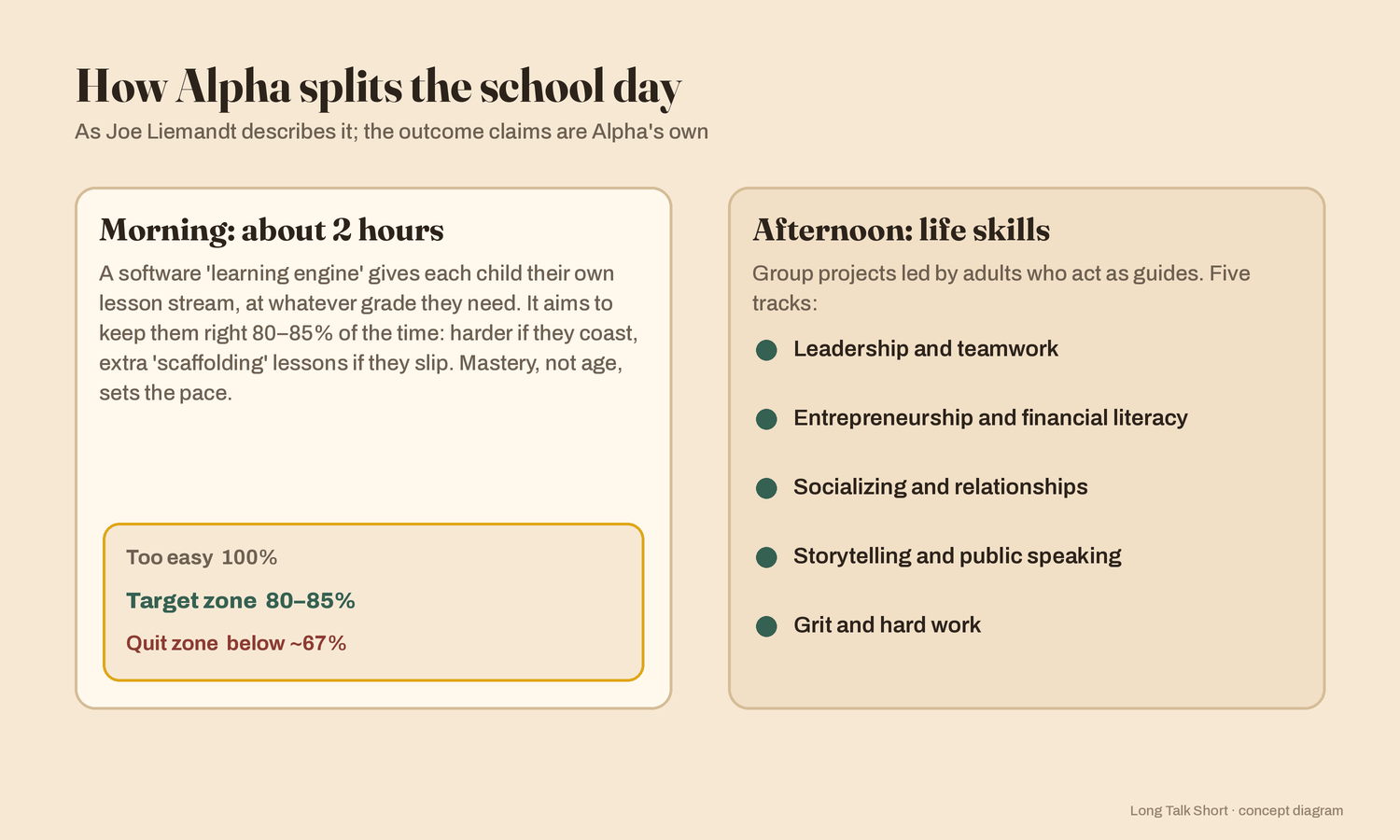
- The freed-up time goes to "life skills": leadership and teamwork, entrepreneurship and financial literacy, relationships, public speaking and grit.
He puts the first promise ahead of the others:
Every kid is motivated. If you have a motivated kid, you can teach them anything.
So how does the software keep them motivated?
2. The 80% rule
Alpha's software, Timeback, builds each child a separate stream of lessons. The key rule is a "mastery zone": about 80 to 85% of questions right.
- Below roughly two-thirds, he says, children disengage.
- At 100%, the work is too easy and they learn nothing.
- Grade levels are ignored. An eighth grader who missed a fifth-grade concept gets the fifth-grade lesson.
- Slip below the zone and the system adds smaller steps until the child is winning again.
"We engineer wins," he says. The idea isn't new; adaptive practice and mastery learning have long research histories. Alpha's bet is running it all day, at scale, with strong incentives to finish.
Then the afternoon starts, and it's meant to be hard.
3. Afternoons with real standards
Each life skill has "levels" students must pass:
- Third graders work through escape rooms wearing microphones; AI measures how much of their talk is team-oriented. He says groups start below 20% and must reach 85%, and teamwork-heavy groups finish three times faster.
- Fourth and fifth graders must pass a business-school survival simulation based on climbing Everest, which he says half of MBA students fail.
- Founders School, the high-school track, promises students will build a business making $1 million in profit before graduating, or get their tuition back. He tells of a 14-year-old who cold-called Nvidia's Jensen Huang and got 90 seconds of feedback.
His theory is blunt:
The key to your child's happiness is high standards.
Why does he think this matters now? He reaches back a century.
4. The 1910 argument
In 1910, he notes, most Americans stopped school around eighth grade, and tractors were about to wipe out farm jobs. Towns across the country voted to tax themselves to build high schools most voters had never attended. He sees AI as a similar shock: schools must prepare children for an economy where knowledge work is partly done by machines.
He also says Alpha deliberately repels some families. Parents who dislike screens or AI are told it isn't the school for them, which he calls magnet marketing.
Weighing it: what holds up
The business facts check out. Scientific American reported in August 2026 that Alpha planned about 50 U.S. campuses this fall, with tuition at most of $40,000 to $75,000 a year. Founders School's own site lists $150,000 a year and a $1 million profit guarantee, with conditions in the enrollment agreement.
The history is broadly right. Economists Claudia Goldin and Lawrence Katz report only 9% of 18-year-olds held a high-school diploma in 1910, and more than half by 1940. His "90% with an eighth-grade education" is a loose paraphrase.
The academic claims are much weaker. "2x learning" comes from MAP Growth tests, comparing each student's gain with the median expected gain. Critics, including an Alpha parent who still loves the school, say this ratio balloons when expected gains are tiny, as they are for strong older students. Researchers quoted by Scientific American note Alpha hasn't released its underlying data, and strong scores may reflect who enrols. Unbound Academy, a free Arizona online charter using Alpha's platform, reported 28% proficiency in English and 10% in math after its first year, far below its targets. A self-described Alpha insider argued the gains look large as statistical effect sizes.
Unverified: the "loves school" and "rather than vacation" figures, the escape-room numbers and the MBA Everest claim are Liemandt's own.
Interests: Liemandt funds and runs Alpha. Co-host Gagan Biyani runs a16z's new Horowitz Andreessen Academy, in which Liemandt is an investor.
Long Talk Short
- Alpha teaches core subjects with adaptive software in about two hours a day and spends the rest on group projects.
- The engine keeps each child at roughly 80 to 85% correct, ignoring grade levels.
- Liemandt puts motivation first: children who love school can be taught almost anything.
- Afternoon life skills are graded with real standards, from AI-scored teamwork to a $1 million business goal.
- The "2x learning" figure rests on Alpha's own test maths, which critics say overstates gains and can't separate the school from its families.
The one thing to remember: the most credible part of Alpha's pitch isn't the AI tutor but the setting that makes children actually use it, and that's the hardest part to copy.
Source: "The AI School Kids Love More Than Vacation | Alpha School's Joe Liemandt", a16z. This is an independent summary and is not affiliated with a16z or Alpha School.
This article is for general information only and is not advice on choosing a school. Quotes are taken from automatic captions and may contain small transcription errors.