Andrew Huberman: Why Every AI Company Is Becoming a Biotech Company
Stanford neuroscientist Andrew Huberman says the real arms race in AI is not chatbots, it is the race to read and write to your brain without surgery. Along the way he explains how to actually fall asleep, why the health-advice world is a mess, and the one habit that quietly separates the peopl
A Stanford neuroscientist argues the giants of AI are quietly becoming brain companies, lays out the mechanics of how that would work, and offers a genuinely useful method for shutting your mind off at night.
Andrew Huberman went on the investing podcast Invest Like the Best expecting, probably, to talk about sleep and morning sunlight. Instead the conversation drifted somewhere stranger and more interesting, and he said a sentence worth pausing on: anyone who thinks Meta, OpenAI, and Anthropic are AI companies is going to be surprised, because every one of them is going to become a biotech company. The real race, in his telling, is not better chatbots. It is the race to read and write to the human brain without cutting it open. What follows is his case for that, plus a few things you can use tonight.
The real bottleneck is energy
The conversation starts somewhere practical. For most of history, the bottleneck on getting things done was that the world could not keep up with its most talented people. Now, Huberman and his host suggest, it has flipped. The constraint on the highest performers is their own energy: how much they can generate, sustain, and not burn through. The Elon Musk archetype of running several companies at once has gotten into everyone's head, but Huberman is blunt that Musk is a physiological outlier, not a template.
His first rule is unfashionably simple: know thyself. Figure out, honestly, how much sleep you actually need to feel awesome, versus good enough, versus not enough. For him it is seven hours; most people know their own number if they are honest. Deluding yourself into four hours because someone famous runs on four is, in his words, ridiculous, and we know where it leads. He is candid that in the first years of building something, medical school or a startup, the goal is cruder: get as much done as you can, and do not injure yourself or wreck your health permanently. Optimization and balance come later. Look at anyone who has been at the top of a demanding field for decades and you can read, in their face and health, how well their schedule actually matched who they are.
How to actually fall asleep
The most useful practical stretch is about the thing many high performers struggle with most: shutting the mind off at the end of the day. Huberman breaks falling asleep into three requirements, and the order does not matter as long as you hit all three.
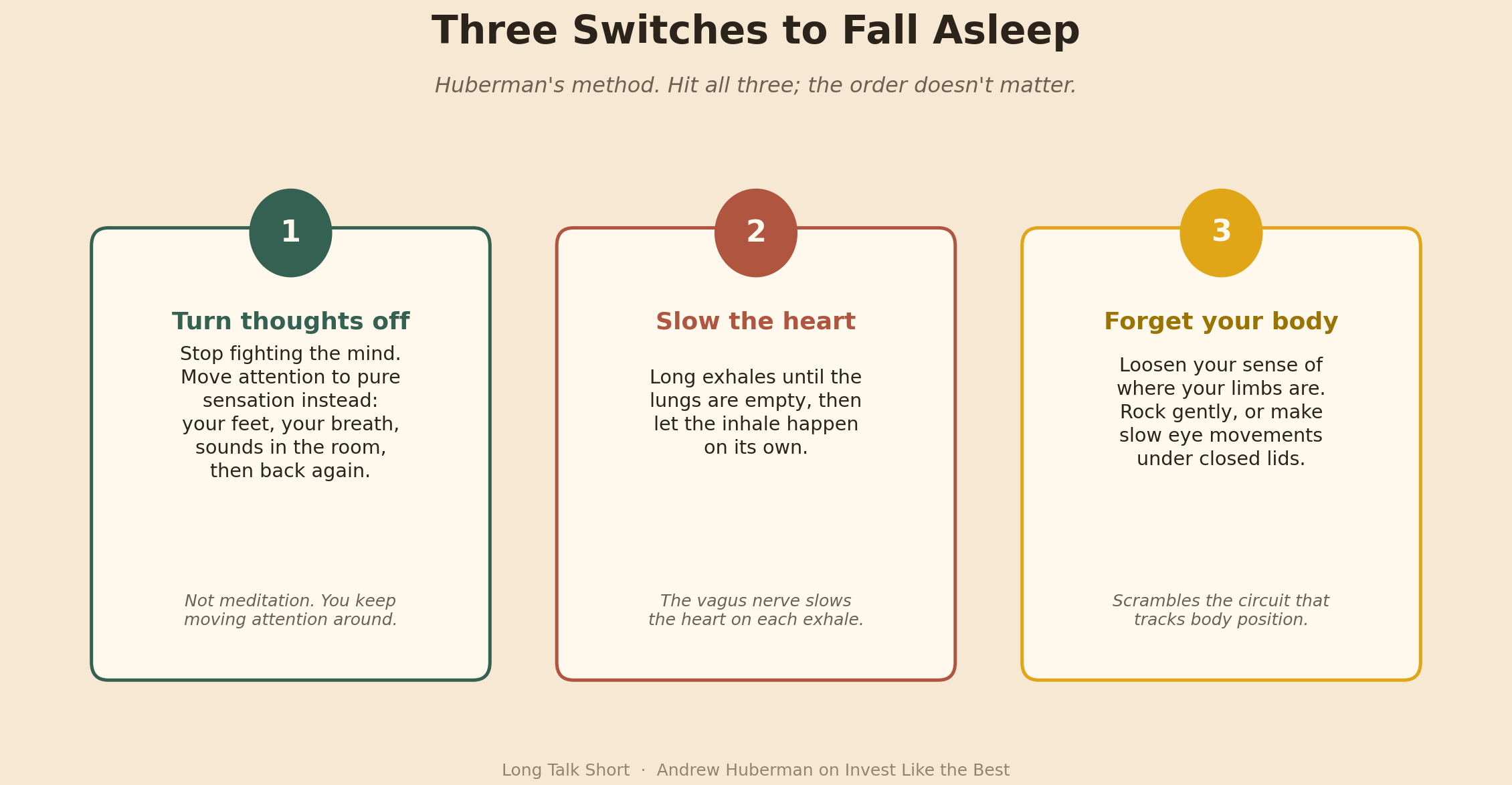
First, turn your thoughts off, which is a skill, not a switch. The brain wants to think, plan, and predict, so you cannot simply command it to stop. The trick is to migrate your attention away from thinking and into pure sensation: the feeling of your feet, your legs, the sound of the room, your own breathing, then back again. You are pulling perception into the present and starving the planning machinery of attention. He is clear this is not meditation, which asks you to fix attention on one thing; here you deliberately move it around the body.
Second, slow your heart rate, which you do with long exhales until the lungs are empty, followed by passive inhales. This works through a real mechanism called respiratory sinus arrhythmia: exhaling signals the heart, via the vagus nerve, to slow down. When we are stressed we tend to over-inhale; flipping to emphasized exhales is the lever for calming down anytime, not just at night.
Third, forget where your limbs are, the sense called proprioception. The old, accepted version is rocking, the same gentle motion that puts babies to sleep, which also works on adults in a bed built to rock. The wackier do-it-yourself version, which he admits feels strange to recommend as a neuroscientist, is to make slow eye movements under closed lids, side to side and up and down, which scrambles the circuit that tracks body position. And the new version is a technology he got to test: an MIT eye mask that nudges those eye movements through gentle stimulation and measures REM directly, built to make people fall asleep faster. He has no stake in it, and says it is roughly a year from release.
Why the health-advice world is a mess
Asked for the biggest problem in his field, Huberman does not hedge about the public side: the discourse around health and longevity is, he says, a disaster, full of theatrics. The bar for entry is near zero, show your abs, claim it is all natural, gain a following, while in real science a PhD is necessary and still nowhere near sufficient to claim you have contributed anything. He is careful to credit people doing it honestly, and just as careful that the gap between rigorous educators and performers is widening. His prediction is a coming correction: a downturn in health hype around 2027 and 2028 as people tire of over-optimizing, followed by an influx of properly trained scientists and doctors who raise the level. It is a notably self-aware thing for one of the most-followed voices in the space to say.
The real arms race in AI
Here is the heart of it. Huberman's claim is that the companies we think of as AI companies are all, underneath, aiming at the brain. The shared goal, he says, is to read from and write to the nervous system non-invasively, and that is the actual arms race. He names the people he considers the serious players, Sam Altman, Mark Zuckerberg, Dario Amodei, and Elon Musk with Neuralink, and argues the technologists are quietly becoming neuroscientists, which he loves, because the field has always advanced by importing outsiders.
Reading from the brain is the part we have gotten good at over the last several decades, from electrodes to fMRI. Writing to it is the frontier. Today we mostly write with blunt instruments: drugs that raise or lower the threshold for whole populations of neurons to fire, which is why stimulants bring jitter and sedatives bring fog. Everything is non-specific because the receptors are everywhere. What he wants, what the field wants, is spatial and temporal precision: the ability to turn a specific brain area up or down, by a little or a lot, on command.
The version he sketches of how that arrives is genuinely science-fiction-sounding, and he says so. You might one day get an injection of a virus, not an infectious one, just a carrier delivering a gene that makes targeted neurons responsive to light or ultrasound. Then a cap on your head sends a beam through the skull that activates only those tagged neurons, dialed up or down, most likely titrated by AI rather than a knob you turn. He is quick to raise the safeguards: an "AND gate" where the stimulation only works if you also take a pill, the way vagal stimulators can be unplugged. This is his prediction and his enthusiasm, not a thing that exists, and the right posture is curiosity with both eyes open.
The finding that unsettles the whole plan
Tucked inside the optimism is a result Huberman says a lot of neuroscientists would rather not discuss. In animals, researchers can tag the exact neurons active during a learned behavior, like a trained movement, and then reactivate them to trigger it. That works. But then comes the control experiment: activate those same neurons in the wrong order, or all at once, like slamming every key of a piano instead of playing the tune. You would expect gibberish. Instead you get the same behavior.
For memory, at least, that suggests the textbook assumption that neurons must fire in a precise sequence may be wrong. It cuts two ways. It could make writing to the brain easier, since you might not need perfect timing. But it also exposes how much we do not understand, and he is honest that for memory and thought, we do not yet have a good model, or even a definition of what a thought physically is. Those same neurons are also used for countless other perceptions, so poking them could send things haywire.
Implants, measurement, and the privacy line
He thinks the near-term move is not wires in the brain but small devices under the skin. Vagal stimulators smaller than a penny are already helping some people with depression, since most vagal pathways are actually excitatory. He describes Neuralink's head surgeon wearing a tiny chip under the skin of his hand that unlocks his front door, and predicts that within a year or so, a meaningful share of the tech world will ask for a vagal stimulator if it is only as invasive as a piercing.
Alongside writing comes better reading. Today's wearables infer stress from heart rate and heart-rate variability, which is indirect. He describes a former student building a cuff that measures the autonomic nervous system directly, and an early, interesting finding: not all high-arousal states are bad. Being stressed while doing something you love can set you up for better sleep and focus, a kind of good stress the blunt metrics miss. He expects direct nervous-system readouts, and cheaper whole-body MRI, to meet real resistance, partly from parts of medicine wary of people gaining access to their own health data.
The line we are already stepping over
The conversation's most sobering turn is genetics. Huberman recounts the real and documented case of the scientist who used CRISPR to edit twin embryos to delete an HIV receptor, announced it to a stunned scientific world, and was condemned and punished. What he adds is rumor he explicitly flags as unverified: that the same scientist may now be running a lab in Austin, and that the edit might have been aimed not only at HIV resistance but at cognition. He is clear he does not know if any of that is true, and it should be read that way, as a question hanging in the air, not a fact.
His larger point stands on firmer ground. The pieces of human genetic engineering already exist in socially accepted forms: prenatal testing, embryo screening for IVF, companies scoring embryos for disease risk and, more controversially, traits, and even old-fashioned partner selection. The lines between these have never been cleanly drawn. His verdict is that people will run with these technologies, and the honest question is only how fast and where, which is why he lands on wanting the ethics and the safeguards built in rather than pretending the capability away.
The one thing he would keep
The interview closes on something quieter. The kindest thing anyone did for him, he says, came from a graduate adviser who watched him sneak into her lab at night to work on what he actually loved, and simply told him his success would be determined by how badly he wanted to answer the questions he was most curious about. He switched labs, published eight first-author papers, and built a career on it.
He phrases the lesson as a near-formula: success is determined by how precisely you match your genuine curiosity to the work that you do. The counterexample he keeps returning to is the pressure on brilliant people to do what others think they should. Telling Elon to drop Mars, he says, is like telling Metallica to play Grateful Dead songs; the whole point is that they make the music they love. The tragedy, in his view, is people who ignore their real curiosity in order to chase a definition of success, which he calls a kind of slow death. For a conversation that spends an hour imagining machines that can dial your motivation up and down, it is a pointedly human place to end.
Long talk short: Huberman's bet is that the next frontier is not smarter chatbots but precise, non-invasive control of our own brain states, which is thrilling and genuinely unsettling, and worth watching with both excitement and a clear head, while the practical core he is sure of, know your real sleep need and learn to switch your mind off, you can use tonight.
Go deeper
- Protocols: An Operating Manual for the Human Body, Andrew Huberman
Affiliate links, a small commission supports the blog at no cost to you.