Judge the Bet, Not the Result: A Poker Pro's Rules for Deciding When You Can't See the Cards
The 'worst call in Super Bowl history' may have been a sound decision. Annie Duke's Thinking in Bets on why we judge choices by outcomes, and the tools that keep your decisions honest.
The worst decision in Super Bowl history may not have been a bad decision at all.
Former professional poker player Annie Duke argues that we judge almost every choice by how it turned out, and that habit quietly makes us worse decision-makers.
With 26 seconds left in Super Bowl XLIX, the Seattle Seahawks were a yard from winning. Coach Pete Carroll called a pass instead of handing the ball to Marshawn Lynch. It was intercepted, and the next morning's headlines called it the worst play call ever. Duke, who studied cognitive psychology in graduate school, opens Thinking in Bets (2018) with that call because almost nobody judged the decision. They judged the result.
In short: every decision is a bet on one of several possible futures. Judge it by the information, reasoning and odds you had at the time, not by how it happened to turn out, then build habits and allies that keep your beliefs honest.
1. Life is poker, not chess
Duke's central distinction is between two kinds of games:
- Chess: almost everything is visible and there's little luck, so a loss usually means you made a mistake.
- Poker: you never see the other hands and the cards are shuffled, so you can play well and lose, or play badly and win.
Life, she argues, looks much more like poker. We decide with hidden information, and the future is uncertain.
So what goes wrong when we treat poker like chess?
2. The trap called "resulting"
Duke's name for it is resulting: treating the quality of an outcome as proof of the quality of the decision.
Carroll's call had several possible results: a touchdown, an incomplete pass that stopped the clock and left time for more plays, or a rare interception. Only the last happened, and that one branch became the whole story. Carroll himself later called it
the worst result of a call ever.
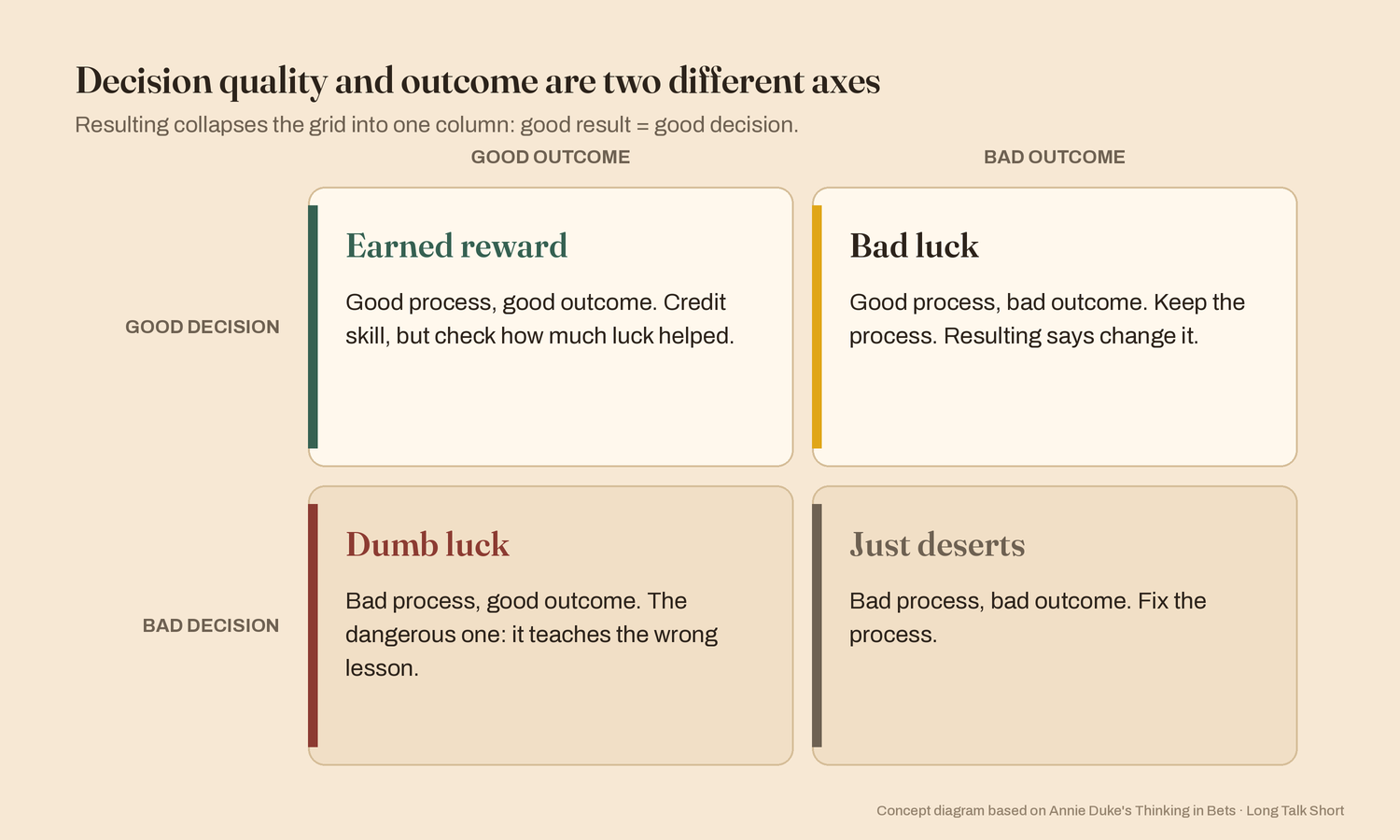
The off-diagonal boxes are where learning breaks:
- Bad luck tempts you to drop a sound process.
- Dumb luck rewards a bad one, and teaches the wrong lesson.
Her alternative is two questions after any outcome: how much came from my decision, and how much from luck I couldn't control?
Once you see luck everywhere, the next step follows naturally.
3. Every belief is a bet
Accept uncertainty, Duke says, and decisions become bets. Her illustration is poker player John Hennigan, who, as she tells it, took a $30,000 bet that he could live for a month confined to one street in Des Moines. Summaries of the book report he lasted about two days and paid $15,000 to get out.
Our beliefs form badly: we hear, we believe, and only sometimes check. Her fix is a phrase from the poker table:
Wanna bet?
Imagine someone asking you to put money on a claim, and you start asking how you know it, what the alternatives are, and how sure you really are.
4. Say how sure you are
Instead of "I'm right" or "that's wrong," state a confidence level: "I'm about 70% sure." Duke argues this:
- is more accurate;
- turns changing your mind into a small adjustment instead of a humiliating reversal;
- invites others to share what they know.
But honesty about your own beliefs is hard to keep up alone.
5. Build a truthseeking pod
Duke recommends a small group committed to accuracy over comfort: at least three people, two to disagree and one to referee. Its charter borrows sociologist Robert K. Merton's norms for science, CUDOS:
- Communism: share all the data, especially the details that make you look bad.
- Universalism: judge an idea on its merits, not by who said it. "Don't shoot the message."
- Disinterestedness: watch for conflicts of interest, including your wish to be right. Try describing a decision without revealing how it turned out.
- Organized skepticism: make dissent a normal, friendly part of the process.
6. Travel in time before you decide
The last tools let your past and future selves weigh in. Duke borrows Jerry Seinfeld's "Night Guy," the late-night self who always ruins things for the morning self.
- 10-10-10 (Suzy Welch): how will I feel about this in 10 minutes, 10 months and 10 years? Duke adds the reverse: how would I feel now if I'd made this choice 10 months ago?
- Backcasting: picture success and ask what steps got you there.
- Premortem (credited to psychologist Gary Klein): picture failure and ask what went wrong. Duke links it to Gabriele Oettingen's "mental contrasting" research: people who imagine obstacles do better than those who only picture success.
- Ulysses contract: bind yourself in advance, as simply as leaving your car at home before a night out.
- Decision swear jar: warning phrases like "I knew it," "I'm sure," "worst day ever" or "How could I be so stupid?" that signal it's time to stop and think again.
Weighing it: what holds up
The Carroll example holds, with a caveat on numbers. Contemporary analyses found it was the first interception thrown from the 1-yard line all season. Wikipedia counts 109 such pass attempts in 2014; Sports Illustrated counted 115, 66 of them touchdowns. SI put the long-run interception rate from the 1 at 3.1%, and ESPN found five interceptions in 270 second-down passes from the 1 over ten seasons. Carroll also gave a clock reason: passing on second down could save time for two more plays. Optimal or not, "worst call ever" is resulting. The exact percentages the book uses were not confirmed.
The Hennigan story is single-sourced. The $30,000 bet, about two days and $15,000 buyout come from the book as reported by online summaries; no independent record was found.
The methods are plausible, not proven. Reviewers, including Cory Doctorow at Boing Boing and several Goodreads readers, call the book repetitive and padded, and Doctorow doubts the tactics work for everyone. The pod, swear jar and confidence percentages are reasonable practices drawn from Duke's experience rather than tested interventions.
Luck versus skill is harder than the grid suggests. With one outcome you often can't tell which box you're in, which is why Duke stresses many decisions and honest review over single verdicts.
Related reading: for the math side of betting well, see The Gambler Who Beat the Horses Explains Why Almost Everyone Else Loses.
Long Talk Short
- Life is poker, not chess: luck and hidden information stand between decision and result.
- "Resulting" judges a decision by its outcome. Ask what you knew, what the odds were, and what you controlled.
- Treat beliefs as bets; "Wanna bet?" forces you to check evidence and alternatives.
- State confidence as a percentage, so updating is an adjustment, not a defeat.
- Build a small truthseeking pod on Merton's CUDOS norms, and share the unflattering details.
- Before deciding, try 10-10-10, backcasting and a premortem; bind your future self with a Ulysses contract and a swear jar.
The one thing to remember: a bad outcome is not proof of a bad decision, and a good outcome is not proof of a good one. Judge the bet you made with what you knew.
Source: Thinking in Bets: Making Smarter Decisions When You Don't Have All the Facts by Annie Duke (Portfolio, 2018). This is an independent summary and is not affiliated with the author or publisher.
This article is for general information only and is not financial, gambling or professional advice.