The Biggest Crypto Robbery, Explained Like You're Five: What Happened at Binance
What if a robber made a big shop's machine hand out everyone's coins? Andrei Jikh explains the record Binance theft, and we explain it so a five-year-old can follow: what's known, what's still a guess, and how to keep your coins safe.
Imagine your piggy bank sits at a giant toy store. The store promises to keep your coins safe. Then a sneaky robber makes the store's own machine push the coins out the back door.
Andrei Jikh says that's roughly what happened at Binance, the world's biggest crypto shop. He calls it the biggest crypto theft in history.
In short: about $6.3 billion left Binance, and about $3 billion was frozen fast. Who did it isn't proven. The big lesson is about where you keep your coins.
1. First, some tricky words
First, the big words, made small:
- Crypto is money that lives only on computers. Bitcoin and Ethereum are two kinds.
- A blockchain is a giant notebook anyone can read. Each time money moves, a new line is written, and nobody can rub it out. That's why people could watch this robbery line by line.
- A wallet is a box that holds crypto. Its secret password is called a key. Whoever has the key can open the box.
- An exchange is a big shop where people buy and store crypto. Binance is the biggest.
- A hacker is someone who breaks into computers they aren't allowed in.
With those words in hand: where was the money sitting when the robber came?
2. The vault and the cash register
Jikh explains that a shop like Binance keeps most coins in cold storage. That's like a bank vault that isn't on the internet.
But people want their money back fast, so the shop also keeps some in a hot wallet. That's like a cash register: online, with money going in and out all day.
The robber went after a busy cash register called "Binance 14."
3. How it seems to have happened
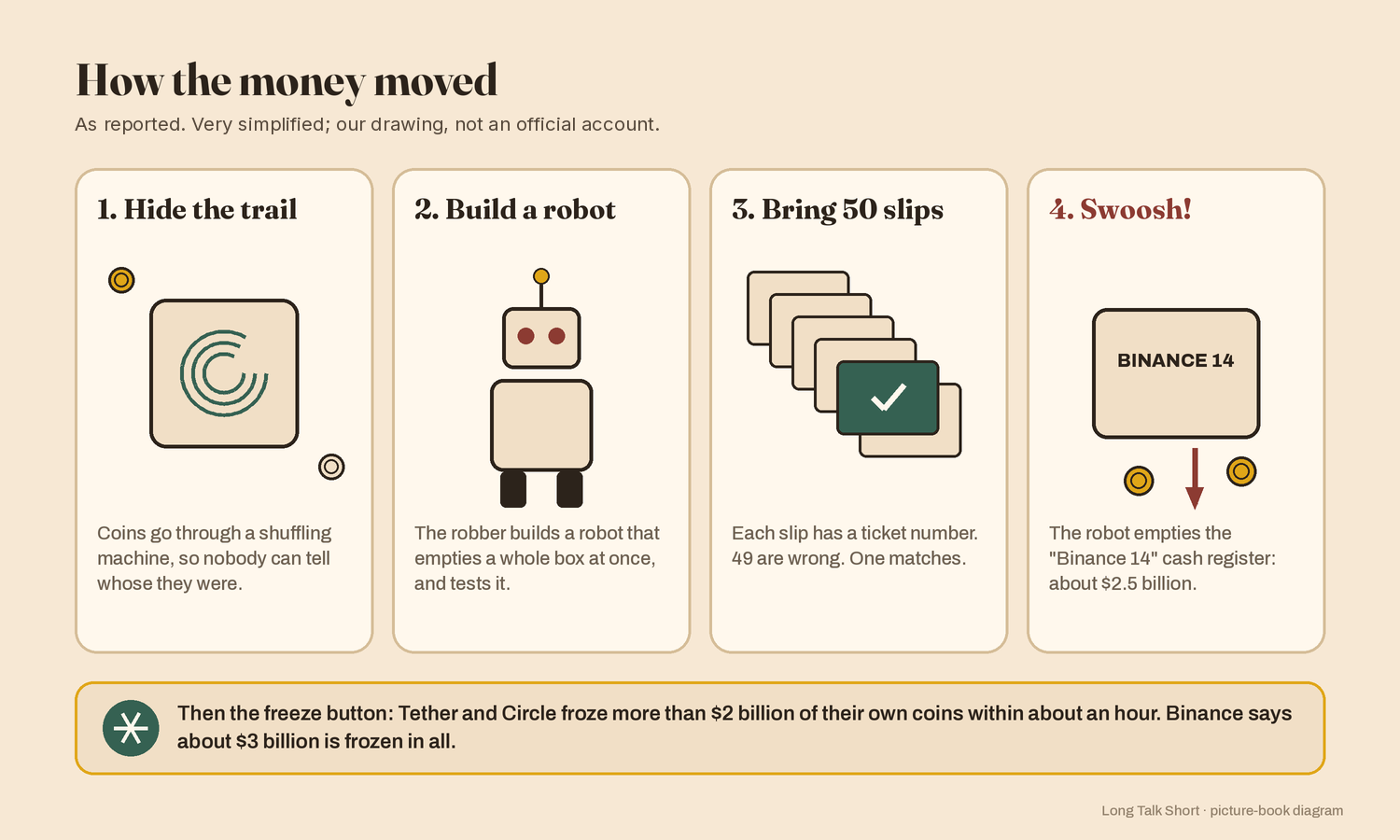
Steps 1 and 2: Hide the trail, build a robot. The robber got starting money from Tornado Cash. That's a kind of shuffling machine. It mixes coins like a deck of cards, so nobody can tell whose they were. Then the robber built a computer robot that empties a whole box in one go, and tested it.
Step 3: Bring lots of permission slips. On Ethereum, a box can sign a slip saying "let this robot run me." But the slip only works with the right ticket number, like "Now serving 47" at a busy counter. The number keeps changing. So the robber brought 50 slips with 50 numbers. Forty-nine didn't fit. One did.
Step 4: Swoosh. The robot emptied Binance 14 in one move: about $2.5 billion. It left the box open, so new coins coming in got swept out too.
Money also left on other blockchains, like Bitcoin, where the slip trick doesn't work. So it looks like the robber was inside the system that approves sending money.
That leaves two big questions. How did the robber get inside? And who was it?
4. How did the robber get in?
Binance says its first look points to one engineer's laptop. Someone got into it, reached a service that sends out money, and made it send money nobody had allowed. Binance found no sign the secret keys leaked.
Binance's co-CEO, Richard Teng, later added a twist. He said the attack was:
not carried out by one person
He also said Binance found more ways in than the laptop.
5. Who did it?
Nobody knows for sure. Binance hasn't blamed anyone.
Two crypto-tracking companies, TRM Labs and Chainalysis, say they think a North Korean hacking group called TraderTraitor, also known as Lazarus, did it. Why? Because the clues match earlier robberies. The FBI says it is "aware" of the robbery, but it hasn't named anyone.
So North Korea is a strong guess, not a proven fact.
6. Is the money gone?
Some of it got stuck. A few crypto coins are made by companies, like Tether and Circle. Those companies can press a "freeze" button on their own coins. They froze more than $2 billion within about an hour.
Binance promises to pay everyone back, partly from an emergency piggy bank called SAFU.
Jikh adds a warning: that freeze button stopped a robber here, but it works on anyone's coins.
So what can you do to keep your own coins safe?
7. How you can keep your coins safe
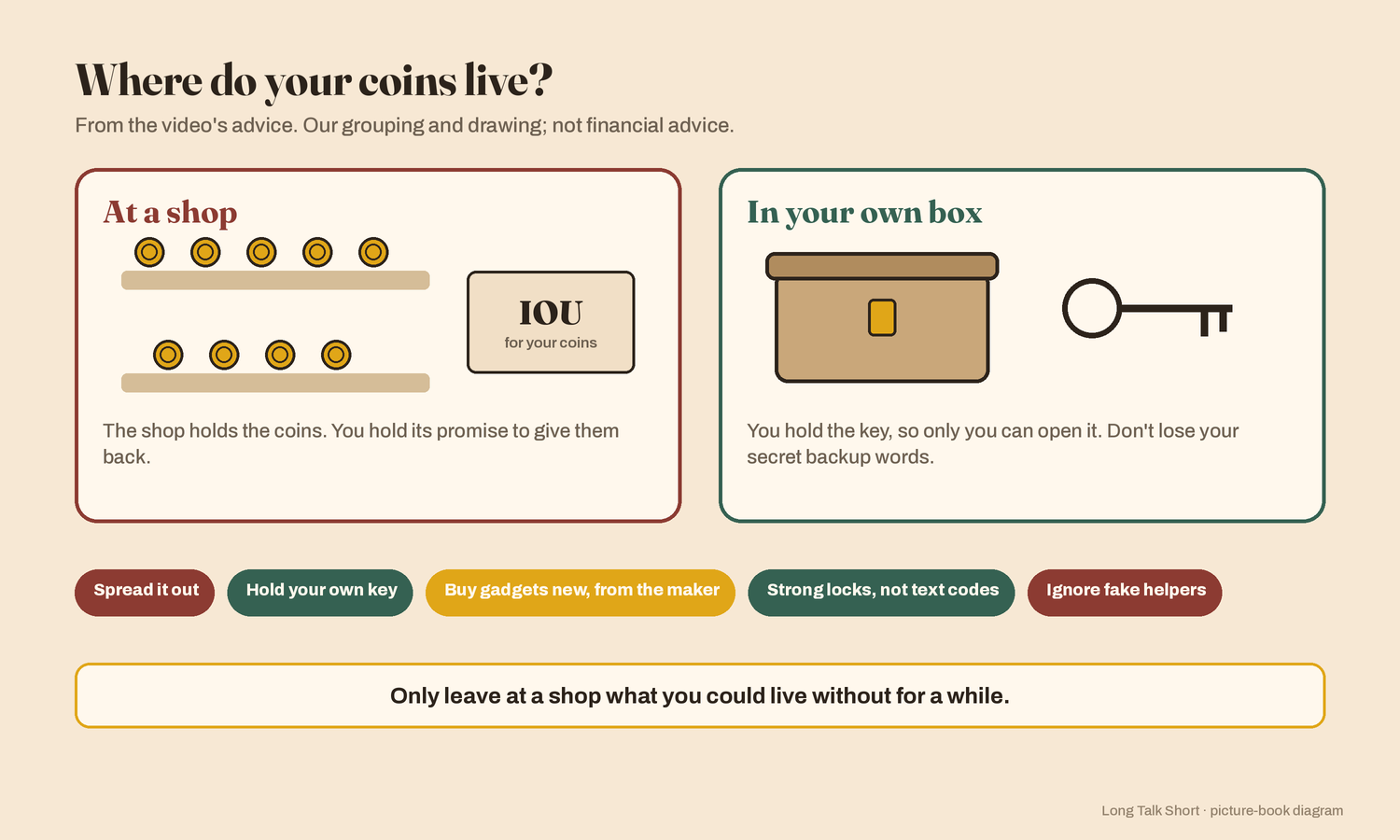
Jikh's main point: coins at a shop aren't really yours to hold. You hold the shop's promise to give them back. A small shop might not manage it. He says he once lost more than 10 bitcoin when a smaller exchange went broke.
His tips:
- Spread it out. Keep only what you're using at a shop, and use more than one.
- Hold your own key. Keep the rest in a wallet where you hold the key, like a hardware wallet bought new from its maker.
- Use strong locks. Log in with an app code or a security key, not text messages.
- Ignore fake helpers. After a big robbery, fake helpers appear. Real companies won't message you offering to get money back.
Weighing it: what holds up
Holds up: Binance's own update gives about $6.3 billion hit, about $3 billion frozen, an engineer's laptop as the likely way in, and no sign of a key leak. CoinDesk's reading of the blockchain matches the 50 slips, the $2.5 billion swept from Binance 14, and later deposits swept again. Reuters, via CNA, reported Tether and Circle froze about $2.38 billion in the first day, close to the video's $2.4 billion. Binance says SAFU holds about 15,000 bitcoin, roughly $1.2 billion, and that it covered a 7,000-bitcoin theft in 2019.
Disputed: who did it stays a guess. The FBI did blame North Korea for the $1.5 billion Bybit theft in 2025. For Binance, only private trackers have named TraderTraitor, saying they're highly confident. We found no government or Binance statement naming anyone.
Overstated: Jikh says "61 other tokens" and "$780 million in USDC." CoinDesk counts 63 tokens, and TRM Labs puts the USDC at $823 million. "Bitcoin is crashing" is strong: it fell about 4 to 5 percent, to around $76,000. And the laptop story is smaller than Teng's account, which found more ways in. Early numbers in a story like this can change.
Not checked: the 93-cent fee, the 195,000 ETH figure, the reports of drained Ledger and Coldcard gadgets, and the AI rumor, which Jikh himself calls only a rumor. Also, his video description has paid links to Ledger, a hardware wallet maker, and to crypto shops.
Bottom line: how the money moved is well documented on the blockchain. Who did it is not settled. The safety advice is sensible whoever did it.
Long Talk Short
- Binance says about $6.3 billion left its wallets, and about $3 billion was frozen.
- It looks like the robber tricked the machine that uses the key, not stole the key.
- Private trackers suspect North Korea's TraderTraitor group. That isn't proven.
- Coin companies can freeze their coins. That helped here, but it works on anyone's coins.
- Coins at a shop are a promise; coins in your own wallet are yours, if you guard the key.
The one thing to remember: if someone else holds your key, you're trusting their locks, so only leave there what you could live without for a while.
Source: "The Biggest Crypto Theft In History" by Andrei Jikh (YouTube). This is an independent summary and is not affiliated with the creator.
Nothing here is financial advice. Crypto is risky and you can lose money. Do your own research before you buy, sell or move any coins.