When Words Aren't Enough: The Body Keeps the Score's Big Idea, and What the Evidence Really Supports
Bessel van der Kolk's The Body Keeps the Score says trauma lives on in a body stuck in alarm, so talking alone often isn't enough. Here is his body-first toolkit, and what the evidence supports and disputes.
You can understand exactly why you flinch, and still flinch.
Bessel van der Kolk's bestseller says that's because trauma lives in the body, not just the story. Some of his case is strong. Some of it goes well past the evidence.
In 1996 a team that included van der Kolk put eight people with PTSD into a PET scanner and read them scripts of their own worst memories. As the memories came back, activity rose in right-hemisphere emotional and visual areas and fell in Broca's area, the region that helps turn experience into speech. Van der Kolk, a psychiatrist who has studied trauma for decades, builds much of The Body Keeps the Score (2014) on that picture: in the grip of a traumatic memory, the brain is reliving it, not telling it.
In short: trauma, he argues, lives on as a body stuck in alarm, so talking is often not enough; you also have to make the body feel safe. Parts of that are well supported, parts are promising, and the boldest claims about brain damage and body-only cures go further than the evidence.
1. The alarm that stays on
The core model is simple. After an overwhelming experience, the brain's threat system keeps firing long after the danger is over. He calls the amygdala the smoke detector. Meanwhile the frontal areas that judge context and time lose their grip. The result:
- Reacting to the present as if it were the past.
- Flashbacks as fragments, a smell, an image, a surge of panic, rather than a story with a beginning and an end.
- Numbing and dissociation in others.
But the title comes from something subtler.
2. Losing the feel of your own body
Van der Kolk argues many traumatized people lose interoception, the felt sense of their own body. They can't tell whether they're hungry, tense or calm, so they can't tell when they're safe. He draws on Stephen Porges's polyvagal theory to describe a nervous system moving between social engagement, fight-or-flight and collapse, and on the Adverse Childhood Experiences research to argue that childhood abuse and neglect show up decades later as heart disease, addiction and depression.
3. Why talking alone often stalls
If trauma is held in parts of the brain that don't do language, insight alone can't reach it. Van der Kolk isn't against talk therapy; he says finding words is part of healing. His point is that many patients first need to be calm enough in their body to stay present while they talk. Otherwise retelling the story just sets off the alarm again.
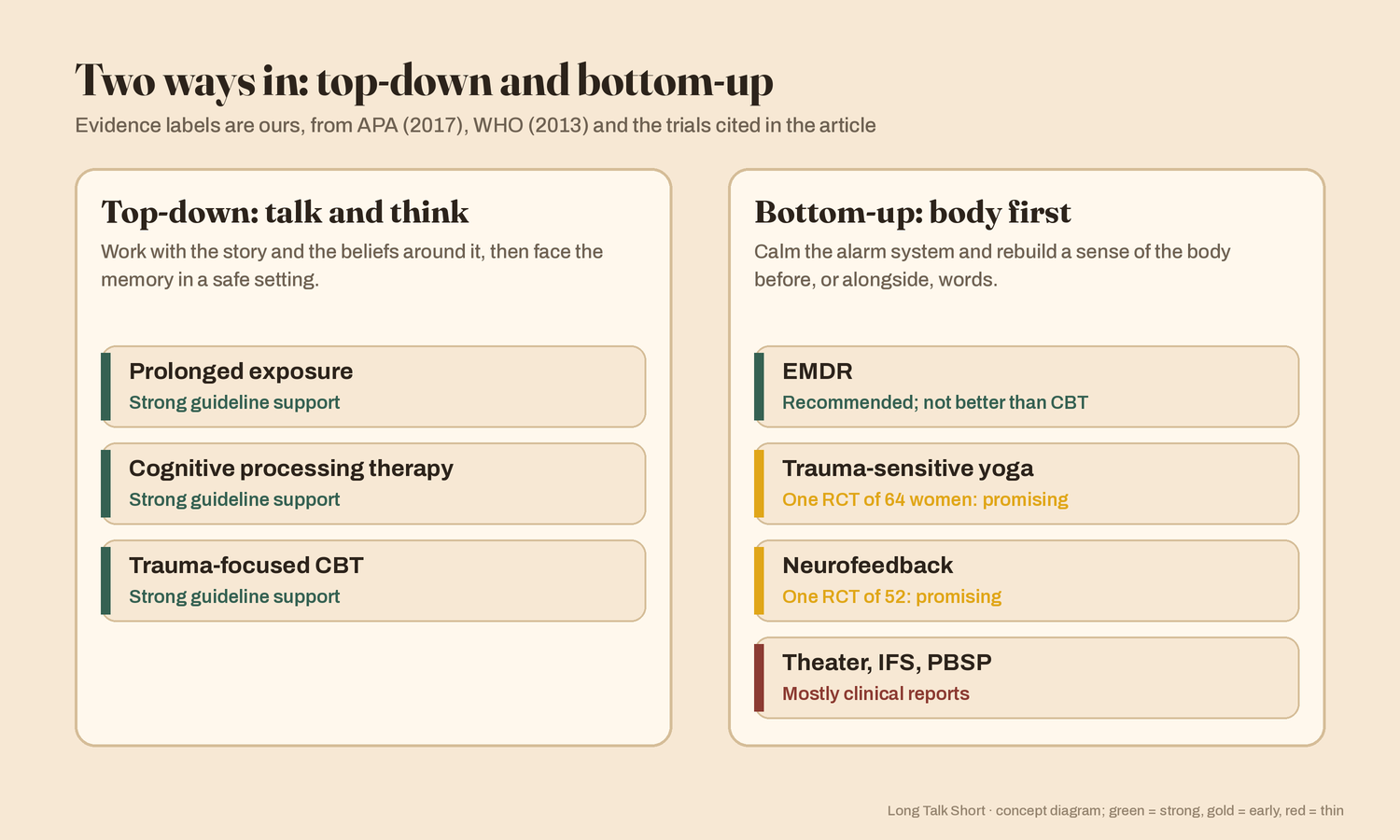
So what does he use instead? The evidence behind each option varies a lot.
4. The bottom-up toolkit
- EMDR has the firmest footing. The patient recalls the memory while following side-to-side movements or taps. The WHO's 2013 guideline recommends it alongside trauma-focused CBT; the APA's 2017 guideline gives it a conditional recommendation. Why it works is still debated.
- Yoga is his own research bet. In his group's 2014 trial, 64 women with chronic, treatment-resistant PTSD got 10 weekly sessions of trauma-sensitive yoga or a health education class. Afterwards 52% of the yoga group no longer met PTSD criteria, against 21% of controls.
- Neurofeedback trains people to change their own brain waves while watching a live readout. In a 2016 trial of 52 people, also from his group, 27% still met PTSD criteria after 24 sessions, against 68% of a waitlist.
- Other routes: internal family systems (IFS), which treats the mind as parts to be befriended; Pesso Boyden psychomotor therapy (PBSP), where group members act out a safe childhood for a client; and theater programs for teenagers. For these, the book mostly offers clinical stories.
Weighing it: what holds up
We checked the main claims against treatment guidelines and published critiques.
What holds up. Trauma often brings hyperarousal, numbing and fragmented, intrusive memories, and the scanner findings he cites are real, though the 1996 study had eight patients. Stabilizing a person before deep trauma work is standard practice. EMDR is a recommended first-line option. The yoga and neurofeedback trials are real randomized trials with large effects.
What is overstated. Those trials are small, come from his own group, and used weak comparisons (an education class or a waitlist). They show promise, not superiority. The treatments with the strongest support are mostly the kind of talk therapy the book plays down: the APA strongly recommends prolonged exposure, cognitive processing therapy, cognitive therapy and CBT. In a 2025 BJPsych Bulletin commentary, Tulane psychiatrist Michael Scheeringa reports examining 122 claims in the book and finding cited evidence often incomplete, selectively presented or wrong. He notes brain-scan differences in PTSD come from single-snapshot studies that can't show cause; studies measuring people before trauma suggest some differences were pre-existing vulnerabilities, not damage.
What is disputed. Polyvagal theory is contested in physiology; a 2023 review by Paul Grossman in Biological Psychology argues all five of its basic premises are untenable or highly implausible. Researchers agree people can forget traumatic events and later remember them, but whether that comes from an unconscious repression mechanism is still debated. Developmental trauma disorder, which van der Kolk and colleagues proposed, wasn't adopted in DSM-5 for lack of validation.
How to read it. Treat the book's descriptions of what trauma feels like as its strongest part, its brain-damage story as a hypothesis, and its treatment rankings as one clinician's view. If talking alone has stalled, the evidence supports a structured trauma-focused therapy such as PE, CPT or EMDR with a trained clinician, with body-based practices like yoga as support.
Long Talk Short
- Trauma, in van der Kolk's model, leaves the threat system stuck on and the body's own signals muted, so the past keeps happening in the present.
- In a 1996 scan of eight patients, Broca's area quieted during traumatic recall: one reason he thinks insight alone often doesn't heal.
- Of his bottom-up tools, only EMDR has strong guideline backing; the yoga (64 women) and neurofeedback (52 people) trials are small but encouraging.
- Trauma-focused talk therapies have the strongest evidence, more than the book admits.
- Critics dispute the permanent-brain-damage story, polyvagal theory, repressed memory and the claim that body-based therapies are uniquely effective.
The one thing to remember: healing usually needs both safety in the body and a way to face the memory. Look for treatment that gives you both, and choose it by the evidence, not the metaphor.
Source: The Body Keeps the Score: Brain, Mind, and Body in the Healing of Trauma by Bessel van der Kolk (Viking, 2014). This is an independent summary and is not affiliated with the author or publisher.
This article is for general information only and is not medical or mental health advice. If you are struggling, please contact a qualified professional. In the US you can call or text 988 to reach the Suicide & Crisis Lifeline; elsewhere, contact a local crisis line.