Brian Tracy's 10 Cs of Success, and the Courage That Shows Up at 4 A.M.
Brian Tracy started out broke and a high-school dropout. In a vintage seminar, he boils success down to ten learnable habits, all starting with C, and one decision: that nothing will stop you. Here's what holds up, and what doesn't.
Picture it: your best deal just fell apart, the rent is late, you're tired and sick, everybody is mad at you, and your car doesn't work. Brian Tracy says that moment, not the good days, is where success is decided.
In a vintage seminar recording, Tracy, who says he was broke and a high-school dropout until he started studying successful people and doing what they do, boils years of that study down to ten qualities that all start with C. The one people remember comes near the end: what he calls "4 o'clock in the morning courage." Here's the five-minute version, plus an honest look at which claims hold up.
In short: Tracy argues that success comes from ten learnable habits, not talent. Clarity, excellence and focus get you moving, courage keeps you moving when things fall apart, and confidence is simply what builds up after you practice the other nine.
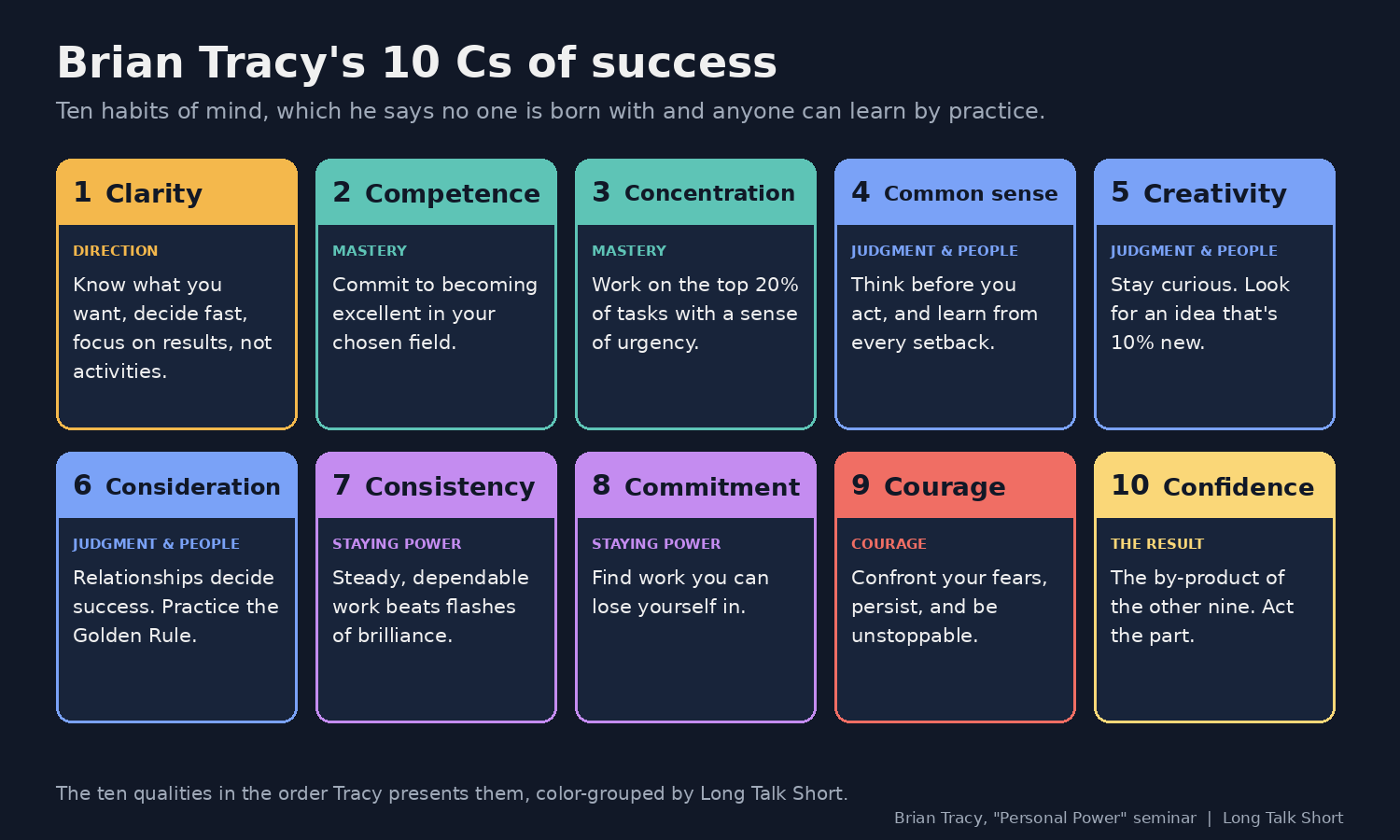
1. Ten habits, not ten talents
With all ten Cs, Tracy claims, success is predictable. Lacking even one can be "the weak link in the chain."
The good news in his framing: all ten are "habit patterns of mind" that nobody starts with and anyone can learn.
2. Clarity: know where you're going
Clarity is "the starting point of all success." Without clear goals, Tracy says, you are "doomed forever to work for people who do." He breaks it into parts:
- Decide fast. About 80% of decisions should be made the first time they come up. Successful people "make their decisions right."
- Dream bigger. Most people shrink their vision until it no longer excites them.
- Results, not activities. Ask: "What results are expected of me?" and "Why am I on the payroll?"
- Speak straight. We tiptoe around bad news, yet want it delivered straight ourselves.
His daily method: each morning, rewrite your major goals in the first person, as if already achieved. Each evening, ask what you did right and what you'd do differently.
3. Competence and concentration: be excellent, then focus
Tracy says he never found a successful person who wasn't excellent at what they did. In an insurer's study of its agents that he cites, the top 20% earned 16 times as much as the bottom 80%. Excellent companies, he argues, are only a percent or two better, but in a hundred areas.
His test: how many job offers did you get this month? And if you don't love your work enough to want to be the best, leave it "the way you would get out of a burning house."
Concentration means working on the top 20% of your list and asking: "What is the most valuable use of my time right now?" Add a sense of urgency, and finish every job you start.
4. Common sense, creativity and consideration
- Common sense, which Tracy says a Gallup survey of Who's Who listees ranked as the top success quality, means thinking before acting: "action without thinking is the cause of every failure." Trust your intuition; mine setbacks for lessons.
- Creativity starts with curiosity. You need only an idea that's 10% new to start a fortune, he says, like the Chicago man who knew nothing about construction but found a way to build a wall's corners and middle at once, and then underbid competitors by 40%.
- Consideration: relationships, "more than anything else," decide success. Build your vocabulary, study communication, practice the Golden Rule. He cites a Carnegie Institute of Technology study claiming 95% of people let go were fired for not getting along with others.
5. Consistency and commitment: the unglamorous part
Dependable steady predictable work is always vastly superior to spurts or flashes of brilliance.
Tracy's "law of accumulation" says every great success rests on thousands of small efforts nobody sees.
Commitment means losing yourself in work you love. Citing Dr. Srully Blotnick's study of self-made millionaires, he says those who got rich picked work they loved, got very good at it and held on to the money.
6. Courage: what happens at 4 a.m.
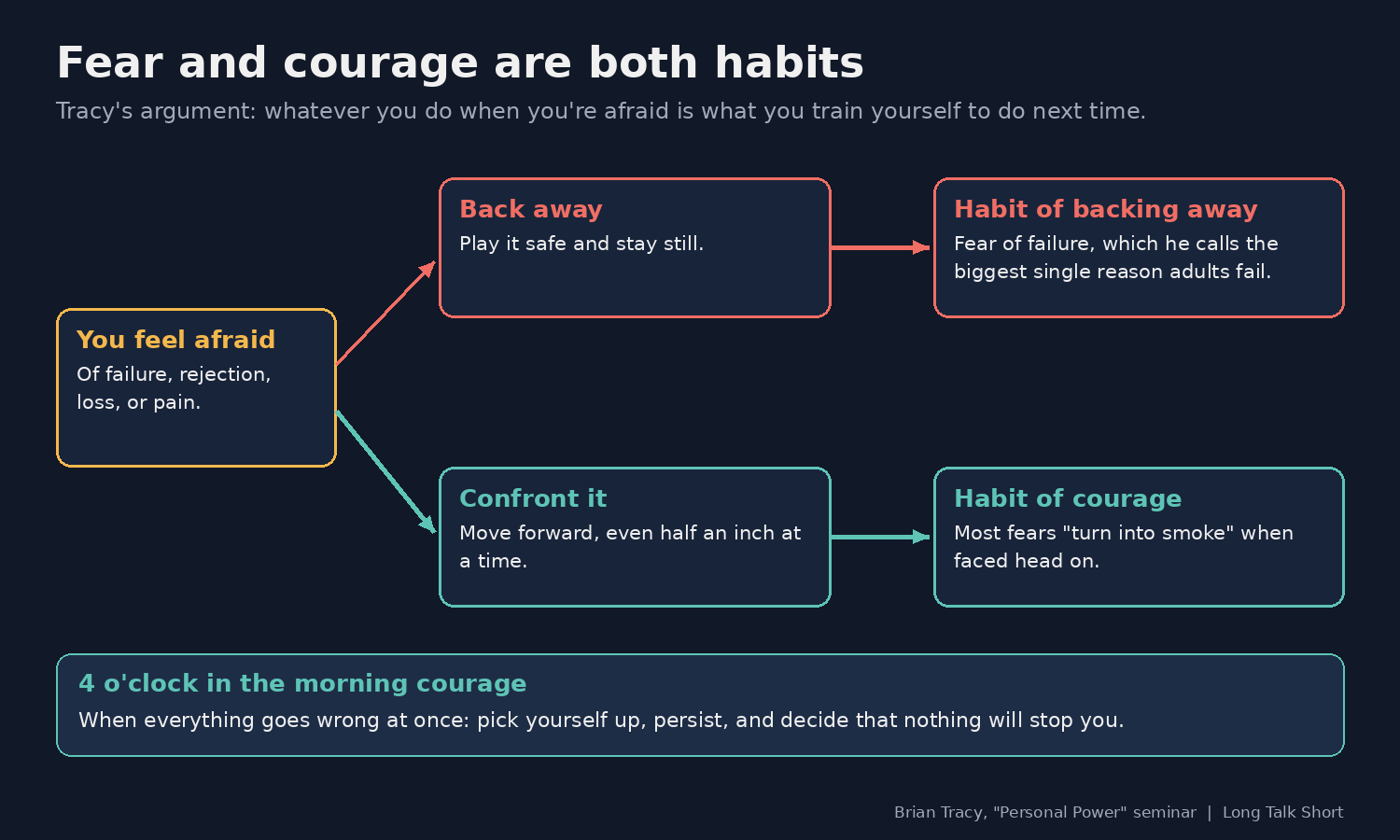
Brave people aren't fearless, Tracy says; they "master their fears." Fear and courage are both habits. Back away when afraid, and backing away becomes a habit. Confront the fear, and confronting becomes the habit. Most fears "disappear when you confront them."
From his karate instructors he took one rule: always move forward, "even if you're only moving forward a half an inch at a time." And he raises the bar: "if you're not a little bit afraid at least three or four nights a week you're not trying hard enough."
Fear of failure, he says, is "the greatest single reason for failure in adult life." The answer is persistence, tested at the worst moment: the deal collapses, the rent is late, you're sick and everyone's angry. That is the moment for 4 o'clock in the morning courage.
Develop the quality of being unstoppable. Say in yourself that no matter what life throws at me, it'll never stop me. No matter how rough it gets, I will never quit, and nothing will ever stop me.
He calls that decision "the basis of self-esteem."
7. Confidence comes last
The tenth C isn't a habit you practice directly; it's a result. "You don't get confidence out of a bottle," Tracy says, and "you can't learn confidence in a motivational seminar." Each finished goal lays down a "success pattern" your mind repeats.
His closing advice: your true beliefs show only in your actions, so "act the part until you feel the part."
Weighing it: what holds up
Solid ground: the habits themselves are sensible: clear goals, focus on what matters, steady effort, getting along with people, acting despite fear.
Shaky numbers: nearly every statistic is unsourced, from "80 to 90%" of unhappiness caused by lack of direction ("in my estimation") to only 2% of people having a sense of urgency and dry cleaning as the top source of self-made millionaires. The named studies are recited from memory without detail, and the insurance arithmetic slips: he calls the top 20% of the top 20% of the top 20% the "top 8%," when it's under 1%. Blotnick lost his Forbes column in 1987 after his credentials and research were publicly challenged. And "do the thing you fear and the death of fear is certain," which he credits to Mark Twain, is usually attributed to Emerson.
The method: it's survivorship. Study winners, work backward, and never see those who had all ten Cs and still failed, or the role of luck. "Success is predictable" doesn't follow. Some claims overreach: a "Law of Attraction" field of vibration he admits "we cannot explain scientifically," and intuition that "always" gives the right answer.
Provenance: references to In Search of Excellence and Lifestyles of the Rich and Famous suggest a 1980s recording, but the upload gives no date or original publisher. It's a fan re-upload, posted by Mind First in August 2017.
Long Talk Short
- Tracy's ten Cs are habits built by practice, not traits you're born with.
- Get clear: write goals daily, decide quickly, and judge yourself by results, not activity.
- Commit to excellence, then spend your time on the top 20% with urgency.
- Think before acting, stay curious, and treat getting along with people as a core skill.
- Steady and committed beats brilliant and erratic.
- Fear and courage are both habits. Always move forward, even half an inch.
The one thing to remember: when everything falls apart at 4 a.m., what carries you is a decision made in advance that nothing will stop you. Confidence follows the action.
Source: Brian Tracy, "Personal Power: The 10 Keys To Building Your Personal Success" (seminar recording uploaded by Mind First on YouTube). This is an independent summary and is not affiliated with the speaker or the uploader.
This article is for general information only and is not professional, psychological, career or financial advice.