Building Ahead of the Models
When building gets cheap, product judgment gets scarce. Gemini leader Tulsee Doshi offers a 60-20-20 heuristic—not a tested formula for success.
If software gets easier to build, choosing what deserves to exist gets harder. On Lenny's Podcast, Gemini product leader Tulsee Doshi makes the case for hands-on model testing, product judgment and her 60-20-20 planning heuristic. It is useful practitioner advice—but it comes from a Google executive on a sponsored show, not an independent test of Google's advantages.
In short: Doshi argues that models are less predictable than product plans assume, so product managers need hands-on "vibes" and simple evals. She suggests building so that about 60% of a product works with available models, 20% almost works, and 20% waits on future models. She makes Google's full-stack case and argues that PMs gain value when building is cheap. These are a practitioner's views, not research findings, and she is a Google executive.
1. Who is talking, and who benefits
The episode description calls Doshi head of product for Google's frontier AI models, including Gemini, Nano Banana, Genie, Veo and Lyria. Host Lenny Rachitsky says she spent six years leading product for Google's responsible AI work before this role. She is a co-author of a 2014 UIST paper on "flash teams" with Stanford's Michael Bernstein, which she describes in the episode.
Her interest is plain. When Lenny asks how listeners can help her, she answers, "use Gemini." The show has two sponsors, WorkOS and DX, and in the WorkOS read Lenny mentions startups he has invested in. Nothing here is independent analysis of Google's position.
2. Models are grown, not specified
Doshi opens with a point that cuts against classic product management. You can set goals and evals for a model, she says, "but the model isn't predictable." Her image is Snape's potions class: "You can put all the ingredients in, but you also have to expect that there will be a little bit of magic." Researchers monitor training runs closely, she adds, but a PM still has to learn where an emerging capability actually shows up.
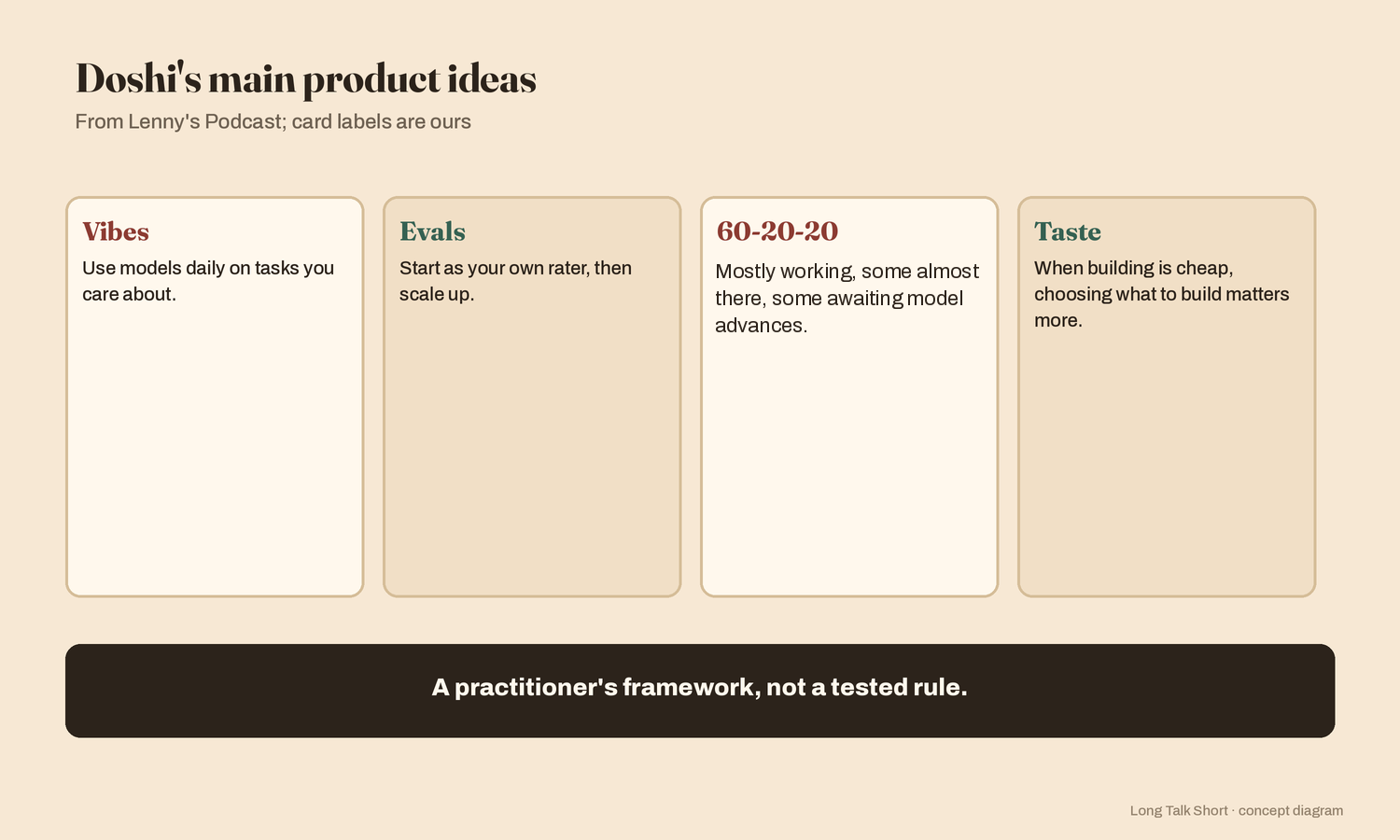
That is why her hiring answer starts with taste. "We are looking for PMs who understand the vibes of our models or other models," she says, people "who are playing with these models every day." She pairs vibes with evals and advises starting small: be the rater yourself, collect examples of what good looks like, and scale only once you can state your own standard. For testing a candidate model, she suggests keeping a personal set of tasks you care about that current models handle only partly, then watching how each candidate model handles them.
3. The 60-20-20 rule
Her most practical idea is a product-planning split. Traditional startup advice says ship a minimum viable product that works. Doshi suggests putting roughly 60% of a product on capabilities that work, 20% on capabilities that almost work, and the rest on hoped-for improvements—areas where she sees "glimmers of light." Her goal is a usable product with room to improve alongside models.
She does not claim the split is precise, saying "the numbers are probably fungible." She also admits that even inside a model team it is hard to say exactly where models will be three months out, which is her reason for preferring this approach to the common advice to build a fixed distance ahead. Lenny adds that builders should regularly retest their scaffolding as models improve.
4. The economics of cheap building
Lenny asks whether PMs are rising in value again. Doshi admits she is "obviously biased because I am a PM," then makes the economic argument: that making software easier to produce increases the value of choosing something worth making. When the cost of producing software falls, the scarce inputs become knowing which signal matters, choosing what to make and getting people to agree. She adds that fast building can "introduce chaos" without someone who drives consensus.
She expects the job itself to shift. In her reading, prototypes and evals can replace requirements documents as working artifacts; the role needs "some heft" behind its recommendations, such as data, a prototype or an eval. On AI-written documents, her division of labor is that the model supplies the data and the person supplies the insight.
On workload she describes a team putting in intense hours. She hopes AI tools will reduce burnout by removing grunt work. That is a hope, not a finding. Lenny cites his own survey of tech workers saying that more hours do not equal burnout; we did not see that survey.
5. Google's full-stack pitch
Lenny raises the obvious challenge: whether Google trails leading rival labs. Doshi answers that Google is building at the frontier with Gemini 4 Argon and also wants models across the cost-quality curve, from search users to engineers to cyber defenders. Google has a blog announcement for Gemini 4 Argon. Its benchmark claims are Google's own, and early access was limited to trusted testers at launch. She also cites Wiz, whose acquisition Google completed, as part of its cyber-defense work.
Weighing it: what holds up
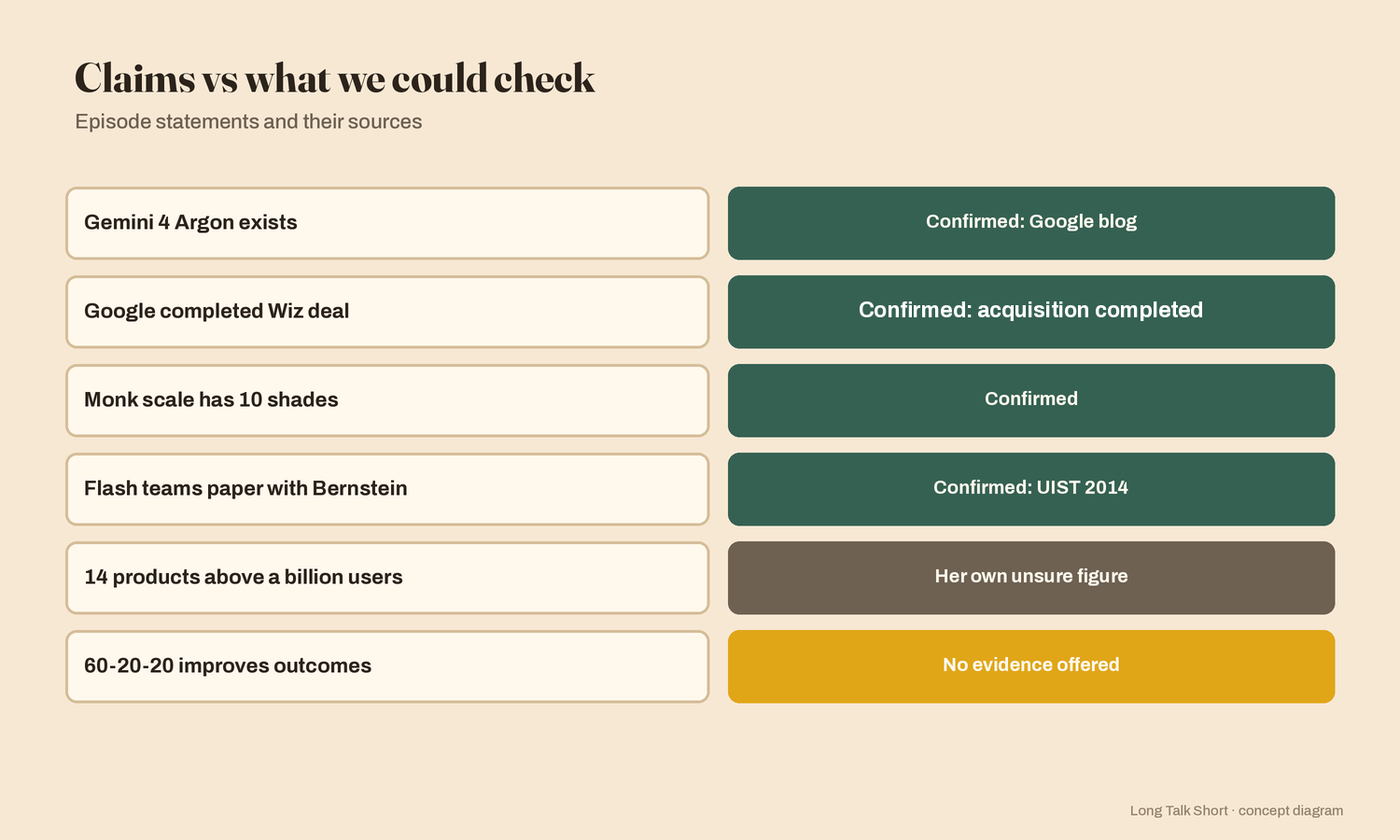
What we checked. Google's Gemini 4 Argon announcement, the Wiz deal's completion, and the Monk Skin Tone Scale, a 10-shade scale developed by Harvard sociologist Ellis Monk that Google adopted instead of relying on the six-type Fitzpatrick scale. We also confirmed the 2014 flash teams paper with Doshi among its authors.
What we did not. Doshi says Google has "14 products that are above a billion users," then adds, "I should check that number." We did not verify it. We have no independent comparison of Gemini against other labs' models, and the benchmark claims come from Google. Neither the 60-20-20 rule nor her eval advice has been tested in published research that we found; they are working heuristics. Our quotations come from YouTube's automatic captions, because the official transcript is behind a paywall, so wording may differ slightly.
Sources. Gemini 4 Argon announcement, Wiz acquisition, Monk Skin Tone Scale, flash teams paper, official transcript (paywalled).
Disclosures. Google vendor interests, WorkOS and DX sponsorship, and the host's startup investments all sit alongside this advice. Doshi works for Google and asked listeners to use its products. The host runs sponsored segments and invests in startups. The case for PMs gaining value is an argument made by a PM and endorsed by the host, not an independent labor-market finding.
Related reading: Figma on AI builders and human judgment · AI agents: trust before autonomy
Long Talk Short
- Doshi says models are less predictable than product plans assume, so PMs need daily hands-on use plus simple evals.
- Her 60-20-20 rule is to build mostly on what works, partly on what almost works and a little on what future models may enable.
- Her economic case is that cheap building makes taste, focus and consensus scarcer, and so more valuable.
- Gemini 4 Argon, the Wiz acquisition and the 10-shade Monk scale check out; her billion-user product count does not yet.
- She is a Google executive making Google's case, on a sponsored show.
The one thing to remember: Treat 60-20-20 as a planning heuristic, not permission to promise capabilities a model cannot deliver.
This summary is general information, not an endorsement of any vendor or a guarantee of product performance.
Source: Lenny's Podcast, "Why PMs are suddenly valuable again | Tulsee Doshi (Head of Product, Gemini)," on YouTube. This is an independent summary and is not affiliated with Lenny's Podcast, Google or Tulsee Doshi.