Can Rhetoric Make You Free?
Since Plato, rhetoric has been suspected of being the enemy of freedom: the art of flattery, the tool of tyrants. Victor Ferry argues the opposite, that the five classical canons are five disciplines of self-possession. We take his case seriously, and then test it.
The ancient quarrel between rhetoric and philosophy asked whether eloquence liberates or enslaves. A modern rhetorician reopens it, and answers through the five canons that you cannot be free if you cannot speak.
There is an old suspicion, as old as philosophy itself, that rhetoric is the enemy of freedom. In Plato's Gorgias, Socrates refuses to call rhetoric an art at all. He calls it a knack, a form of flattery, the verbal equivalent of pastry-making: it gives people the pleasure of being persuaded without the labor of being taught, and in the wrong hands it is the instrument of the tyrant, who rules not by knowing the good but by moving the crowd. On this view, the skilled orator is not a free man. He is a seducer, and his listeners are the ones who have lost their freedom to him.
Victor Ferry, a rhetorician who teaches the discipline to a modern audience, begins from the opposite intuition. Rhetoric, he argues in this lecture, is a discipline that will set you free, and the freedom he means is double. It is a mental liberation, the autonomy of a mind that thinks for itself, and it is also a material one. Ferry is cheerfully frank about this second dimension. He calls himself a materialist, and insists the word means realist: you are not fully free if your head is liberated but your days are sold, hour by hour, to an employer, in a job you dislike and a life you did not choose. Financial liberation, the capacity to eventually live as you see fit, is for him the realistic condition of any genuine freedom at all. The two are meant to travel together, and his claim is that the ancient art of speaking well is the road to both.
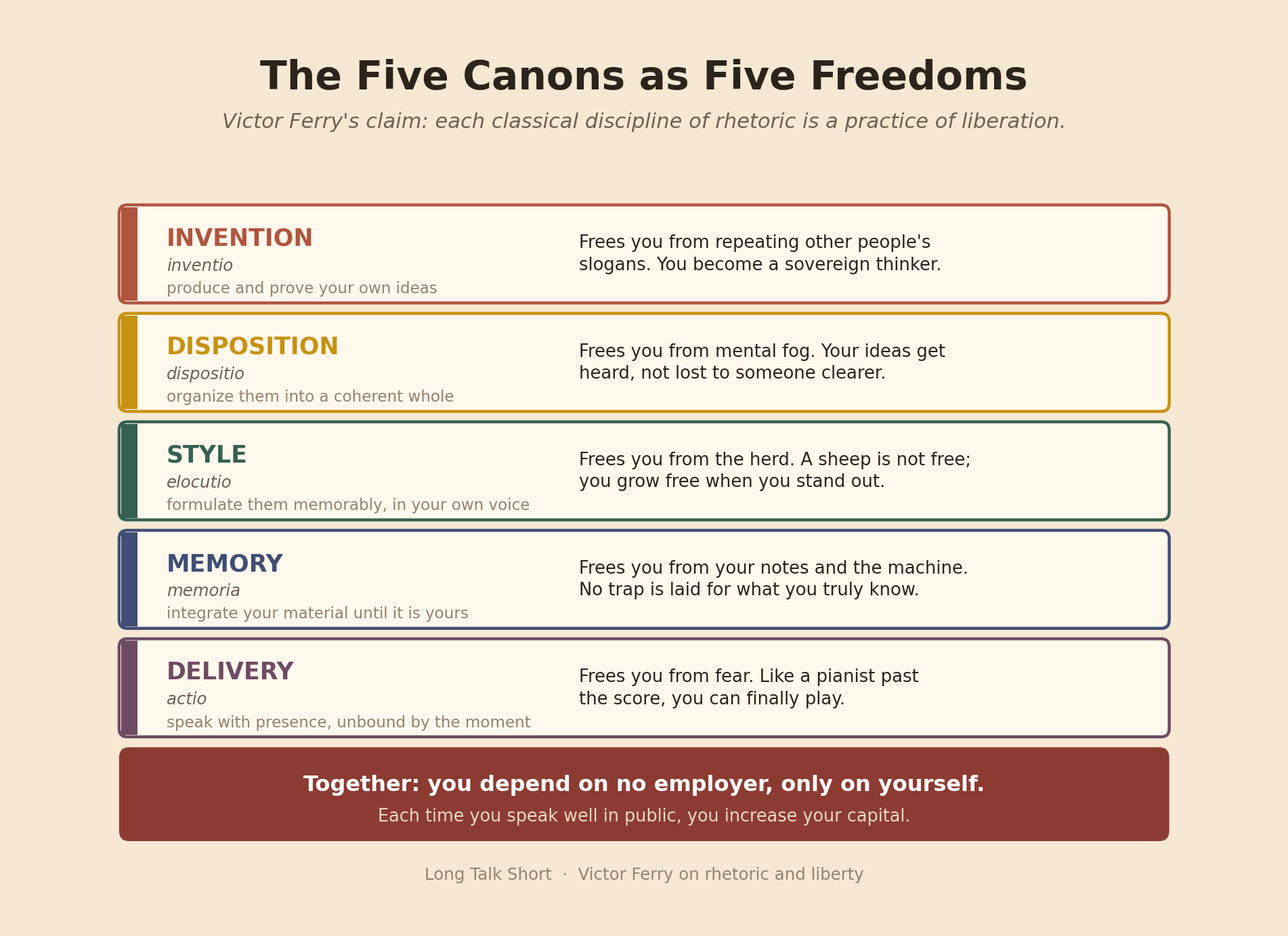
To make the case, he returns to what the classical tradition called the canons of rhetoric, the five domains of competence the discipline was divided into by Cicero and the Roman handbooks: invention, disposition, style, memory, and delivery. Ferry walks through all five, and treats each as a distinct practice of liberation. It is worth following him canon by canon, because the argument is more serious than the self-help frame around it suggests, and because the places where it strains are as instructive as the places where it holds.
Invention: the freedom to think for yourself
The first canon, inventio, is the work of producing ideas, and Ferry gives it the most weight. His practices are concrete. List your great ideas, by which he means the principles that actually guide your life, and then refuse to leave them as pious abstractions. A principle only becomes yours when you can point to a situation in which the easy, short-term option pulled one way and you chose the other because the principle was more truly who you are. His own example is personal: after his application for a tenured university post was rejected, he could have waited, reapplied, and lived on assistance in the meantime. Instead he decided that if he had been refused, the responsibility was his, that something in what he had done was lacking, and that rather than ask for a job he would make one. That is how he turned to YouTube and to entrepreneurship, taking responsibility, as he puts it, for his own income.
The second practice of invention is to list the received wisdom of your field and try to refute it. In rhetoric, the obvious pieties are that manipulation is wrong, that emotion is suspect, that only reason matters. A genuine thinker, Ferry argues, takes a step to the side of these evidences and tests them, because some will turn out to rest on good reasons and some will not, and you cannot know which until you have tried to knock them down. The third practice is to write out the axioms you repeat and then prove them, tracing the mechanism, marshaling the facts, answering the objections.
Behind all three sits the oldest ideal in the tradition, which the Roman teacher Quintilian compressed into a phrase: the orator is the good man skilled in speaking. What makes a speaker trustworthy, what the Greeks called ethos, is the coherence of word and deed, and the labor of setting down your principles and living by them is how that coherence is built. The liberation, Ferry says, is that you become an autonomous thinker rather than a machine that repeats other people's slogans, blown about by the wind. You become sovereign, guiding your acts by things you have actually examined, and you cease to be at the mercy of anyone who has done this work and could, in front of an audience, demonstrate that you cannot defend the very things you claim to believe.
Disposition: the freedom from your own mental fog
The second canon, dispositio, is arrangement: once you have ideas, the power to organize them into a coherent discourse. In the plainest, most scholastic form, it is simply the plan, how you begin, develop, and end. The classical tradition built it for three kinds of speech, Ferry notes, the judicial (defending or accusing), the deliberative (proposing a measure to an assembly), and the epideictic (binding a community around shared values and heroes), and today it extends to every format we use, the good post, the good video, the good short.
The freedom here is freedom from a very common misery. Many people are certain they have brilliant ideas, and yet no one pays them any attention, because they cannot deliver those ideas in a shape that holds together. They are at the mercy of someone who may have worse ideas but expresses them better, and that person will always go first. You cannot be free, Ferry says flatly, if your thought is not structured, because mental fog is itself a weight. The people who come to him often describe exactly this: a sense of having ideas that dissolve the moment they start to speak, not knowing where to begin. To order and structure your thinking is to gain agility and force, and it is here too that the material dimension first appears, because the person who can produce original ideas and formulate them in formats that work builds an audience, and an audience can be turned into income, and with it into geographic and financial liberty.
Style: the freedom to leave the herd
The third canon, elocutio, is style: the capacity to strike and stay in the mind by formulating ideas in a way that is memorable. Style breaks the routine of everyday language, which is why it reaches for ternary rhythms, metaphor, rhyme, cadence, the signals that tell a listener we have changed registers, that this is no longer ordinary talk.
But Ferry draws a distinction that matters. There is a difference between having style and having a style. Having style is knowing the figures, rhythming your speech, using striking images, a craft anyone can learn. Having a style is the capacity to set yourself apart, to cultivate something that is yours rather than speaking, as he puts it, like everyone around you, steeped in the contemporary manner without noticing it. This is where his language turns frankly philosophical. A sheep is not free, he says, an ant is not free; you begin to become free when you distinguish yourself, and style is one of the dimensions through which a person stands out from the troop. Freedom, on this telling, is individuation, and voice is its instrument.
Memory: the freedom from your notes, and from the machine
The fourth canon, memoria, is the integration of your material so deeply that it becomes yours, and Ferry argues it has become newly fundamental in the age of artificial intelligence. From a distance, he observes, everyone now looks like an expert. He does not really speak to his accountant or to the tax administration; he skims their emails, hands them to a chatbot, and receives a learned, technical answer he does not care to master, because he has no wish to shine as an accountant. But if someone sat across from him and asked him to justify a line in that email by naming the relevant text, he would be exposed. He is an expert only from afar.
Within his own discipline it is otherwise, and he offers the lecture itself as proof: he delivers it without notes, because over years of writing and thinking he has integrated it. Memory, he insists, is not only a matter of your AI knowing the figures; you must be able to summon the right fact at the right moment in a live exchange. The orator who speaks from a sheet is not free, because a trap can be laid, a sudden "what did you just say?" can undo him, and he is at the mercy of anyone more at ease without notes and without the machine. To cultivate memory is to be liberated from both your papers and your technology.
Delivery: the freedom to be present
The fifth canon, actio or delivery, is the freedom not to be a prisoner of the moment. The unfree speaker is monotone, riddled with verbal tics, forever asking himself what to say next, visibly afraid, and the audience is bored. The speaker who has integrated everything can slow down, speed up, play with the level of energy, and enjoy himself, the way a pianist who has internalized the score is no longer deciphering it as he plays and can finally interpret, and have fun on stage. This is liberation as sheer presence, the state of being wholly unbound because there is no longer any fear and no longer any scramble to check that the material is really there.
From thinker to free agent
The canons are cumulative, and so is the freedom. Work on them steadily, Ferry argues, and you become an orator the public finds interesting: original in your ideas, clear in your arrangement, distinctive in your style, independent of your notes, at ease in your delivery. The audience turns toward you; the audience becomes income; people begin to seek your counsel, and at that point you no longer depend on an employer but only on yourself, and on a performance that is good enough that every time you speak in public, you increase your capital. That, he says, is the relationship between rhetoric and liberty he wanted to pass on.
How to read this: can it, really?
The case is more coherent than its genre lets on, and before judging it, it deserves to be stated at full strength, which is what we have done. The five canons do describe a real discipline of self-possession: knowing what you believe and why, saying it clearly, making it memorable, holding it in your own mind, and delivering it with presence. It is not absurd to call that a component of freedom. The ideal underneath it, Quintilian's good man skilled in speaking, is one of the most durable in Western thought, and Ferry's insistence that word and deed must cohere is its genuine heir. His link between inarticulacy and powerlessness is also simply true to experience: the person who cannot say what they mean is, in a real sense, less free than the one who can.
And yet the old suspicion from the Gorgias does not disappear just because it is unfashionable. If rhetoric frees the speaker, it often does so by capturing the listener, and one person's liberation through persuasion can be another's manipulation. Ferry meets this worry, but he meets it by deflecting it. When people ask whether mastering rhetoric risks turning them into manipulators, his answer is not an ethical one but a competitive taunt: who do you think you are, you have not even done your scales and you think you will beat the champion, your problem is not that your words have become a weapon, your problem is that nobody is listening. This is rhetorically excellent and philosophically evasive. It answers the question "are you good enough to manipulate?" and leaves untouched the question Socrates actually asked, which is whether the art, once mastered, serves truth or merely power. A discipline that frees you to move audiences is not, by that fact alone, a discipline that makes you good.
Two further cautions follow from the frame. The lecture is itself a performance of its own thesis, delivered without notes, by a man who ends it by pointing to his paid courses, coachings, and consultations; the freedom on offer is bound tightly to a product, and the speech is, among other things, an advertisement. And the illustrative axioms he chooses, that taking responsibility means a missing salary is your own fault, that social aid creates long-term poverty rather than reducing it, are presented as neutral demonstrations of method but are in fact contested political claims. The method, prove your principles, is worth keeping. The particular principles are his, not conclusions the method forces, and a careful reader separates the two.
So, can rhetoric make you free? The honest answer is that it can make you more capable, more present, and harder to push around, and that these are real goods the ancient quarrel never denied. Whether they add up to freedom depends on something rhetoric cannot supply from inside itself: what you choose to say, and whether it is true. Plato's worry was never that eloquence is worthless. It was that eloquence without wisdom frees the speaker at everyone else's expense. Ferry has made the strongest modern case that the discipline of speaking well is a discipline of becoming someone. The question he leaves open, perhaps deliberately, is the one that discipline cannot answer on its own: someone worth listening to, or merely someone who cannot be ignored.
Go deeper
- Gorgias, Plato
Affiliate links, a small commission supports the blog at no cost to you.