Charisma Is a Skill, Not a Gift
Charlie Houpert grew up so forgettable a classmate told him he was invisible. Then he treated charisma as something you practice, not something you are born with, and rebuilt himself. Here is his playbook for connection, and the small habits that quietly push people away.
Based on Charlie Houpert's conversation on The Diary of a CEO with Steven Bartlett. Houpert founded Charisma on Command and has taught connection and confidence to millions. This distills his practical playbook, including the habits that make people instantly dislike you. One section touches on childhood sexual abuse, handled briefly and with care.
Charlie Houpert spent the first eighteen years of his life convinced that charisma was something you either had or did not, like being able to throw a football. He did not have it. In a graduating class of five hundred he was voted "most likely to break out of his shell in college," which, as he notes, is a strange thing to be known for, being known for not saying much. One classmate put it more bluntly: "Charlie, you're so normal that you're invisible." On The Diary of a CEO, the founder of Charisma on Command makes the case that none of that was fixed, that charisma is a skill, and that he is the proof, because he learned it on purpose.
The myth that you cannot learn it
The biggest myth, Houpert says, is that charisma is innate. He believed it for eighteen years, until, studying abroad in Costa Rica at nineteen, exhausted by a pattern of building entire relationships in his head that evaporated the moment he opened his mouth, he decided to treat it as a problem to solve. He ran experiments on himself, some of which failed, there was a week of walking around with deliberately "big eyes" until a friend asked what on earth he was doing. But within six months to a year, people on campus were asking what had happened to him, because he had become a different person. The engine was a mindset he adopted for a decade: if an interaction did not go well, something he did caused it, and something he could change. That took the mystery out of it and turned every awkward moment into data.
He is careful to frame why this matters, and it is not mainly about getting the girl or the promotion, though he grants those are often why people show up. The deeper payoff is internal. You can have money, fame, even a six-pack, he says, and still feel terrible if you feel disconnected from the people in your life. Connection, not achievement, is what makes a life feel good from the inside, and it is, in his view, the most underrated lever of success from the outside too.
One more sentence
If charisma sounds abstract, Houpert's starting move is almost comically small: one more sentence. You already have dozens of micro-interactions a day, the Uber driver, the person behind the counter, whoever steps into the elevator. The prescribed script is tiny ("what floor?"). His advice is simply to add one sentence beyond it. "Have you lived in this building long?" And suddenly the elevator person has a name, and your social world widens by one. It compounds. It is the lowest-risk way to start building the reps of good experiences that, over time, rewire your belief that other people are a threat to get past rather than an opportunity.
The first 60 seconds: fun, trust, respect
The common advice on first impressions, be interested in others, Houpert calls true but incomplete, because it ignores status. Plenty of people approach you full of sincere interest, he points out to Bartlett, and still leave you with no desire to see them again. The fix is sequence. In sixty seconds or less, before you express your interest in someone, communicate three things: that you are fun, that you can be trusted, and that there is something to respect about you. Do that first, then show interest, and the whole dynamic flips.
Fun can be as simple as beating the autopilot answer. When someone asks "how are you?", the gimme reply is "fine, good." Be better than good, he says, be "fantastic" or "electric," because enthusiasm reads as fun (though he is clear he is not asking you to fake a feeling you can genuinely cultivate). Trust is mostly non-verbal, eye contact, an unhurried handshake, but it also means not tipping people off that you want something from them, which is why over-qualifying and name-dropping backfire. Respect you earn not by selling yourself but by having something real going on, revealed lightly.
Leave hooks, and go there first
Houpert's favorite trick for escaping small talk is to stop giving dead-end answers. Asked where you are from, "Philadelphia" ends the conversation at weather and sports. Instead, leave three "hooks," little crumbs that invite the other person to pick the thread they find most interesting: "I grew up in Philadelphia but never fit in, so I traveled through my twenties and now live in LA for my business." Now they ask about the travel or the business, and you are past the fluff. The craft is to pre-load the two or three things you genuinely love talking about and seed them into the ordinary questions.
The deeper version is what he calls "going there first." Connection happens a level beneath the surface, yet nobody volunteers that level, everyone waits for permission. So give it. Be the one to crack the first joke in a stiff room, offer the first compliment, share the real thing ("honestly, I've been wrestling with something I haven't figured out") instead of "yeah, busy, you?" Whoever goes first becomes the leader of the interaction, and gives everyone else permission to be human too. His brother, he recalls, once wrote "Dragon" on his name badge at a networking event and became the most magnetic person in the room, while Charlie worked the floor trying to impress people with his professionalism. The lesson stuck: we spend our lives terrified of overshooting, coming on too strong, but we have maybe a dozen true overshoots in a lifetime and thousands of undershoots. Take the risk of the overshoot, because not connecting is also a failure, just a silent one.
Prey versus predator
On body language, the cue Houpert keeps returning to is prey versus predator. Frightened prey animals are twitchy, darting, head on a swivel; predators move slowly, calmly, because they feel safe. People read this instantly. The anxious intern darts his eyes, jams his hands in and out of his pockets, and the whole pattern feeds back on itself, feeling unsafe makes you move like prey, which makes you feel less safe. You can run the loop the other way. Slow your movements a touch, open your body, expose the vulnerable spots, the neck, the inner elbows, the palms, and you signal safety to your own nervous system. It is why he would hit the dance floor first at a nervous event, opening up his body until he actually felt looser. Another tell: comfortable people let themselves be caught looking, turning head and chest toward others, while the uncomfortable glance with only their eyes, afraid to be seen. And there is a pre-first-impression that matters as much as the handshake, being settled and present with whoever you are actually with, rather than scanning the room over their shoulder for someone better.
Five habits that push people away
Since so much of charisma is subtraction, here are the likability-killers Houpert flags across the conversation, the small, often invisible habits that make people cool on you. Two of them come straight from his most-watched video on the subject.
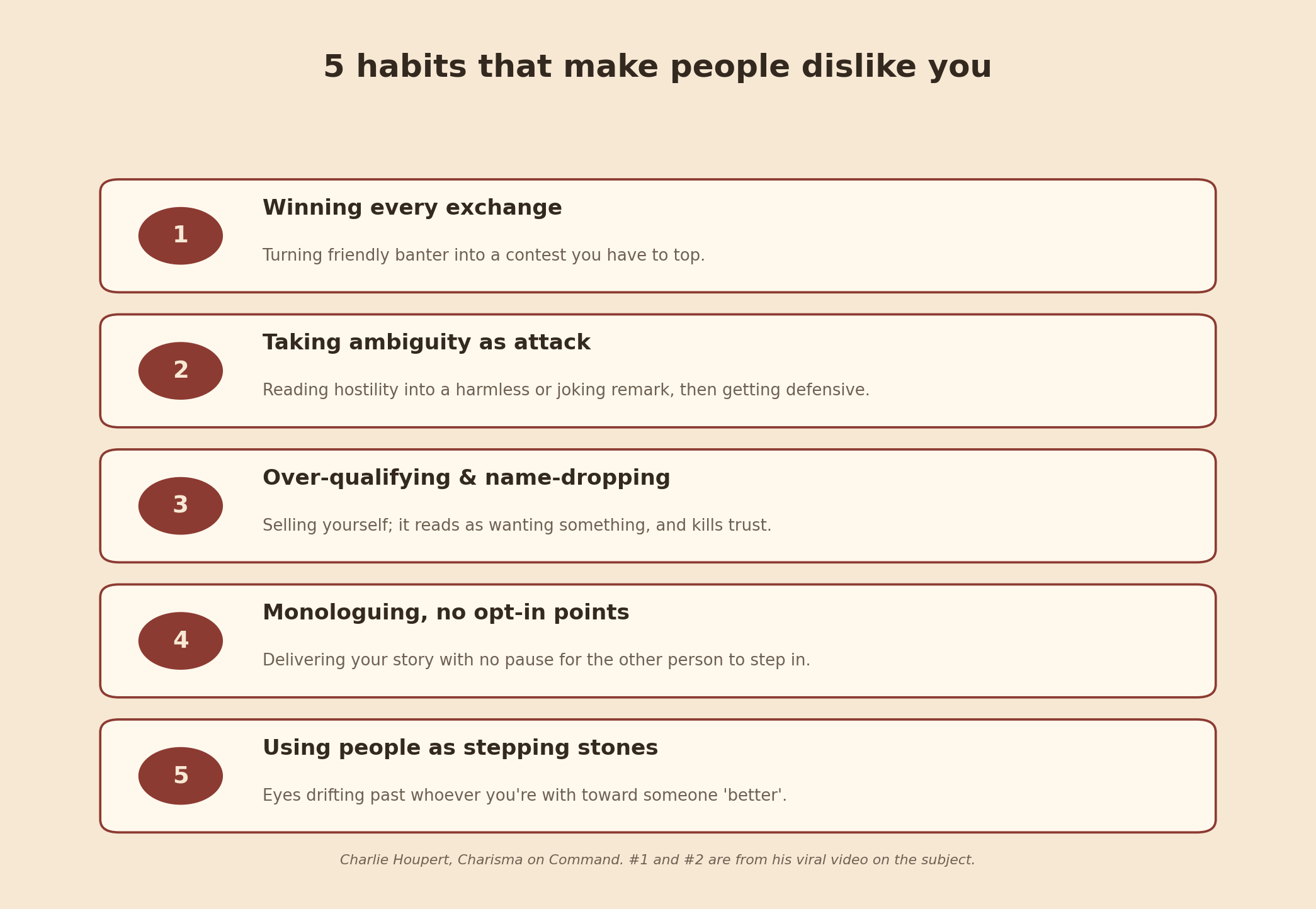
Five habits Houpert warns against, drawn from this conversation. The first two are the ones he details from his viral "5 Habits That Make People Instantly Dislike You" video.
The first is having to win every exchange. His example is a celebrity press tour where, asked playfully who the most powerful character was, she kept turning banter into a contest ("well, actually, my character would win"). Cute once, exhausting by the third time. Friends banter to connect, not to crown a victor. The second is taking ambiguous comments as attacks. Faced with a question that was probably a joke, the same celebrity snapped "is that a personal attack?" and did not laugh, reading hostility into something harmless. Houpert's rule is the opposite: interpret ambiguous communication charitably, the way the character Ted Lasso deflects a jab with warmth. Defending yourself against mere words, he adds, signals insecurity; the person who is genuinely comfortable just laughs and often "tags" the joke, piling on at their own expense. The third is over-qualifying, name-dropping, and selling yourself, which reads as trying to get something and quietly kills trust. The fourth is monologuing with no opt-in points, delivering your life story without ever pausing to let the other person step in; a few hooks and a breath keep it a conversation rather than a performance. The fifth is treating the person in front of you as a stepping stone, the eyes already drifting to someone more important or more attractive, which everyone feels even when they cannot name it.
Speak like a leader
Two of Houpert's most popular videos are about speaking like a leader, which he finds telling, people badly want this. His advice is less about polish than presence. Replace filler words, the ums and uhs, with silence, because silence is a vacuum and vacuums pull attention toward you; most people dramatically underestimate how much silence they are allowed. And fill your own space rather than invading anyone else's: get your elbows off your sides, gesture with your full wingspan instead of a cramped little box in front of your chest. You do not need to take up someone else's room, you need to occupy your own completely, and it reads as confidence.
Underneath all the technique sits one mindset he calls the essence of confidence: there are no superiors. Yes, status and hierarchy exist, but you are never dealing with a role or an investor or an avatar of beauty, you are dealing with a person, and the people they love most they love for the same ordinary human reasons you love your friends. Stop trying to convince people, he says, and start giving them invitations to connect.
When success distorts the people around you
A sober thread runs through the second half. As Houpert's channel grew, he was unprepared for how people adjust around power, how some who seemed to like him turned out to like what he could provide, withdrawing almost the instant he stepped back from running the business. He warns anyone gaining influence to develop a discernment he never needed in his twenties: the ability to tell who likes you from who likes your access. His own hard lesson was letting a single person become his sole eyes and ears inside his company, which let that person control the narrative in both directions for years, with some "fudging of the truth" and eventually outright lies. If there is doubt, he says, there is no doubt, and the guilt you feel about verifying someone is not a reason to skip it.
By twenty-eight he had built the life he had dreamed of at eighteen, the relationship, the money, the work, and watched it fall apart because these deeper things had gone unaddressed. In retrospect he calls it falling together. If a life is exhausting to hold together, he suggests, it was not real in the first place. He now runs his work by a question borrowed from a mentor: not how to build a business you can sell, but how you would run it if you could never sell it, which for him means cutting the toxic people, setting a pace you could keep for fifty years, and doing the work you actually love rather than the work that merely performs.
The thing underneath the charisma
Asked what most improved his wellbeing, Houpert goes somewhere unexpected and brave. Much of his early invisibility, he says, traced back to childhood sexual abuse he suffered around the age of ten, and to the way a child makes sense of such a thing by turning it inward: this was my fault, I must have wanted it. That buried shame leaked out sideways for years as perfectionism, approval-seeking, and a compulsion to rescue other people. Through therapy and, more recently, guided work, he was able to meet that shame directly and move through it, arriving somewhere he never expected, a genuine self-compassion, even love. He shares it, he says, because he knows others are somewhere on that same road, and he wants them to have the hope that it leads back to yourself. If any of this resonates with your own experience, it is worth knowing that support exists and that talking to someone is a strength, not a failure.
It reframes everything that came before. The tips, the hooks, the prey-versus-predator cues, are real and useful, but Houpert's arc is from charisma as something you perform to charisma as something you are once the shame is out of the way. The most connected moments in the whole conversation, he and Bartlett agree, were not the clever techniques but the two of them simply going there first and saying the real thing. Which is, in the end, the entire lesson: connection is a choice to be seen, and it is almost always available if one person is brave enough to add the one more sentence that matters.
Long talk short: Houpert's central claim is that charisma is learnable, a set of skills and mindsets, not a personality you are stuck with, and he is living proof, having gone from invisible to outgoing by running small social experiments. The highest-leverage moves are simple: add one more sentence to the small interactions you already have, lead with fun, trust, and respect in the first 60 seconds before showing your interest in someone, go there first by being the one to be real or vulnerable, and leave hooks in your answers so people can connect over what actually matters to you. Just as important is what to stop doing, the quiet habits that push people away, from needing to win every exchange to treating the person in front of you as a stepping stone. Underneath the tactics is the real lesson: connection is a choice to be seen, and most of us spend our lives undershooting it.
Further reading
- Charisma on Command, Charlie Houpert
- How to Win Friends and Influence People, Dale Carnegie
- Captivate, Vanessa Van Edwards
Affiliate links, a small commission supports the blog at no cost to you.