The Nod That Rewrites You: Chase Hughes's Quiet Trick for Changing Minds
Behavior profiler Chase Hughes says one casual remark can get you to nod, and quietly agree who you are. Here's how his "negative dissociation" and PCP model work, the research behind them, and where his best stories fail a fact-check.
Someone remarks how many people these days are closed off and locked into rigid beliefs. You nod, because it sounds true. According to behavior profiler Chase Hughes, that nod just committed you to being open-minded for the rest of the conversation.
Hughes tells Steven Bartlett that in a world of AI, the most valuable human skill is guiding other people's decisions. His toolkit is mostly classic social psychology with a sharper edge, and some of his best stories don't survive a fact-check. Here's the five-minute version, with both.
In short: Hughes argues that influence works by changing how people see a moment, then what they feel allowed to do, and above all who they agree they are. The identity and commitment ideas have real research behind them. The numbers, the hypnosis stories and the psychedelic metaphysics need a pinch of salt.
1. Perception, context, permission
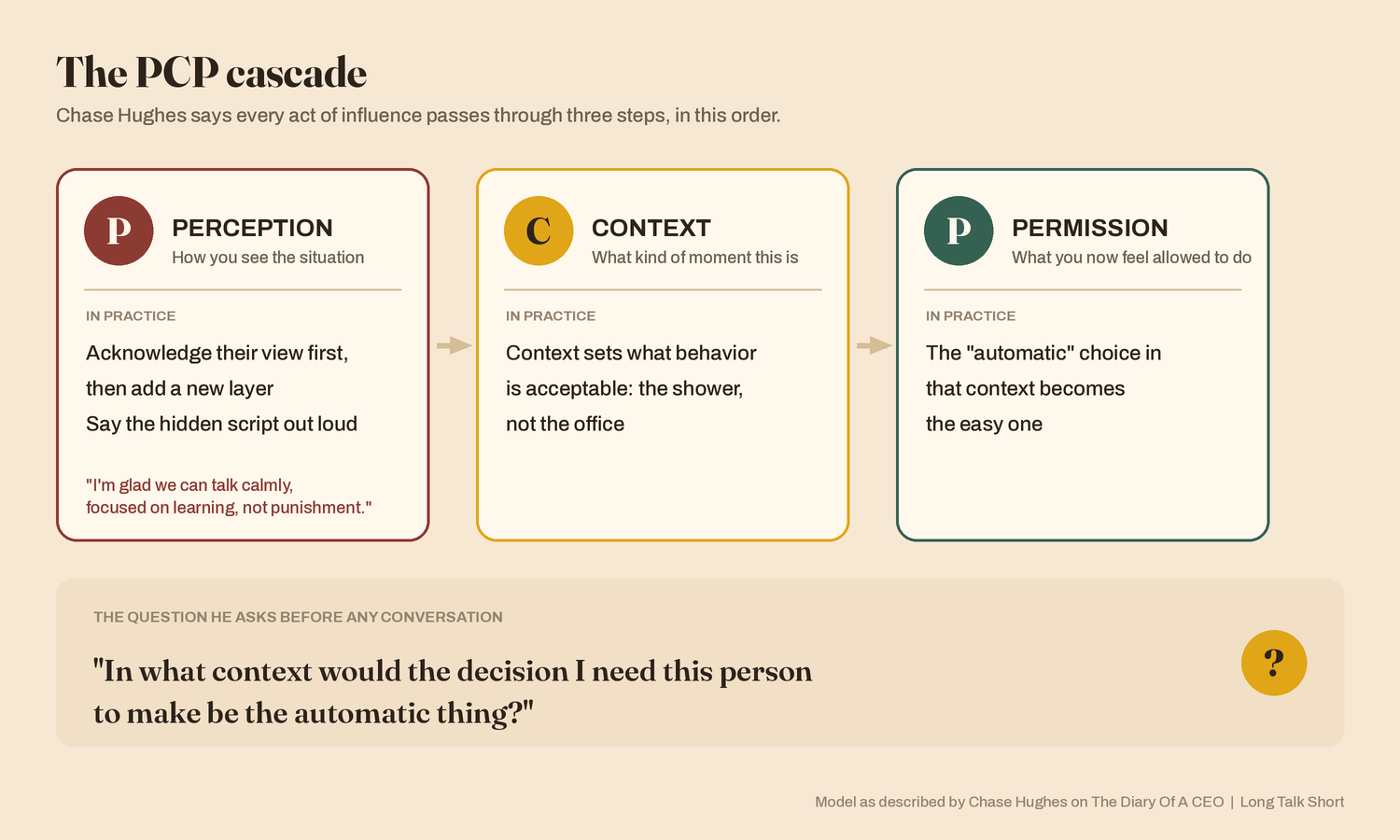
Hughes calls his PCP model the most important thing to understand about influence. It works as a cascade:
- Perception: change how someone views the situation. Acknowledge their view before offering yours, because language "should be resonating and not directing." Saying a hidden social script out loud, like the networking-event pressure to look professional, weakens it.
- Context: this sets what behavior is acceptable. Nearly everyone will get naked today, he notes, just not at the office.
- Permission: context grants it. His examples are dark: a hypnotized off-duty policeman who fired into a stage-show audience, and diners in the 1979 Manchester Woolworths fire who stayed in their seats.
The everyday version: set the frame aloud at the start, such as telling a child the talk is "focused on learning instead of punishment." Bartlett admits nobody set the frame in his recent Los Angeles meetings, so the talk drifted.
Hughes's test question: in what context would the decision you need be the automatic one?
2. Negative dissociation: the nod
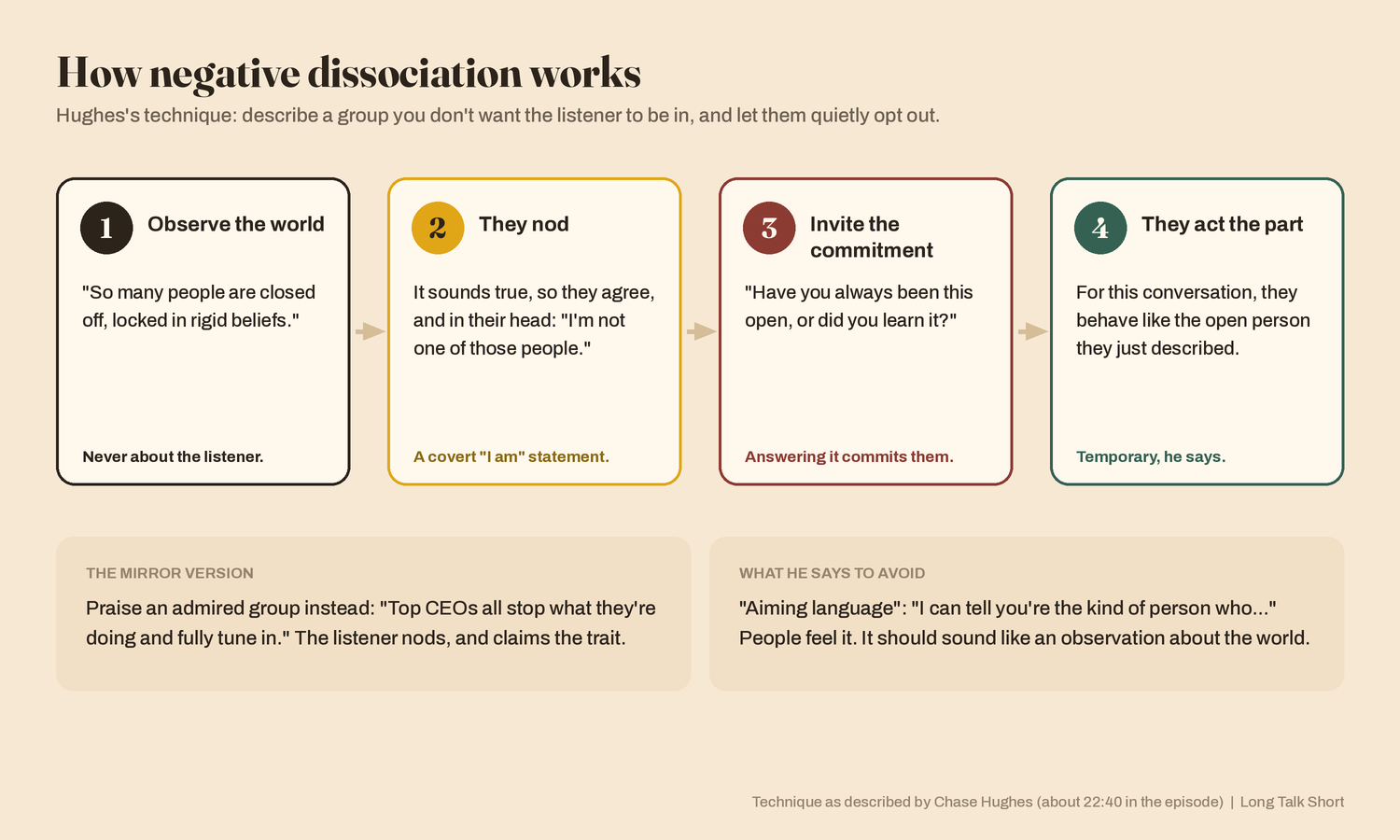
The episode's slyest trick comes at about 22:40, when Bartlett asks how to get guests and audiences to arrive open-minded. The move sounds like an observation about the world: you remark how many people are closed off, maybe because they fear what others will think. The listener nods. In doing so, Hughes says, they covertly agree "that they are not that person."
He calls this "hacking your way into that person's identity": you aren't getting agreement about how someone will act, but about who they are.
- Lock it in: a follow-up question, like whether they've always been this open, commits them to openness for the rest of the talk.
- It's temporary: Hughes stresses the change is limited to "one little compartment" of the interaction.
- The mirror version: praise an admired group, such as CEOs who tune in fully when others talk, so the listener claims the trait.
- What fails: "aiming language" like "I can tell you're the kind of person who..." because people feel it.
3. Identity is the lever
For Hughes, identity is "the number one thing" in persuasion. "I am the kind of person that goes to the gym" beats "I'm going to the gym tomorrow."
Influence, he says, builds two walls, anxiety and cognitive dissonance, with relief in the hallway between. An Olympian who woke up 295 pounds would race back into shape, he argues, because the body "is not me." So he has weight-loss clients put an app-generated photo of a heavier self on the fridge, since we move away from bad things before toward good ones.
Bartlett adds studies on pre-commitment: students who committed to spaced deadlines, bystanders who chased a thief after agreeing to watch a stranger's things, and savers who committed in advance.
4. Scripts written in a child's voice
Hughes's "childhood development triangle" asks what you had to do as a kid to make and keep friends, to feel safe, and to earn rewards. Those scripts, he says, get packed into a backpack and carried into adulthood.
The voice never goes away, so the fix is to hear it as a misguided child's. One client believed staying small kept him safe, so Hughes had him make a desktop wallpaper reading "My kids don't deserve for me to be successful," to show what the belief cost.
5. Micro-compliance and planted ideas
Stage hypnosis, Hughes says, starts with dozens of meaningless requests: hands out, flip them over, look up. That "micro-compliance" is how cults and social media rope people in, so use it on yourself through small, regular wins. Novelty grabs focus first, he adds, so even rearranging furniture can jolt a change.
His "most dangerous" skill is making people feel clever. Lay down two familiar pieces of information and never connect them, like a news teaser about a missing woman whose neighbors saw her arguing with her boyfriend. As a trial consultant, he seeds archetypes, scattering words like "giant" and "slingshot" until a jury finishes the David and Goliath story itself.
Late on he describes taking intravenous DMT for what he calls a brain disease. He ends on making people feel heard and seen, which he thinks AI can't replace.
Weighing it: what holds up
Solid ground: commitment and consistency are well studied. The "drive safe" yard-sign study Hughes credits via Robert Cialdini is Freedman and Fraser's 1966 foot-in-the-door experiment. Bartlett's studies hold up broadly: Ariely and Wertenbroch on deadlines, Moriarty's beach experiment (about 20 versus 95 percent), and Thaler and Benartzi's Save More Tomorrow plan, which committed future raises to savings.
Details off: in Freedman and Fraser, the first request was a small window sign, not a one-question survey. Compliance with the big sign was about 76 percent versus 17 percent, not 85 versus 1, and the study wasn't "double blinded." Identity framing has mixed support: a 2011 study found "being a voter" wording raised turnout, but a larger 2016 replication didn't.
Untested: negative dissociation is Hughes's own term, and no published research appears to test it under that name. It plausibly borrows from self-perception and consistency, and his claim is modest: a temporary nudge in one conversation. It is also covert by design, pitched half-joking as a way to "manipulate" a guest.
Stories that don't check out: the hypnotized policeman wasn't a 1957 comedy show. As Bartlett found, papers including The New York Times reported it in December 1923 from Šibenik, in present-day Croatia. It's a single old news report, and research doesn't show hypnosis can make people do anything. Woolworths diners were reported reluctant to leave, but the restaurant was on the second floor, where the fire started, not by an open door. Milgram gave no real shocks, and later analyses suggest many subjects doubted the setup. Brain-scan studies of decisions forming before awareness predicted simple choices only modestly above chance, and what they mean is still debated.
Shakier still: his childhood triangle is a coaching framework, not a validated measure. The fridge photo and the wallpaper run on shame, and research links weight stigma to more weight gain, not less. Early psychedelic trials for depression and PTSD are promising, but we found no Johns Hopkins finding that they are the most effective drug ever tested. Ibogaine carries serious heart risks, and claims that DMT researchers don't see it as a hallucination, or that physics is proving hermetic principles, go well beyond the evidence.
Disclosure: Hughes promotes his NCI University and describes himself as the only trial consultant offering a 200 percent money-back guarantee.
Long Talk Short
- Set the frame out loud at the start of a meeting, an argument or a talk with your kids.
- Acknowledge someone's view before you offer a new one: resonate, then guide.
- Identity beats intention. "I'm the kind of person who..." is a stronger commitment than "I'll try."
- Learn to spot negative dissociation and planted pairs of facts, in the news and in sales pitches as much as in your own talk.
- Ask what you did as a kid to make friends, feel safe and earn rewards, and notice where those scripts still run.
- Use small, regular wins to build momentum, but be wary of shame as fuel.
The one thing to remember: people defend who they've agreed they are. That makes identity your best tool for changing yourself, and the first thing to guard the next time you catch yourself nodding along.
Source: The Diary Of A CEO with Steven Bartlett, "Chase Hughes: The 3 'Dark Psychology' Tricks To Read Anyone's Mind!". This is an independent summary of that episode and is not affiliated with the show.
This article is for general information only and is not mental-health, medical, psychological, legal or financial advice. Psychedelics carry real medical and legal risks. If you are struggling, please talk to a qualified professional.