Make It Safe to Be Wrong: 17 Rules for Winning Arguments Without Being Right
Facts rarely win arguments. Chase Hughes's 17 rules do the opposite: slow down, meet the feeling, skip the verdict, and leave the other person a dignified way to change their mind.
Stop trying to win the argument. You'll start winning more of them.
Behaviour consultant Chase Hughes has seventeen rules for arguing, and none of them is about being right. They're all about one thing: making it cheap for the other person to change their mind.
His opening line is a provocation:
If you argue with facts, you already lost.
In short: stop arguing the facts, slow everything down, meet the feeling, and leave the other person a way out.
Hughes gives his rules as one rapid list. We've sorted them into four groups; the grouping is ours.
1. Hear them before you answer
- "Never correct first." Instead, ask how they arrived at the idea. That turns a position to defend into a story to tell, and people rarely feel attacked while telling their own story.
- "Repeat their point better than they can." Proving you understood removes their main reason to keep pushing.
- "Ask for clarification at the peak of emotion." When someone is most heated, a sincere question invites them to explain instead of escalate.
Listening is half of it. The other half is the pace of the room.
2. Slow the room down
Four rules are about tempo, not content:
- "Lower your voice when they escalate."
- "Slow your pace down when they speed up."
- Wait two seconds longer than feels normal after they finish talking.
- "Mirror their last five words and then just pause."
Each one refuses to match their intensity. The silence usually gets filled by them, often with the softer reasoning behind their claim.
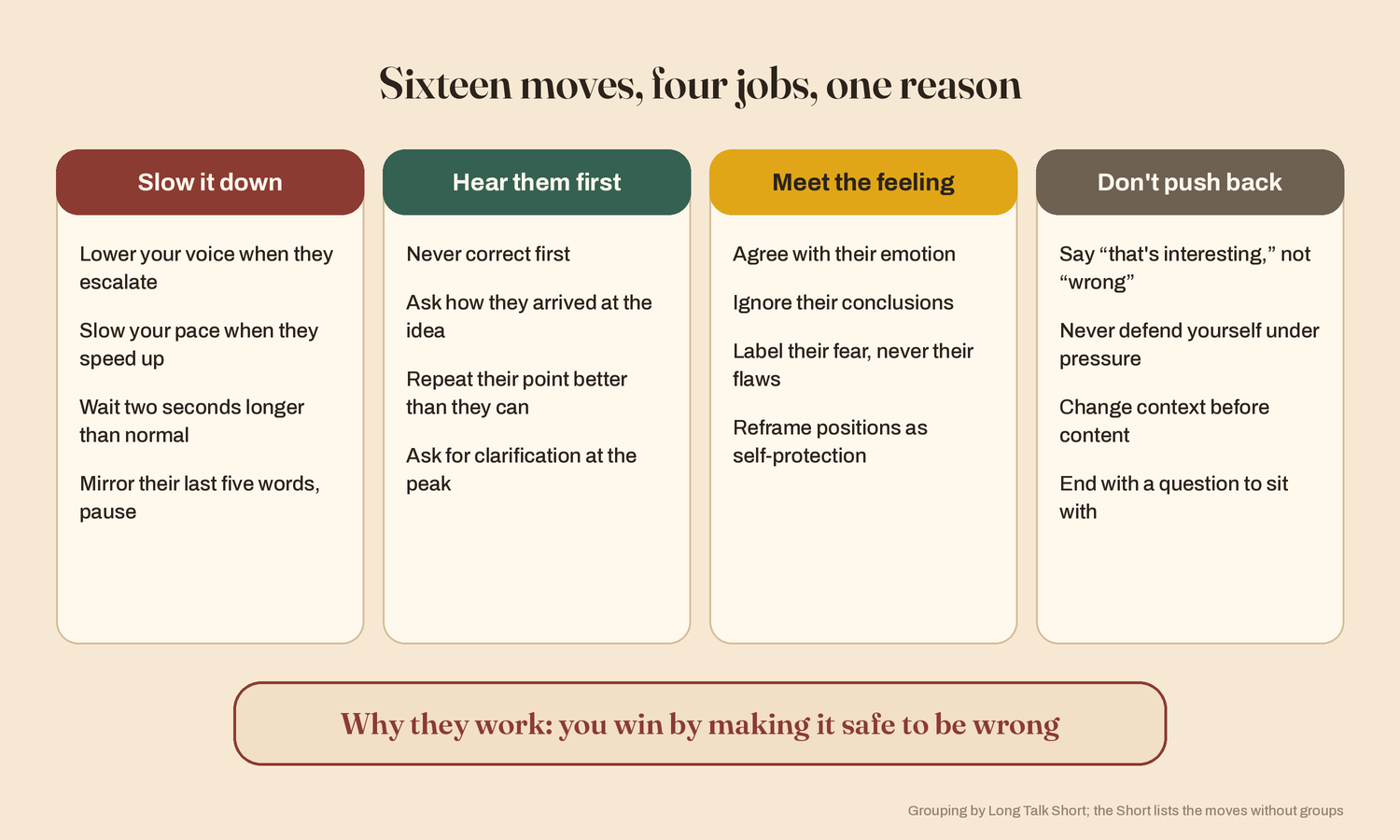
3. Meet the feeling, not the verdict
This is the heart of the list:
Agree with their emotion and always completely ignore their conclusions.
You can honestly say "I get why that worries you" without accepting the claim that came with it.
- "Label their fear and never their flaws." "It sounds like you're worried this costs you your job" names something they can agree with. "You're being paranoid" names something they have to fight.
- Reframe their positions as self-protection. Treat a stubborn view as a way of staying safe, not as stupidity, and you can answer the need underneath.
4. Take away the fight
- "Never say, 'That's wrong.' Say, 'That's interesting.'"
- "Never defend yourself under pressure." Both deny them an opponent.
- "Change context before content." Fix the setting and mood before the substance. Hughes doesn't explain this one further.
- "Ask questions that you already know the answer to." In context it sounds like letting them reach the point themselves, not a trap, though he doesn't say which he means.
- End with a question they have to sit with. The change of mind happens later, in private, where nobody loses face.
So why do all seventeen work? Hughes gives one answer.
The one reason behind all of it
All of these work for the exact same reason. You don't win arguments by being right. You win by making it safe to be wrong.
Every rule either lowers the threat in the room or gives the other person a dignified way to move. "Win" doesn't mean beating them. It means they change their position.
Weighing it: what holds up
Rules, not evidence. Hughes cites no studies, and most of this is practitioner advice. Two rules were checked.
Labeling has modest support. A 2007 UCLA fMRI study by Matthew Lieberman and colleagues (Psychological Science, 30 participants) found that naming the emotion on a face reduced amygdala response. Lieberman said the effects are "likely to be modest," and the study covered labeling your own perceptions, not someone else's fear in an argument.
"Five words" is his variation. Former FBI negotiator Chris Voss's well-known version repeats the last one to three words with a questioning tone, then pauses.
"Facts lose" overstates it (context added by Long Talk Short, not checked this session). Research since the late 2010s suggests corrections often do shift beliefs, and the "backfire effect" is rarer than once thought. Read his line as: facts alone, delivered as an attack, lose.
The ethics depend on the goal. The same moves that calm a partner can steer someone. Used to actually understand a person, they're simply good listening.
Related reading: for Hughes's full persuasion playbook, see Whoever Frames the Room Wins.
Long Talk Short
- Ask how they arrived at the idea before you correct anything.
- Lower your voice, slow down, and wait two seconds longer than feels normal.
- Agree with the emotion, leave the conclusion alone; label their fear, never their flaws.
- Swap "that's wrong" for "that's interesting," and don't defend yourself under pressure.
- End on a question they have to sit with.
The one thing to remember: you don't win arguments by being right. You win by making it safe to be wrong.
Source: Chase Hughes, "How to Win Every Argument Forever", YouTube Short, January 13, 2026. This is an independent summary and is not affiliated with Chase Hughes.
This summary is for information only. Quotes are taken from auto-captions and may contain small transcription errors.