Two Steps Ahead: Colin Camerer on Why You're Only About 75% Rational
Caltech's Colin Camerer tells Sean Carroll why people are only about 75% rational: we reason a step or two ahead of others, run on habit, and price the future in brain circuits that wording can bend. His studies, checked.
You probably think of yourself as a rational person who makes the odd mistake. Colin Camerer puts a rough number on it: about 75% rational. Camerer, a behavioral economist and neuroscientist at Caltech, said it half in jest on Sean Carroll's Mindscape podcast, then spent the episode explaining where the other quarter goes. You think only a step or two ahead of other people. You run on habit more than you plan.
In short: Camerer treats perfect rationality as a limiting case, like a frictionless surface in physics: useful, but never quite real. Real people reason a limited number of steps about others, switch between autopilot and deliberate choice, and value things in brain circuits that respond to framing and to how vividly they picture the future.
1. Rationality is the frictionless plane
Camerer doesn't throw out the economist's perfectly rational chooser. He calls it a "limiting case": a clean idealization you can reason from, as long as you remember that real surfaces have friction.
One kind of friction is framing. He points to work involving his colleague Eric Johnson. Ask people how likely they are to live to 85, or how likely they are to die by 85, and the answers imply life expectancies years apart, though logically it's the same question. If an estimate bends with wording, so can your pension and insurance choices. So how far ahead do people actually think when other people are involved?
2. Most people stop after a step or two
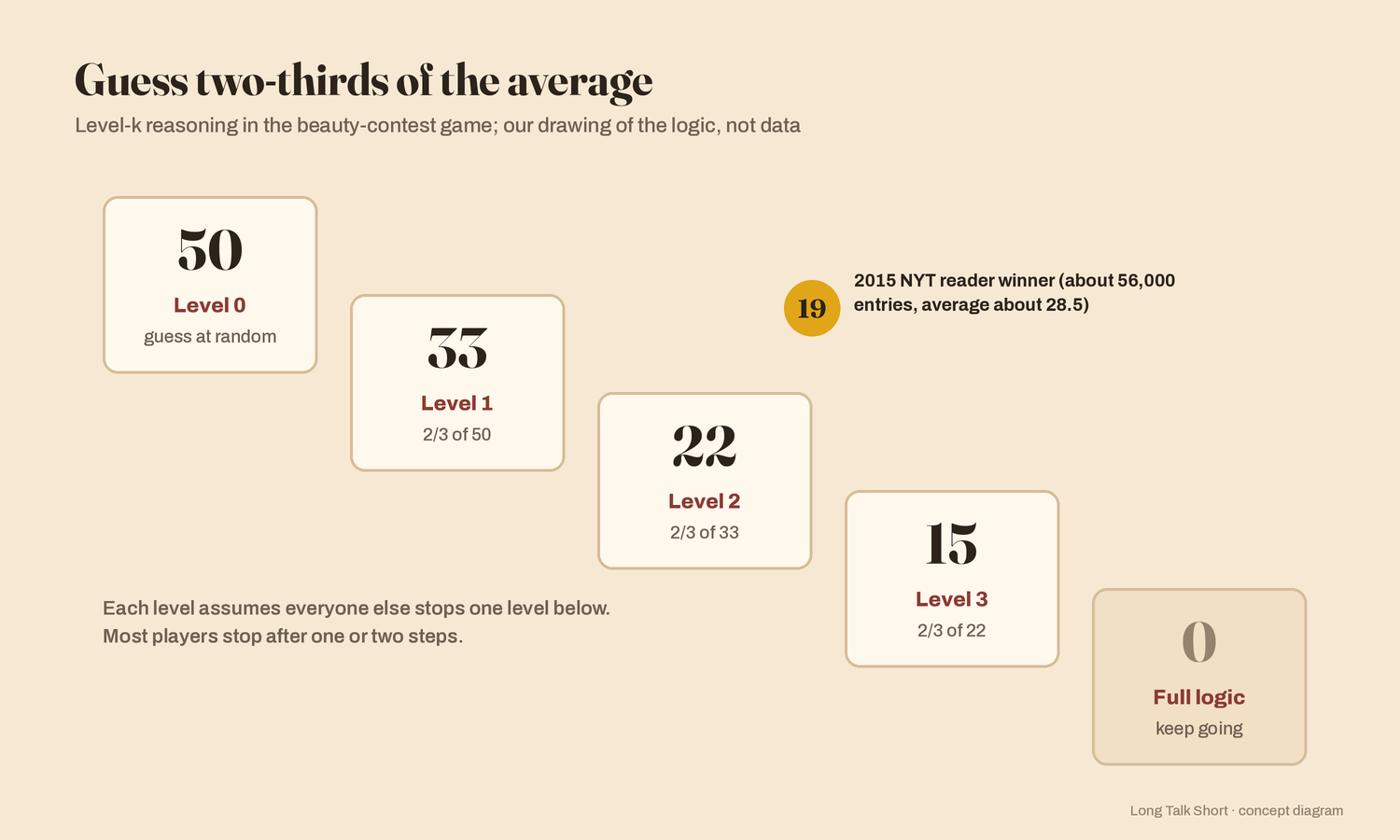
His signature tool is the "beauty contest" game. Everyone picks a number from 0 to 100, and the winner is whoever comes closest to two-thirds of the average. Perfectly rational players would reason all the way down to zero. Nobody plays that way, and if you pick zero you lose. When The New York Times ran the game for readers in 2015, the winning number was 19.
Camerer's explanation is a ladder of reasoning, known as level-k or cognitive hierarchy thinking. A "level 0" player picks roughly at random, averaging around 50. A level 1 player best-responds to that and picks about 33. Level 2 assumes everyone else is level 1 and picks about 22. In his telling, most people stop at level 1 or 2, and the best answer is exactly one step ahead of the real crowd, not of an imaginary perfect one.
The same limited reasoning shows up outside the lab. Studios sometimes refuse to show a film to critics before release, a "cold opening". A fully strategic moviegoer would read missing reviews as a warning. In a study Camerer co-wrote with Alexander Brown and Dan Lovallo, cold-opened films did better at the box office than comparable films, which suggests many viewers didn't make that inference. He also cites the Cognitive Reflection Test, whose trick questions catch students at elite universities too.
3. Your brain has a circuit for other minds
When people play these games in a brain scanner, thinking about what others will think recruits what Camerer calls the mentalizing network, including the temporoparietal junction and the dorsomedial prefrontal cortex.
He is cool on the popular split between fast "System 1" and slow "System 2" thinking. He once asked Daniel Kahneman whether neuroscientists had found a clean dissociation between the two. In his view the labels are a useful list of traits, not two boxes in the brain. If there aren't two selves at war, what is willpower?
4. Self-control is a pricing problem
Camerer frames willpower as valuation. In a 2009 study he co-wrote with Todd Hare and Antonio Rangel, dieters chose between foods in a scanner. In those who showed self-control, a valuation region, the ventromedial prefrontal cortex, weighed health as well as taste, and a region linked to control, the dorsolateral prefrontal cortex, was more active.
Other researchers found that imagining a specific future event made people more willing to wait for a larger reward. The practical reading: if you want to be patient, make the future concrete enough to compete with the present.
5. Habits run on autopilot
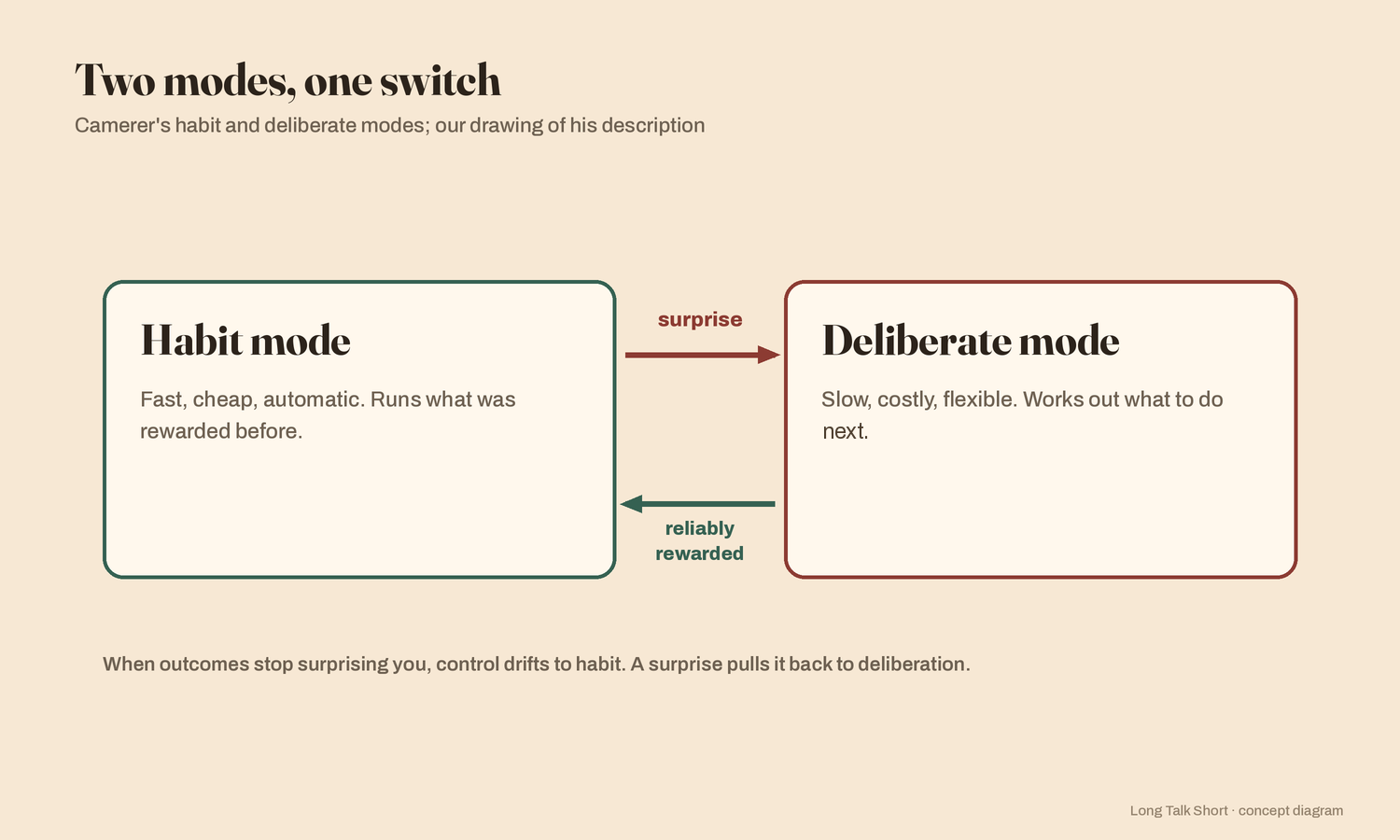
His work on habit treats it as a mode you slip into. In gym check-in data, attendance comes in streaks and long gaps rather than at an even pace. Camerer's "neural autopilot" model says you stay in habit mode while the habitual choice keeps paying off, and switch to deliberate choice when something surprises you.
A 2023 study he co-wrote, led by Anastasia Buyalskaya, found that the best predictor of a gym visit was how short the gap was to your previous visit, and that there's no magic number of days to form a habit.
Weighing it: what holds up
Framing: The episode delivers what its framing promises, though much of it is behavioral game theory with no brain data attached. The two-step summary in our headline is our framing of his argument.
Holds up: The Times's 2015 game drew about 56,000 entries, with an average guess of about 28.5, making 19 the winning number. In Shane Frederick's 2005 paper, MIT students averaged 2.18 of 3 on the Cognitive Reflection Test, and Harvard students averaged 1.43, below a crowd at Boston's Independence Day fireworks (1.53). The samples were small. The cold-opening study (Brown, Camerer and Lovallo, 2012) covered 1,303 films and found roughly 10% to 30% higher domestic box office. The live-to/die-by study (Payne, Johnson and colleagues, 2013) found life-expectancy estimates 7 to 9 years apart. We also confirmed the 2009 dieter study in Science (37 dieters) and the 2023 gym study in PNAS: 12 million check-ins from about 60,000 members, with gym habits taking roughly two to three months to become predictable.
Partly holds: "75% rational" is a quip, not a measurement. Level-k thinking fits many lab games well, but people's levels shift from game to game, so "you're a level-2 thinker" isn't a fixed trait. The cold-opening authors caution that selection could explain part of the box-office gap.
Corrections: his recollection of the MIT test score ran slightly high; nothing else needed correcting.
Not checked: the rodent lesion and optogenetic studies he describes, the claim that replaying cues during sleep raised the value of snacks by about 10%, the claim that brain stimulation over the temporoparietal junction made people more generous, and the power-law figures for gym streaks. Treat them as early results reported by one researcher.
Disclosures: We worked from YouTube's automatic captions, so quotes may contain small errors. Camerer co-wrote the movie, dieter and gym studies he describes, so he's presenting his own work, and we checked them against the papers. The episode carries sponsor reads, including one for Amazon.
Bottom line: the core findings are real and replicated in the papers we checked.
Related reading: Why nice players finish first in the prisoner's dilemma · Bill Benter on the math of beating the odds
Long Talk Short
- Perfect rationality is a reference point, like a frictionless plane, not a description of you.
- Wording changes answers: "live to 85" and "die by 85" produce estimates years apart.
- In strategic situations, aim one step ahead of the real crowd, not of an imaginary perfect one.
- Willpower works partly by changing what you value; picturing the future concretely helps.
- Habits form on their own clock. Expect months, not a fixed 21 days.
The one thing to remember: before you try to outthink everyone, ask how many steps they're actually taking.
This summary is general information about research, not financial or investment advice.
Source: Sean Carroll with Colin Camerer, Mindscape episode 373 on the neuroscience of economic thinking, on YouTube. This is an independent summary and is not affiliated with Sean Carroll, Mindscape, Colin Camerer or Caltech.