Power Without a Vote: How Robert Moses Ran New York Unelected, and How LBJ Built the Senate's Top Job
Robert Moses ran New York for 30 years without an election, by drafting the laws, locking powers into bonds and making himself too useful to fire. Dwarkesh Patel sets that beside LBJ. We check the figures.
For more than 30 years, the most powerful person in New York was someone nobody had voted for.
Robert Moses built the Triborough and Verrazzano bridges, Jones Beach, the Cross Bronx Expressway and hundreds of parks and pools. In a video essay made ahead of his interview with biographer Robert Caro, Dwarkesh Patel pulls out how Moses did it. He then turns to a second Caro subject, Lyndon Johnson, who took the Senate's weakest leadership post and made it the second most powerful job in America.
In short: neither man relied on a big title. Moses wrote the rules, locked them into bond contracts and made himself too useful to fire. Johnson collected every source of leverage, controlled the agenda and brokered every deal himself.
1. Moses: write the rules, then make them permanent
Moses was known as "the best bill drafter in Albany," and Patel argues that was the root of his power.
Public authorities were supposed to be temporary. One would sell bonds for a bridge, collect tolls until the bonds were paid off, then hand the bridge to the city and shut down. But in the 1933 act creating the Triborough Bridge Authority, Moses had slipped in a sentence letting it pay off old bonds with new ones, "for any other corporate purpose." Every time the bonds were about to run out, they could be rolled into fresh 40-year debt for something else.
Other clauses let the authority build "facilities not inconsistent with the use of the project." Read creatively, that covered almost any road or park connected, however indirectly, to a bridge. And the toll money was huge: in 1946, Patel says, the entire city government could borrow $150 million before hitting its debt limit, while Triborough could borrow $360 million.
The masterstroke was legal. The US Constitution bars states from passing laws that impair contracts, and a bond is a contract. Moses had his powers, including the right to set tolls and keep the surplus, written into the bond covenants. Once those bonds were sold, no mayor, governor or legislature could take the powers back, and refinancing kept extending them.
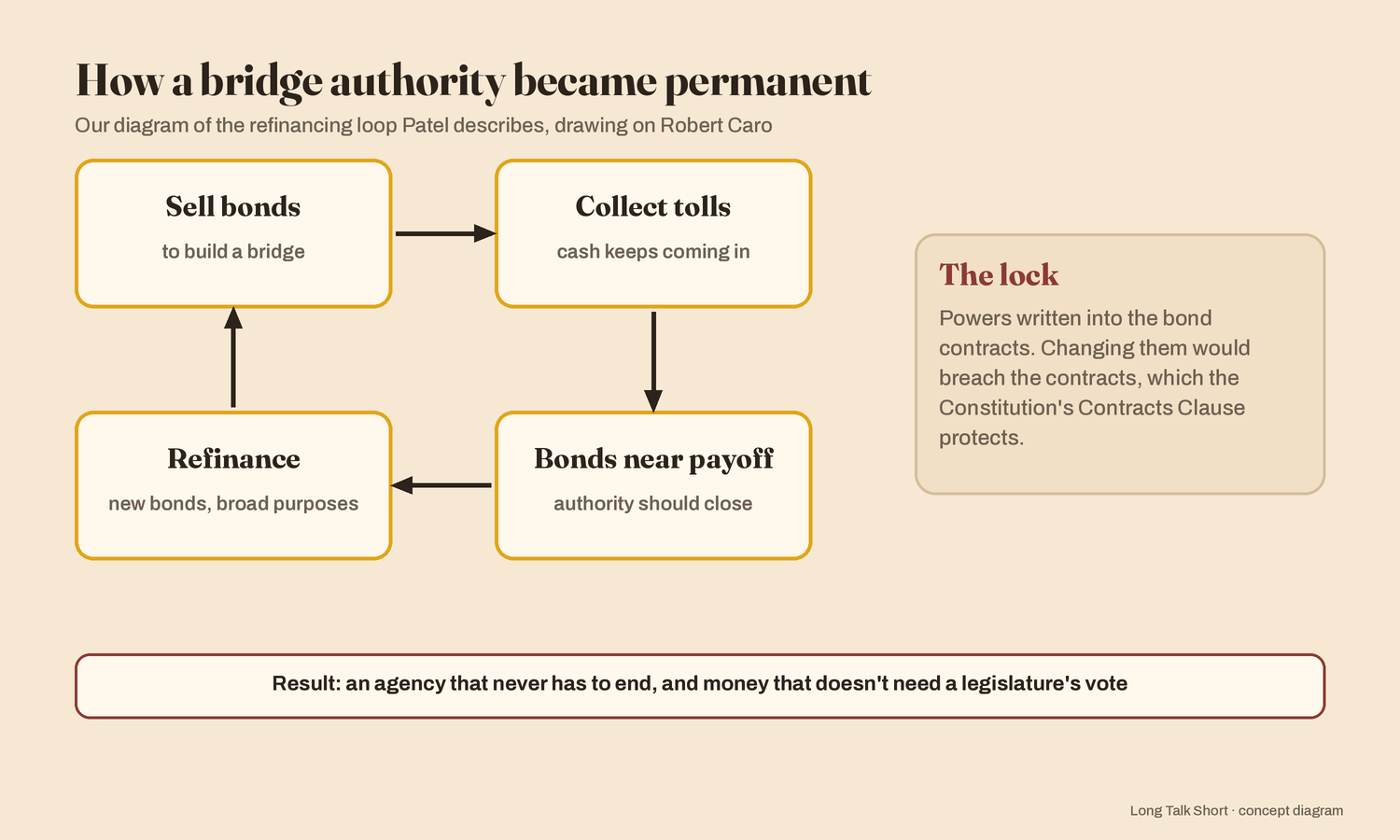
Locking in the powers was one thing. Keeping the job was another.
2. Too useful, too popular, too connected to fire
- Hard to remove. Commissioners could be removed midterm only on "stated charges after a formal hearing," and Moses gave nobody grounds: Caro calls him "money honest." At his peak he held 12 posts at once, some appointed by the mayor and some by the governor, so no single official could remove him from all of them.
- Popular and fast. In the 1930s and 1940s, Patel says, New York high schools voted Moses the most admired New Yorker. In his first four months as parks commissioner he finished 1,700 park renovations. He could finish projects within one election cycle, so a mayor could cut the ribbon before facing voters. Compare the Second Avenue Subway: work began in 1972, and the first two miles opened in 2017 at a cost of $4.5 billion.
- Plans ready. His team of planners and engineers was the biggest around, so by 1936 New York was getting one-seventh of the nation's federal work-relief money, spent on projects he chose.
- Constant leverage. He threatened to resign so often that Mayor La Guardia's lawyer had forms printed for him.
Patel's sharpest framing is that Moses built a pro-building faction, a "YIMBY" machine. Banks bought his bonds at a discount without competitive bidding, unions got jobs, connected lawyers got fees and party bosses got insurance commissions. All of them had a reason to defend his projects.
Caro's verdict: Moses began as a good-government idealist who learned that ideals are useless without power. Then the power took over.
It is a drug that creates in the user a need for larger and larger doses, and Moses was a user.
3. Johnson: turn an empty title into the second-biggest job
Johnson ran the other way. Caro shows him as an opportunist who moulded himself to the Senate's Southern conservatives, and who used power for civil rights only once he had it.
When Johnson asked the Library of Congress what formal powers the majority leader had, Patel says, the answer was one: the right to be recognised first. He got the party's top job at 44 partly because nobody else wanted it. Patel identifies three tactics:
- Leverage. Johnson made himself the person who could schedule a bill, reach House Speaker Sam Rayburn, find Texas oil money for a campaign and, above all, hand out committee seats. In 1957, after Estes Kefauver crossed him, a coveted Foreign Relations seat went to the more junior John F. Kennedy.
- The agenda. He made unanimous consent agreements the norm, so bills reached the floor with debate and amendments already limited and votes settled beforehand. In Senator Paul Douglas's words, "all the action takes place offstage before the play begins."
- Brokering. Information flowed to him, so he could stitch unrelated wants together. To pass the 1957 Civil Rights Act, he packaged a federal dam vote for Western senators, jury trials for striking workers for Midwestern Republicans, and a guarantee that Black citizens could serve on federal juries for moderates. Southerners kept the jury-trial clause that kept the bill weak enough not to filibuster.
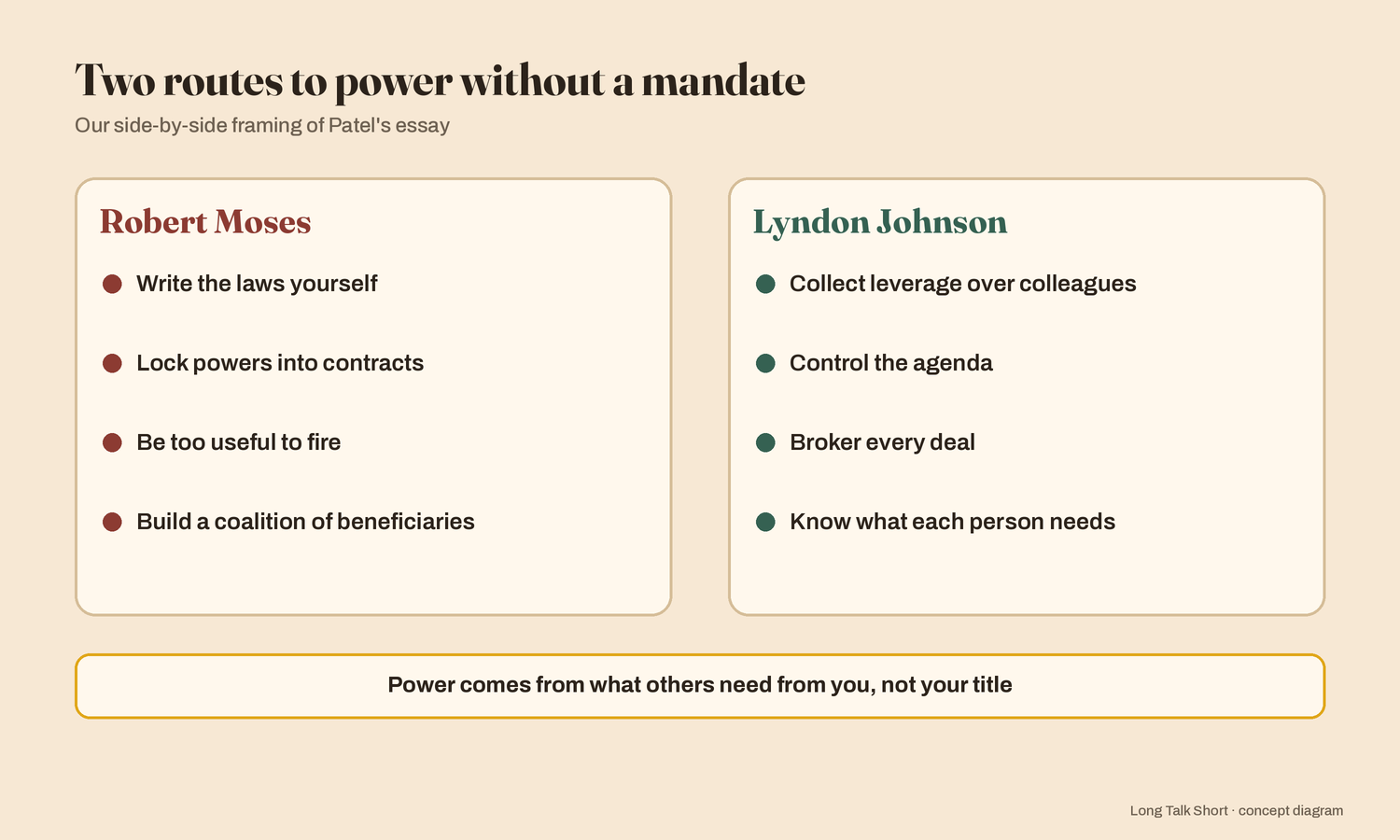
Weighing it: what holds up
A transposed figure: Patel says Moses built 672 of the 899 miles of highway completed "in New York State by 1964." In Caro's account, as widely quoted, it's 627 miles of urban expressways in the New York metropolitan region, with most of the remaining 272 miles in New Jersey. The essay appears to swap the digits and mislabel the area.
Confirmed:
- The one-seventh share of 1936 federal work-relief money matches New Deal histories.
- The $150 million city debt limit against Triborough's $360 million matches summaries of Caro.
- Second Avenue Subway: construction began in 1972 and stopped in 1975; Phase 1 opened on 1 January 2017 at about $4.45 billion.
- Johnson became Democratic leader in 1953 at 44. His two predecessors, Scott Lucas and Ernest McFarland, both lost their seats.
Not traced separately: the pre-printed resignation forms, the 1,700 renovations, the high-school polls, the Kefauver seat and the Library of Congress list. They're only as good as Caro's sourcing, which is famously deep but not beyond dispute.
Opinion: Patel's view that New York's 1970s decline owed more to national forces than to Moses, since Detroit and St. Louis fell further, pushes back against the subtitle of The Power Broker.
Long Talk Short
- Moses held power for decades without being elected, by drafting the laws that governed him.
- Refinancing "for any other corporate purpose," plus powers written into bond contracts, made his authority self-renewing and legally hard to touch.
- Speed, popularity, ready-made plans, press allies and a coalition of beneficiaries made firing him unthinkable.
- Johnson turned a post with one formal power into a command centre through leverage, agenda control and deal-brokering.
The one thing to remember: power rarely sits in the job title. It sits in the rules you write, what others need from you and the deals that run through you.
Source: "How an unelected man ruled New York for 30 years", a video essay by Dwarkesh Patel, also published as "What I learned about power from LBJ and Robert Moses" on the Dwarkesh Podcast. This is an independent summary and is not affiliated with Dwarkesh Patel or Robert Caro.
Quotes are taken from automatic captions and lightly cleaned.