Make Room Before You Add More: Ed Mylett on Why Real Change Starts by Taking Things Away
The man famous for "one more" now says most of us need less. Ed Mylett on why worry is caught, how your inner thermostat pulls you back, and why change starts with subtraction.
You probably don't need another goal. You need less.
That's the surprising message from Ed Mylett, the man known for "one more": one more call, one more rep, one more try.
In his first interview in almost two years, on The Mel Robbins Podcast, Mylett, after his father's death and two cardiac events of his own, argues that most people don't need to add anything. They need to clear space.
In short: worry is learned, your life drifts back to an inner "thermostat" setting, and change starts with subtraction: write down what you want and what you fear, cut what no longer fits, then add one deliberate thing.
The conversation is billed as "5 shifts," but he never lists five. The five below are our grouping.
1. Subtract before you add
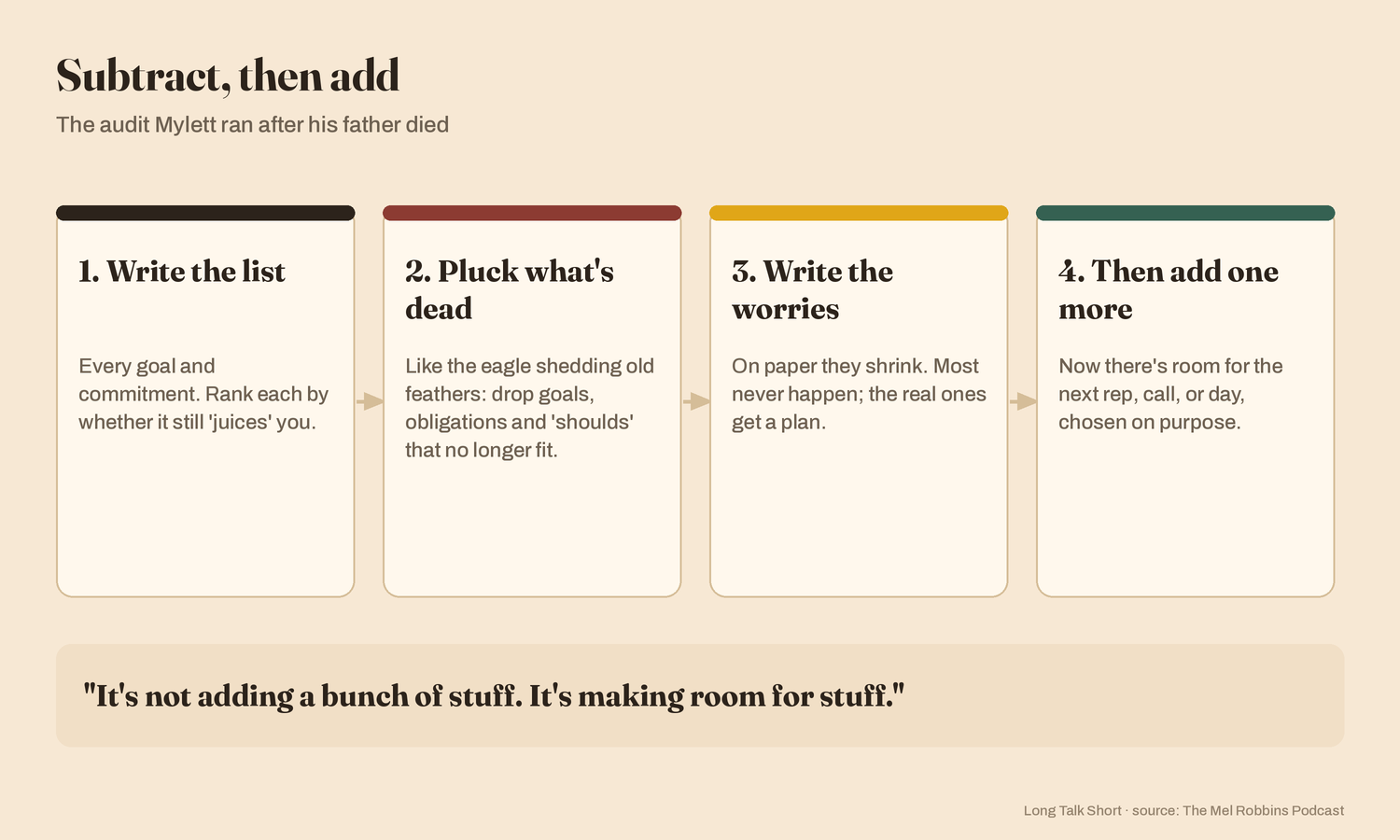
When his father died, it struck Mylett that you are not your possessions, your fears or your worries, because none of them come with you. So he did an audit:
- He wrote down everything he thought he wanted and ranked each item by whether it still "juiced" him. Many didn't.
- Then he wrote down what he was afraid of, and on paper those fears lost much of their power.
His image is a pair of bald eagles, Fred and Wilma, on an island he bought. When Fred died, a bird-sanctuary worker warned that Wilma would probably go soon too. Instead, weeks later, he heard her banging against the rocks, plucking out feathers that no longer served her. About six months later she was flying again, fully feathered.
It wasn't adding stuff. It was eliminating stuff.
Success, he now thinks, "is making room for stuff."
The first thing he'd have you subtract? The habit he carried most of his life.
2. Worry is a habit you caught
Mylett says he worried most of his life, and he thinks worry is "caught, not taught": children pick it up from the adults around them. His case against it is practical:
- Most of what you worry about never happens.
- When you worry, you live through the bad event many times instead of once.
His fix costs nothing: take out a sheet of paper, write down everything keeping you awake, and "notice how dumb half of it is."
But why do we drift back to worrying even after we know better?
3. Reset your inner thermostat
This is the idea Mel Robbins says she's hearing for the first time. If a room is set to 75 degrees, a hot day doesn't change it; the air conditioning kicks on and pulls it back. Mylett says we have settings like that for love, money, fitness and peace. Run hotter than we believe we deserve, and we find a way to cool down. Run colder, and we warm back up to the old number.
His own peace setting was about 50 degrees for most of his life. Calm felt unfamiliar, so he kept finding reasons to worry. Most people, he adds, run on five or six dominant emotions and return to them not because they feel good but because they feel familiar.
Changing the setting means changing what you believe you're worth, and the biggest influence is who you spend time with:
I will not shrink myself for your acceptance.

4. One more, for someone else
The emotional heart of the conversation is his father's drinking. His dad tried to get sober many times. What finally worked was "one more time" tied to love: the thought that his son deserved a dad he could be proud of. It became "one more day at a time," and he never drank again.
The man who helped him, also named Ed, had been sober only 31 days. Mylett's takeaway: you're most qualified to help the person you used to be. He says his father went on to help around 4,000 people.
From a beach conversation with the late Wayne Dyer comes a related idea: get your confidence from your intentions, not your ability. And when you feel most helpless, Mylett adds, become most helpful.
5. Start before you're ready
His daily "catalyst" is simple: move his body early, then within a minute of sitting down start writing, in the same spot, for about half an hour. He writes to one specific person, such as Griselda, an airport cleaner he noticed during a flight delay whom nobody seemed to acknowledge. He calls it the shift from "here I am" to "there you are."
He also tells of his sister's newborn twin son, who died about an hour after birth, as a reminder that you never know when the last time is. His closing words to listeners: the people who believed in you "were right about you. Make them proud."
Weighing it: what holds up
The worry claim is directionally right, but the number is often inflated. The "most worries never happen" line usually traces to a 2020 Behavior Therapy study by LaFreniere and Newman. Among 29 people with generalized anxiety disorder who logged worries for a month, 91.4% of predicted outcomes didn't come true, and about 30% of those that did turned out better than expected. Striking, but from a small clinical sample, and not the 99% often quoted.
Writing it down has support, in a narrow setting. In a 2011 Science study, Ramirez and Beilock found students who wrote about their worries for 10 minutes before a high-stakes exam performed better, especially those prone to test anxiety. That's not proof the method works for life in general.
The thermostat isn't new. Self-image as a thermostat is the central metaphor of Maxwell Maltz's 1960 book Psycho-Cybernetics. Useful, but a metaphor, not a measured mechanism.
Unverified: the eagle story and the 4,000 figure are Mylett's own accounts. Wayne Dyer's The Power of Intention (2004) had sold about a million copies by 2007, according to his publisher.
If worry has become constant or is getting in the way of sleep, work or relationships, talk to a doctor or a licensed therapist. In the US, you can call or text 988 at any hour if you're in crisis.
Long Talk Short
- Before adding a goal, audit: list what you want, keep what still "juices" you, drop the rest.
- Write your worries down. Seeing them on paper shrinks many of them, and there's some evidence behind it.
- Your life returns to your inner set point. Change what you believe you deserve, and watch the company you keep.
- Tie the next hard rep to someone you love; that's what finally got his father sober.
- You're most qualified to help the person you used to be.
The one thing to remember: lasting change usually starts by taking something away.
Source: Ed Mylett on The Mel Robbins Podcast. This is an independent summary and is not affiliated with the show or Ed Mylett.
This summary is for general information and is not medical or psychological advice.