The Case Too Small to Take: Why No Lawyer Wants Your Small Claim, and How AI Could Change That
Plaintiff lawyers turn away cases worth under about $5,000 in fees. Eve's Jay Madheswaran says AI can do that labour, so firms take far more clients. a16z is an Eve investor; we check the claims.
If a lawyer turned down your small case, your claim probably wasn't the problem. The maths was.
A fender bender below your deductible, or a problem at work that isn't quite a lawsuit: often no lawyer will take it. On the a16z podcast, Jay Madheswaran, chief executive of the legal AI company Eve, argues that AI can change that maths, and could turn small plaintiff firms into very large businesses along the way.
In short: plaintiff lawyers are paid only when they win, so they turn down cases worth too little to cover the labour. Madheswaran says Eve automates that labour, from the first phone call to the settlement brief, so firms can take far more clients. Disclosure: the interviewer's firm, a16z, is an investor in Eve.
1. Why the small case gets turned away
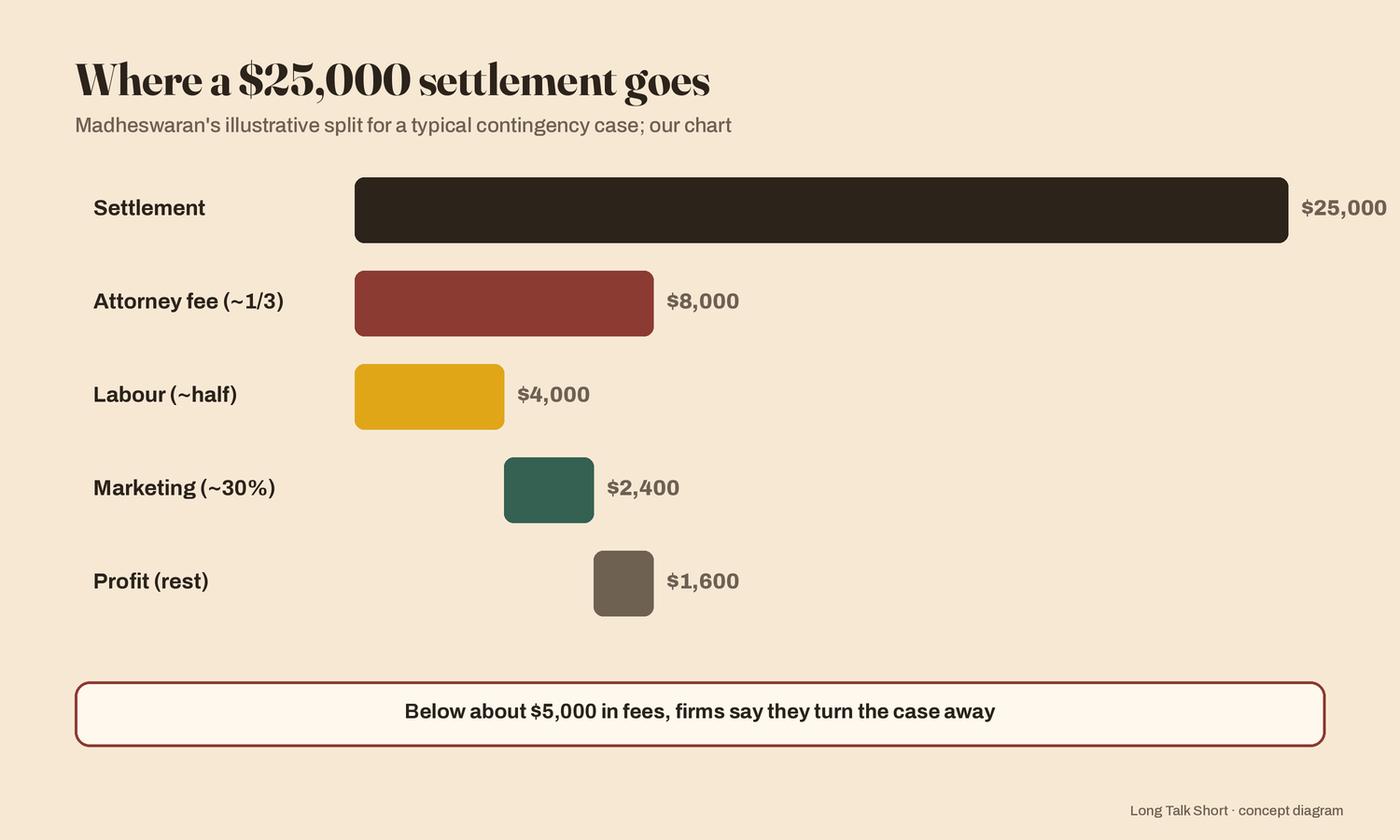
Plaintiff law, the side that sues on behalf of individuals, mostly works on contingency: the firm takes a share of the settlement, often about a third, and nothing if it loses. That lets people who can't pay "$500, $600 an hour on a blank check" get a lawyer. But it builds in a floor.
If a lawyer doesn't make at least 5,000 fees of a case, they do not take it on
Even at that level, firms lose money on many cases and depend on a few big wins.
His employment example shows why. A worker being harassed calls a firm. Someone spends 30 to 45 minutes on the call, then maybe 10 hours researching whether the facts fit a recognised cause of action, only to find the case may not earn $5,000. He puts the rejection rate for employment cases at 96%.
Alex Rampell, the a16z partner who hosts, frames it as a supply curve: demand for legal help is huge, but the supply of affordable legal labour stops well short of it.
So what happens if that labour gets cheap?
2. From 100 clients per attorney to 500
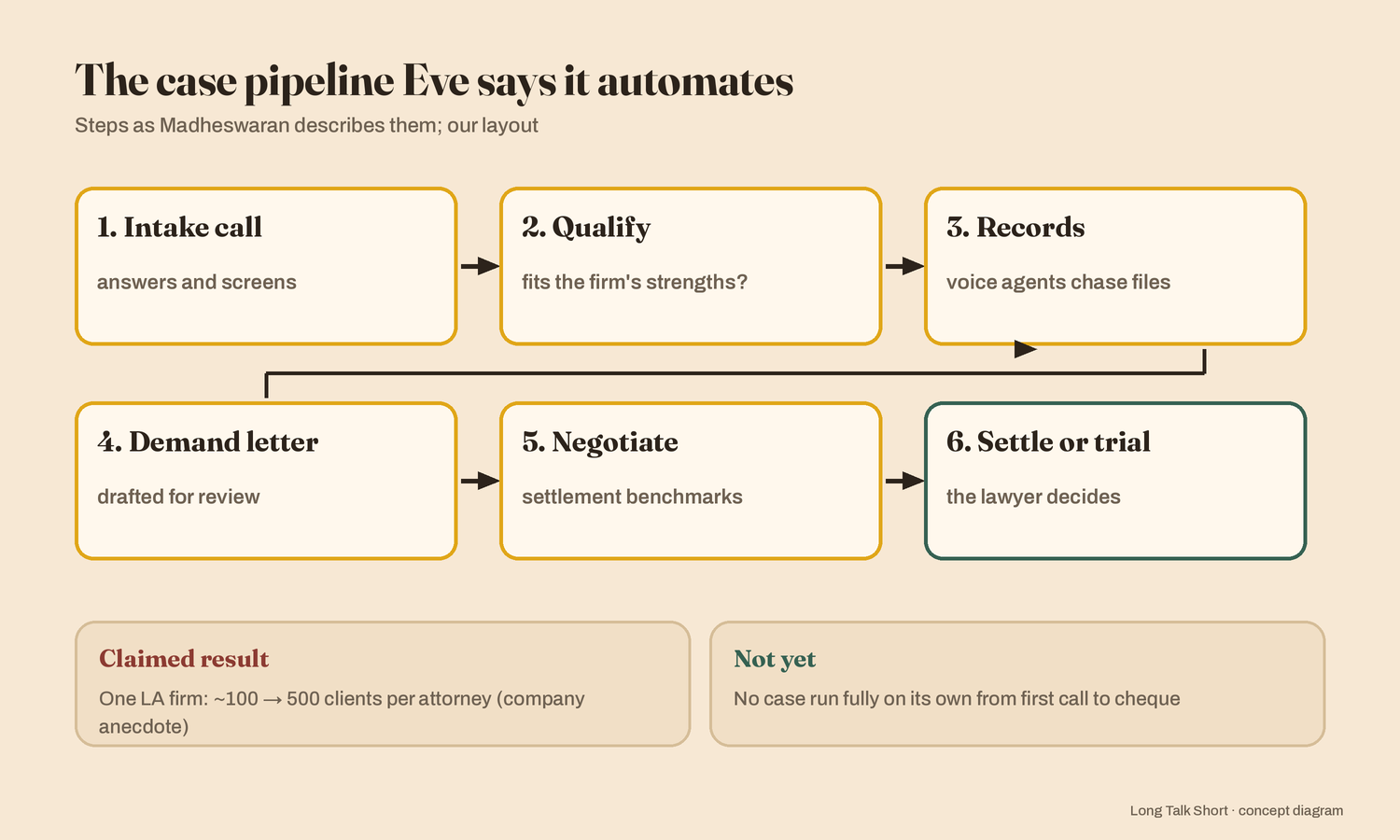
Eve's pitch is that it handles the work end to end:
- Intake: it answers the call and checks whether the case fits what the firm is good at.
- Drafting: it writes the demand letter.
- Auditing: overnight, a tool called Auditor reads every page of every case file, looking for anything "a perfect attorney would catch every time."
- Settlement prep: before mediation, it briefs the lawyer on what similar cases settled for and which tactics worked.
- Records: voice agents call hospitals and insurers to chase medical records, a chore he says takes about two weeks. Increasingly, he adds, those agents are talking to other agents.
One firm in LA went from managing about 100 clients per attorney to 500.
He estimates a single case involves around 10,000 back-and-forths. Eve has not yet run one case fully on its own from first call to cheque, but he says it is close.
Rampell's point is about who wins. Most people assume legal AI means firing staff. He argues it means taking on more cases, so the firm earns more. The old software market for plaintiff law looked tiny because firms ran on "a cell phone [and] email address." The real market is the labour they couldn't afford, a "shadow labor market" much larger than anyone measured.
3. Why not just use ChatGPT?
Why won't the big AI labs do this themselves? Madheswaran's answer is that raw intelligence isn't enough.
If you drop Albert Einstein into a law firm today, he will not be productive for quite some time.
Most plaintiff cases settle before trial, so the useful data never appears in any public court opinion, such as what an insurer actually paid for a soft-tissue injury in a particular county. He says Eve never trains on a client's private case data. Instead it hires its own attorneys and tracks success rates across the platform, much as lawyers already swap tactics at training seminars.
He describes the other side's reaction with relish. One defence firm made a habit of sending discovery requests the day before Thanksgiving, knowing the plaintiff's lawyer would have to rush through them over the holiday. The firm using Eve built an agent to reply the same day. "The defense were like, what is going on here?"
4. Can a small firm become a billion-dollar business?
Rampell floats the big idea: if one attorney can handle 500 cases, or 5,000 later, a small firm could grow into a billion-dollar revenue business. Madheswaran expects:
- National specialists: narrow firms that get very good at, say, soft-tissue cases with a particular set of facts, then advertise nationally.
- Roll-ups: large firms using AI to make buying other firms easier.
- Faster dispute resolution outside the courts, AI-assisted.
- Outcome pricing spreading to other parts of law, with the billable hour shrinking.
What's left for human lawyers? He thinks the work may become "99% AI, maybe 99.9%." The human part is judgement about the client, the facts and the local opposition. Some Eve customers, he says, spend more time on trials because routine work no longer swamps the firm.
Weighing it: what holds up
Conflict of interest: we checked that Andreessen Horowitz led Eve's $47 million Series A in January 2025. It also took part in a $103 million Series B in September 2025, led by Spark Capital, which valued Eve at $1 billion. On air Rampell calls himself "delighted to be your partner." This is a portfolio conversation, not an independent review, and the episode doesn't push back on Eve's claims.
Vendor-reported: the jump from 100 to 500 clients per attorney is one firm's result as told by the vendor; we found no independent data.
Not sourced, but plausible: we couldn't source the 96% rejection figure. The closest evidence points the same way: older surveys of plaintiff employment lawyers, including one by the National Employment Lawyers Association in 1991, found many turned away more than 90% of the people who asked for help.
Anecdote: Rampell's story about suing Wells Fargo with ChatGPT is his own.
The trade-off: cheaper lawsuits mean more claims for insurers and employers to defend. Some will be weak, and those costs can return to you as premiums and prices. Madheswaran's answer, that most of this will be settled by agents talking to agents before it reaches court, is a prediction, not evidence.
Related reading: on why a company's own data and tests matter more than the model, see Own the Test, Rent the Model.
Long Talk Short
- Contingency law leaves small cases without lawyers: below about $5,000 in fees, the labour costs more than the case pays.
- Eve says it automates intake, research, records chasing, drafting and settlement prep, and that one LA firm went from 100 to 500 clients per attorney.
- The pitch is revenue growth, not cost cutting: more cases taken, not fewer staff.
- Its claimed edge is private settlement knowledge that general AI models can't find online.
- a16z is an Eve investor, so read the bigger claims as the company's own.
The one thing to remember: if a lawyer turned you down because your case was too small, that's a pricing problem, and cheap AI labour is the kind of thing that could change it.
Source: "What Happens When Both Sides of a Case Use AI?", Jay Madheswaran with Alex Rampell on the a16z podcast. This is an independent summary and is not affiliated with a16z or Eve.
Quotes are taken from automatic captions and lightly cleaned. This article is for general information only and is not legal advice.