Force Yourself To Grow
Change isn't positive thinking, says Joe Dispenza. It's catching the unconscious thoughts and emotions you have run on autopilot for years, then stepping into the one place that is still unknown: the present moment. The usable neuroscience of changing your mind, and a clear-eyed look at the hea
Metacognition, the known and the unknown, the loop of thinking and feeling, and why your memories quietly lie. Joe Dispenza's model of change, distilled, with its bolder promises weighed honestly.
Joe Dispenza has built a large following, and a sizable business of week-long retreats, on a single promise: that you can change who you are on purpose. Talking with Chris Williamson, he lays out the model underneath it. Some of it is a genuinely useful account of how the mind keeps us stuck and how attention can get us unstuck. Some of it reaches much further, into claims about healing serious disease that deserve real skepticism. We will take the useful core first, then weigh the rest honestly.
Change begins where you least want to look
The first step to change, Dispenza says, is not thinking positively. It is becoming conscious of the thoughts you think without noticing. The reflex that says start tomorrow, it's too hard, you'll never change, you're too much like your parents, you failed last time. Most of us run those scripts below awareness and then wonder why nothing moves. The work is to catch them so completely that you can no longer think them on autopilot, and to do the same with the behaviors (blaming, complaining, self-pity, judgment) that quietly keep you unhappy.
He has a sharp image for why people so rarely do this on their own. When you are inside the jar, you cannot read the label. Usually it takes a crisis, a loss, a diagnosis, a betrayal, something uncomfortable enough that you finally see yourself from the outside and ask the vertiginous question, "could it be me?" That seeing-yourself-from-outside is what psychologists call metacognition, and it is the real beginning. His more hopeful point: you do not have to wait for catastrophe. You can learn to reach that same vantage point from inspiration rather than pain, by getting clear enough on a future you believe in that you can watch the old self from above.
The known and the unknown
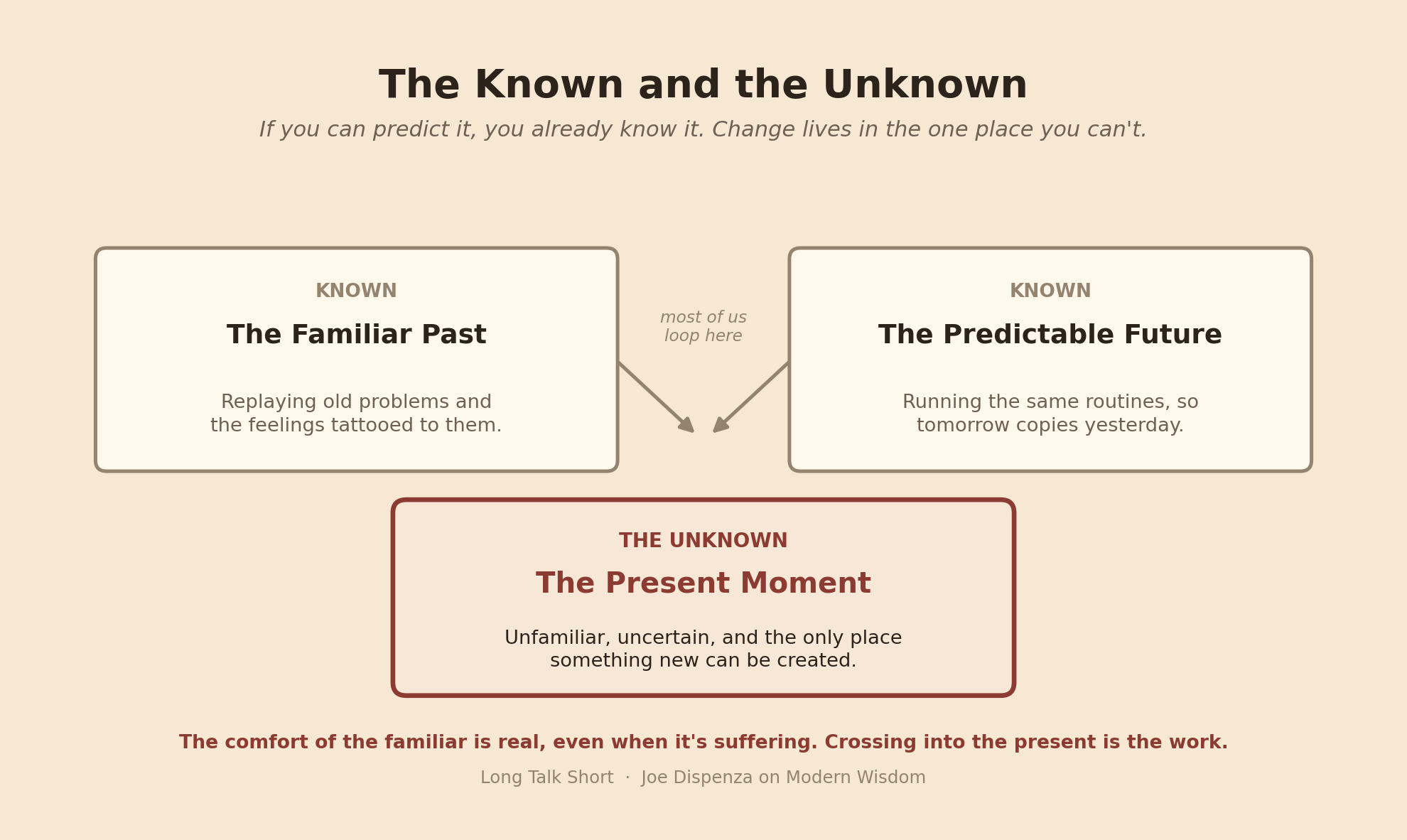
Here is the idea most worth keeping. Your brain, Dispenza says, is largely a record of the past, a map of everyone and everything you have already met. So you wake up, think about your problems, which are memories, feel the emotions attached to them, and your body is now living in the past before breakfast. Then you run the day on automatic: the same routines, the same reactions, which makes tomorrow a decent copy of yesterday. A habit, in his tidy definition, is a redundant set of thoughts, behaviors, and emotions acquired through repetition.
The twist is that both your familiar past and your predictable future count as the known. If you can predict it, you already know it. That leaves exactly one place where anything genuinely new can happen: the present moment. And the present is unfamiliar, which is why we flee it. He frames the leap from the old self to a new one as a kind of death, the uncomfortable, uncertain crossing of a river, and notes that most people would rather cling to a familiar misery than gamble on an unknown better. The comfort of suffering is real: it is at least predictable.
Why the familiar keeps winning
The reason the old self is so sticky is partly biological. The uncertainty of the unknown has been wired as danger for a very long time, is that a tiger in the bushes or just a shadow, and when we are living in a threat state, anything unpredictable reads as risk. So the body, conditioned by years of the same feelings, keeps sending signals up to the brain to think the familiar thoughts that reproduce the familiar state. The servant becomes the master.
Dispenza's claim about where the leverage sits is worth hearing: the brain changes most right at the point where you think you cannot go further and you want to quit. Push past that, and you are in the unknown. The practical version of this is unglamorous and true to most skill-building: the discomfort is not a sign you are doing it wrong, it is the doorway.
Addicted to your own thoughts
If negative thoughts hurt, why would anyone keep thinking them? His answer runs through stress physiology, and this part is well grounded. Stress is the body knocked out of balance: a perceived threat flips on the fight-or-flight system, which floods you with arousing chemicals meant for a short emergency. For a gazelle that outruns the lion, the event ends and the body resets. For humans, the event can be ten years gone and we keep re-triggering it, because every time you replay the betrayal or the firing, you switch the stress response back on by thought alone.
That surge of adrenaline is, in its way, a rush, and people can come to crave it. So, he argues, some of us unconsciously need the bad job, the bad relationship, the running grievance, because it reliably makes us feel something. The mechanism he describes is a loop: a thought triggers a chemical, the chemical produces a feeling, the feeling generates more thoughts to match it, and round it goes until the pair settle into what he calls a state of being. Feelings become the means of thinking, and the body gets conditioned, below awareness, to keep producing the same emotion to confirm who it thinks it is. The honest, usable takeaway: a grievance you keep rehearsing is not neutral. You are practicing it.
Your memories are lying to you
We build memories out of emotion, Dispenza says: the stronger the feeling at the time, the harder the brain freezes the frame into long-term memory. The trouble is that every time you relive the event, you reproduce its chemistry, so the body ends up reliving the trauma many times a day, and the wound migrates from the brain into the body as a felt identity. Ask such a person why they are bitter and they will name an event from a decade ago. What they are really saying, he suggests, is that after it, they stopped being able to change.
Then the uncomfortable research point: ask someone to recount a defining painful story and a large share of the details will no longer be accurate. This squares with what memory science actually shows, that recall is reconstructive, not a recording, and that each retelling can edit the file. Dispenza's gloss is pointed: we tend to embellish in the direction that excuses us from changing, which can mean reliving a worse life than the one we actually had, to keep feeding the emotional state we are attached to. His reframe is the best line in the conversation: strip the emotional charge off a memory and what is left is wisdom. "The memory without the emotional charge is wisdom," he says, and at that point the past stops running you. His instruction follows from it: stop romancing your past, start romancing your future.
Building the new self
The constructive half of his method rests on one solid neuroscience finding and extends it. The finding: mental rehearsal grows real neural circuitry. Vividly imagining performing an action recruits much of the same machinery as doing it, which is why athletes and musicians rehearse in their heads and why Dispenza tells people to close their eyes and rehearse exactly how they want to respond, until the brain looks, in his phrase, like it has already done it. Repeat it and the deliberate becomes automatic, a hardware change turning into a software program you run without effort.
He pushes it one step further: not just rehearsing the behavior, but teaching the body, in advance, the elevated emotion of the future, gratitude, say, before the thing you are grateful for has happened, on the premise that the body does not sharply distinguish a felt experience from a vividly generated one. Pair a clear intention with an elevated emotion often enough, he argues, and you begin to embody the future rather than the past. Whatever you make of the framing, the underlying practice, rehearse the person you want to be and deliberately cultivate the feeling that goes with it, is closer to sports psychology than to magic.
And his account of meditation is refreshingly forgiving. You sit, your mind wanders to the to-do list and the predictable future, and you assume you are bad at this. On the contrary, he says: noticing that you drifted and returning your attention to the present is not the failure, it is the rep. "You become conscious that you've gone unconscious," and come back. That is the victory, repeated until presence becomes a skill.
How to read this
Everything above is worth taking seriously, and most of it rests on real ground: metacognition, the reconstructive nature of memory, the physiology of chronic stress, the neuroplastic effects of mental rehearsal, and attention training are all well supported. As a practical philosophy of change, catch the unconscious script, stop rehearsing the grievance, deliberately practice the response and the feeling you want, Dispenza is a vivid and useful teacher.
The claims around the edges are a very different matter, and they need naming plainly. Dispenza also asserts that people at his retreats have reversed multiple sclerosis, Parkinson's, cancer, blindness, deafness, and more through meditation, that he holds "the largest database in the world" with "over 500 billion data points," and that his intervention runs "between 75 and 100%" effective where drug trials manage 25%. These are extraordinary medical claims, and extraordinary claims require the kind of independent, replicated, peer-reviewed evidence that, as of now, is not there. A handful of papers from a research program financially and reputationally invested in the outcome is not the same as scientific consensus. Dramatic testimonials select hard for the rare and the recovered, say nothing about everyone who did not improve, and cannot rule out spontaneous remission, misdiagnosis, or concurrent medical care. Even Dispenza repeatedly says he finds the stories hard to believe, which is the correct instinct.
So, two things held at once. The psychology of change he describes is genuinely helpful and costs nothing to try. The promise that the same practices cure serious disease is unproven, and acting on it carries real danger. This is not medical advice, and nothing here is a reason to stop or delay prescribed treatment, medication, or care from a doctor. If you are facing a serious diagnosis, meditation can sit alongside medicine; it is not a substitute for it. Use the parts of this that help you pay attention and break an old loop. Keep your skepticism, and your treatment, for the rest.
Go deeper
- Breaking the Habit of Being Yourself, Dr. Joe Dispenza
Affiliate links, a small commission supports the blog at no cost to you.