How Not to Lose Everything When the System Collapses
A French entrepreneur argues we are living through a transition, not a stable world, so the safe-looking portfolio is the dangerous one. His answer: a four-point compass and three uncorrelated burrows, sized so any one can collapse to zero and you still walk away.
A rabbit does not dig one burrow. It digs several, with separate exits, so that when a predator comes down one hole it is already gone out another. That image sits underneath this keynote, which the entrepreneur and investor Richard Détente gave to the clients of a Swiss bank. His "theory of the three burrows" is not really about getting rich. It is about not being caught in the open when the system that held the last forty years finally gives way.
Détente is not a banker. He runs the Grand Angle media group (economics, Bitcoin and tech), and he was co-founder and chairman of Data Factory, a US Bitcoin-mining operation built to own the energy layer underneath it, now merging into a full-stack AI infrastructure group called Antimatter. So he thinks like an operator who has to put his own money somewhere, and he is careful to say he only ever talks about what he actually holds. Read what follows the same way: as one entrepreneur's personal, deliberately aggressive playbook, not as advice, and with his commercial interests (compute power, Bitcoin) kept in view.
First, decide what world you are in
The whole talk hinges on a question Détente says you have to answer before you buy anything. Do you believe tomorrow will broadly look like yesterday, a stable world that projects the past forward, or do you believe you are living through a transition, where a new order reshuffles politics, technology, debt and money all at once? This is not idle philosophy, because the same asset behaves completely differently depending on which world you are standing in. Get the regime wrong and even a "safe" holding can hurt you.
His own answer, stated early and often, is that nothing will ever be as it was. We are in the reshuffle, not the continuation.
Why he thinks the old recipes are expiring
He stacks up several reasons the ground is moving.
Money has a shelf life. A currency, he says, fails roughly every 70 years, wiped to zero or debased through a whole toolkit of monetary torture. The dollar's modern order dates to Bretton Woods, about 70 years ago, and the debasement of the dollar, he argues, is not a myth but something you watch happen, especially once you hold Bitcoin.
Technology adoption is accelerating and overlapping. Every technology spreads on an S-curve, slow among early geeks, then a steep climb past an inflection point, then maturity (think dishwashers, phones, electricity). What is new is the pace. Curves that used to be separated by millennia, from fire to the wheel, now arrive on top of each other: Bitcoin mining had barely matured before AI data centers came for the same resources. That overlap raises a genuinely strange question, he says, of whether we will even have recessions in the old sense, since each new technology arrives to rescue the one before it. The Bitcoin miners who should have been wiped out simply converted into selling cloud compute.
Globalization is regionalizing. The stable world let companies string supply chains across the planet. Now the world fragments into blocs, chiefly the US and China. Globalization is not dying, he insists, but it is breaking into regions, which gives outsized importance to what he calls the hinge countries, Singapore, Switzerland, Dubai, Miami, Hong Kong, the places where the big blocs can still talk to each other and value passes through.
Gold's monopoly on trust is being challenged. Gold is the monetary Schelling point, the thing everyone converges on without needing to agree (the medieval trader packs gold because he assumes strangers will want it too). Bitcoin, he argues, is in the process of trying to take that role, which has consequences all the way down a portfolio.
The compass: four cardinal points
The good news, Détente says, is that the asset classes still exist; you just need a compass to position inside this moving world. His has four cardinal points.
1. Value moves, so you have to anticipate it
What had value yesterday may not tomorrow, and tomorrow's value is usually created out of something that barely exists today. To capture it you have to anticipate where it is going, which means making entrepreneurial choices, which means taking risk. This is why he is wary of "prudent" management: it tends to sell you the recipes that worked for the last 40 years (his example: French government bonds), which is precisely the wrong bet if the world is actually in transition. In a reshuffle, the cautious portfolio can be the one that quietly puts you in the hole.
He leans on Ray Dalio's long debt cycles here (the roughly 50-year arcs in The Changing World Order), which Dalio reads as the rise and fall of empires and which, Détente notes, suggest the Western blocs are near the end of a cycle. "The end" does not mean everyone dies in the rubble. It means a great deal gets reset and reconfigured, and value moves, sometimes through conflict but not necessarily. The gold-to-Bitcoin shift is one such move.
On how much to bet when you are unsure, his framing is useful: the question is not whether to hold a volatile idea but in what proportion. His no-brainer example for a gold lover: take gold's market cap and Bitcoin's, convert the ratio into a position, and you end up holding maybe 2% in Bitcoin. If it goes to zero it will not kill you; if it runs, it can double your portfolio. Size the bet so the downside is survivable and the upside still matters.
He adds two forces reshaping where value sits. Stablecoins are a deep modernization of fiat money, which is why figures like BlackRock's Larry Fink and JP Morgan's Jamie Dimon, hardly crypto-geeks, keep warming to them: for them, stablecoins are the new rails of finance. And a cluster of new technologies (robotics, biotech) is bottlenecked by one thing, AI. A robot with good actuators is useless until an intelligence can drive it; a protein-folding problem that would take centuries in a lab falls in days once you point an AI at it. AI, in his phrase, is the key that unlocks the other revolutions.
2. Antifragility: match the asset to the weather
Here he draws on Nassim Taleb's antifragility, mathematized, he notes, by his friend the physicist Didier Sornette. In a stable world, where tomorrow resembles yesterday, you want fragile assets like stock indices, which perform best when volatility is low. In a transition world, where value is on the move, you want antifragile assets that gain value precisely when volatility rises. These are two different animals, and the mistake is holding the stable-world animal while betting the world is unstable.
3. Decorrelation: the only free lunch
Normally, he says, you cannot raise a portfolio's return without raising its volatility. The one exception, which Milton Friedman called the only free lunch in finance, is decorrelation: holding things that move independently of each other. Bitcoin, over long enough windows, is about the most decorrelated asset there is; so is, say, real estate in Singapore relative to gold in the US. Sum enough uncorrelated waves and the line flattens, which cuts your maximum drawdown, the worst peak-to-trough fall. That matters enormously if you borrow against your portfolio (Lombard loans and the like), where a deep drawdown can trigger a forced sale.
The catch is psychological. Our brains are correlated; we hold views that are consistent with one another. Pitch Singapore real estate, Texas AI compute and a Bitcoin-amplification stock in the same portfolio and you will annoy almost everyone, because no single worldview loves all three. That friction, he says, is exactly why decorrelation stays a free lunch few people pick up.
4. Danger is not risk
This is the distinction the whole survival case rests on. Risk, to a financier, is volatility, the price moving around, which is not a problem if you manage time well and can even be an opportunity. Danger is different: it is your capital going to zero and staying there. You limit danger two ways. First, hold assets with strong collateral, the kind his grandparents meant when they said certain real estate "will always be worth something." Second, hold assets with deep liquidity, like the 24/7 markets of digital assets, so you are never trapped watching a position you cannot exit while the market is closed.
Put the four points together and you get his actual method: choose the most volatile, highest-returning, genuinely risky assets, then marry them to things that have nothing to do with each other. If one pillar yields 40% (Bitcoin), another 30% (AI), another 20%, and one of them collapses to zero, the loss is roughly a single year of the other two's gains. Decorrelation is what lets you own dangerous winners without being destroyed by any one of them.
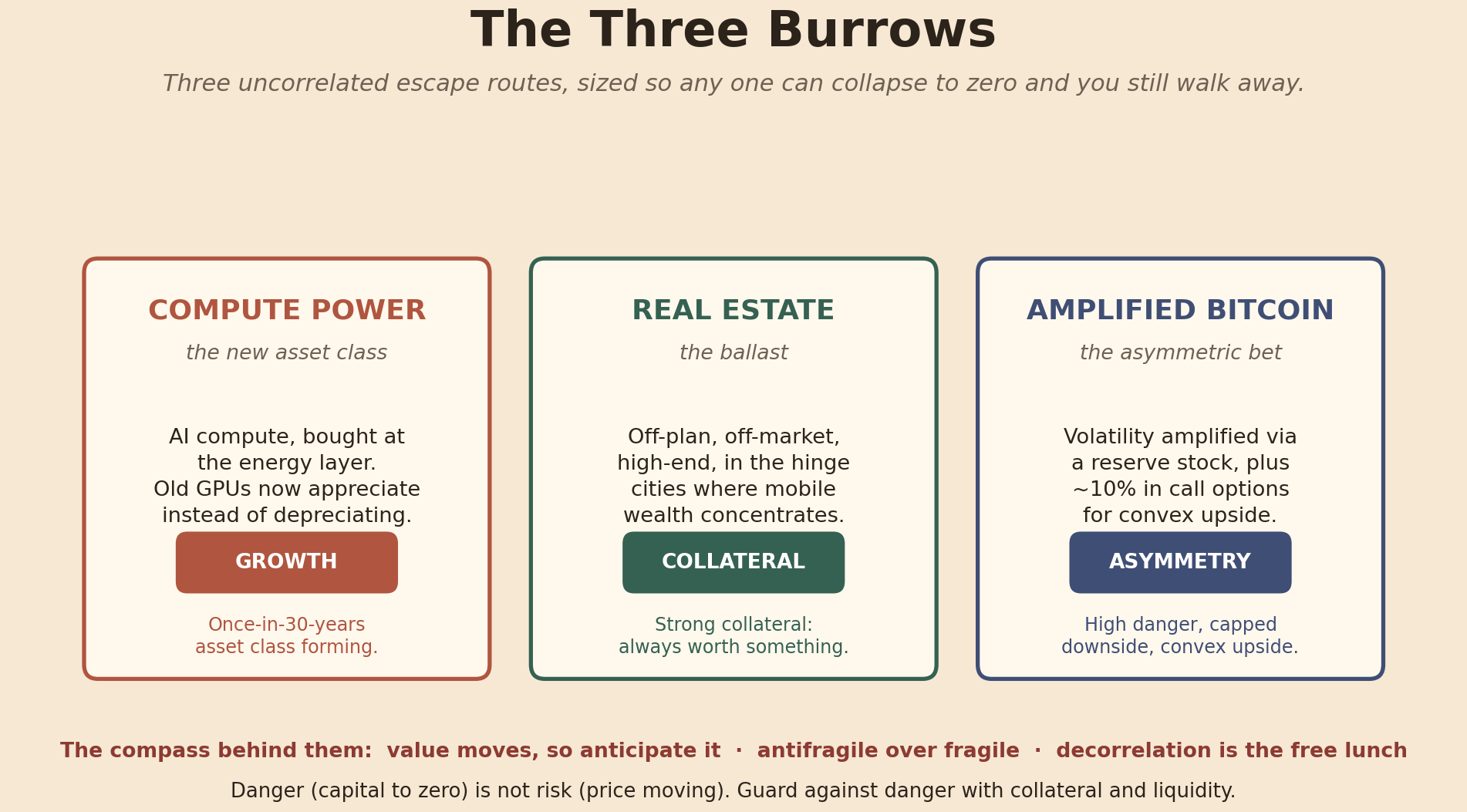
The three burrows
Then the concrete part, what he personally holds across three pockets, chosen so that no single collapse empties the field.
Burrow one: compute power
Détente's strongest conviction is that computing power is becoming a brand-new asset class, the kind that, old financiers told him, appears maybe once every 30 years (his first was Bitcoin, which he admits he reached late, in 2021). The signal is that Larry Fink has already called compute an asset class, and when BlackRock says it out loud, he argues, the pieces are already placed: exchanges have begun listing which GPUs qualify, which means futures, options and trillions of dollars arriving. Once an asset is valued on your balance sheet and lendable against, your banker treats it as real, and your world changes. He is buying one of the first "polyclouds" out of his own group, hosted on a Texas power farm whose energy he controls. And the economics have inverted: a computer used to depreciate to junk in four years, while old Nvidia cards now appreciate, their compute renting for more on marketplaces like Vast AI. His blunt thesis for why the compute giants dangle talk of a $15,000 universal income: they want the compute, and they are happy to hand you dollars while they make twentyfold and you make threefold.
Burrow two: real estate, deliberately uncorrelated
The second pocket is real estate, chosen precisely because it has nothing to do with the first. Specifically off-plan, off-market, high-end property for globally mobile people, entrepreneurs and artists who live across several countries by weather and tax. His reasoning is uncomfortable but clear: the world we are entering is sharply unequal, so wealth concentrates onto a shrinking, more localized set of profiles, and it clusters in the hinge cities (Singapore, Dubai, Miami, Switzerland) that are, not coincidentally, quite content with globalization. Real estate also supplies the strong collateral from his danger rule, the thing that will always be worth something.
Burrow three: amplified Bitcoin
The third pocket is the aggressive one, and where the caution flags go up highest. Bitcoin's own volatility has fallen so far (around 30%, he jokes, it is almost a calm asset now) that he deliberately amplifies it. His vehicle is Strategy, Michael Saylor's company, which revives the old idea of an asset reserve: pile up Bitcoin, then issue instruments against it. Holding it, he says, is a way to get 80 to 90% volatility with risk better managed than if you built your own leverage in DeFi, where liquidation thresholds are brutal. On top of that he adds options: put about 10% of this pocket into call options, and the asymmetry of their convexity means that if your timing is wrong the options expire worthless and you lose that 10% (a loss, he notes, that never killed anyone on an 80%-volatility asset), while if it runs you can double the whole pocket. He also observes, without judging, that Bitcoin's privacy-and-sovereignty crowd is fading while the yield-chasing financiers have never held more of it, Saylor first among them, a real shift in what Bitcoin is becoming.
How to read this
Take this as a vivid, internally consistent worldview, not a prospectus, and weigh it against its obvious tilts. The speaker sells compute infrastructure and is openly long Bitcoin, so the two pockets he is most excited about are also the two he profits from; he closes the talk with his business email, which tells you what kind of talk it partly is. The strategies in the third burrow (leveraged Bitcoin-reserve stocks, call options) are genuinely high-danger by his own vocabulary, and the reassurance that "losing 10% never killed anyone" assumes a portfolio most people do not have. His macro claims (currencies failing every 70 years, the end of recessions, an imminent Western reset) are provocations drawn from Dalio and Taleb rather than settled facts, and reasonable economists dispute all of them.
What survives the skepticism is the architecture, and it is worth keeping. Decide honestly whether you think the world is stable or in transition, because it changes everything. Separate danger (capital gone for good) from risk (price wobbling). Protect against danger with collateral and liquidity. And above all, dig more than one burrow: hold things that genuinely do not move together, sized so that any single one can collapse to zero and you still walk away. You do not have to share his bets to use his map.
Go deeper
- The Changing World Order: Why Nations Succeed and Fail, Ray Dalio
- Antifragile: Things That Gain from Disorder, Nassim Nicholas Taleb
Affiliate links, a small commission supports the blog at no cost to you.