The Marshmallow Test Was Never About Willpower. One Professor Says It Measured Trust.
The kid who grabs the marshmallow isn't weak. He may be reading his world correctly. Jiang Xueqin argues self-control, grit and growth mindset follow from a stable childhood, and that blocked ladders spark revolutions. What holds up, and what overreaches.
A child sits alone with one marshmallow and a promise: wait, and you'll get two. For decades, the kids who waited were held up as proof that willpower builds success.
Jiang Xueqin thinks we read the experiment backwards. The child who eats the marshmallow, he argues, may simply have learned that adults don't always come back.
In the third lecture of his Game Theory course on the Predictive History channel, the Canadian educator, who teaches in China, asks who succeeds and why. His answer is blunt: the traits schools try to teach mostly follow from a stable, well-off childhood rather than cause success. Then he widens the lens to revolutions. It is provocative, and often sharper than the evidence allows.
In short: the marshmallow test measures trust, not willpower; poor parents rationally raise children to obey while rich parents raise them to negotiate; and when elites multiply faster than top jobs, frustrated insiders lead the poor in a "game reset."
1. Three famous theories of success
He opens with the explanations you've likely read in bestsellers:
- Delayed gratification. Walter Mischel's marshmallow test: children who waited for a second treat did better decades later.
- Growth mindset. Carol Dweck: people who treat failure as a lesson keep trying.
- Deliberate practice. K. Anders Ericsson: top performers practice strategically, check their weaknesses and revise the plan.
Then comes the turn. Schools teach these skills to struggling students, he says, and "the student doesn't actually get better."
2. The arrow points the other way
His diagnosis: correlation is not causation. Successful people get up at four in the morning, but getting up at four won't make you successful.
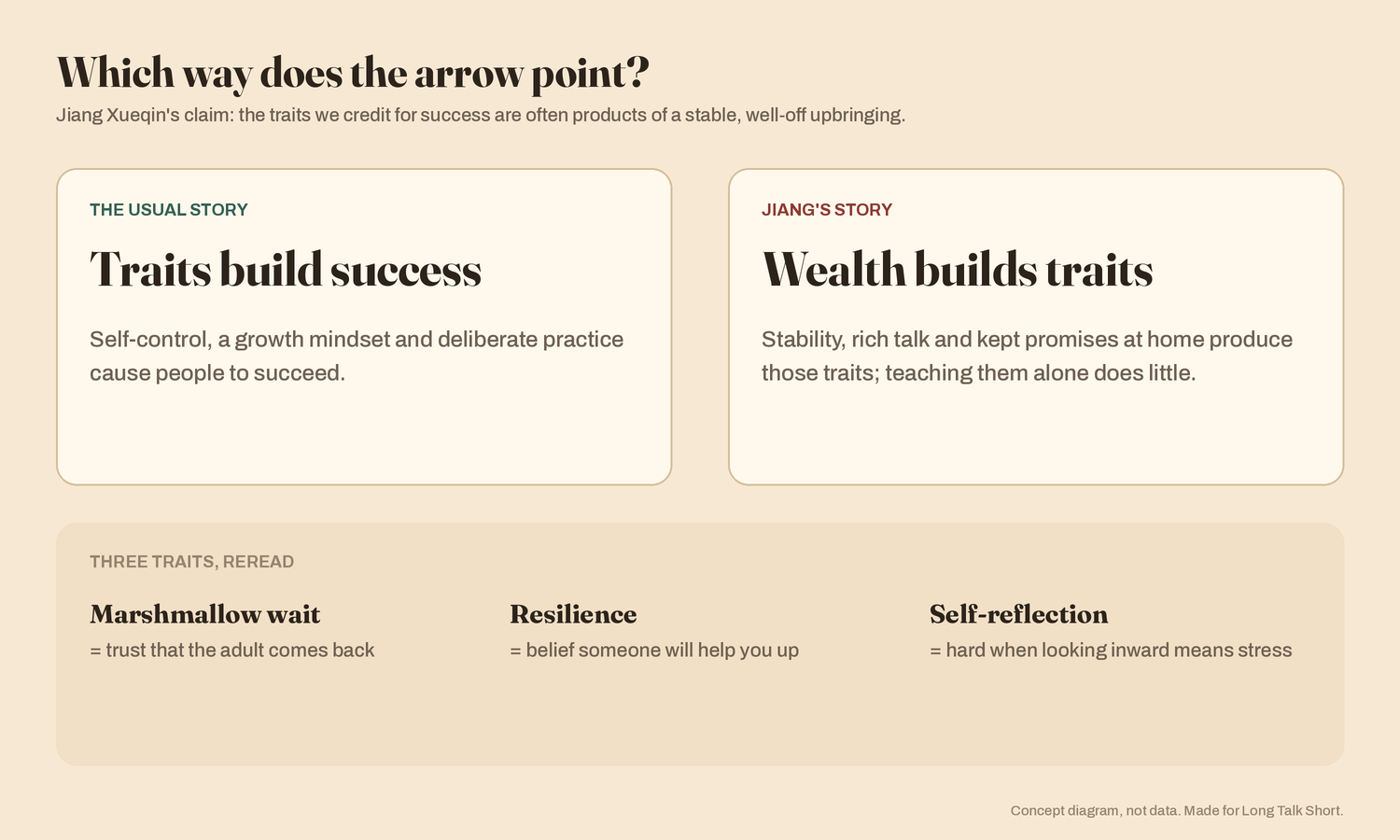
If you're rich, guess what happens? You become successful and therefore you will have growth mindset, self-control, deliberate practice.
So where do the traits come from? He points to what happens at home.
3. What the marshmallow really measures
Rich parents, in his telling, do three things differently:
- They talk more and use bigger words.
- They explain instead of command. A child who touches a hot stove gets a reason, not a threat.
- They keep promises, because money makes promises keepable. A poor parent's planned McDonald's lunch can vanish when the paycheck falls short.
That third point recasts the famous experiment.
Marshmallow test is not a test of self-control. It's a test of your trust in others.
A child who has learned that adults come back waits. A child who has learned they often don't eats the marshmallow, and is "actually better off" doing so. "Poor kids are rational," he says, "and they're responding to the circumstances that they live in."
The same logic reframes other virtues. Resilience is a belief that someone will help you up. Self-reflection is hard when looking inward mostly means pain and stress.
So why not just teach poor parents better habits? That's where game theory comes in.
4. Parenting is a game you play with the neighbors
Friendlier, word-rich schools help somewhat, he says, but children arrive with their worldview set, and parents resist change. The reason is strategic:
- A poor family's survival depends on the police, the boss and relatives, so teaching a child to obey is the optimal strategy.
- Rich families live by negotiation, so they teach children to debate.
Parenting, he concludes, is less about a child's outcome than about fitting in.
He offers himself as evidence twice. He and his wife raise three children with free play, family "democracy" and storytelling instead of math drills, and other Chinese families think they are "crazy." And he was a poor immigrant's son in Toronto who reached Yale on scholarship.
His escape routes for the poor are leaving your community, war, revolution and marrying up, all high-risk. His verdict on his own path: "I lucked into Yale." Luck can be positioned for, he allows, but self-made success belongs to perhaps 1 percent.
If the split between rich and poor is this stable, what ever breaks it?
5. Elite overproduction and the game reset
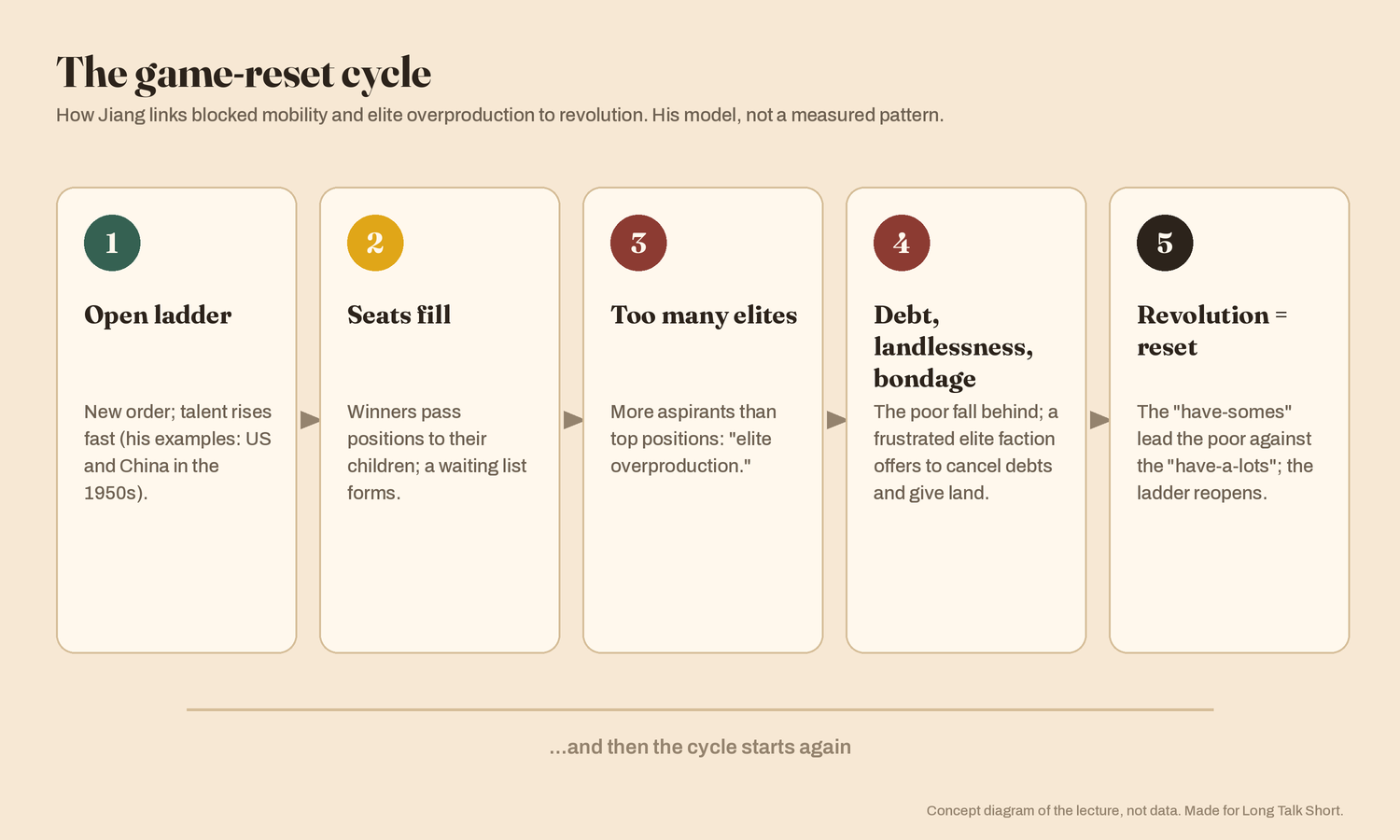
His surprising answer: the rich. Raised to want the maximum, they outnumber the top positions, a condition he calls "elite overproduction." Revolutions, he says, are never rich against poor but "have a lot versus have some." He says Mao, Zhou Enlai and Deng Xiaoping came from comfortable but not top families.
The poor supply the numbers because of three recurring problems:
- Debt
- Debt bondage that passes to children
- Landlessness
A breakaway elite promises to cancel debts, give land and end slavery. He fits communism, early Islam and Julius Caesar to that template, and adds Donald Trump's appeal to indebted Americans.
Asked whether elites keep some mobility on purpose, he calls social mobility "the best form of governance," more important than democracy, citing both 1950s America and 1950s China. But within a generation the winners reserve seats for their children. Imperial China's civil-service exam, the keju, was gamed, then corrupted. Hong Xiuquan, who failed it repeatedly, launched the Taiping rebellion.
Revolution, in his words, is a "game reset."
Weighing it: what holds up
The marshmallow reframe has real support. In a 2013 study led by Celeste Kidd, preschoolers who first saw an experimenter break a promise waited far less than those who saw one keep it. A larger 2018 replication by Tyler Watts, Greg Duncan and Haonan Quan, with about 900 children, found the link between waiting and later achievement about half the original estimate, and it shrank sharply once family background and early ability were controlled. That fits Jiang's direction, but neither study shows self-control is irrelevant or that the test measures only trust.
On mindset and practice, he overstates a fair point. A 2018 meta-analysis by Victoria Sisk and colleagues found weak links between mindset and achievement and very small intervention effects, though a large 2019 U.S. trial led by David Yeager found a small benefit for lower-achieving students. A 2014 meta-analysis by Brooke Macnamara and colleagues found deliberate practice explained a modest share of performance differences, more in games and music than in professions. "It doesn't work" is too strong. "It's not the whole story" is fair.
Several factual claims slip. The Dunning-Kruger study did not use IQ tests or 500 students; it tested Cornell undergraduates on humor, grammar and logic. The vocabulary gap echoes Hart and Risley's 1995 study of 42 families, whose famous "30 million word gap" has been contested. And "school doesn't really matter" goes well beyond mobility research, which finds parental income matters a lot, but not everything.
The revolution model is interpretation. Elite overproduction is Peter Turchin's term, from a model he argues fits many historical crises; critics say it is hard to test and easy to fit after the fact. The "every single revolution" template and the Trump example are Jiang's reading, not established history.
Long Talk Short
- Patience, resilience and self-review may partly reflect a secure upbringing, not just cause achievement.
- A child who doesn't wait for the second marshmallow may be reading an unreliable world correctly.
- Parents raise children to fit their environment: obedience where authority is harsh, negotiation where it is open.
- When elites multiply faster than top positions and hoard them for their children, frustrated insiders lead the poor.
- The research backs his direction more than his absolutes: willpower, mindset and practice matter, just less than popular books claim.
The one thing to remember: before blaming someone's character, ask what their world has taught them to expect.
Source: Predictive History, "Game Theory #3: Rich Dad, Poor Dad", a lecture by Jiang Xueqin. This is an independent summary of that lecture and is not affiliated with the channel.
This article is for general information only and is not financial, parenting or professional advice.