Joe Navarro: What 25 Years in the FBI Taught Him About Reading People
A former FBI counterintelligence agent who caught spies by watching their bodies explains how we are judged in milliseconds, the handful of signals that leak what people really feel, and how to read a room, and project confidence, on purpose.
The FBI agent who once caught a spy by watching his cigarette shake breaks down the science of body language: what people broadcast without knowing, and what you can learn to control.
Joe Navarro spent 25 years in the FBI, much of it in counterintelligence, sitting across from spies, terrorists, and traitors and trying to read what their words would not tell him. He once identified the most damaging spy in US history partly because, when he said a certain name, the man's cigarette shook. Talking with Steven Bartlett, Navarro, now a world-renowned body-language expert, lays out what that quarter-century of watching people taught him. The promise is simple and large: learn to read others faster, and understand what you yourself are quietly broadcasting.
You are judged in three milliseconds
Start with the uncomfortable science. Navarro points to the research of the late Harvard psychologist Nalini Ambady on "thin-slice" assessments: shown just a few seconds of a stranger, people judge their warmth and competence about as accurately as those who observed them all semester, and we form these impressions in as little as three milliseconds, faster than a blink. We are, he says, exquisitely built for this. A newborn cannot speak, so a mother reads it; a baby in the womb already tunes to its mother's speech and is born crying in the lilt of her native tongue. We evolved to read each other because, surrounded by predators, our survival depended on it.
The practical upshot is humbling: the old advice about "the first four minutes" of an impression is ancient history. The assessment is already made before you have finished sitting down.
It is comfort versus discomfort, not a lie detector
Navarro is firm that body language is widely oversold. He has no patience for the "this gesture means that" industry. What he actually teaches is far simpler and more honest: look for comfort or discomfort. Is a person's behavior "positively balanced," gravity-defying, expressive, warm, or "negatively balanced," restrained, tight, self-touching? You will not read minds, and you do not need to. Evolution, he says, is about approximation, not perfection; being right 75 to 80% of the time is plenty. Most of the signals he reads are not deception tells but "pacifiers," the small self-soothing things we do to calm a brain under stress.
The places the body tells the truth
Over decades he has learned where to look, and the list is short and usable.
The glabella, the small patch between the eyebrows, furrows when we feel doubt, dislike, or confusion; he has seen babies do it within seconds of birth when a light is shone in their eyes. The lips he calls the body's "emotional seismograph": when we are comfortable they are full and colored, and the instant we hear something we dislike, blood leaves them, they narrow, and we tighten, bite, or purse them. The neck, specifically the supersternal notch, that little dimple at the base of the throat, is the great tell of insecurity: when people feel fear or doubt, they cover or touch it (women tend to touch it directly, men to rub the neck more robustly). Covering it is, he says, the single worst thing you can do in a negotiation, because it broadcasts weakness. The hands give it away too: confident fingers spread wide ("I care about this"), while fear pulls the fingers together and, at its worst, tucks the thumbs away, the way a frightened dog tucks its ears. And general face-touching is mostly self-soothing, a short route for a stressed nerve to send a calming signal to the brain, which is why, when a number lands badly in a negotiation, people escalate from touching their face to scratching it.
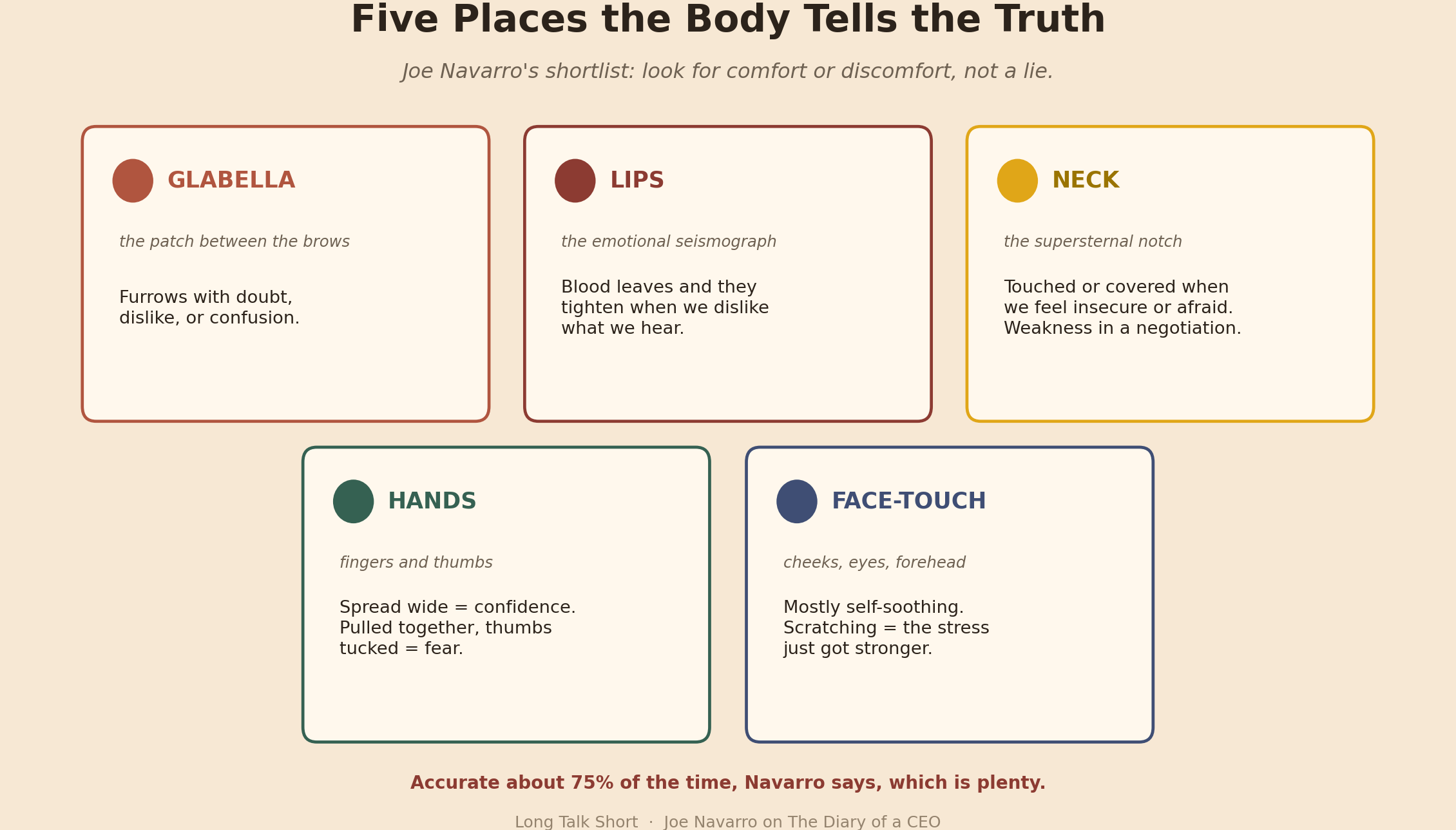
Several of these trace back to four ancient survival reflexes he says the brain reaches for again and again: freeze, cover the mouth (so a predator could not see your breath), cover the neck (where big cats strike), and throw your hands to your head when something goes wrong. The brain, he jokes, does not have a closet full of ties; it has about four reliable moves.
What you broadcast, and how to control it
The flip side is that everyone is reading you, and most of it is adjustable.
The worst thing you can do, he says, is hold a "still face." The famous still-face experiments show babies become distressed when a parent goes blank, and adults do the same: a motionless face reads as a threat, as untrustworthy, as insignificant. In a meeting or on a video call, you want to nod, tilt your head, react. When you do want to project confidence, there is one gesture above all: steepling the fingers, the move you see from Angela Merkel, Elon Musk, and Steve Jobs, reserved for the moments you want to emphasize.
Your voice matters as much as your hands. A command voice goes down, not up; "No" said with a falling tone sounds like a complete sentence, while "no?" rising at the end sounds like a plea. He once spent a Harvard class making future executives simply practice saying the word properly. And he prizes cadence, the deliberate slowing and spacing that let listeners feel the emotion, not just hear the words. Think of Churchill's "we shall fight on the beaches" or King's "I have a dream." Flatten those into ordinary sentences and no one listens. Slowing down, he notes, is also a form of power, because whoever controls the pace controls the room.
Two uncomfortable advantages are worth naming because they are real and measurable. There is a "beauty dividend," better-looking people earning meaningfully more over a lifetime, and a "height dividend": men who are 6 foot 2 are about 3% of the population but roughly 39% of Fortune 500 CEOs. Taller people are not smarter, he stresses; it is simply an advantage the world hands out. Posture and the "territory" you occupy, shoulders back, taking the space you are entitled to without sprawling, are the levers you actually control.
Synchrony is harmony
The fastest way to connect, Navarro says, is to get in sync. We mirror the people we are comfortable with, matching clothing, gestures, lean, and speech, and a conversation flows when two people fall into that rhythm. It breaks the moment one person sits back and kicks their feet up while the other leans in. His negotiation version is to match the other person's own words: if they say "family," do not answer "wife and kids"; if they ask "what's the price," do not reply with "the points on this are," because that signals you are not really listening. Even with terrorists who hated him, he says, getting grounded into the same words and rhythm was what made talking possible.
He also rejects the old idea that you should strip emotion out to get to business. That is not how we evolved. Negativity rises to prominence and demands to be dealt with first; the person who arrives at your office late, flustered, and badly greeted cannot simply switch it off because you want to start the meeting. Let people vent it, give it time, and only then move to the transaction.
Negotiation, FBI-style
To Navarro, negotiation is just "effective communication with a purpose," and his first rule comes from an old-timer who told him interviewing is not about the confession: "You'll get the confession. It's about face time." Keep someone talking for two, three, twelve hours, and they will tell you what you need; the whole game is making them want to stay in the room.
The rest is control, much of it invisible. Whoever controls time controls the negotiation, so when a bully storms in and throws down the papers demanding numbers, the worst response is to match their pace; you slow everything down. He planned his FBI interviews in exquisite detail: who enters first, who sits where, who is offered water and when, because offering the drink quietly casts you as the parent figure and the other person as the child. (He uses the same mechanism to explain Stockholm syndrome and, carefully, the dynamics of abusive relationships, where the provider becomes an authority the victim defends.) In the decade-long case against the spy Rod Ramsay, Navarro's team would arrive early at hotel rooms and arrange the furniture so that Navarro always sat an inch or two higher, and even shaved down the couch Ramsay sat on. Ramsay, who had one of the highest army-tested IQs on record and had memorized the nuclear launch codes, never noticed. Across 37 interviews, that quiet, relentless control of the room is part of how a confident, superior adversary was slowly disarmed.
Two practical habits fall out of this. Write your goal down before you walk in, or you will get swept into the heat of the moment and forget what you came for. And know your exact role in the room, including where to look: looking at your own colleague while they make the key point actually amplifies its weight.
Confidence can be trained
Navarro insists confidence is made, not born, and he is living proof: a penniless Cuban refugee who learned to read by pulling books from garbage bins, recruited by the FBI at 23 "barely learning how to shave" and taught to be confident. His method rejects "just walk in and be confident" as nonsense. Instead, become genuinely confident about one small thing, anything, how you make your bed, how you stack papers, and then a second, and a third. The surest route, he says, is knowledge: he never enters a meeting without having read everything he can on the subject, and he has watched nervous young graduates visibly "flower" the moment they start talking about something they truly know. Competence in one vertical becomes confidence that spreads.
The small signals of care
Near the end, Navarro analyzes his own first meeting with Bartlett from the tape, and the lesson is tender. When Bartlett crossed the room quickly to shake his hand, Navarro reads it as a sign of care, because how much someone matters to us shows in how fast we move toward them; babies recognize this "prosocial" speed by 11 months. His few corrections are gentle: stay standing a moment longer, sit when your guest sits rather than standing over them. On handshakes, keep the fingers low and the pressure equal, no Trump-style yank or crushing squeeze. And he is against typing notes while someone talks, the habit creeping into therapy and meetings alike, because if you are writing, you are not observing, and observing is where the information is. We evolved to touch, greet, and face each other, he says, and a screen between you and that is a cost.
For all the talk of control and advantage, the through-line of Navarro's life is generosity. He grew up with nothing, got a rare education in human nature from the strangest of classrooms, and decided the point was to hand it on so other people's lives might be a little easier, and so that, armed with it, they would be harder to manipulate. Read people well, he suggests, and you spend less energy guessing and more on everything else, which is its own kind of freedom.
Go deeper
Affiliate links, a small commission supports the blog at no cost to you.