You Can Learn to Wake Up Inside Your Dreams. The Pill Works, but the Free Method Is Better
More than half of us have known we were dreaming while still asleep. Scientists can now spot it in the brain, and a pill can triple the odds. But the method with the best evidence costs nothing.
You dream every night, then forget almost all of it.
But more than half of us have, at least once, realized mid-dream that we were dreaming. Science can now see that moment in the brain, and even make it more likely.
French mentalist and science communicator Fabien Olicard titled his Facebook explainer "Contrôler ses rêves" (Controlling your dreams). It doesn't actually teach you to steer a dream. It's a brisk tour of dream science: where dreams live in the brain, early attempts to read images out of it, and a pill for lucid dreams.
Most of it holds up. A few of his numbers don't. And the most useful part is what he leaves out.
In short: lucid dreaming is real, measurable and fairly common, and a drug can make it more likely. But the dependable ways to get there are drug-free routines, and the video skips them.
1. Knowing isn't the same as controlling
Olicard defines a lucid dream as "dreaming while being aware that you are dreaming." (translated from French) Then he splits it in two:
- The omnipotent version. You change the scenery, the people, even your own powers.
- The passenger version. You know you're dreaming, but you choose only your own actions and let your unconscious supply the rest. In his words, you:
put up with the script and the set
That's a genuinely useful distinction. Awareness and control are separate skills, and researchers measure them separately.
He also insists everyone dreams, including people who swear they don't. They simply forget, which he calls a built-in safeguard. He credits the measurement of this fast forgetting to Antonio Zadra of the Montreal dream lab, though we couldn't find the specific study.
So if we all dream, where in the brain does it happen? One lab found out by waking people up, again and again.
2. Scientists found the brain's dream zone
Olicard's first "big advance" is a study by Francesca Siclari's team at CHUV, the Lausanne university hospital. It checks out.
Published in Nature Neuroscience in 2017, it recorded 32 volunteers with 256-electrode EEG caps and repeatedly woke them to ask whether they'd been dreaming.
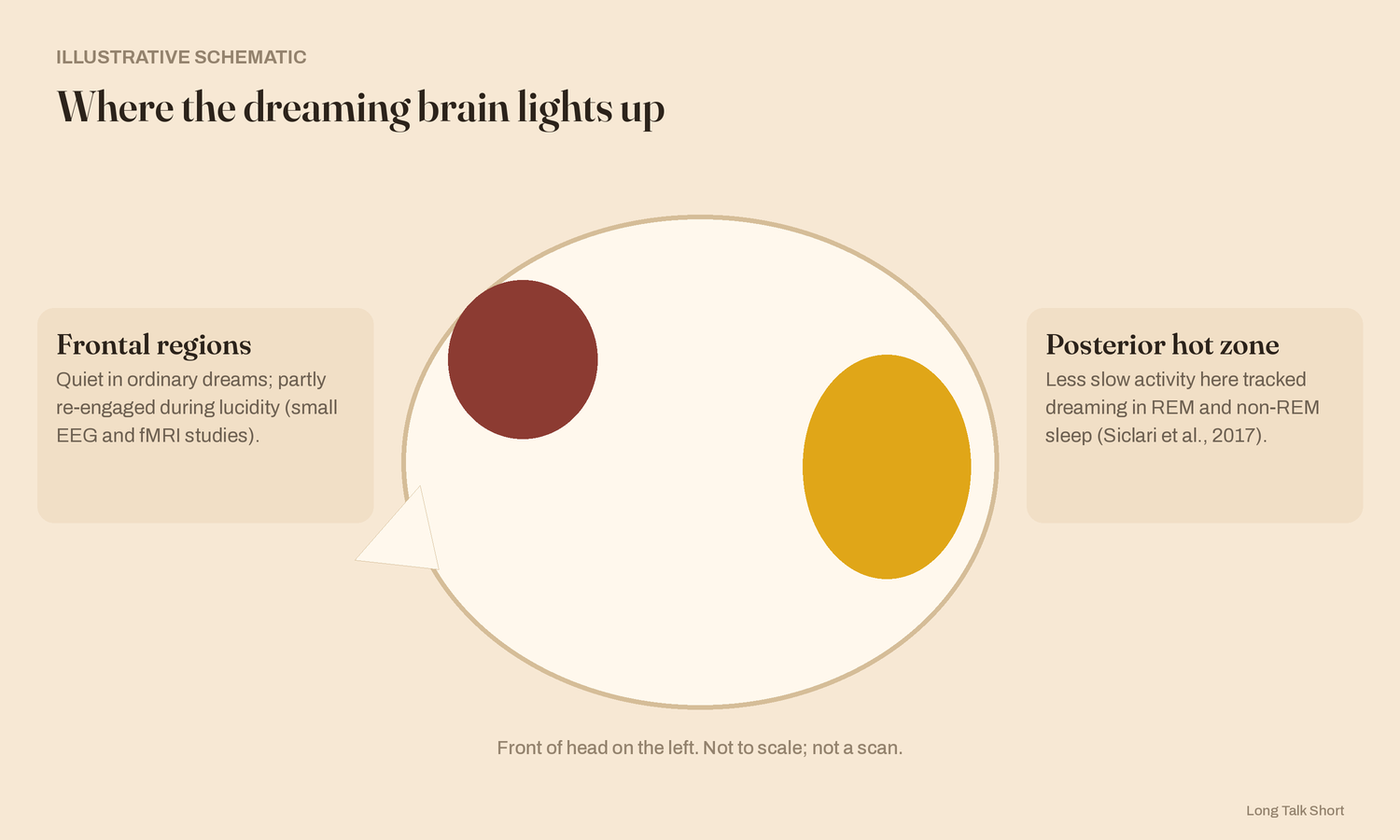
The finding: dreaming, in both REM and non-REM sleep, tracked a drop in slow activity in a "posterior hot zone" at the back of the brain.
Olicard says the team could then predict dreams "in 92% of cases." (translated from French) Close, but not quite. In a separate real-time test with seven people, the algorithm correctly flagged 91.6% of dreams and 80.7% of dreamless awakenings, about 87% overall.
Spotting a dream is one thing. Watching it is another.
3. Can AI play back your dreams?
Not yet. Olicard shows images rebuilt by AI from brain activity: an airplane, an owl, a letter.
They look like the work of Yukiyasu Kamitani's Kyoto lab, whose 2019 paper in PLOS Computational Biology reconstructed natural images, shapes and letters from fMRI scans. But there's a catch: that work decoded what people were looking at in a scanner, not dreams.
His idea that we'll one day "see dreams as films" (translated from French) is a forecast, as he admits, not a result.
Which brings us to the claim behind the title: a pill.
4. The lucid-dream pill
Olicard says lucid dreaming has "its own brain signature," (translated from French) a hybrid state in which the frontal lobe partly switches back on. Research supports that in outline:
- A 2009 EEG study by Ursula Voss's group found more frontal 40-Hz activity during lucidity.
- A 2012 fMRI case study led by Martin Dresler found prefrontal and parietal activation.
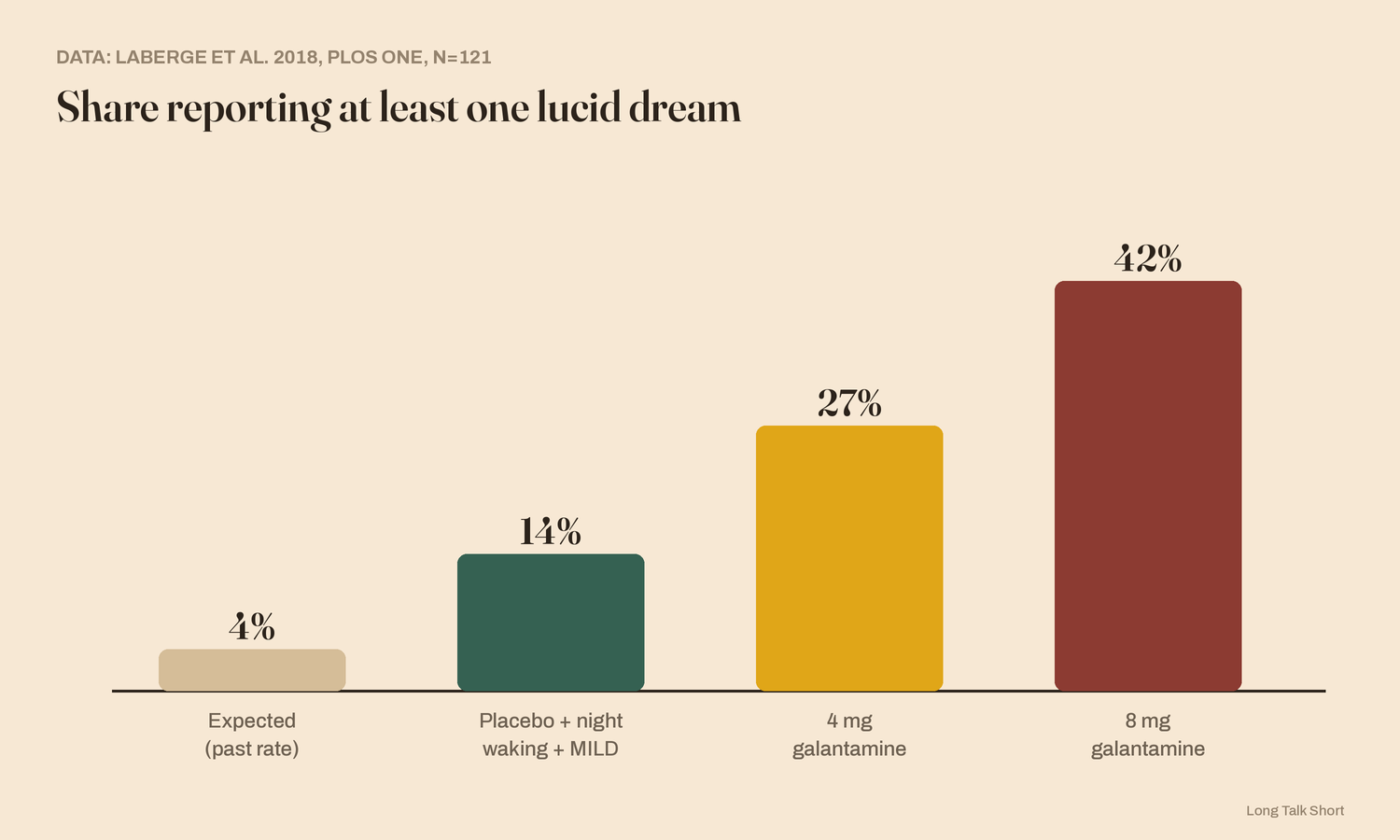
The pill is galantamine, a drug used for memory problems in Alzheimer's disease. In a 2018 double-blind trial led by Stephen LaBerge, 121 people woke about 4.5 hours after lights-out, took 0, 4 or 8 mg, stayed up at least 30 minutes, then practiced a mental technique called MILD as they fell back asleep.
At least one lucid dream was reported by:
- 14% on placebo
- 27% on 4 mg
- 42% on 8 mg
So "multiplies your chances by 3" (translated from French) is fair for the top dose. His "one chance in two" (translated from French) rounds 42% up.
Here's the part he skips: the placebo group still woke at night and used MILD. That routine alone tripled lucidity against the 4% their past rates predicted.
To his credit, Olicard added a warning while editing. Sleep drugs "mask problems," (translated from French) he says, there's "no long-term data" (translated from French) on galantamine, and he advises against websites selling it for lucid dreaming. The trial itself reported mild side effects in 12% of people, like stomach upset and insomnia, over just three nights.
So if the routine did much of the work, how do you do it without the pill?
5. The free method with the best evidence
The video never explains this, so this section is ours, not his.
In Denholm Aspy's 2017 Australian study of 169 people:
- Reality checks alone did nothing.
- Combined with waking in the night (wake back to bed, or WBTB) and MILD, they raised lucid nights from 9.4% to 17.4%.
- When people fell back asleep within five minutes of MILD, 45.8% of attempts worked.
In MILD, you rehearse a recent dream and repeat an intention such as "next time I'm dreaming, I'll remember I'm dreaming."
Aspy's 2020 international study of 355 people found MILD and a sensory technique called SSILD similarly effective, with MILD groups lucid on about 16.5% of nights, and no harm to sleep quality.
Weighing it: what holds up
The core science is solid. Lucid dreaming was verified in the lab decades ago, when sleepers signaled with pre-agreed eye movements during REM sleep: Keith Hearne in 1975, then Stephen LaBerge's Stanford team in a 1981 paper. In 2021, four labs reported in Current Biology that of 36 people tested, six answered questions correctly 29 times from inside lucid dreams, solving simple sums with eye signals.
It isn't rare. A 2016 meta-analysis by David Saunders and colleagues put lifetime prevalence at 55% and monthly lucid dreaming at 23%.
Several figures are unsourced. His 100,000 dreams a lifetime, five a night, 42% recalling a dream every morning and 34% weekly, 38% of dreams drawing on the past and 32% on the future: we couldn't confirm them. Large surveys report lower recall; one representative German sample found about 23% recalling dreams at least weekly.
Two headline numbers are rounded up. The Siclari "92%" is 91.6% for dreams and about 87% overall, from seven people. The galantamine "one in two" is 42%, in a sample chosen for high dream recall and interest in lucid dreaming.
The risks deserve more weight. Induction methods work by interrupting sleep, and researchers have warned that deliberate practice may blur the line between sleep and waking. In a two-month study of 78 students, Aviram and Soffer-Dudek found deliberate induction predicted rises in dissociation and schizotypy, while spontaneous lucid dreams did not. That shows prediction, not proof of harm. Lucid dreaming is also linked to sleep paralysis, which is more consistently tied to poor sleep and distress.
Long Talk Short
- A lucid dream means knowing you're dreaming. Controlling it is a separate, further skill.
- Everyone dreams. Forgetting dreams fast is normal.
- Ordinary dreams were tracked to a posterior "hot zone." Lucidity brings some frontal activity back.
- Galantamine raised lucid dreams from 14% to 42% in one trial, but long-term effects are untested and it's a prescription drug.
- Drug-free routines, WBTB plus MILD and falling back asleep fast, have the best evidence. Reality checks alone don't.
The one thing to remember: lucidity is a trainable habit of noticing, but it costs sleep, so guard the sleep first.
Source: Fabien Olicard, "[Cerveau] Contrôler ses rêves" (Controlling your dreams), a French-language video on Facebook. Quotes are translated from French by Long Talk Short. This is an independent summary of that video and is not affiliated with Fabien Olicard.
This article is for general information only and is not medical advice. Don't take galantamine or any other drug to induce dreams without a doctor's advice. If you have insomnia, sleep paralysis, nightmares or another sleep disorder, talk to a doctor before trying induction techniques.