Trust Is the Product: Mark Cuban on Why Healthcare Costs Hide in the Contracts, and How to Drag Them Out
Mark Cuban says trust is the real product at Cost Plus Drugs, and US healthcare stays expensive because prices and contracts are hidden. His fixes: published markups, direct contracts and AI before you sign.
Mark Cuban runs a pharmacy that tells you exactly how much it marks up your pills. He says that's the whole business.
His argument: American healthcare is expensive mostly because the prices and contracts are hidden. Publish them, and a lot of the cost starts to fall away.
Mark Cuban Cost Plus Drug Company sells generic drugs online at the price it pays, plus a fixed 15% markup and a pharmacy fee, and spends nothing on advertising. Talking to Julie Yoo and Erik Torenberg on the a16z podcast, Cuban explains how he's applying the same idea, publish the price and show the math, to drug manufacturing, hospital supplies and the health-plan contracts employers sign.
Trust is still our primary product
In short: publish prices, simplify deals with doctors, and use AI to read contracts before you sign them, because after signing it can't help you.
1. A pharmacy that shows its markup
Cost Plus Drugs started with a short list of generics in January 2022; Cuban now puts it at about 4,000 products. The published price is the selling point: if a competitor ever undercut the markup, he says, customers would stay because they believe the number.
- The Team Cuban Card network, he says, covers about 17,000 independent pharmacies, each paid a $12 fee per prescription.
- He admits the trade-off: a very cheap generic can cost more at a local pharmacy than at a big chain. The network pays off on expensive drugs such as insulins and biosimilars.
Then he started making the drugs himself.
2. Factories, pods and a hospital marketplace
- The Dallas plant began with a cold email from Dr. Alex Oshmyansky about drugs on the FDA's shortage list. It now makes sterile injectables, and Cuban says automation lets it switch products every four hours.
- "Pods" are factories the size of a tractor-trailer, which Cuban prices at about $20 million each and says the government will buy first. They're meant to make small batches on site, including one-patient therapies for rare diseases.
- Cost Plus Marketplace sells sterile injectables to hospitals at cost plus 10 to 12%. Getting a hospital chief executive to agree is easy, he says; the purchasing department is the hard part.
3. Where the money hides
His bigger target is the employer health plan. Cuban says about 60% of people with job-based coverage are in self-insured plans: the employer pays the claims and hires a big insurer only to administer them. That, he says, is where the waste is.
- Spread pricing: administrators charge the employer more than they pay the provider and keep the difference.
- Hidden claims files: employers often can't see their own records of what was billed (837) and paid (835).
- Unreadable contracts: he calls the paperwork "contractual terrorism," citing the City of Dallas's pharmacy-benefit contract, which he says runs to 1,335 pages.
- Money moving inside one company: Cuban says UnitedHealth has more than 3,000 subsidiaries booking about $150 billion a year in sales between them. When one company owns the insurer, the pharmacy-benefit manager, the clinics and the data, payments between its arms can look like costs.
4. His deal with doctors
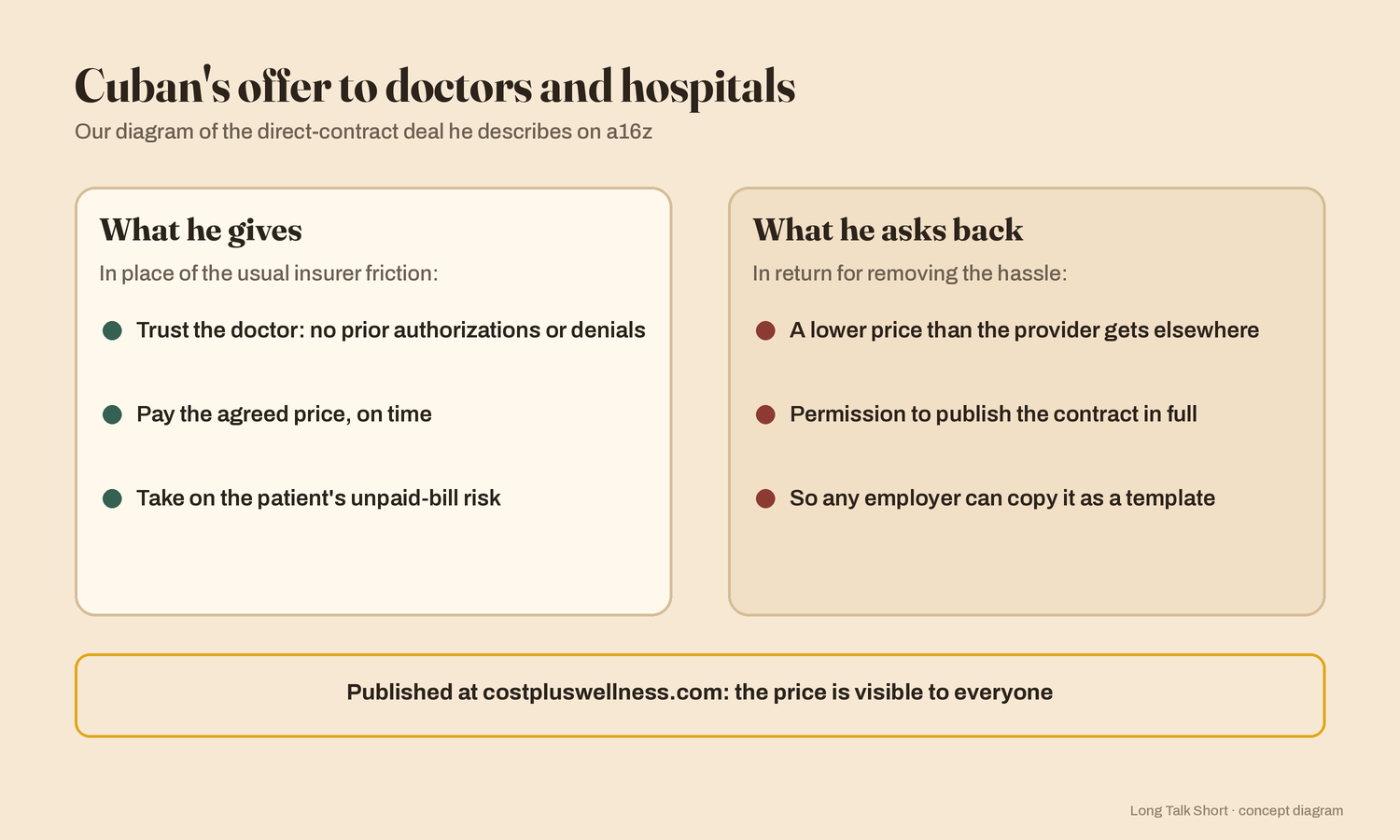
Cuban's answer is direct contracting through Cost Plus Wellness. For his own companies' plans he offers providers three things:
- Trust: no prior authorizations or denials outside something "crazy."
- On-time payment of the agreed price.
- Taking on the patient's unpaid share, so the provider isn't, in his words, "a subprime lender."
In return he wants a lower price and the right to publish the signed contract, so any employer can copy it.
His policy list: make every contract paid with taxpayer money public; let cash paid outside a plan count toward the deductible (he says eight states already do); make nonprofit hospitals publish their general ledgers. He also sketches a plan where a deposit account and a loan cover routine costs and stop-loss insurance covers catastrophes. Insurers would object, he argues, but about 72% of their revenue already comes from taxpayers.
5. What AI can and can't do
Once a contract is signed, AI can't change it, and AI tools on both sides of billing disputes mostly cancel each other out. The leverage comes earlier. If every employer ran its benefits contracts through AI before signing and negotiated from what it found, he says:
the cost of health care in this country would drop like a rock
He describes using AI agents to find every state body with an open-records process and draft requests for its contracts, and expects drug prices to start appearing in doctors' prescribing screens through deals with Epic and Amazon.
Weighing it: what holds up
The company facts mostly check out. Cost Plus Drugs launched on January 19, 2022, but contemporary coverage (NPR, Fortune and the company's release) says it opened with 100 generics, not the 111 Cuban recalls. Launch pricing was cost plus 15%, plus a $3 pharmacist fee and shipping. Cost Plus Wellness publishes unredacted direct contracts at costpluswellness.com, and Becker's and STAT have reported on the trailer-sized pods.
His UnitedHealth figures are close. Reporting based on company filings counted about 2,694 subsidiaries in 2024, below his "more than 3,000." UnitedHealth's 2024 accounts show $150.9 billion in intercompany eliminations, about 27% of its $400.3 billion revenue, matching his $150 billion.
Other numbers, roughly right. He said about 40% of Americans can't cover a $400 emergency; the Federal Reserve's 2025 survey found 37% wouldn't cover it with cash or its equivalent, and 12% couldn't cover it by any means. He put the FDA fee for a generic application at about $365,000; it was $358,247 in fiscal 2026 and is $375,684 in fiscal 2027. Federal rules already require nonprofit hospitals to have written financial-assistance policies and cap charges to eligible patients.
Not checked: the 4,000 products, the 17,000 pharmacies and $12 fee, the pod price and buyer, the 1,335-page Dallas contract, the 60% self-insured share, the eight states, the 72% taxpayer share and the Epic and Amazon timing.
Interests: Cuban owns the businesses he describes, so his case for transparency is also a sales pitch for them. It can be both.
Long Talk Short
- Cost Plus Drugs sells generics at a published 15% markup with no ad spending; Cuban says trust is the product.
- He's expanding into partner pharmacies, a Dallas sterile-injectables plant, trailer-sized "pods" and a hospital marketplace at cost plus 10 to 12%.
- His villain is opacity: spread pricing, hidden claims files, unreadable contracts and money moving between arms of one company.
- His direct-contract deal: trust the doctor, pay on time, carry the patient's credit risk, then publish the contract for anyone to copy.
- AI can't fix a bad contract after signing. Use it to read the contract before you sign.
The one thing to remember: when a price can't be seen, assume someone is profiting from that, and ask to see the contract before you sign.
Source: "Mark Cuban on Why AI Could Turn Solo Founders Into Trillionaires", a16z, with Julie Yoo and Erik Torenberg. Despite the title, most of the conversation is about healthcare. This is an independent summary and is not affiliated with a16z, Mark Cuban or Cost Plus Drugs.
This article is for general information only and is not medical, legal or investment advice. Quotes are taken from automatic captions and may contain small transcription errors.