Memory Series, Part 1: How a Six-Time Memory Champion Remembers (It Starts at Your Front Door)
Memory Series, Part 1. Six-time USA Memory Champion Nelson Dellis says he was never a natural. His main tool is the ancient memory palace, and anyone can learn it. Plus the review schedule the episode skips, and a fact-check of its wilder claims.
Memory Series, Part 1 of 3.
Nelson Dellis has won the USA Memory Championship six times. He'll tell you he was never a natural. He started training around 2009, worried about his own future after his grandmother developed Alzheimer's, and found that the people doing astonishing memory feats were using learnable tricks.
On The Danny Jones Podcast, he explains the oldest of them, the memory palace, which still does most of the work. The first hour is a practical masterclass. The rest drifts into memory living outside the brain and remote viewing, which deserve far more doubt. Here's the useful part in five minutes, plus the one piece the episode leaves out.
In short: turn what you want to remember into vivid pictures, park them along a route you already know, and pay real attention while you do it. That part is well supported. The episode never gets to how to keep those memories for months, so we add the missing piece: spaced review.
1. A banquet hall and a lyric poet
The origin story comes up around the four-minute mark. The Greek poet Simonides stepped out of a banquet moments before the roof collapsed. He could identify the crushed dead by picturing where each guest had sat. Dellis calls it the famous story behind the memory palace, not proof the Greeks invented it.
His lesson: "our brains remember spatial information really well." Numbers, passwords and lists are abstract symbols our brains weren't built for. Pictures of familiar things, placed in familiar spaces, are what we hold onto.
Forgetting, he argues, is often a retrieval failure: the information went in, but you never filed it somewhere you can walk back to.
2. How the memory palace works
From about 8:00, Dellis breaks it into two jobs:
- Convert the information into pictures.
- Organize those pictures by attaching them, in order, to locations along a route you know well: front door, kitchen, stairway.
To recall, you walk the route in your mind and look at what you left at each stop.
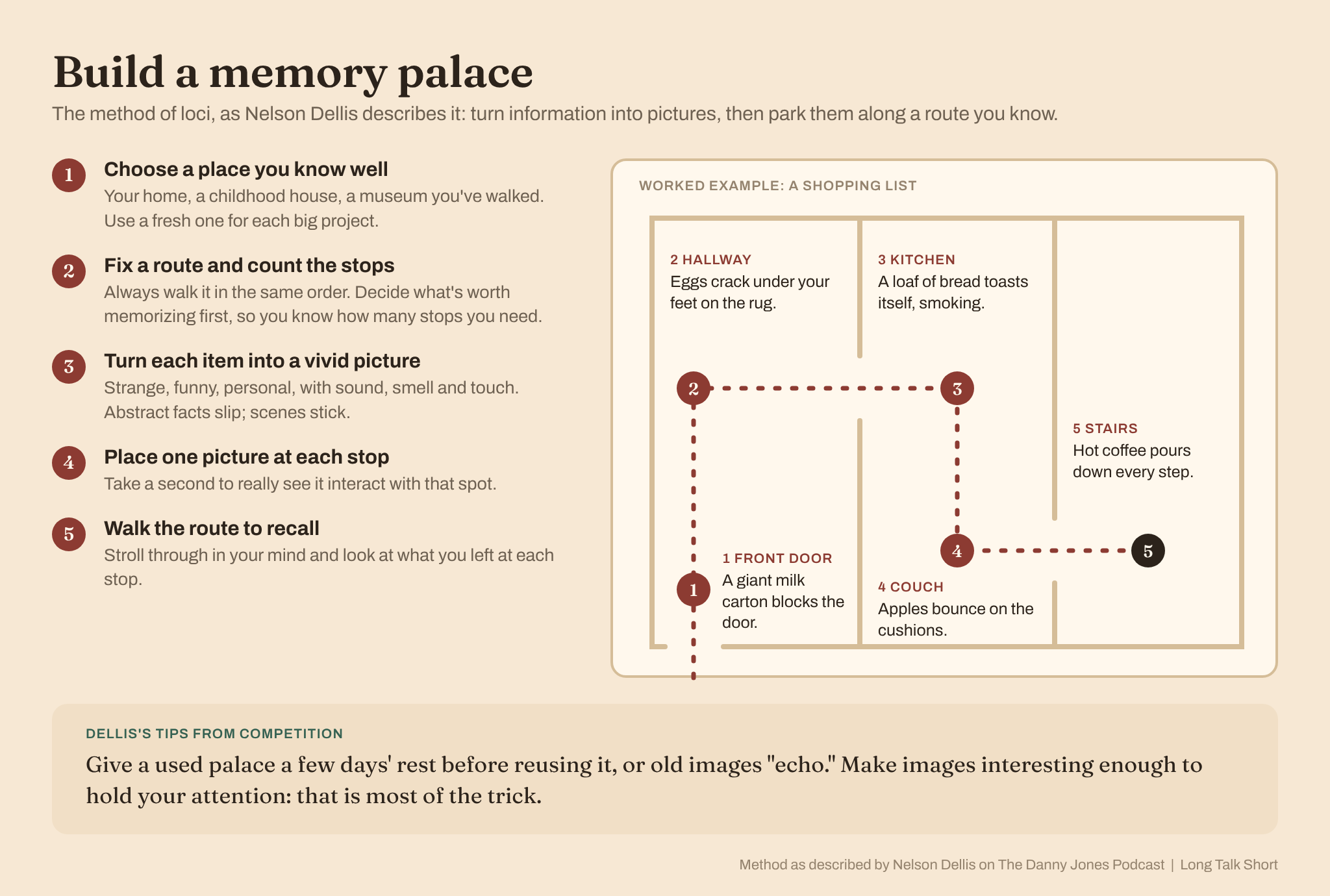
A few details make it work in practice:
- Size the palace first. Decide what is actually worth memorizing, then count the stops you need. For a book, he memorizes key ideas, not every word, and builds a fresh palace just for that book.
- Make the images interesting. In competition, each playing card is a person doing an action with an object. The ace of hearts is his friend Arno. Three cards become one strange little scene at one stop.
- Let palaces rest. Reuse one too soon and you get "echoes" of the old images. For a final, he picks one he hasn't used in a few days.
Top competitors keep dozens to hundreds of palaces. The US championship, he explains around 18:00, tests numbers, a deck of cards, names and faces and an unpublished poem, then ends with two decks in five minutes.
3. Read so it sticks
The talk turns to everyday learning, and Dellis's advice is refreshingly unexotic:
- Attention is the technique. Stripped down, memory methods are "really just paying a lot of attention to something." Interest drives attention, so make dry material vivid.
- Read with more senses. A paper book you hold, underline and annotate gives memory more to hook onto than audio "zipping through your ear."
- Vary the setting. Reading in different places can tie what you read to where you were. Jones's habit of one instrumental soundtrack per book fits the same idea.
- Triage your speed. Dellis plays repetitive self-help audiobooks at 2x, then slows down or replays the parts he wants to keep. Books he loves get slow, analog reading.
- Chunk big books. Split a long book into sessions, such as eight 30-minute sittings, and picture when and where each will happen.
4. The missing piece: spaced repetition
Dellis never describes a review schedule; the closest he gets is rereading Lord of the Rings every year. Yet spacing out reviews is one of the best-replicated findings in learning research. A palace gets you a vivid first encoding. Reviewing it at widening intervals is what keeps it.
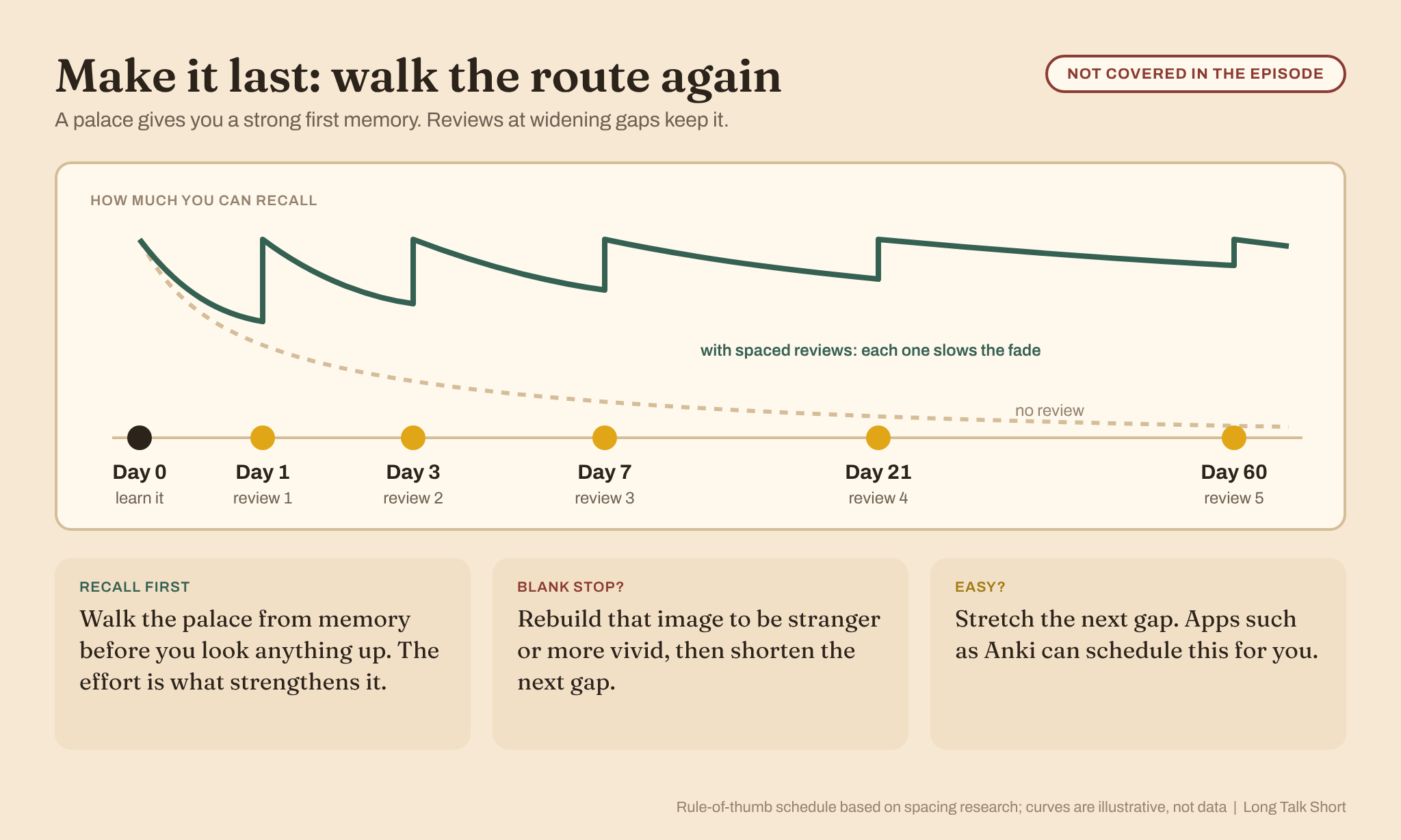
Keep it simple: walk the palace from memory a day later, then after three days, a week, three weeks and two months. Try to recall before you check. If a stop is blank, fix that image and shorten the next gap. Apps such as Anki automate the timing.
Weighing it: what holds up
Solid ground: in a 2017 study in Neuron, Martin Dresler and colleagues found top memory athletes did not have unusual brains, and ordinary people who practiced the method of loci for six weeks more than doubled their word-list recall, with brain connectivity shifting toward the athletes' pattern. An earlier study by Eleanor Maguire reached a similar verdict: champions use strategy, chiefly spatial, not special anatomy.
Records, with footnotes: Dellis won USA titles in 2011, 2012, 2014, 2015, 2021 and 2024; his best world finish was seventh in 2012. His sub-30-second deck was a practice time; his listed competition best is 40.65 seconds. Alex Mullen won three straight world titles, 2015 to 2017. The first sub-30 competitive deck came from Britain's Ben Pridmore in 2007 before Germany's Simon Reinhard pushed it near 20. The official record is now 12.74 seconds, set by Mongolia's Shijir-Erdene Bat-Enkh in 2018.
History, mostly right: Simonides was a lyric poet of the sixth and fifth centuries BC, not the fourth as Jones says, and the story reaches us through Cicero, centuries later. Lynne Kelly's The Memory Code does argue that oral cultures used similar systems, including the Luba people's lukasa memory boards, and floats the Nazca lines as a memory space, which is speculation. The claim that Chinese speakers hold longer digit strings because their number words are shorter is supported by research.
The weaker second half: the idea that memory isn't stored in the brain leans on old lesion experiments and Rupert Sheldrake's analogy of the brain as a TV receiver. Modern neuroscience finds memory distributed across networks, and researchers can tag and reactivate specific memory traces in mice. The government's Stargate remote-viewing program was shut down in 1995 after a review concluded it had never produced useful intelligence. In the on-air demo, Jones scored himself zero, and Dellis rated his own attempt 4.5 out of 10 under conditions that were not blinded. To his credit, Dellis tells cautionary stories of being fooled, including by a Nepali performer who claimed to memorize books by scanning pages.
Promotion: ads for ButcherBox, Ridge, HexClad and White Rabbit Energy, plus Jones's Patreon and Dellis's YouTube channel, books and website. The "superhuman" title oversells it; Dellis's own point is that this is trainable.
Long Talk Short
- Pick a place you know, fix a route, and place one vivid image at each stop.
- Decide what is worth memorizing before you spend palace space on it.
- Make images strange, personal and multisensory; boring images fade.
- Read actively: hold the book, underline, vary where you read, and slow down for what matters.
- Review on a widening schedule; the episode skips this, but it is what makes memories last.
- Treat the remote-viewing segment as entertainment, not evidence.
The one thing to remember: a great memory is mostly attention plus a filing system, and anyone can build both. Start with your front door.
This is Part 1 of a three-part Long Talk Short series on memory. Part 2 is coming next.
Source: The Danny Jones Podcast, "The Ancient Greek Technique to Gain Super Human Memory | Nelson Dellis". This is an independent summary of that episode and is not affiliated with the show.
This article is for general information only. Memory techniques are learning tools, not treatments. If you're worried about memory loss in yourself or someone close to you, please talk to a doctor.