You Never See the Sun as It Is: Michelle Thaller on Why Every Telescope Is a Time Machine
Astronomer Michelle Thaller explains why every telescope is a time machine: sunlight is about eight minutes old, Andromeda is 2.5 million years gone, and the farthest light is a baby picture of the universe. Figures checked.
If you have been thinking of a telescope as a way to see faraway things as they are, Michelle Thaller’s point is that you never get that luxury. Light takes time to travel. The farther the object, the older the picture. “There’s no way that you can’t be a time traveler,” she says. “You can’t escape this.” A telescope, in her telling, is not only a way of looking out. It is a “ringside seat” to a universe that has already changed.
The video is “An astronomer explains why every telescope is like a time machine | Michelle Thaller: Full Interview,” a Big Think conversation, at youtube.com/watch?v=xXROVLqhchg. The official YouTube description is a placeholder template. Auto-generated captions were used for wording. This article stays with the light-travel argument, the numbers she gives for it, and the gravitational-lensing example she uses to look still farther back. Her figures are checked against NASA, ESA, and the Planck results in “Weighing it” below.
In short: Thaller’s rule is that light takes time to travel, so every telescope shows the past. The Sun is about eight minutes old when you see it, Andromeda about 2.5 million years, and the cosmic microwave background, the “baby picture of the universe,” comes from a few hundred thousand years after the Big Bang. Her numbers hold up with ordinary rounding.
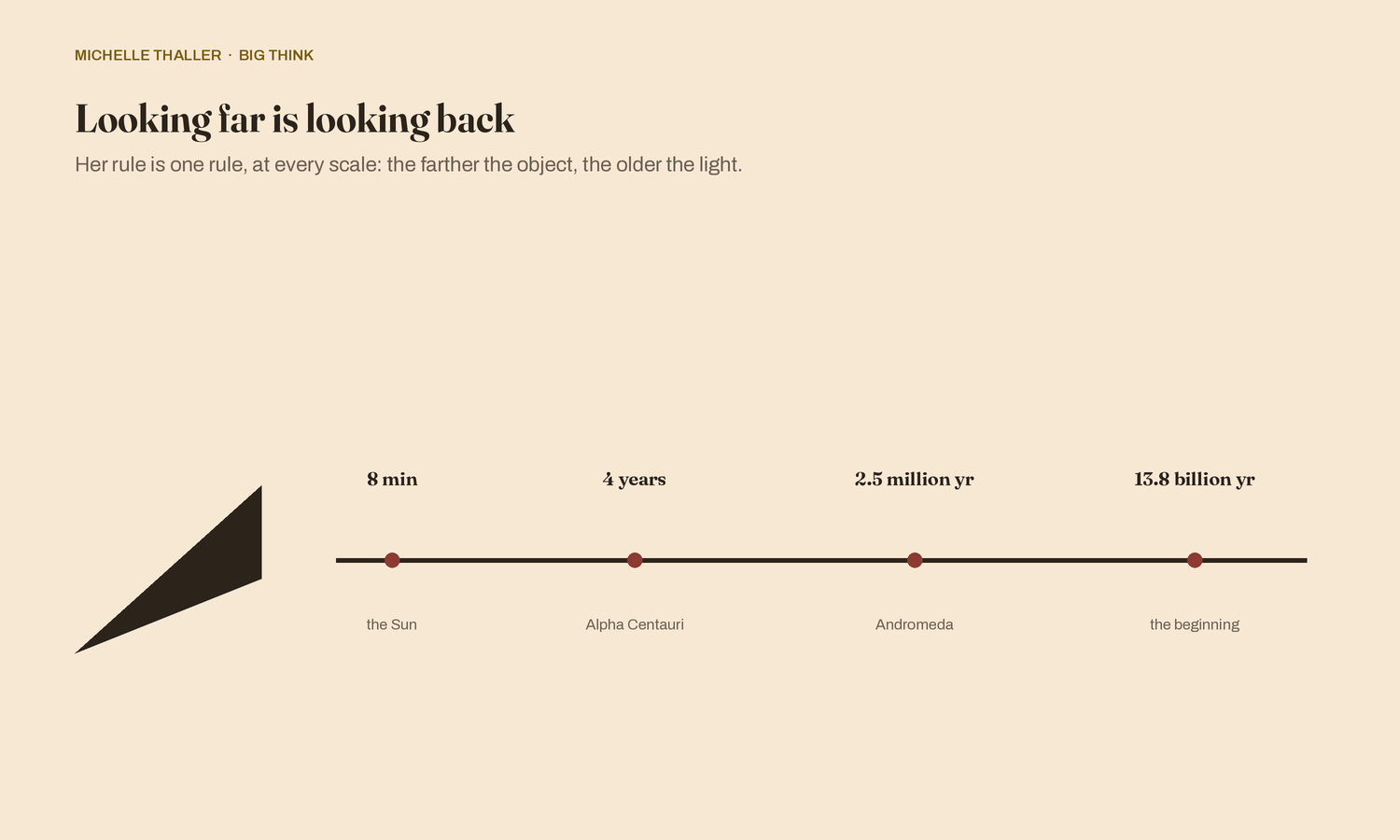
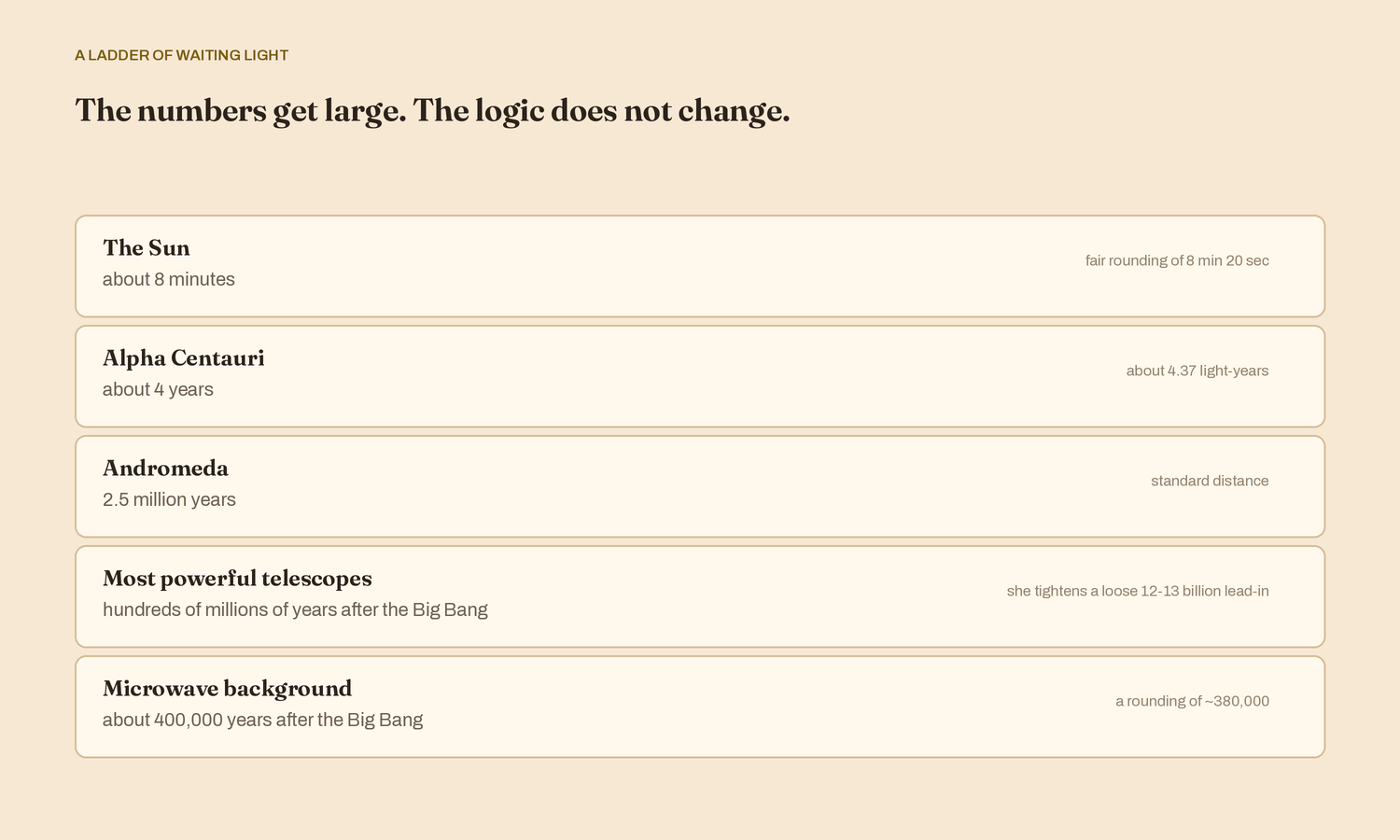
She starts with the unit that makes the distances sayable. “A light year is the distance that light travels in one year. Light going at 186,000 miles per second.” Run that speed for a year and “you cover approximately 6 trillion miles,” a figure she admits no human brain really holds. Then she brings it back to the familiar sky. Light from the Sun “takes about 8 minutes. So when you see the sun in the sky, you’re seeing it as it was eight minutes ago. There’s no way you can see it right now.” “The nearest star to us, Alpha Centauri,” is “about four light years away. So you see it in the sky as it was four years ago.” Keep adding distance. “The nearest other galaxy we can see, Andromeda, is 2 and a half million light years away,” and “you can actually see Andromeda with the unaided human eye” — light that left before recorded human civilization.
1. A universe you can watch change
That is why, for an astronomer, “it’s not just a vast universe. It’s a universe in time.” With a telescope, “you kind of have this ringside seat to actually watch the whole universe change, see how it formed, see what things were like in the past.” Some of those objects “no longer exist in our universe.” “We know for a fact that the universe has changed. That’s not a theory. That’s not a guess.” Look farther out, and “you have to see the universe as it was, farther and farther back in time.”
She then gets to the reach of the most powerful telescopes. They can see the universe “as it was, on the order of 12 13 billion years ago.” “You’re getting close to the beginning. We believe the Big Bang happened about 13.8 billion years ago. So you’re now talking about looking back to a time only some hundreds of millions of years after the Big Bang.” Things at that distance “look very different indeed.” She does not name the James Webb Space Telescope here; she is describing the lookback, not a particular observatory’s press release.
The farthest look, she says, is not even a telescope in the ordinary sense. “Satellite images… can actually look back to a time about 400,000 years after the Big Bang.” (The standard figure is about 380,000 years, so she is rounding.) That number is “a specific event. It’s the first time the universe ever became transparent to light.” Before that, “the universe was once so hot and so dense that the entirety of space, everything was glowing like the surface of the sun.” The cosmic microwave background is, in her phrase, “a baby picture of the universe,” light that “left as high energy light” and “now comes to us as these very low energy microwaves.” “That’s the limit that we can ever look with a telescope.”
2. Natural telescopes, and a star that is no longer there
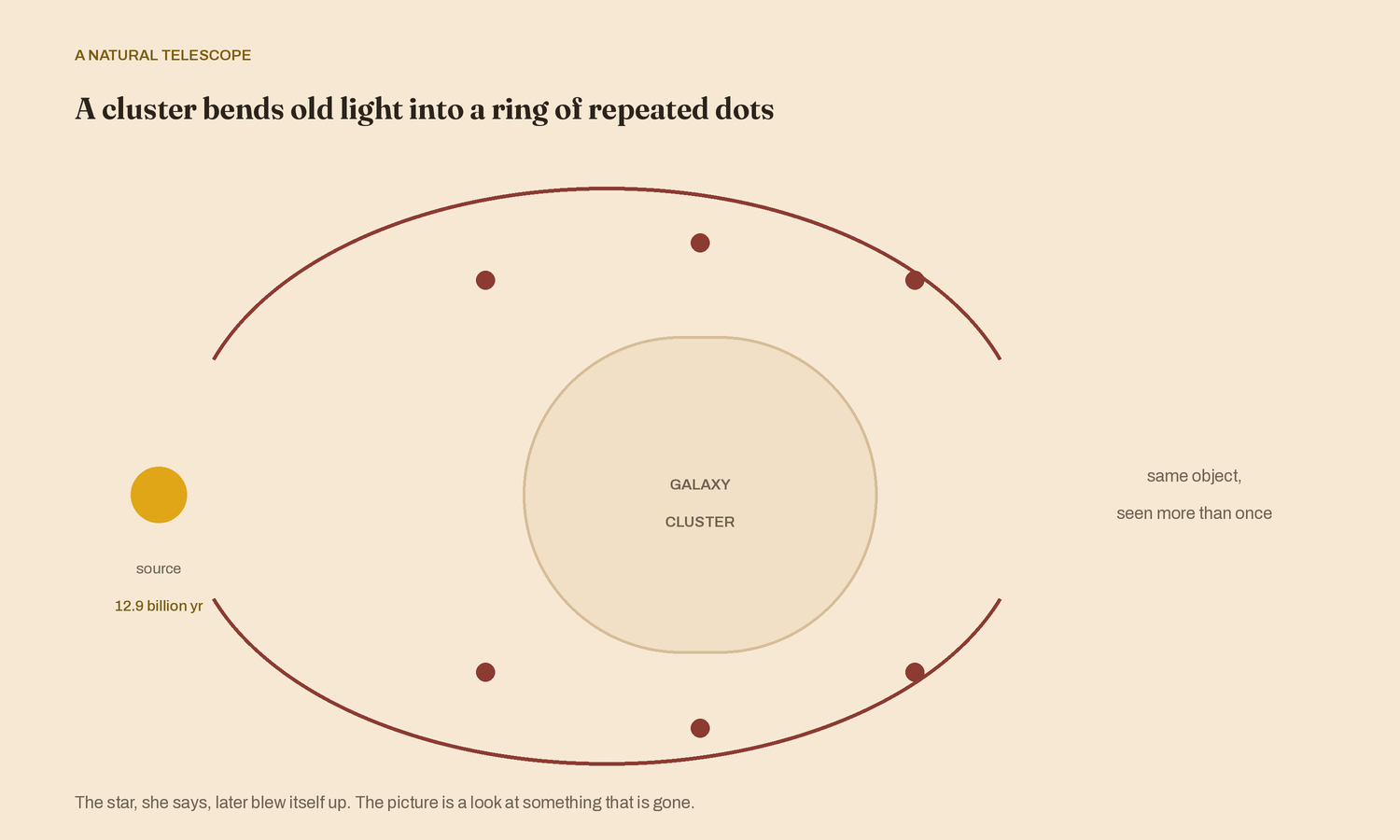
She turns to gravitational lensing: mass that bends light, so a galaxy cluster can act as a “natural telescope” and show you objects “even farther than you should.” Hubble, looking along the edge of one of these lenses, saw “a series of little smudged out dots… kind of on a ring like beads on a necklace.” Careful work showed they were “actually the same object,” an image “being broken up by the gravitational lens,” “a cluster of stars” or “one huge massive star.” “We’re looking back to a time about 12.9 billion years ago. That’s how far away this object is. The light took that long to get to us.” The star “is less than a billion years after the beginning of the universe,” and, she adds, it later “blew itself up. It’s not there anymore.” The picture is a look at something that does not exist in our time.
The rest of the interview opens out into early black holes, “pseudo stars,” and the first image of a black hole — still, in her framing, a problem of light and time. The spine remains the same rule: distance is delay.
Weighing it: what holds up
The light-travel times she uses are in standard ranges, with ordinary rounding. Light from the Sun takes about 8 minutes 20 seconds; “about 8 minutes” is fair. The speed of light is about 186,282 miles per second; 186,000 is the usual rounded figure. A light-year is about 5.88 trillion miles; “approximately 6 trillion” is the common rounding. Alpha Centauri is about 4.37 light-years away; “about four” is loose but in bounds. Strictly, the nearest single star is Proxima Centauri, about 4.24 light-years away and part of the Alpha Centauri system. Andromeda is about 2.5 million light-years away, as she says; it is the nearest large spiral galaxy, though the Large and Small Magellanic Clouds, visible from the Southern Hemisphere, are closer, at roughly 160,000 and 200,000 light-years. The age of the universe at “about 13.8 billion years” matches the Planck 2018 results (13.787 ± 0.020 billion years with baryon acoustic oscillation data). The “400,000 years” she gives for first transparency rounds recombination, which ESA puts at about 380,000 years after the Big Bang. Her “on the order of 12 13 billion years” is a loose lead-in; she then tightens it to hundreds of millions of years after the Big Bang, which holds: Webb has confirmed galaxy MoM-z14 as it was about 280 million years after the Big Bang, a lookback of about 13.5 billion years (NASA). She does not name Webb, or the lensed star. Its 12.9-billion-year lookback and its age of less than a billion years after the Big Bang match Earendel, the most distant individual star detected (NASA), though the interview does not name it. Lookback time should not be confused with comoving distance, about 46 billion light-years for the microwave background. Her point that the microwave background is “the limit” holds for telescopes that collect light; neutrinos and gravitational waves could in principle reach earlier. Auto-generated captions are close, not word-perfect. The official description is a template and cannot serve as show notes.
Related reading: Origin Mysteries Physics Can’t Yet Explain · Gravity Without Dark Matter?
Long Talk Short
- Thaller’s rule is that every view of a distant object is a view of the past, from sunlight eight minutes old to Andromeda two and a half million years ago.
- A telescope is, in her phrase, a ringside seat: some of the objects you can still see no longer exist.
- She puts the Big Bang at about 13.8 billion years ago, the reach of the most powerful telescopes at hundreds of millions of years after that, and the microwave background at about 400,000 years after the beginning (about 380,000 by the standard figure), when the universe first became transparent to light.
- Gravitational lenses, including a Hubble image she dates at 12.9 billion years, look still farther along the same time line.
The one thing to remember: Looking out and looking back are the same act: the farther the object, the older the light, and the deeper the look, the earlier the universe you are seeing.
Independent summary; not affiliated with Big Think or Michelle Thaller. Astronomy figures checked against NASA, ESA, and the Planck results.
Source: Big Think, “An astronomer explains why every telescope is like a time machine | Michelle Thaller: Full Interview,” on YouTube (linked above); checked figures are linked in the article. Independent summary; not affiliated with the channel or its guest.