More Information, Not More Truth: Yuval Noah Harari's Nexus on Why AI Is an Agent, Not a Tool
Yuval Noah Harari's Nexus argues information connects people more than it reveals truth, and that AI is the first technology that can decide for itself. His case, what it means for democracy, and the pushback.
Your phone holds more information than the Library of Alexandria. So why, asks Yuval Noah Harari, aren't we any wiser?
With more information moving faster than ever, he writes, "humanity is closer than ever to annihilating itself." Nexus (2024), the historian's account of information networks from the Stone Age to AI, sets out to explain how that can be.
His answer has two parts. Information was never mainly about truth. And the newest network is different from every one before it, because it can decide things by itself.
In short: Harari argues that information mostly connects people rather than describing the world, so more of it doesn't automatically mean more truth. What keeps societies honest is institutions that catch and fix their own mistakes. AI, which he calls an agent rather than a tool, puts those institutions, and democracy, under new strain. Reviewers liked the history more than the theory.
1. Information connects before it informs
Harari starts by attacking two views:
- The naive view: if information flows freely, errors get exposed and truth wins, so more information means more wisdom and power.
- The populist view: all information is a weapon in a struggle for power, and truth is a myth.
His alternative: information's main job is to link people into networks. Shared stories, scriptures, laws and lists let strangers cooperate at scale. Some of those stories are true, many aren't, and a network can run very well on fiction for a long time. Order, in his account, often matters more to a network than truth.
Bureaucracy is the second great invention: documents like a deed or a tax record that create reality rather than describe it.
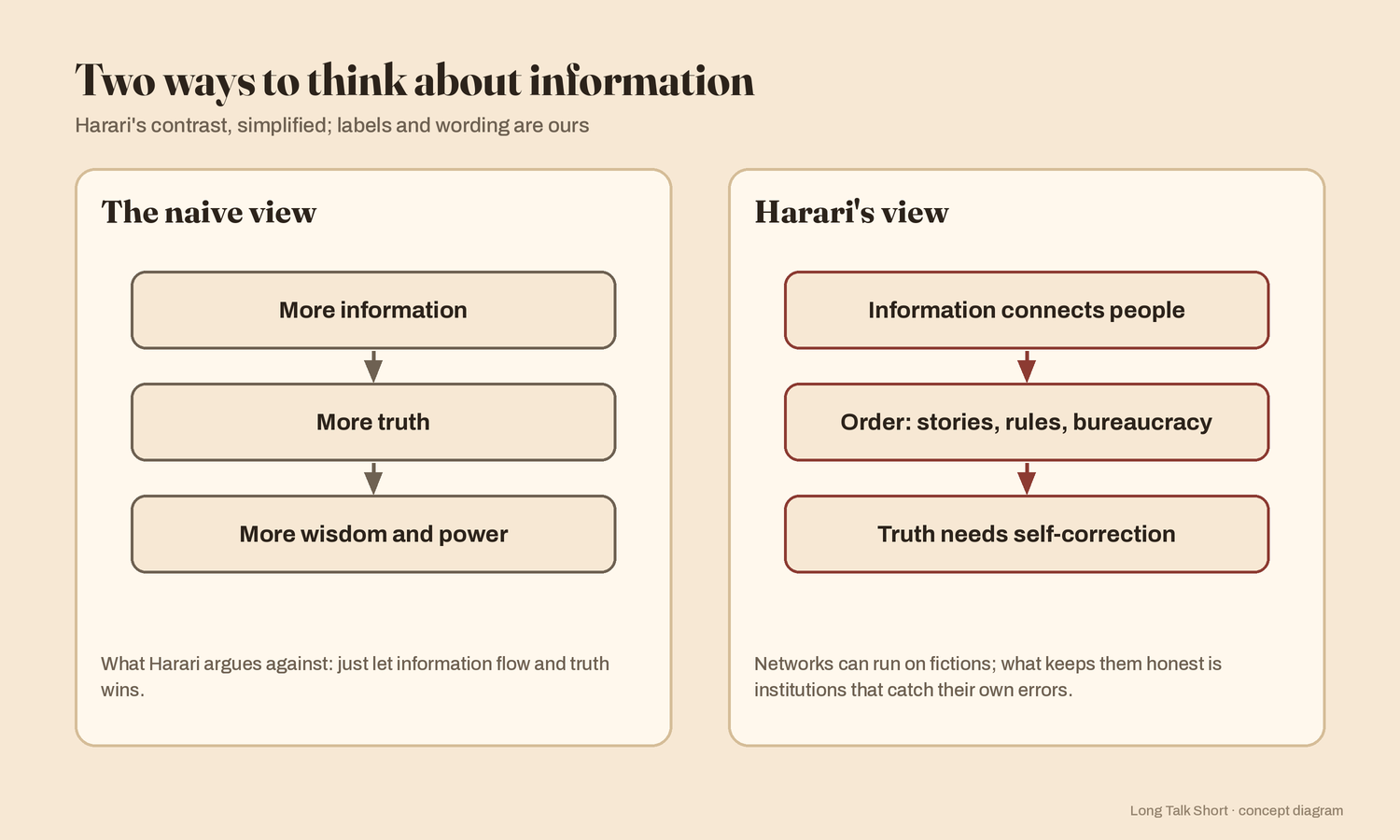
If information doesn't sort itself into truth, something else has to.
2. Self-correction is the real test
Harari's answer is self-correcting mechanisms: institutions built to find and admit their own errors. He contrasts a church that treats its scripture as infallible with science, which rewards people for exposing mistakes, including its founders'.
The printing press is his warning. It didn't usher in an age of reason on its own. It also helped spread the Malleus Maleficarum, a witch-hunting manual first printed in 1487, during decades of trials across Europe that historians estimate killed tens of thousands of people.
Political systems are information networks too:
- Dictatorships pull all information to one centre and have weak ways of correcting it.
- Democracies spread it across many independent nodes, such as courts, a free press and elections, so they can notice and fix errors. That, he argues, is the real case for democracy.
3. The first technology that decides
Then comes the turn that drives the book. In an extract published by the Guardian, Harari writes:
AI is an unprecedented threat to humanity because it is the first technology in history that can make decisions and create new ideas by itself.
A nuclear bomb can't decide whom to kill or design a better bomb. AI systems can do versions of both. "AI isn't a tool – it's an agent."
He suggests reading AI as alien intelligence rather than artificial intelligence. His emblem is move 37, played by DeepMind's AlphaGo against Go champion Lee Sedol in 2016: a move few human experts would have considered, which helped it win, and which its creators couldn't fully explain. For democracy, that opacity is the danger:
If more and more decisions about people's lives are made in a black box, so voters cannot understand and challenge them, democracy ceases to function.
There's an example already. A 2022 Amnesty International report found that Facebook's algorithms substantially contributed to the violence against the Rohingya in Myanmar in 2017 by amplifying hateful content. No one at the company chose that outcome; a system built to maximise engagement did. Between countries, Harari warns of a "silicon curtain" splitting the world into rival digital spheres, with countries that lack AI becoming data colonies of those that have it.
His prescriptions are modest. Summaries of the book list principles such as:
- Benevolence: data about people should be used to help them.
- Decentralisation: don't merge all information in one place.
- Mutuality: if governments and companies watch citizens more, citizens should be able to watch them more.
- Room to change and rest.
Above all: build and protect institutions that can correct themselves.
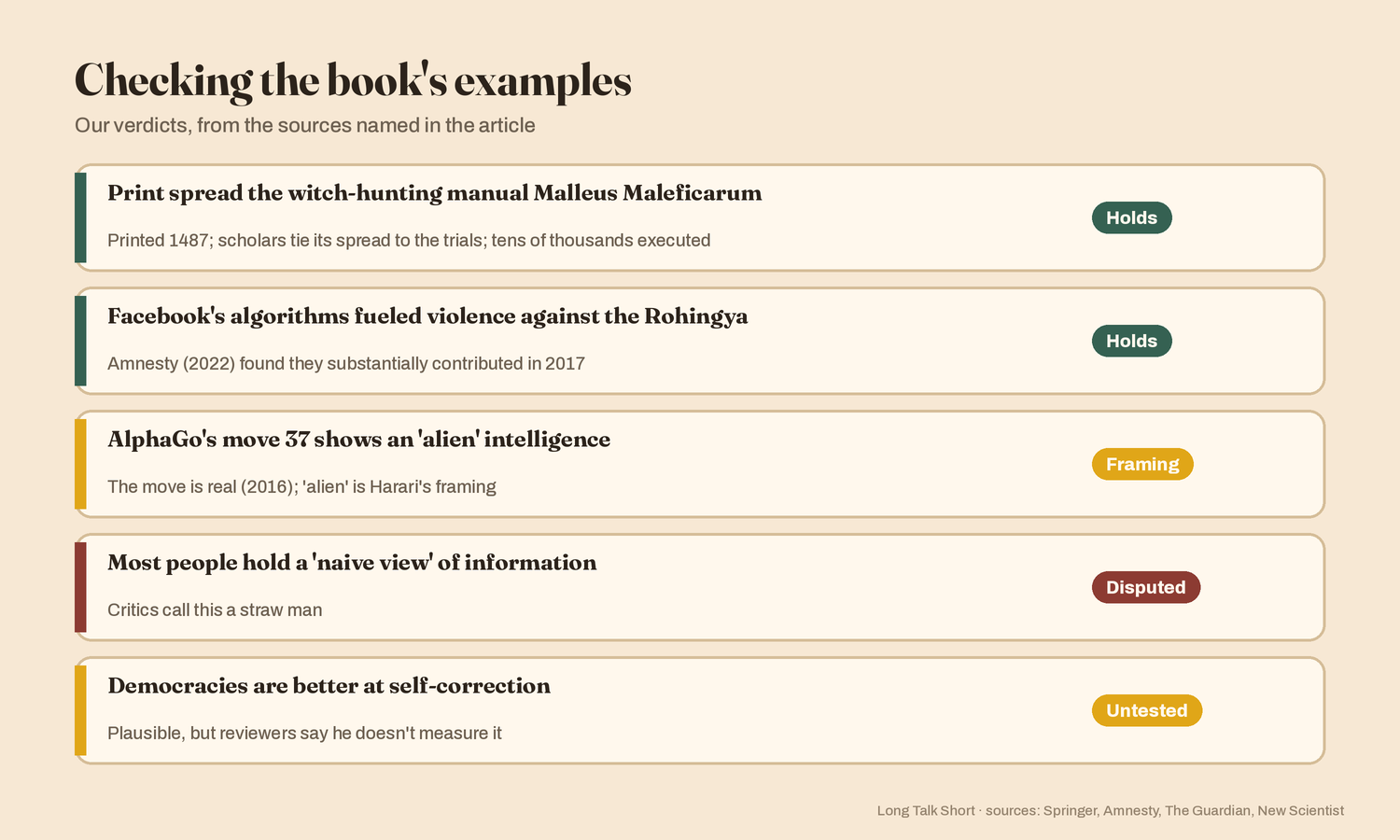
Weighing it: what holds up
Holds up:
- The witch-hunt history: the Malleus Maleficarum was written by Heinrich Kramer, printed in 1487 and widely reprinted, and recent research ties the spread of witch trials in Central Europe partly to it. Estimates of executions across early modern Europe run from roughly 40,000 to 60,000.
- Myanmar and move 37: Amnesty's findings are as he describes them. Move 37 happened, and its creators' trouble explaining it is documented.
Overstated:
- A straw man: in the Guardian, Steven Poole argued that few serious thinkers hold the naive view, that Harari was too ready to credit AI with creativity, and that the closing advice was thin after such a sweeping diagnosis.
- Circular: in New Scientist, Michael Marshall said that defining information as whatever connects people makes the thesis hard to test, and that the democracy claim was fairly obvious and never measured.
Disputed:
- Agent or tool: whether AI is truly an agent, or a very capable tool used by people and companies, is a live argument, and how much risk it poses is unsettled. Calling it "alien" is a framing, not a finding.
- Cherry-picking: other reviewers accused the book of choosing historical examples to fit the thesis.
Related reading: for a DeepMind co-founder's case that AI can only be contained, not stopped, see The Wave and the Narrow Path.
Long Talk Short
- Information mainly connects people into networks; truth is a by-product that has to be worked for.
- Networks can run for a long time on useful fictions, so more information can mean more delusion, not more wisdom.
- What protects truth is self-correction: science, courts and a free press that find and fix their own errors.
- AI, Harari argues, is the first information technology that can make decisions and create ideas by itself: an agent, not a tool.
- Critics call the naive view a straw man, the definitions circular and the solutions thin; the history is the strongest part.
The one thing to remember: don't ask whether a network has more information. Ask whether it has a way to notice when it's wrong, and who gets to say so.
Source: Nexus: A Brief History of Information Networks from the Stone Age to AI by Yuval Noah Harari (Random House, 2024). This is an independent summary and is not affiliated with the author or publisher.