OOCEMR: Tony Robbins' 6-Step Framework for Decisions You Can Bet the Company On
Tony Robbins credits a six-step decision process, OOCEMR, with a single decision worth $400 million to him personally. Strip away the stagecraft and it is a ruthlessly practical operating system for founders.
Define what you want, list every option, ledger the consequences, weigh the odds, blend the best paths, then commit completely. The decision framework Tony Robbins has used since his small-business days, translated for founders.
Introduction: The Most Expensive Skill in Business
In a short video, Tony Robbins describes the decision framework he has used since his small-business days, a six-step process he calls OOCEMR, and credits it with a single decision worth $400 million to him personally. The number is his; what matters for the rest of us is the machinery underneath, because it is unusually well suited to the founder's life.
Founders make consequential decisions weekly, sometimes daily, under exactly the conditions Robbins names: anxiety, fear, excitement, passion. His opening warning is that any of those emotions, trusted as a compass, can lead you astray. Fear shrinks your option set; excitement makes you skip the downside; passion makes the improbable feel inevitable.
His second rule is the one most entrepreneurs violate: never run a big decision in your head. You cannot manage it there, the variables slip, the fears amplify, the ranking shifts with your mood. Write it down. The six steps below are a paper exercise, and that is the point: once the decision is on paper, your brain stops defending a feeling and starts solving a problem.
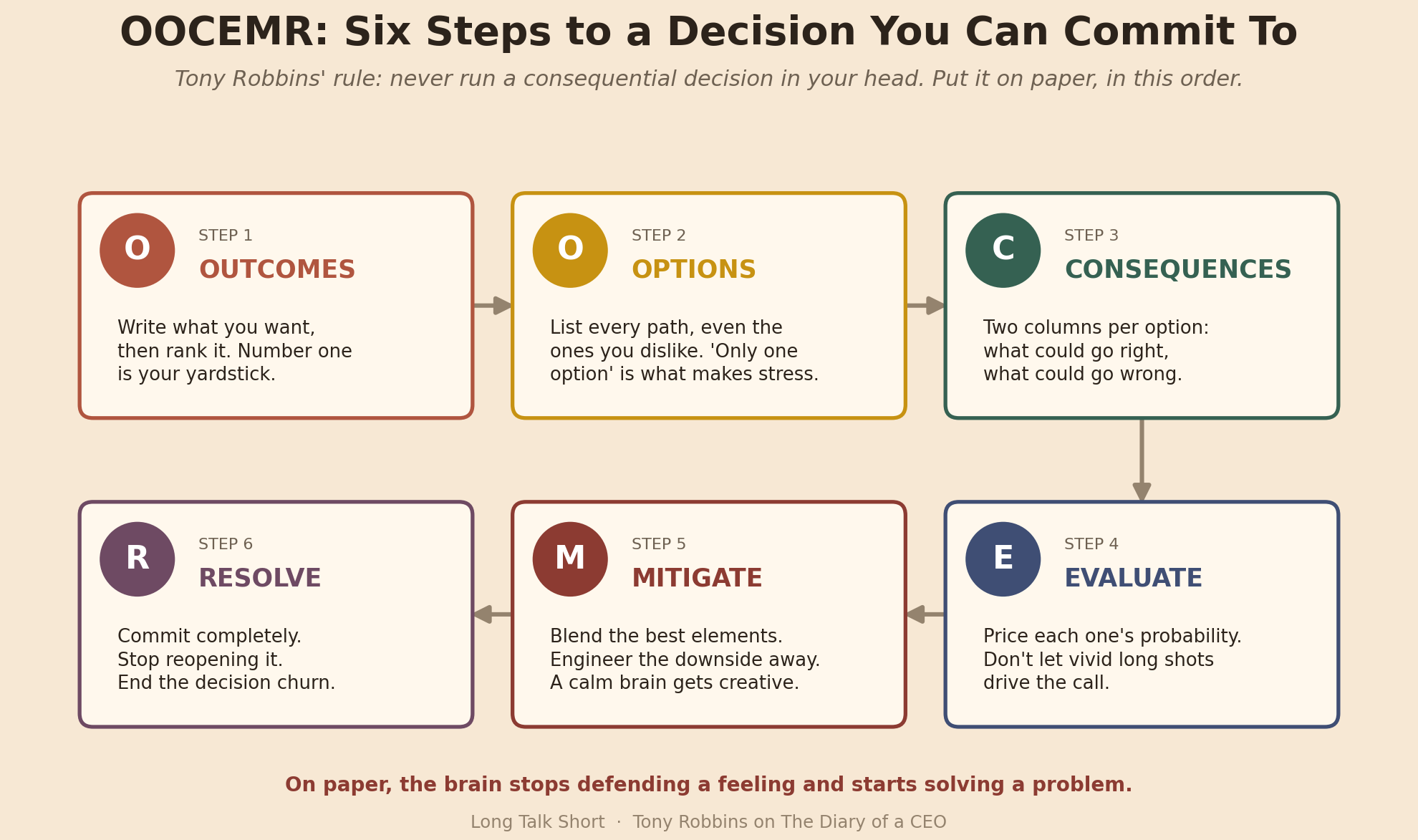
Steps 1 and 2: Outcomes and Options, Get Brutally Clear on Paper
Step 1, Outcomes: start with what you want. Not what you fear, not what you are trying to avoid, what you actually want. Write the outcomes down, then rank them. Robbins is insistent on rigor here: what is number one? For a founder in a cash crunch, the ranked list might read: (1) survive twelve months, (2) keep the core team intact, (3) avoid a down round. That ranking becomes the yardstick for everything that follows.
Step 2, Options: write down every option. All of them, including the ones you dislike. Founders routinely collapse to a single perceived option ("raise or die"), and Robbins' diagnosis is blunt: telling yourself there is only one option is what manufactures the stress. Put five or six on paper, raise, bridge, cut burn, pause hiring, acqui-hire conversations, wind down a product line, and the pressure drops immediately. The decision is no longer a cliff edge. It is a menu.
Steps 3 and 4: Consequences and Evaluation, Do the Honest Math
Step 3, Consequences: ledger the upside and downside of each option. For every option from Step 2, write what could go right and what could go wrong, to the best of your current knowledge. Two columns, no spin. This is the step where wishful thinking dies: the glorious outcome you have been telling yourself about the fundraise gets its downside column, and the painful option you have been avoiding gets its upside column.
Step 4, Evaluate: price the probability. This is the step almost everyone skips, and the one that makes the framework work. For each consequence, ask: how likely is this, really? A catastrophic outcome with near-zero probability should not be driving your stress; a euphoric outcome with near-zero probability should not be driving your hopes. Founders are chronically guilty of overweighting tail scenarios, both the doom case and the unicorn case, because both are vivid. Probability is the antidote to vividness. Score each consequence, and the real shape of the decision emerges.
Steps 5 and 6: Mitigate and Resolve, Blend, Then Commit
Step 5, Mitigate: blend the options. Now the creative step, and it is fast. Look across your options: can you take the strongest element of one and combine it with another? Can you engineer the downside away? A smaller bridge plus targeted cuts might deliver survival without a full down round; a hiring pause plus a consulting revenue line might buy the six months the product needs. Robbins' observation is that the brain gets genuinely creative at this stage, not because of a technique, but because of a state: the decision is on paper, the fear has been priced, and the mind is finally solving instead of worrying.
Step 6, Resolve: commit completely. Analysis ends; decision begins. Robbins closes the loop with the point no spreadsheet can make: he values one such decision at $400 million economically, and describes its emotional value as beyond price. The founder's translation: once you have run the six steps, decide, announce it, and stop reopening it. A decision made this way does not need to be revisited every anxious morning. That is the real dividend, not just better choices, but the end of decision churn.
Key takeaways
- Never run a consequential decision in your head, write the whole process down. Emotion, whether fear, anxiety, excitement or passion, is a compass that points anywhere.
- Start with outcomes, not fears: define exactly what you want and rank it ruthlessly. Your number-one outcome is the yardstick for every option.
- List every option, including the uncomfortable ones. Pretending there is only one option is what manufactures the stress.
- Ledger the upside and downside of each option, then evaluate the probability. Do not let vivid but near-impossible extremes drive the call.
- Mitigate by blending: combine the strongest elements of different options and engineer the downside away. A calm brain is a creative brain.
- Resolve: once the six steps are done, commit completely and stop reopening the decision. The end of decision churn is half the value.
Source: The 6 Steps To Making Confident Decisions, The Diary of a CEO.
Go deeper
- Awaken the Giant Within, Tony Robbins
Affiliate links, a small commission supports the blog at no cost to you.