Outlive in 5 Minutes: Peter Attia's Plan to Train Now for the 90-Year-Old You Want to Be
Most of us will die slowly, after a frail final decade. Peter Attia's Outlive says medicine acts too late, and that you should prevent early and train now for the body you'll need at 90. Medicine 3.0, the Four Horsemen and his exercise plan, plus what holds up.
Most of us won't die suddenly. We'll die slowly, of heart disease, cancer, dementia or metabolic disease, often after a frail final decade of losing strength, mobility and memory. Peter Attia's Outlive, written with journalist Bill Gifford and published in 2023, argues that medicine steps in too late against those slow killers.
His alternative: prevent those diseases decades early, and train like an athlete for the body you will need at 90. The exercise case is strong. Some of his medical advice runs ahead of the evidence.
In short: Attia calls for "Medicine 3.0," a proactive, personalized approach that aims at healthspan as well as lifespan. He targets four chronic killers, makes exercise the centerpiece (zone 2, VO2 max intervals, strength and stability), treats nutrition as personal biochemistry rather than a diet, and ends with sleep and emotional health.
1. From Medicine 2.0 to 3.0
In Attia's history, Medicine 1.0 ran on observation and guesswork from Hippocrates on. Medicine 2.0 arrived with germ theory and the scientific method. It excels against fast killers such as infections and acute heart attacks.
It is weaker against slow ones, because it acts once disease is diagnosable and judges risk over ten years.
Medicine 3.0 is personalized prevention on a far longer horizon. It cares about healthspan, the quality of your years, as much as their number. "The first principle of Medicine 3.0 is you have to take a much longer arc on the prevention of chronic disease," he told 60 Minutes in 2025.
2. The Four Horsemen
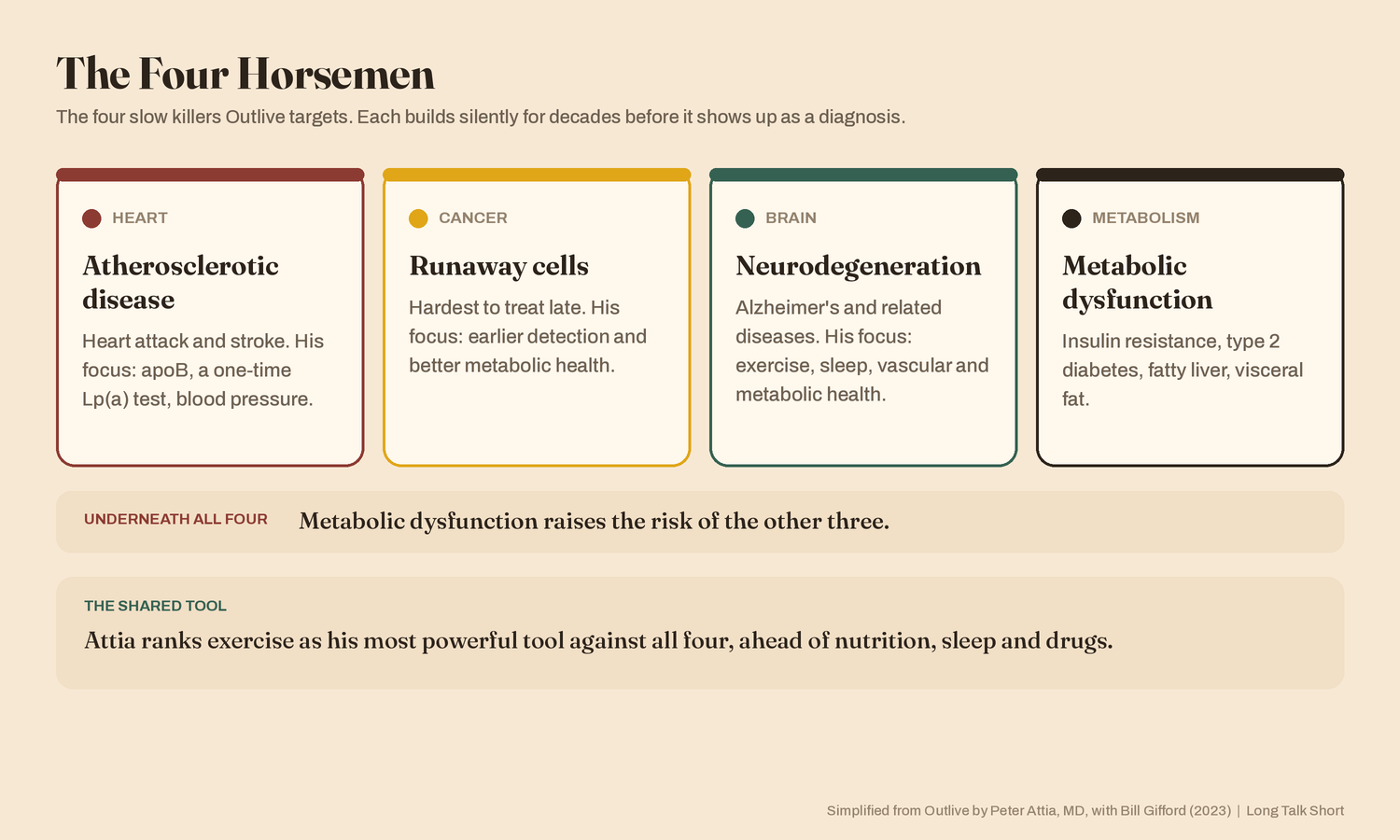
His targets are the chronic diseases that kill most people:
- Atherosclerotic heart disease and stroke
- Cancer
- Neurodegenerative disease, such as Alzheimer's
- Type 2 diabetes and the metabolic dysfunction behind it
Each builds silently for decades. Metabolic dysfunction feeds the other three, and he flags fatty liver disease as a common, underdiagnosed early warning.
On the heart, he says the standard cholesterol panel misses too much. He wants apoB, the protein on every artery-clogging lipoprotein particle, measured and pushed down early, plus a one-time test for Lp(a), an inherited risk factor. His own calcium scan at 36 already showed plaque.
On cancer, he favors aggressive early detection. On the brain, what is good for the heart and metabolism is good for the brain.
3. The marginal decade and the centenarian decathlon
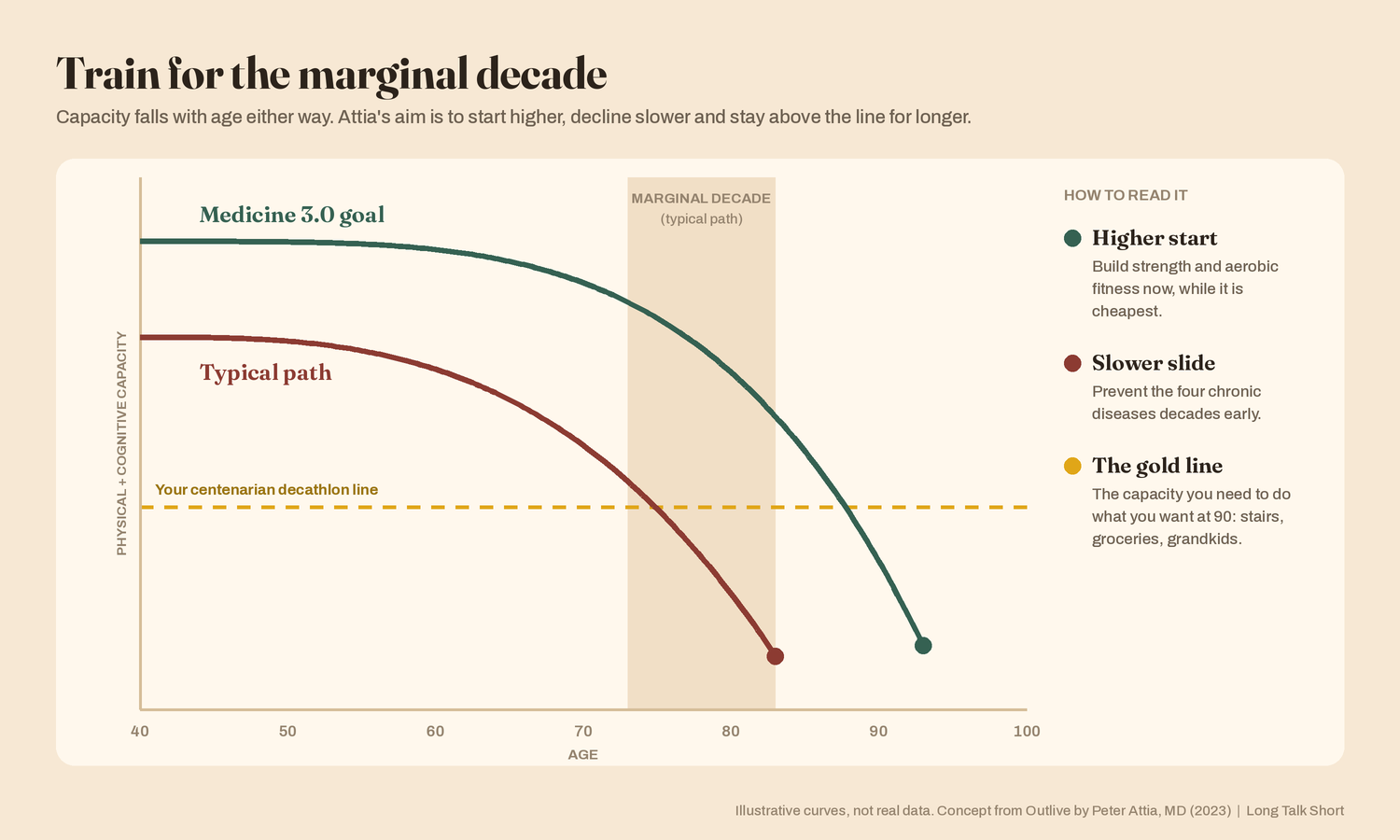
Everyone gets a "marginal decade," his term for the last ten years of life, usually marked by sharp losses in strength, mobility and cognition. Attia makes it the target.
His method, the centenarian decathlon: list the physical things you want to still do at 90, then work backward. For example:
- Carrying groceries upstairs
- Lifting a grandchild
- Getting up off the floor
Because fitness slides with age, you need to be well above those levels now. His archery analogy: practice at 100 yards, and 50 becomes easy.
4. Exercise, the most potent "drug"
Exercise is by far the most potent longevity 'drug.' No other intervention does nearly as much to prolong our lifespan and preserve our cognitive and physical function.
He splits training into four parts:
- Zone 2. Steady, conversational-pace aerobic work, about three hours a week, for mitochondrial and metabolic health.
- VO2 max. Hard intervals of three to eight minutes, once or twice a week. The goal: fitness rated excellent for people a decade or two younger.
- Strength. Heavy, controlled lifting with emphasis on grip, pulling, hip hinges and the lowering phase. Muscle and bone are reserves you draw down for life.
- Stability. Short, frequent balance and movement work to prevent the injuries and falls that end training and, later, independence.
His anchor statistic comes from a 2018 JAMA Network Open study of 122,007 Cleveland Clinic patients. The least-fit quarter had about five times the adjusted risk of death of the fittest 2.3 percent, and below-average versus above-average fitness carried the same hazard ratio as smoking.
5. Food, sleep and the emotional house
Attia tells readers to forget diets and think about "nutritional biochemistry": eat less, cut certain foods or narrow your eating window, whichever works for you. He is cool on long fasts, mainly because they cost muscle.
The constant is protein: at least 1.6 grams per kilogram of body weight a day in the book. On 60 Minutes he put it at about a gram per pound, more than double standard guidelines.
Sleep gets a chapter as brain and metabolic maintenance: skip alcohol, keep the room cool and dark, fix your wake time.
The final chapter is the most personal. Attia describes childhood abuse, anger and depression, and treatment that included two inpatient stays. His therapist Esther Perel's question frames it: "Why would you want to live longer if you're so unhappy?" Emotional health, he concludes, deserves the same deliberate work as lipids.
Weighing it: what holds up
The fitness numbers are real but observational. The Cleveland Clinic patients were referred for treadmill tests, and fitness was estimated from one test's speed and grade, not measured VO2 max. The authors note that the association "does not prove causation"; genes, illness and wealth all shape fitness. Norway's randomized Generation 100 trial of 1,567 people aged 70 to 77 found fewer deaths after five years of interval training (3.0 versus 4.7 percent), but not significantly fewer. Exercise clearly helps; training alone won't buy a fivefold gap.
Drugs come last for a reason. They are last among his five tactics. Rapamycin extends lifespan in mice but has no human longevity trial. In 2025 he told 60 Minutes he had stopped taking it "for now" because of mouth sores, while still rating it "promising" on his podcast. CBS reports he quit metformin in 2018 because of negative effects around exercise.
Lipids: right direction, debatable destination. Mainstream cardiology agrees that apoB particles cause atherosclerosis and are undertested. Attia goes further, aiming as low as possible, early, for almost everyone. The Skeptical Cardiologist, Anthony Pearson, calls that speculative: U.S. guidelines target LDL below 100 mg/dL for primary prevention, Europe's below-55 goal is for very high-risk patients, and near-newborn levels take several drugs for decades, untested in long-term trials. The 30-year statin analysis Attia cites is a model, not a trial.
Screening draws the sharpest pushback. In Sensible Medicine, primary-care doctor Paul Fenyves calls Attia's cancer screening far beyond guidelines and notes the book skips overdiagnosis. The American College of Radiology says there is "no documented evidence that total body screening is cost-efficient or effective in prolonging life." Attia concedes such scans will "detect a lot of things that are not cancer."
He sells what he prescribes. His clinic, Early Medical, takes fewer than 75 patients at a fee he told 60 Minutes is "much closer to $100,000 than $500,000" a year. His podcast, The Drive, offers a $149-a-year premium membership, and an Outlive app is in the works. None of that makes the advice wrong, but the full program is priced for his clientele; the core habits are cheap. In February 2026, Attia resigned as a CBS News contributor after crude emails between him and Jeffrey Epstein were made public; he apologized and has not been accused of a crime.
Long Talk Short
- Medicine 3.0 means acting on risk decades early and counting healthy years, not just years.
- Heart disease, cancer, dementia and metabolic disease build silently; metabolic health underpins all four.
- List what you want to do at 90, then train well above that level now.
- Mix zone 2, hard intervals, heavy lifting and balance work. Fitness predicts survival, though the exact payoff is unproven.
- Ask about apoB and a one-time Lp(a) test; how low to go and how much to screen are judgment calls with real costs.
- Treat longevity drugs as experiments. Attia himself dropped metformin and paused rapamycin.
The one thing to remember: the 90-year-old you want to be is built in your 40s and 50s, mostly through training, and nothing in a pill bottle comes close.
Source: Outlive: The Science and Art of Longevity by Peter Attia, MD, with Bill Gifford (Harmony Books, 2023). This is an independent summary of the book, drawn from the publisher's description, Attia's interviews and published reviews, and is not affiliated with the author or publisher.
This article is for general information only and is not medical advice. Talk to your doctor before starting a new exercise program, medication, supplement or screening test.