Ramp’s Eric Glyman Says AI Is Making 100x Employees — and Breaking the Org Chart
Ramp CEO Eric Glyman tells YC’s Garry Tan that AI is creating radically faster individuals, and that the uneven jump strains the org chart. Figures are Ramp’s own claims; YC backed his earlier company. Not investment advice.
If you have watched one teammate become startlingly faster with AI while the rest of the company still treats it like a slightly better search box, Eric Glyman’s point is that this is not a side effect. It is the problem. On Y Combinator’s How to Build the Future, the Ramp co-founder and chief executive says the gains are real, uneven, and already breaking the ratios a company is built around. “The future is here. It is not evenly distributed. That is for sure.”
The episode is “Ramp’s Bet on the 100x Employee,” on Y Combinator’s How to Build the Future, at youtube.com/watch?v=0Hvs6-XODgU. Garry Tan hosts. The episode includes a mid-roll asking founders to apply to YC. This article stays with the 100x-employee idea, not with a company biography. Auto-generated captions were used for wording; obvious names have been corrected from the official title and description.
Disclosure: Glyman and co-founder Karim Atiyeh went through Y Combinator in 2015 with their earlier company, Paribus, which they later sold to Capital One; Ramp is the company they started afterward. This conversation is on YC’s own show, hosted by the head of the accelerator that backed that earlier company. The show cites a $60 billion valuation; that matches Ramp’s own funding announcement as reported by TechCrunch, a private-round valuation and not an audited figure. Every productivity figure below is Ramp’s own internal claim, not a published study.
In short: Glyman says AI is creating radically faster individuals — in his words “100x engineers” — while most people have barely started. Ramp saw a thin slice of employees use most of its AI tokens, and the uneven jump strained staffing ratios and hiring. His fix is access and redesign, not a better prompt. The numbers are Ramp’s own. This is not investment advice.
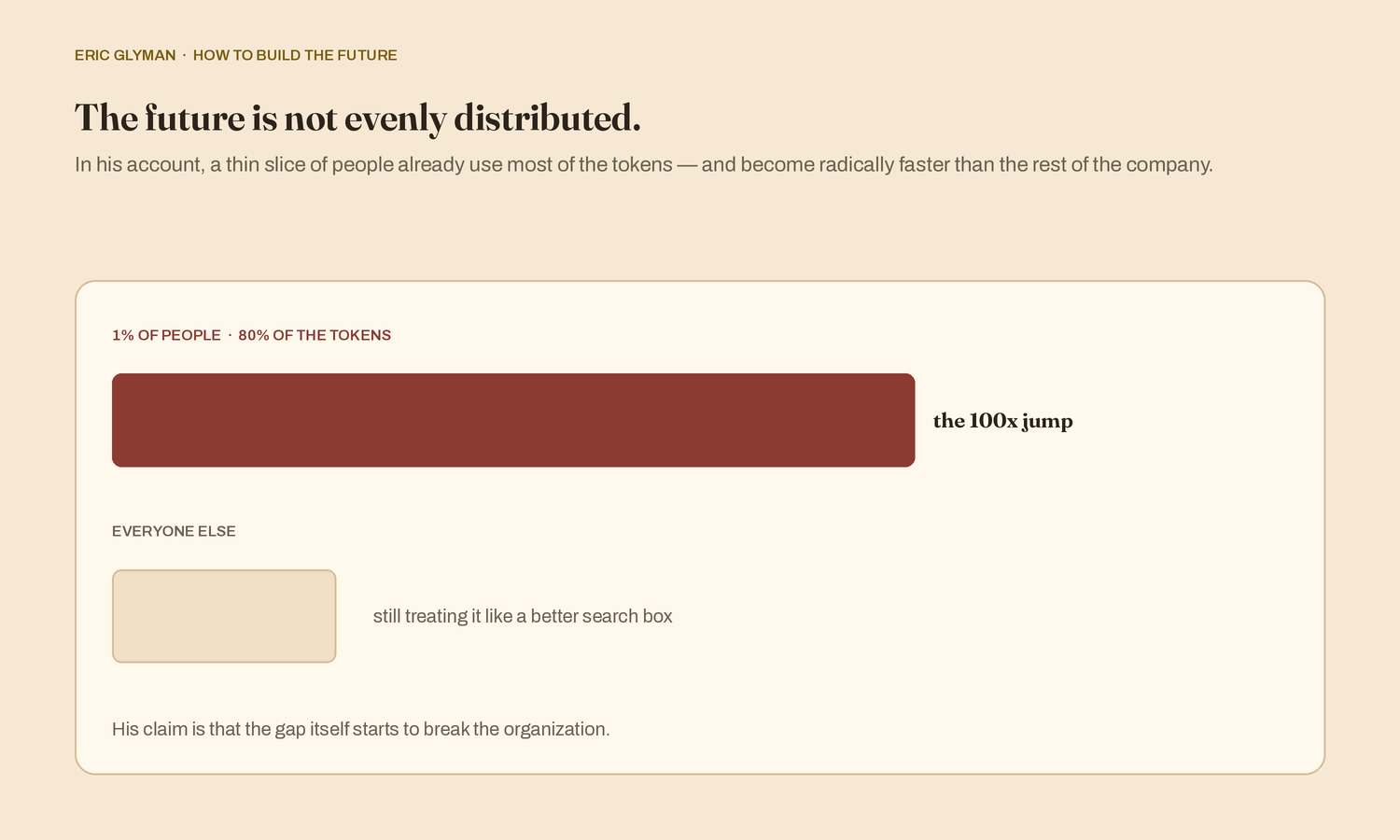
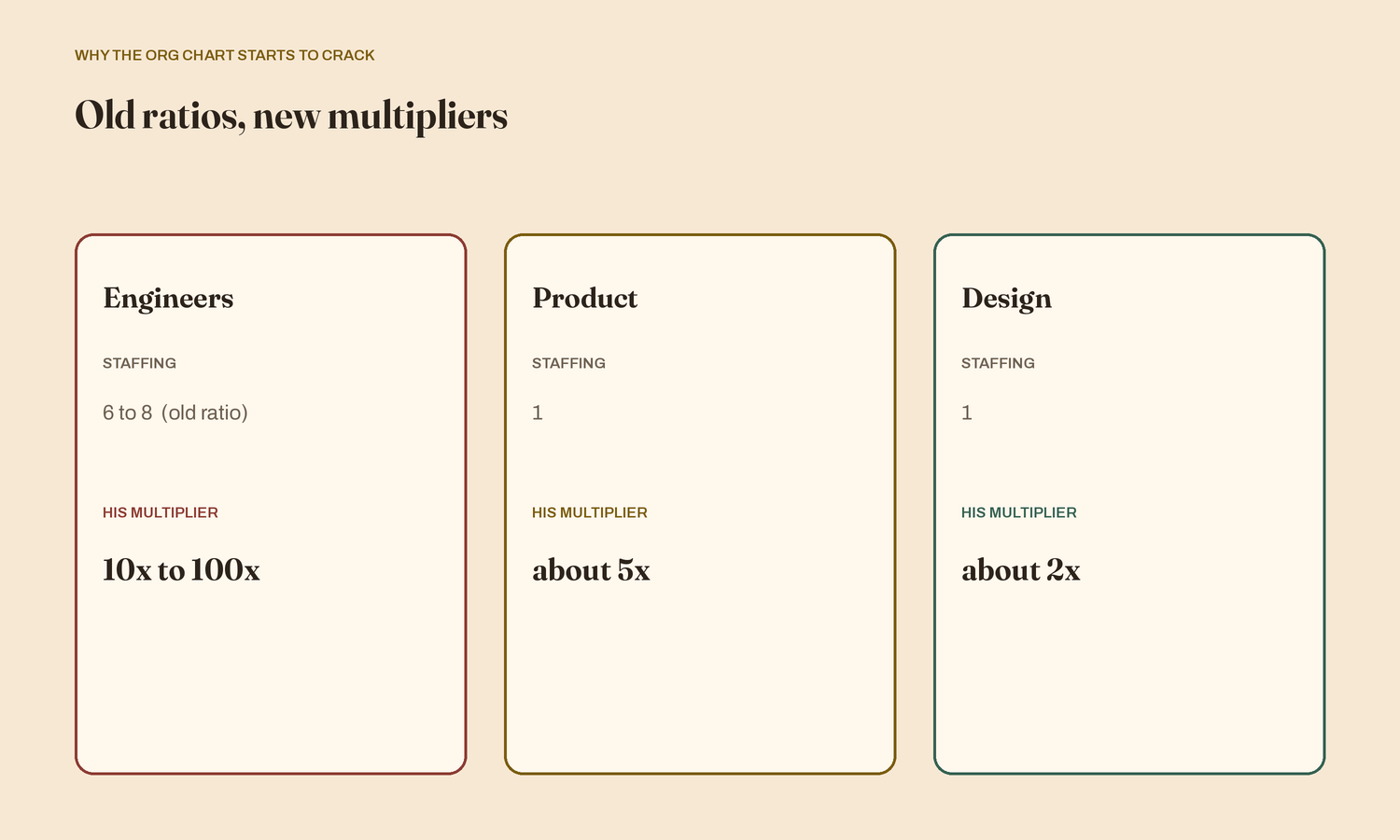
The raw pattern, as he tells it, showed up first inside his own firm and looks, to him, like the world. “1% of the people were using 80% of the tokens” and becoming “the most extraordinarily productive people.” He does not want to be accused of hype: “not exaggerating, 100x engineers,” he says, “people who were just so radically productive.” Others lagged. Functions moved at different speeds. Designers might be “2x as productive,” product people “5x,” engineers “10 or 100x.” Traditional companies, he says, still staff to old ratios — “six to eight engineers to one product manager to one designer.” When one function jumps and the others do not, “you’d start having like all these pain points where engineers were outrunning other parts of the company.”
1. Why the org chart starts to crack
The second-order effects, in his account, were as important as the speedups. Hiring requests arrived with “this inverse correlation”: the people using a lot of AI were “radically more efficient,” so they did not need as many colleagues; the people not using it requested a lot of headcount. Even while the business was “growing more than 100% per year,” he says, Ramp “said we’re not hiring for a whole quarter.” Part of that was the ordinary cost of hiring. The other part was a decision about attention. He “didn’t want learning AI to be like a in 5% of your time. Like it needs to be like your core competency.” The goal was an “aha moment where finally you see it and you understand it and you never want to go back.”
He is careful, at least in tone, about how hard that ask is. Finance people who are excellent at Excel on Windows, he says, can be thrown by the same program on a Mac. Telling someone, “I know you’ve been doing work this way for 20 years. You should just use AI now,” is “a really big ask. It’s like a lot bigger than just same program, different OS.” Tan had already put a sharper edge on the same gap: a “crazy stat” that “the top 1% of spenders spend 80% of the spend on AI tokens.” Glyman agrees. “While most people still haven’t yet adopted AI in their own workflows,” even fewer organizations have asked whether, in a world where this kind of intelligence exists, “have I designed my organization in the right way?”
2. A note through a wall, or a system that can actually act
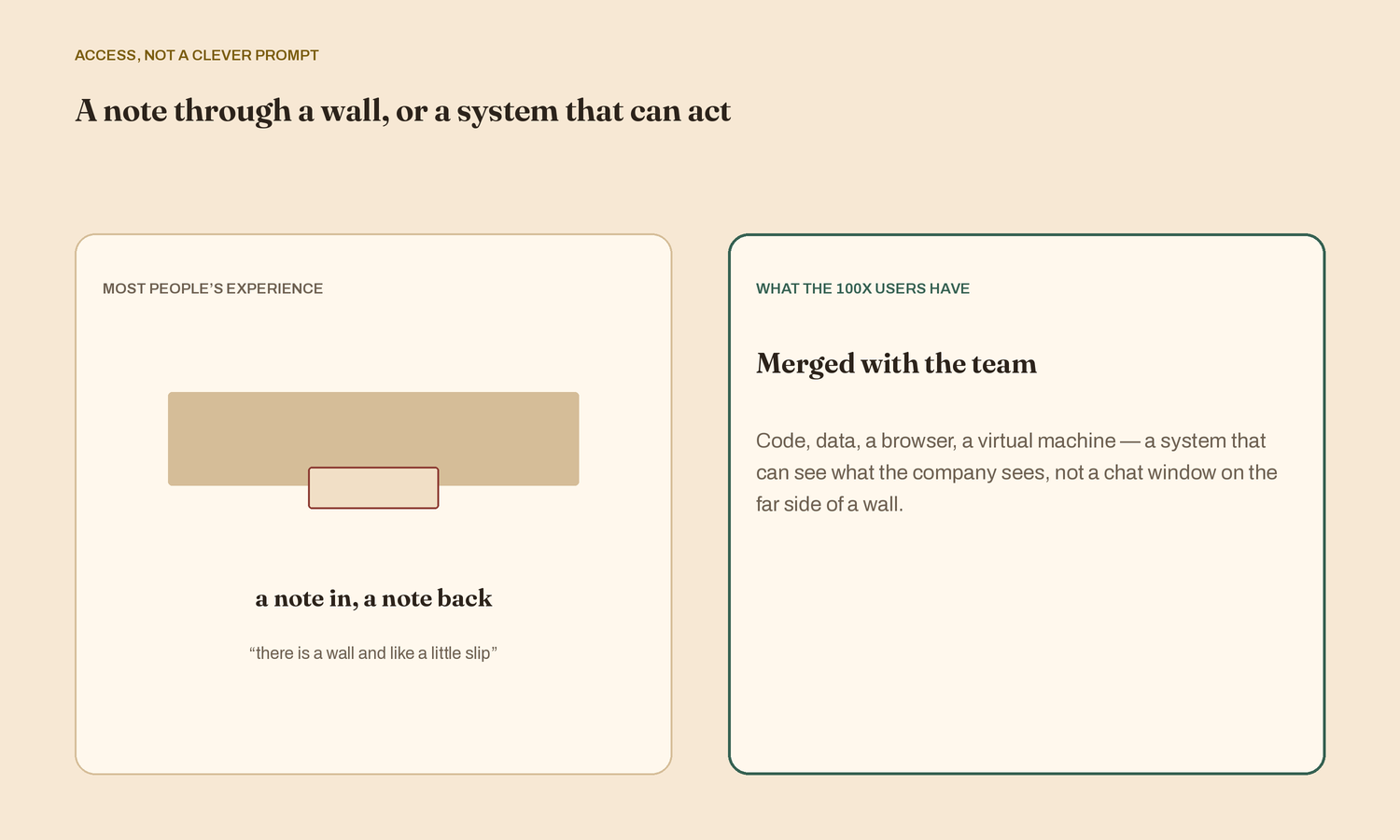
What the 100x people have, he argues, is not a better chatbot. It is access. Most people’s experience of AI, he says, is “this unbelievable alien intelligence and there is a wall and like a little slip,” through which you “can write a note” and get a note back. That is “so far from” the engineers getting large gains with a coding agent that can see the code, the data, a browser, a virtual machine — “merged with your team.” In a large organization the wall is practical: someone is told to use a coding tool, opens a terminal, does not know what a terminal is, then cannot connect it to the company’s systems. In a tiny startup, your whole environment may already live on one laptop. The difference is why he talks about a “company brain” and an “AI harness” — internal tools that already know how the firm works — more than about a generic chat window. “If you believe that there are 100x engineers and 10x engineers,” he says later, “how could you not try to make everyone 100x engineers?”
That last sentence is a founder’s ambition, not a measured law of productivity. “100x” is his language for a radical, uneven jump, not a controlled study. The useful claim is narrower, and it is what keeps this conversation apart from a generic essay about AI coworkers: the multiplier lands on individuals first, it lands unevenly, and an organization that does not redesign around that fact will feel the strain as engineers outrun everyone else, or as headcount requests arrive from the people least able to use the new tools.
Weighing it: what holds up
Glyman is describing the company he runs, on a show run by the accelerator that backed his earlier startup. The 100x figures, the 1%/80% token split, and the pause in hiring are Ramp’s own internal claims, not a published study or an audit. “100x” is his language for a radical, uneven jump. Old staffing ratios are a rule of thumb. The $60 billion valuation is a private-round figure. Auto-generated captions are close, not word-perfect. This is not investment advice.
Related reading: A Bot With a Job, Not a Chat · A Smarter Model Is Not a Bigger Economy
Long Talk Short
- Glyman says a thin slice of people already consume most of the AI tokens and become radically more productive, while most of the organization has barely started.
- When engineers jump by 10x or, in his language, 100x, and design or product lag, the old staffing ratios start to crack.
- He treated that gap as a reason to pause hiring and make learning the tools a core job, not a side project.
- The difference between a 100x user and everyone else, in his telling, is less a clever prompt than access: a system that can see what the company sees, not a note passed through a slot in the wall.
The one thing to remember: AI can multiply a person without automatically multiplying the firm — and, on Ramp’s own account, the unevenness is not a footnote but the management problem.
Independent summary; not affiliated with Y Combinator, Ramp, or Eric Glyman. Company figures are Ramp’s own claims. Not investment advice.
Source: Y Combinator, How to Build the Future, “Ramp’s Bet on the 100x Employee,” on YouTube (linked above). Independent summary; not affiliated with the show or its guest.