Respect Is Taught: Dan Martell's Six Habits for Earning It
Dan Martell says respect isn't given for money or brains, it's taught by how you show up. His six habits: speak up early, stop people-pleasing, look the part, speak with certainty, lead with your body, and be the same person everywhere. The useful core, and where it overreaches.
Respect is built from small, repeated signals, a hard conversation held early, a clean no, a finished sentence, a steady stance, more than from status or talent.
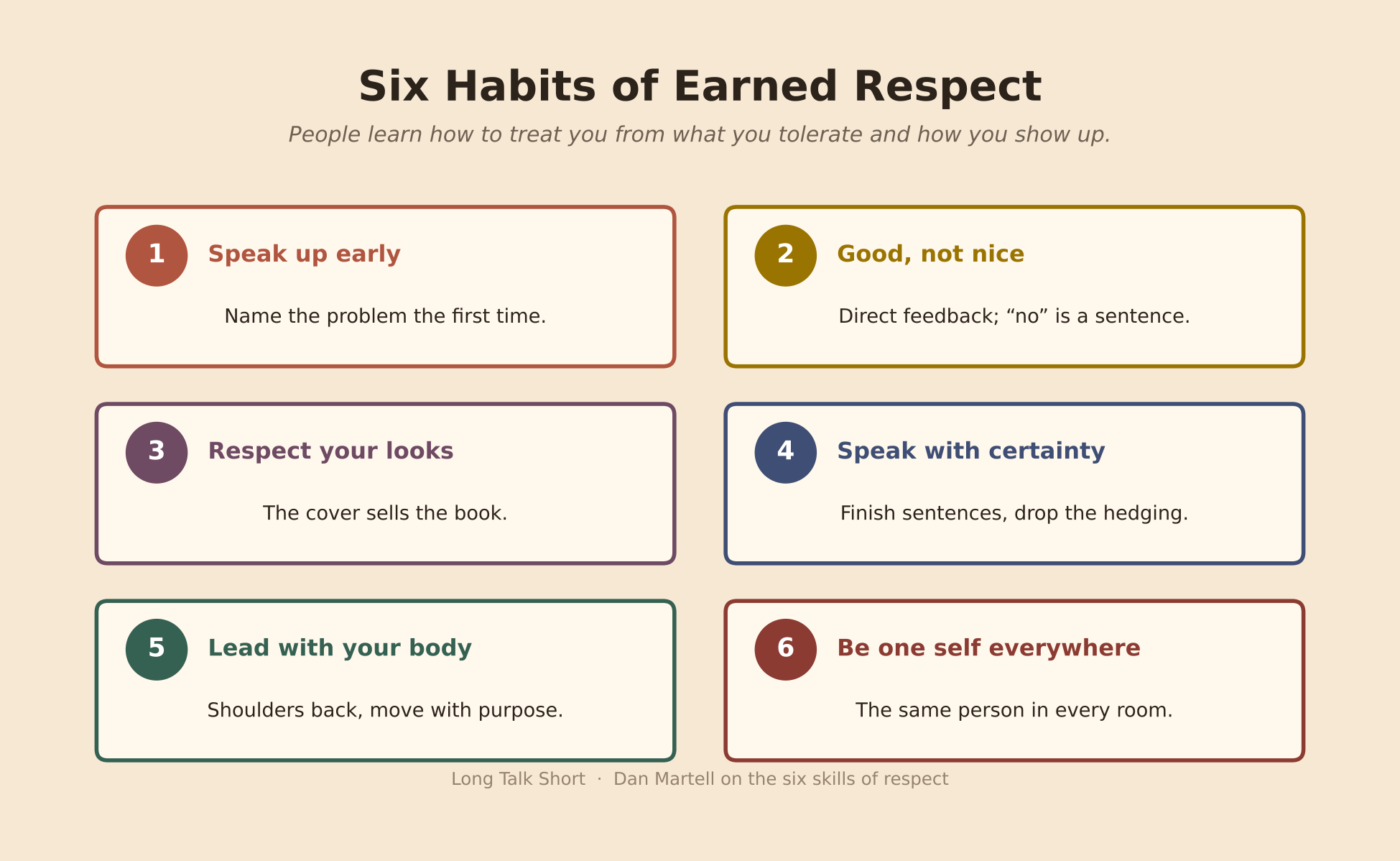
Dan Martell says he went from a self-described nerdy, awkward, introverted programmer to someone people take seriously, and he credits respect rather than money or intelligence. In a short solo video he lays out six habits for earning it: speak up early, stop people-pleasing, look the part, speak with certainty, lead with your body, and be the same person everywhere. Behind all six sits one idea: people learn how to treat you from what you tolerate and how you show up.
You teach people how to treat you
Martell's first rule is to speak now, not later. If someone shows up late or misses a meeting, say so the first time, because silence teaches them it is acceptable. His compression of the point is the sharpest line in the video: "If you avoid short-term discomfort, you just create long-term dysfunction."
He makes hard conversations easier in three ways. First, he relabels them: he is not confronting anyone, he is being clear. Second, he treats them as practice, dealing with problems at a level two rather than waiting until they are a level ten, on the logic that the size of problem you can handle is the size of life you can run. Third, he keeps emotion out and sticks to the facts: here was the agreement, here is what happened, could you do this differently next time? He also credits his friend Jefferson Fisher with a framing move: state the conversation you want and the outcome you are after, then ask whether that is okay. Once the other person agrees, they have accepted both the hard conversation and its goal.
Good, not nice
Rule two is to stop being so nice, which does not mean being a jerk. It means giving up the need to be liked by everyone. Martell says a coach once warned him that universal praise was a bad sign, because if everyone likes you, you are probably not saying anything of substance. His preferred standard is to be a good man rather than a nice one, since niceness keeps people comfortable instead of accountable. In practice that looks like two things:
- Feedback without sugar-coating. He told a talkative team member that padding answers and repeating questions stretched his communication by roughly 20 percent in expensive meetings. Withholding direct feedback, he argues, robs people of the chance to improve.
- No without guilt. No is a complete sentence. People with clear boundaries earn respect because it signals they know what they are after, while a habit of constant yeses signals that your time is always available.
The cover sells the book
Rule three is to respect your appearance. Neglecting it, he says, is like printing a book with no cover, because people judge on appearance whether or not that is fair. Martell dropped his old nerdy look once he started meeting entrepreneurs who had built big companies, on the principle that your appearance signals the level of respect you expect. He extends this to looking after what you own and, more usefully, to looking after your body, which he says signals discipline and follow-through.
Speak with strength
If you sound unsure, he says, no one will follow even when you are right. He passes on five habits he picked up from speaking coaches:
- Finish your sentences. He admits his own team catches him trailing off.
- Drop qualifiers like "maybe," "I hope," "kind of," and "I think."
- Avoid should, could, and would, which quietly build in an expectation of failure. Say "I'll see you at 5:00 sharp."
- Offer decisions, not questions. Say "we're doing this," not "should we do this?", on the view that people want to be led.
- Use pauses. Silence after a strong point creates gravity, the way music works because of the gaps between the notes.
Your body speaks first
Rule five is to lead with your body, because it speaks before your mouth does. Martell, who is 6 foot 3, says years of coding rounded his shoulders, and that he used to play small so he would not make people nervous. His checklist is simple: shoulders back; head up with eye contact, broken often enough that it is not a stare; a smile, especially if you are physically imposing; feet planted with no nervous rocking; and movement with purpose rather than out of nerves.
One self, everywhere
The last rule is consistency. Martell points to figures like The Rock, Oprah, and Richard Branson as people respected for being the same in every setting. He admits his early videos showed a buttoned-up character who was not really him, and says he would now rather be disliked for who he actually is than admired for a performance. Being fully yourself, he argues, draws the people who genuinely like that version of you, and the ones who find you too much are free to go find less.
Weighing it
Much of this lines up with widely shared, sensible communication advice: name problems early, set boundaries, give direct feedback, cut the hedging, and say how you want to be treated, consistently. Where it needs a cooler eye:
- No evidence is offered. The implied promise that these habits will change how people treat you rests on Martell's own stories and the friends and team members he quotes, not on data.
- Context matters. Cutting every "I think" and converting every question into a decision can read as overbearing, especially when you are junior, working across cultures, or when the uncertainty is real and honest hedging is simply accurate.
- Appearance advice depends on the room. "Look the part" is a fair description of how people judge, but the fitness-as-trustworthiness claim is a personal belief, not a finding.
- "Be yourself" and "change yourself" pull against each other. Most of the video is about changing your posture, voice, and looks, so the workable reading is to stay consistent across settings while polishing how you come across.
- Survivorship. Citing famous people as proof that authenticity pays cannot separate the authenticity from the many other reasons they succeeded.
Long Talk Short
Strip away the guarantees and the useful core is steady and doable: respect is not a thing you are granted, it is something you teach, one small moment at a time, by choosing clarity over comfort.
- Raise problems the first time, at a level two rather than a level ten. Silence teaches people what is acceptable.
- Call hard conversations "being clear," keep them about facts, and agree on the frame and the outcome up front.
- Aim to be good, not nice: give direct feedback, and treat no as a complete sentence.
- Your appearance and posture talk before you do, so look after both.
- Speak in finished, certain sentences, offer decisions, and use pauses.
- Be the same person in every room, and let consistency do the work over time.
- The signal worth keeping: respect builds up from small moments where you choose clarity over comfort, again and again.
Source: Dan Martell, "6 Skills You Must Have to Become Successful." This is an independent summary of that video, not affiliated with Dan Martell. It is for general information only and is not professional, psychological, or career advice; communication norms vary by workplace and culture, so adapt these ideas to your own situation.