The Sea Beats the Land: Historian Sarah Paine on Why Conquest Burns Wealth, and What Russia's War Reveals
Naval War College historian Sarah Paine says conquest burns wealth while the rules-based maritime order compounds it. Her toolkit explains Russia's war, sanctions as chemotherapy, and her warning to America.
Some great powers get rich by holding land. Others get rich by keeping the seas open and the rules predictable. According to historian Sarah Paine, only the second kind wins in the long run.
Paine teaches strategy at the US Naval War College. She told Steven Bartlett on The Diary Of A CEO that conquest burns wealth while the rules-based trading order compounds it. She says this one distinction explains Russia's war in Ukraine, Europe's nerves and, in her view, America's own drift.
In short: Paine argues that conquest is a losing business, that the rules-based trading order is the only positive-sum game on offer, and that America is weakening the order it built. Her concepts are useful even if you don't share her politics.
1. Continental versus maritime
For most of history, says Paine, security meant territory and buffer zones. Your neighbour was a threat to absorb, and every gain was someone else's loss. Then maritime powers, Britain first, met the industrial revolution and found that wealth could compound. Power came to be measured in industry, commerce and trade rather than acres.
The maritime order rests on "universal rules." Her everyday example is the credit card:
your little piece of plastic works everywhere
It works only because strangers in many countries follow the same rules.
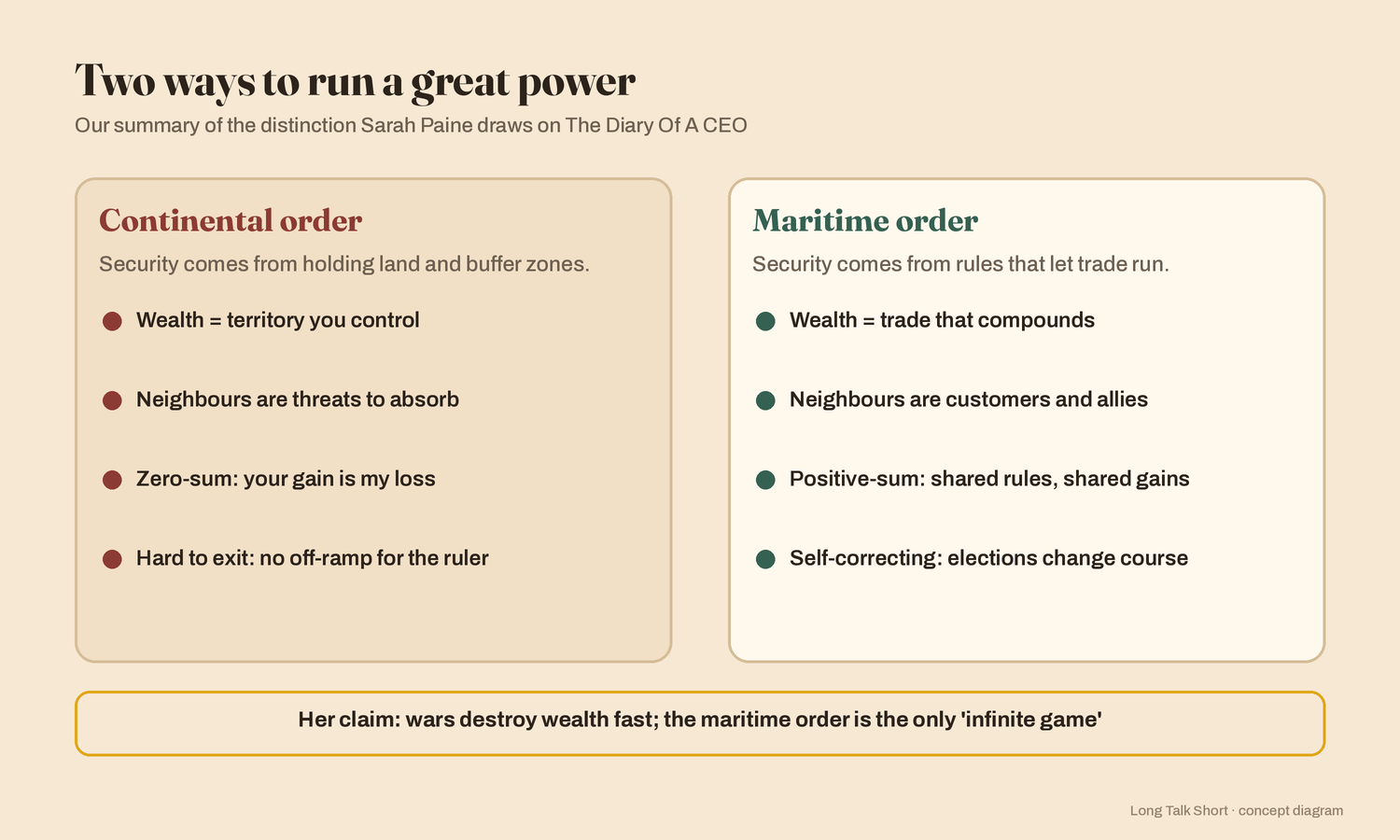
Russia is her archetypal continental power: the largest country on earth, still convinced it needs more land. She calls the Kremlin's worldview "half-court tennis": it sees everyone else's moves as aggression and never looks at its own side of the net. That, she argues, is why Eastern Europeans ran toward NATO. They weren't lured. They were escaping what Russia does to its neighbours.
To make sense of a war like this, she uses a handful of tools.
2. Four tools for reading a war
- Positive vs negative objectives. A positive objective makes something happen, and you can verify it. Her example is snatching Venezuela's Nicolás Maduro and putting him in a New York prison. A negative objective stops something happening, which is harder to prove and harder to finish.
- Limited vs unlimited objectives. A limited aim can be negotiated. An unlimited one, like regime change or, at the extreme, genocide, can't. She puts Vladimir Putin in the unlimited camp, saying he wants to restore the old Soviet empire.
- Situation vs problem. A problem has a solution. A situation can only be managed, because the ideal outcome isn't feasible.
- Opportunity cost. Tsar Nicholas II chose what she calls a "recreational war" with Japan in 1904–05. That money didn't build railways in western Russia, so in the First World War he couldn't move troops or bread well. Food riots followed, then the end of the dynasty.
Unlimited aims are why wars are "easy" to start and "really hard to end." The loser keeps
doubling down long after they've lost
3. Compounding decides it
Underneath all of this is arithmetic. An economy doubles in roughly 70 divided by its growth rate. At 1% a year that takes about 70 years; at 3%, about 23. Small differences in growth, kept up for a generation, decide which country can afford the next war.
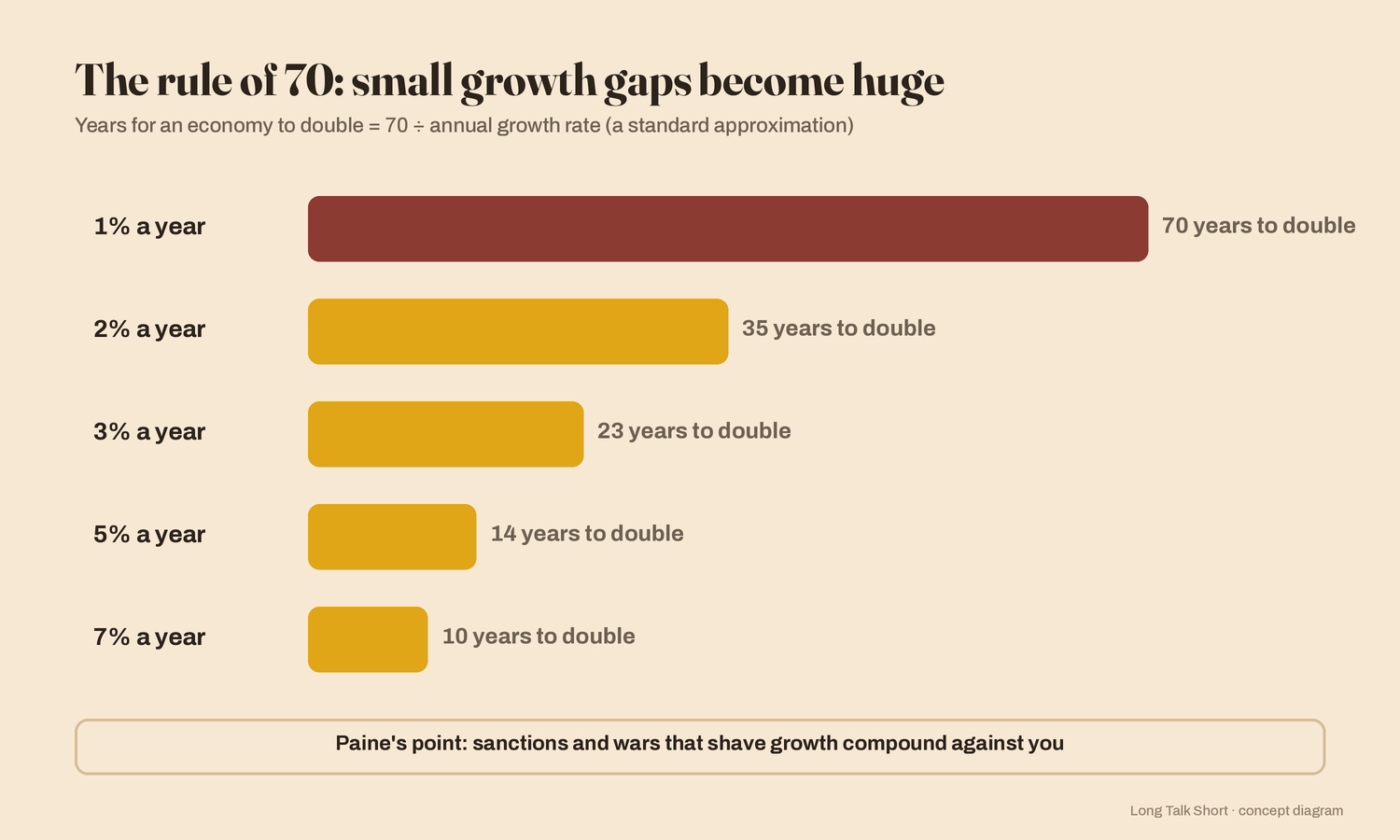
Dictatorships, she argues, misallocate capital and labour and "don't notice that it's a disaster until it's metastasized." They seem eternal "until the day they shatter."
That's why she prefers sanctions to wars:
Sanctions don't solve problems
"…but you're shrinking the opposing piggy bank," she adds, while cooperating with allies grows your own. She calls it "a form of chemotherapy": you don't remove the tumour, you shrink it. Her prescription for Ukraine follows the same logic: no combat troops, but give Ukraine "what they need," which she calls the cheap option.
Then she turns the lens on Washington.
4. Her warning to America
Paine describes two kinds of American hubris:
- Type A: believing every decision that matters happens in the United States.
- Type B: which she pins on some tech leaders, believing brilliance in one field makes you competent in all of them.
On the Maduro capture, the Iran war, tariffs and Elon Musk's political spending, she's openly critical of the current administration. These are her views, and listeners on the other side will push back.
Her core claim is structural, though. If the United States can simply remove another country's leader, other countries will hedge. Asked whether the world is pulling away from America, she says "they're fleeing" and counterbalancing. Her advice: strengthen institutions rather than abandon them, and if one, such as the UN, can't be reformed, build a parallel one and move the work there over time.
Weighing it: what holds up
Confirmed or close:
- Maduro: his capture by the US on January 3, 2026, is widely reported.
- Sea trade: her "90% of the world's trade" is a common round number; UNCTAD's figure is over 80% by volume, so she rounds up.
- Container ships: her example of about 21,000 boxes is now low. The largest ships, such as the MSC Irina, carry about 24,000 TEU.
Bartlett's numbers, not Paine's, were the shakiest:
- Russian defence spending of 40% of the budget: current 2026 estimates put national defence at about 28% of the federal budget, or about a third on SIPRI's broader measure.
- Interest rates above 20%: the Bank of Russia's key rate peaked at 21% in 2024–25 and has since come down to 14%.
- Refining down by up to 50%: Ukraine claims 45–51% of capacity knocked out; independent throughput data we found showed output about 42% below capacity in June. Treat the higher figure as a claim.
- Drones: Romania did shoot down two in October; Bulgaria hasn't, and is instead seeking anti-drone systems.
Not checked: what Volodymyr Zelensky told her, Soviet grocery-store item counts, her reading of Chinese and Iranian strategy, and the claim that Putin wants to rebuild the Soviet empire, which is her interpretation. Her criticism of US policy is opinion and presented as such.
Long Talk Short
- Paine divides great powers into continental (wealth from holding land) and maritime (wealth from trade under shared rules).
- Wars are negative-sum and hard to end, because the loser keeps doubling down. Unlimited aims leave no room to negotiate.
- Her toolkit: positive vs negative objectives, limited vs unlimited objectives, situation vs problem, and opportunity cost.
- Compounding decides the long game: small growth gaps become huge over a generation.
- Sanctions are "chemotherapy" that shrinks a rival's piggy bank while allies grow theirs.
- She warns that America's own actions are pushing allies to hedge; the answer is better or parallel institutions, not none.
The one thing to remember: before backing any big move, ask whether it compounds wealth or burns it, and whether its goal is limited enough to ever be finished.
Source: "Dr. Sarah Paine: Why The World Is Turning Away From America" (posted on YouTube as "WW3 Threat Expert: Russia Is Coming For Europe…"), The Diary Of A CEO with Steven Bartlett. This is an independent summary and is not affiliated with The Diary Of A CEO, Dr. Paine or the US Naval War College.
Quotes are taken from automatic captions and may contain small transcription errors. Views on current politics are the guest's own.