Subtract to Find: Why Naming What You Don't Want Gets You What You Do
Asked to define happiness, a friend said it was his ability to subtract problems from his life. Not add, subtract. That small flip turns out to be a fast, almost cheating way to figure out what you actually want: stop asking what you want, and start naming what you don't.
Your brain is built to spot what's wrong, so use it. The case for finding what you want by first crossing out everything you don't, and the one trap to avoid.
Instead of searching for what you want in life, try doing the opposite. The seed was a conversation. I once asked a friend what happiness was, and the answer stuck with him: happiness, the friend said, is my ability to subtract problems from my life. Not to add things, to remove them. To take weight off.
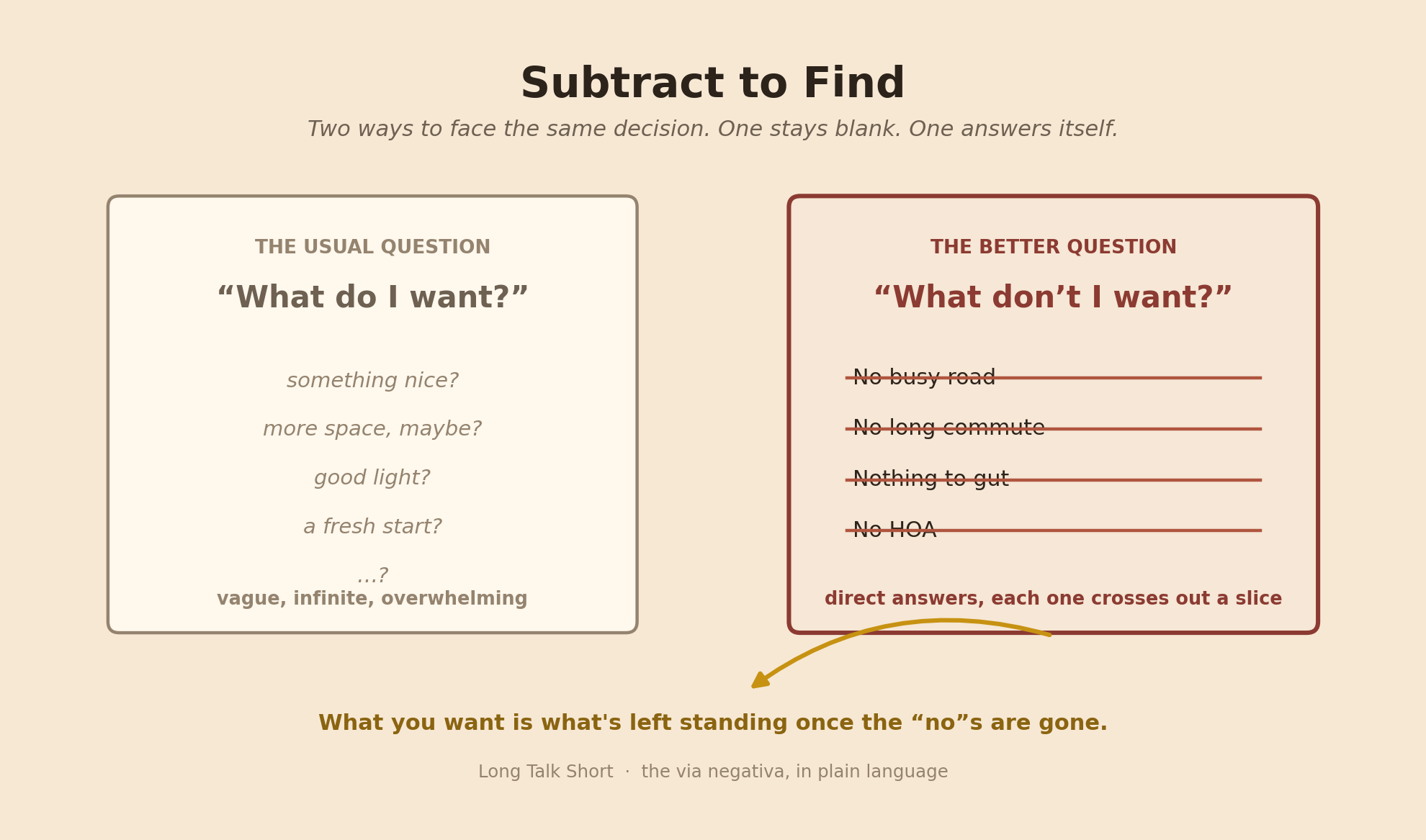
That is a quietly radical reframe, and it generalizes into a tool. Most of us, facing a big choice, ask the forward question: what do I want? And most of us find it strangely hard to answer. The field is too open. Point the question the other way, ask what you do not want, and the answers arrive almost instantly. Cross those out, and what you actually want starts to draw itself.
Why your brain is so much better at "no"
The reason this works is not willpower or cleverness. It is wiring. The human brain is built to detect what is wrong, the threat, the error, the thing out of place. Psychologists call it negativity bias, and it was a survival feature long before it was an inconvenience: the ancestor who noticed the predator, the rot, the betrayal lived longer than the one savoring the sunset. So we are fluent in problems and clumsy with open-ended wants. "What would make me happy?" stares back blankly. "What is making me miserable?" produces a list before you have finished asking.
The move is simply to stop fighting that bias and start using it. Aim your sharpest faculty at the question it can actually answer.
Try it on your next real decision
Ask "what kind of house do I want?" and you drift: style, neighborhood, light, a hundred half-formed images, none of them decisive. Ask "what do I not want in a house?" and the answers are concrete and immediate. No ground floor on a busy road. No long commute. No house that needs gutting. No homeowners' association. Nothing I cannot afford to heat. Each "no" removes a huge slice of the possible, and the house you do want emerges from what survives.
It is the same for a vacation, a job, a partner, a life. "Where should I go?" is paralysis. "Where do I definitely not want to spend two weeks?" is easy, and it clears the map fast. "What do I want from work?" is a job-coach cliché that produces nothing. "What can I no longer stand at work?" is a resignation letter's worth of clarity. You are not lowering your ambition by starting with the negatives. You are using the back door because it happens to be unlocked.
An old idea with a usable handle
If this feels familiar, it should. It is a plain-language version of an idea that keeps being rediscovered by people who think for a living. Charlie Munger built an investing career on "invert, always invert," borrowed from the mathematician Carl Jacobi: to solve a hard problem, study its opposite. Tell me where I'm going to die, Munger liked to say, so I never go there. Nassim Taleb calls it via negativa, the observation that we often know what is wrong with far more confidence than we know what is right, so progress comes more reliably from removing the harmful than from adding the clever. Doctors reach for it too: first, do no harm.
And the friend's original line sits in an even older tradition. The Stoics and Epicureans both suspected that the shortest path to contentment runs through subtraction, fewer needs, fewer entanglements, fewer sources of avoidable pain, rather than through the endless acquisition of more. Happiness as the removal of problems, not the accumulation of pleasures.
How to read this
Use it as a tool, not a temperament, and it is excellent. There is one trap worth naming. A mind already tuned to find what is wrong does not need much encouragement, and "always look for what you don't want" can curdle, in the wrong hands, into chronic negativity, a life defined entirely by avoidance. Subtraction is a brilliant way to narrow the field; it is a poor way to live full-time. Two honest limits follow. First, crossing out the unacceptable leaves you a smaller, clearer menu, but you still have to choose from it, elimination gets you to the finalists, not to the yes. Second, some of the best things, love, meaning, a calling, are not reached by removing everything you dislike until they remain; they have to be moved toward, not just filtered for.
So hold it lightly and let it do what it does well. The next time a decision has you stuck in front of the blank question "what do I want?", flip it. Name what you don't want, cross each one off, and watch the answer sharpen into focus. Then close the list, and go choose.
Long Talk Short
- Stop asking "what do I want?" Ask "what do I not want?" The answers come faster and sharper.
- It works because your brain is wired for negativity bias: it detects problems far more fluently than it imagines ideals.
- Apply it to any big choice, house, trip, job, by listing the deal-breakers first and crossing out everything they rule out.
- It is the everyday form of Munger's "invert, always invert" and Taleb's via negativa: subtract the wrong to reveal the right.
- Keep it a tool, not a mood. Elimination narrows the field, but you still have to choose, and the deepest things are moved toward, not just filtered for.
Go deeper
- Antifragile: Things That Gain from Disorder, Nassim Nicholas Taleb
Affiliate links, a small commission supports the blog at no cost to you.