Expect the Gold to Get the Silver: A Neuroscientist on Why Optimism Pays
Most of us expect a better future than the evidence suggests. Neuroscientist Tali Sharot says that bias is mostly useful: it fuels effort and happiness. Stress shrinks it; a plan and a sense of control bring it back. What holds up, and what needs caveats.
A doctor puts your Alzheimer's risk at 70 percent. Privately, you'll still think it's more like 40 or 50. That, says Tali Sharot, is the optimism bias, and about 80 percent of people in her lab show it, including plenty who arrive calling themselves realists.
Sharot, a cognitive neuroscientist who runs the Affective Brain Lab at University College London and holds an adjunct professorship at MIT, tells Alberto Zandi that this bias is mostly useful: it lifts mood, fuels effort and tracks with success. Stress turns it down, and a sense of control turns it back up. Much of the core research is her own and well published. A few numbers and anecdotes need a closer look.
In short: optimism is a positive view of the future, and the optimism bias is expecting better than the data warrant. Sharot says about 80 percent of people have it, that it drives motivation and happiness, and that you can nudge it by explaining events like an optimist, building a concrete plan and protecting your sense of agency.
1. Optimism is not the same as the bias
Sharot draws a line the episode's title blurs. Optimism means positive expectations. The optimism bias means expectations rosier than the evidence. We overestimate our odds of talented kids, a great career or financial success, and underestimate divorce or illness.
You probably can't see it in yourself. When her lab checks people's predictions against what actually happens, about 80 percent show the bias. Because it's an error in belief, it feels like plain accuracy from the inside.
She puts optimism at roughly a third genetic. People with mild depression show no systematic bias, she adds, and severe depression tilts toward pessimism.
2. Why expecting good things pays
Optimism, she says, "is correlated with success in every domain, business, sports, academia, politics."
You have to think that you're going to get the gold in order to get the silver.
Someone who expects every restaurant to fail won't put in the time or effort, so the expectation becomes the outcome.
It also shapes happiness now. How we feel in the moment depends heavily on what we expect next. Waiting at a cold, rainy bus stop to see a partner can feel wonderful; a sunny beach before a planned breakup does not. She cites a study in which travelers' happiest day was the day before vacation, when the trip existed only in their heads.
Expectation steers action, too. Anticipating a reward triggers a "go" signal in the brain; anticipating something bad triggers a "no-go" signal that makes us freeze. So if you want a child or a team to act, highlight what they'll gain. Warnings work better for stopping behavior.
3. Stress turns the dial down
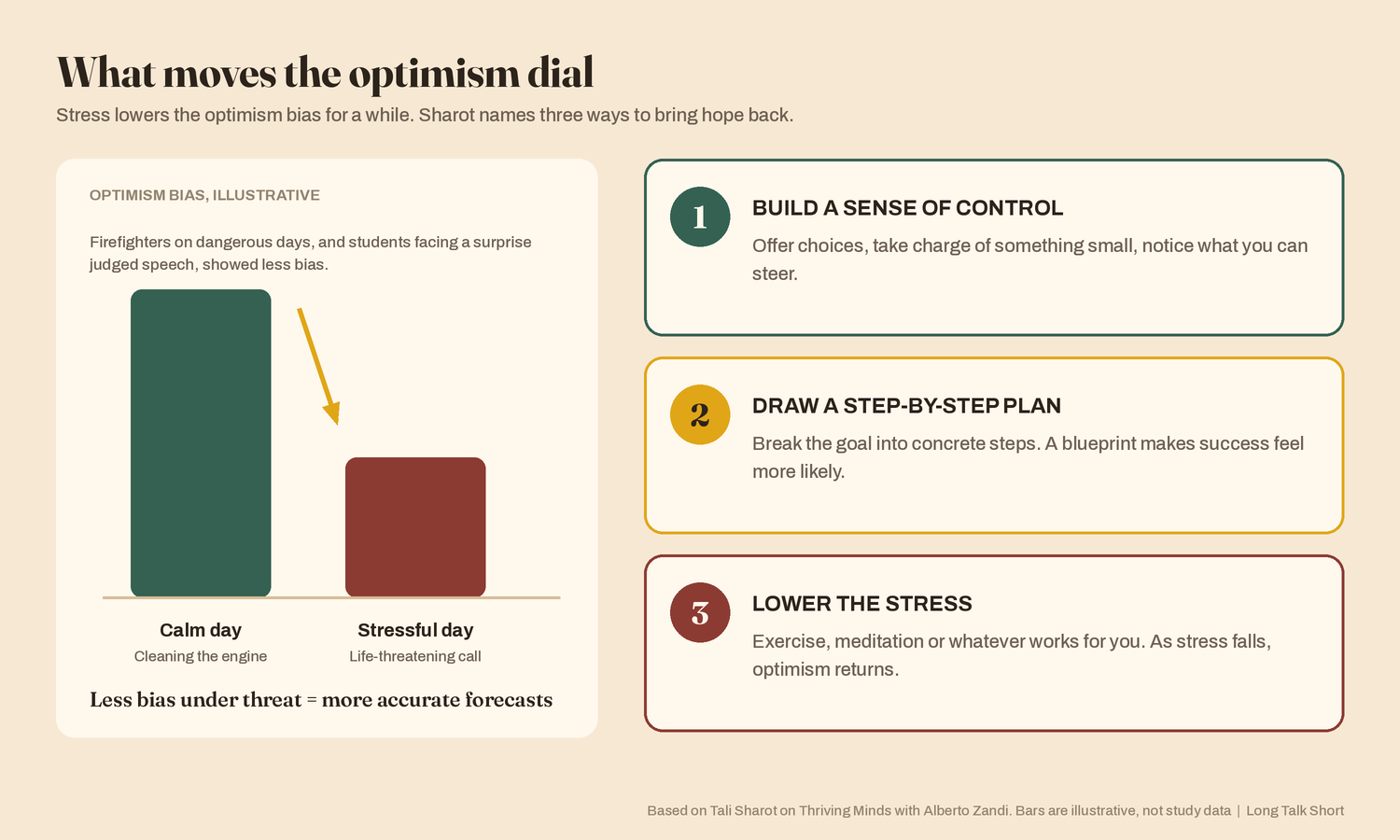
Optimism isn't fixed. On Sharot's account, it runs high in youth, bottoms out around 40 to 50, and climbs again later in life. And stress lowers it for a while:
- Firefighters on days with life-threatening calls showed less optimism bias and made more accurate predictions.
- Students told they'd give a surprise speech, filmed, judged and posted on YouTube showed the same dip; students writing an essay no one would read did not.
That makes sense when a lion is coming, she says, but a long line at Starbucks can trigger the same shift.
4. How to tilt toward optimism
Her practical advice, gathered from across the conversation:
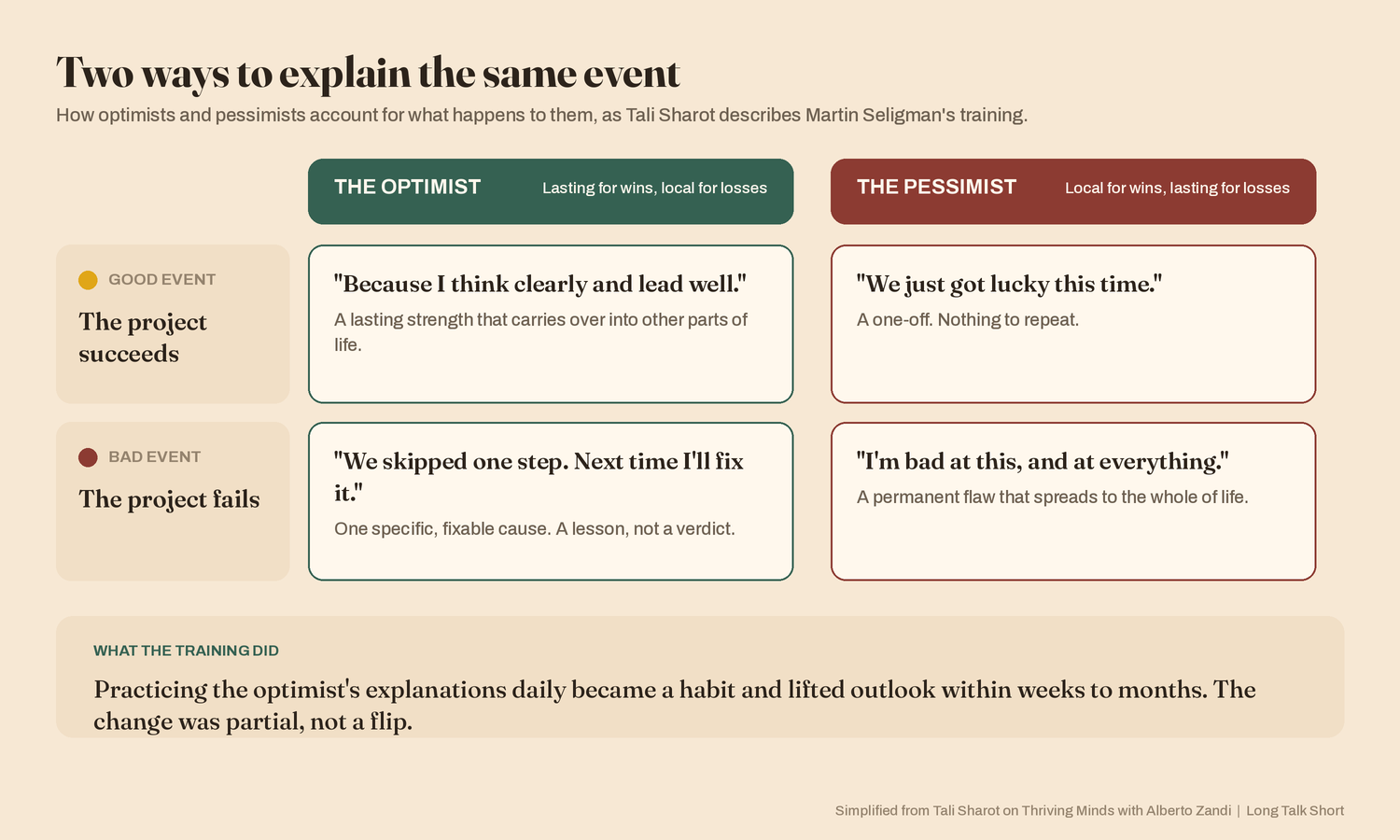
- Explain events like an optimist. She describes Martin Seligman's training at the University of Pennsylvania. Optimists credit wins to lasting traits that carry over into other areas of life, and pin setbacks on one specific, fixable cause. Pessimists do the reverse. Practiced daily, the optimist's style became a habit within weeks to months, though the change was partial.
- Draw a blueprint. After a breakup or a lost job, list the concrete steps from where you are to where you want to be. A detailed plan makes the goal feel more probable, "and that's optimism."
- Lower stress. Exercise works for her and meditation for others. When stress falls, optimism comes back.
- Build agency early. Offer children choices: carrots or cucumber, or let them make the salad. A plant or pet to care for helps too.
- Curate your inputs. Screen time itself isn't the issue, she argues; what you consume is. People in low moods seek out negative content, which deepens them. She has never used TikTok or Instagram, confines social media to set windows and reads a Kindle at bedtime.
Her one-line advice ties it together: be intentional, so you shape your life rather than letting it flow past.
Weighing it: what holds up
Solid ground: the core science is hers and solid, if debated. Her 2011 Nature Neuroscience paper showed people update beliefs more after good news than bad. Critics, notably Ulrike Hahn's group in 2016, argue some of that asymmetry is a statistical artifact of how the tasks are built, so treat "80 percent" as a lab measure, not a census. The stress findings match her published 2018 firefighter and student studies.
Numbers that need context: classic twin studies put trait optimism at about a quarter heritable, and Sharot's own 2022 twin study found belief updating only marginally heritable, about 13 percent. Optimism does predict better health and persistence, but "success in every domain" is a correlation, and very optimistic people make riskier financial choices, which she concedes. Her midlife "rock bottom" clashes with large panel studies of about 75,000 people, which find self-rated optimism rising into midlife and declining in old age. The U-shape is better documented for life satisfaction.
Anecdotes that drift: we couldn't trace the Harvard vacation study, though a 2010 Dutch study of 1,530 adults found the lift came before the trip, not after. Her Facebook example, "a hundred people" who "went straight back," is likely the 2020 Stanford-NYU experiment: about 2,700 users paid roughly $100 to deactivate for four weeks. Well-being improved modestly, and afterward they used Facebook less, not more. Her point that dopamine drives wanting more than liking fits the research, but the gambling she links to L-dopa in Parkinson's is tied mainly to dopamine agonists.
Promotion: light. No ads, just an Amazon link to her 2024 book Look Again. The "MIT Neuroscientist" title undersells UCL, her main home, and the video's chapter list names topics never discussed, such as pre-mortems and safer-driver illusions.
Long Talk Short
- Optimism is a hopeful outlook. The bias is when hope outruns the evidence, and most of us can't see our own.
- Expecting to do well fuels effort, and anticipation is a big share of everyday happiness.
- Stress makes forecasts gloomier for a while. Treat that as a state, not a verdict.
- Credit wins to lasting strengths. Blame setbacks on specific, fixable causes.
- Turn a goal into concrete steps; a plan makes success feel more likely.
- To prompt action, highlight the reward. To stop it, highlight the cost.
The one thing to remember: optimism is less a mood than a sense of control. Build the plan, and the belief tends to follow.
Source: Thriving Minds with Alberto Zandi, "MIT Neuroscientist: How to Wire Your Brain for Optimism Today - Dr Tali Sharot". This is an independent summary of that episode and is not affiliated with the show.
This article is for general information only and is not medical or mental health advice. If low mood or hopelessness persists, please talk to a doctor or mental health professional.