The Cancer Theory the Field Won't Accept
Biologist Thomas Seyfried argues that cancer is not a genetic disease but a metabolic one, rooted in damaged mitochondria, and that it can be managed by starving tumors of their fuel. It is a bold, contested claim that mainstream oncology does not accept. Here is his case, and the serious cavea
Based on Thomas Seyfried's conversation on The Diary of a CEO with Steven Bartlett. Seyfried is a biology professor at Boston College. His metabolic theory of cancer is a genuine but minority scientific position that mainstream oncology does not endorse, and several of his treatment claims are unproven. This distills his argument and includes the mainstream counterpoint. It is a summary of his views, not medical advice, and nothing here should be used to delay, replace, or self-manage cancer treatment. Anyone facing cancer should work with their oncologist.
Thomas Seyfried arrives at The Diary of a CEO with an envelope marked confidential and an argument that, if he is right, upends how the world treats its most feared disease. Cancer, the Boston College biologist insists, is not fundamentally a genetic disease at all. It is a metabolic one, a disease of the mitochondria, the tiny power plants inside every cell, and it can be managed, he says, by understanding and starving the fuel that tumors run on. It is a genuinely held, decades-long body of work. It is also a minority position that mainstream oncology does not accept, and before going further that needs stating plainly: nothing in this piece is medical advice, and nobody facing cancer should use it to delay, replace, or self-manage treatment. Seyfried himself says to work with your oncologist. Hold onto that as the argument unfolds.
The engine in the cell
Seyfried's starting point is the German Nobel laureate Otto Warburg, who showed in the 1920s and 30s that cancer cells do something strange with energy. Normally a cell burns fuel using oxygen inside the mitochondria, an efficient process that yields a large amount of ATP, the body's energy currency, and leaves carbon dioxide and water as waste. Warburg noticed that cancer cells instead ferment, producing energy without properly using oxygen even when oxygen is plentiful, and dumping out lactic acid as waste. Something, he reasoned, must be wrong with the mitochondria themselves.
Seyfried's contribution is to argue that this damage is the origin of the disease, not a side effect. The mitochondria, he explains, are descended from ancient bacteria that fused with our ancestral cells billions of years ago. In their modern form they do far more than make energy: they signal the nucleus, govern when a cell should divide and when it should stop, and keep each cell in step with its neighbors. When they are chronically damaged, by carcinogens, inflammation, intermittent low oxygen, microplastics, so-called forever chemicals, poor sleep, chronic stress, or a flood of processed carbohydrate, the cell loses efficient energy production and falls back on that ancient fermentation pathway. And that ancient pathway, from an era before the regulatory machinery existed, comes with no brakes on growth.
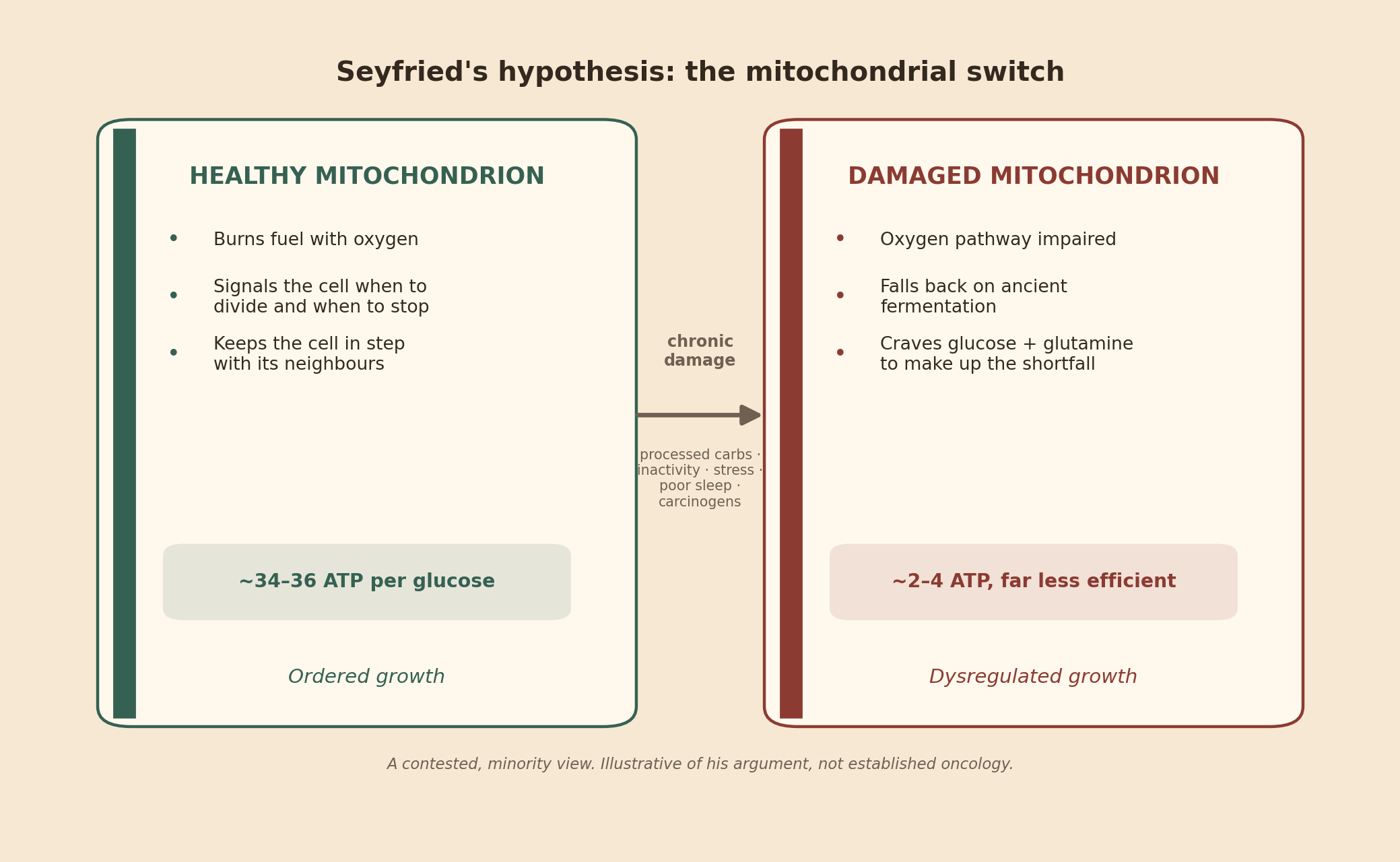
Seyfried's hypothesis, simplified: a healthy mitochondrion makes energy efficiently with oxygen and keeps cell growth ordered; chronic damage flips it to inefficient fermentation and, he argues, to dysregulated growth. This illustrates his contested claim, not settled oncology.
The paradox he says he solved
The puzzle Seyfried claims to answer is one the Nobel laureate Albert Szent-Gyorgyi called the oncogenic paradox: many different things can cause cancer, viruses, chronic inflammation, chemicals, radiation, rare inherited mutations, yet no one could explain the single common mechanism by which all of them produce uncontrolled growth. Seyfried's answer is that they share one thing: each damages the mitochondria's ability to make energy with oxygen, forcing the cell onto the fermentation pathway and its unregulated growth.
He leans on a provocative set of cell experiments to argue the nucleus is not the culprit. Take the nucleus of an aggressive tumor cell, put it into a normal cell whose own nucleus has been removed, and you do not get cancer. Reverse it, put a normal nucleus into the cytoplasm of a tumor cell, with its damaged mitochondria, and the growth goes haywire. The driver, he concludes, is in the cytoplasm, not the genes. He points too at "ghost mitochondria" visible under the electron microscope in tumor cells, shells with their internal structures missing or deformed, and invokes a basic rule of biology: structure determines function. Even inherited cancer risks, he argues, like the BRCA mutations, are not fully penetrant the way true genetic diseases are, and each, in his reading, ultimately disturbs mitochondrial energy production.
This is the crux of the disagreement. Mainstream oncology runs on the somatic mutation theory, that cancer is driven by accumulated DNA mutations, and designs its treatments accordingly. Seyfried's view is a minority one, and the nuclear-transfer and electron-microscopy arguments he cites are interpreted very differently by most cancer biologists. That tension is the real subject of the conversation.
Two fuels, and a number
If a tumor runs on fermentation, Seyfried argues, it depends on two fuels: glucose, blood sugar, and glutamine, the most abundant amino acid in the body. Starve a tumor of both at once, the theory goes, and you strip it of what drives its growth, while the rest of the body, with healthy mitochondria, happily switches to burning fat and ketones instead.
This is where the practical tool of the episode comes in, the Glucose Ketone Index, or GKI, which Seyfried developed after working with a brain-tumor patient named Trudy Dupont. Because blood glucose is volatile and ketones are measured on a different scale, he created a single ratio, glucose divided by ketones, that gives a stable number reflecting, in his framing, how metabolically "switched over" you are. A low number means low blood sugar and raised ketones, the state he associates with our Paleolithic ancestors who had no pastries and frequent spells without food. Bartlett pricks his finger live and lands at 12.5, which Seyfried calls the prevention zone; a week of eating mostly ribeye steak, Bartlett notes, had taken him down to 10. Seyfried is careful to separate this nutritional ketosis, with ketones under one, from the dangerous ketoacidosis of uncontrolled diabetes, where ketones run many times higher.
It is worth being clear-eyed here. The GKI is Seyfried's own metric, and the idea that pushing it low can treat an existing cancer is not established medicine. Wearing a glucose monitor taught Bartlett something real and benign, that food changes his blood sugar within minutes and that crashes track his mood, but that is a long way from a cancer therapy.
What he actually proposes, and what he does not claim
Seyfried is explicit on one point: he never uses the word cure. What he describes is management, and crucially he frames diet as an adjunct to conventional treatment, not a replacement for it. His clinical collaborators, he says, put patients into nutritional ketosis and then give standard chemotherapy or radiation at much lower doses, the ketogenic state acting as what one of his papers calls a "metabolic vehicle" that, in his account, makes healthy cells more resilient and tumor cells more vulnerable, so smaller drug doses do more with less harm. He describes a "press-pulse" strategy, pressing down glucose with diet and pulsing drugs that target glutamine, and points to cases like Pablo Kelly, a man with an inoperable glioblastoma who, Seyfried says, used metabolic therapy and lived about a decade. These are compelling stories. They are also individual case reports, not controlled trials, and that distinction matters enormously.
Here the mainstream counterpoint, which Bartlett raises squarely, deserves equal weight. Most oncologists do not recommend a ketogenic diet to newly diagnosed patients, and many actively advise against a strict one. The central fear is cachexia, the severe wasting of muscle and fat that is itself a leading cause of death in cancer, which a restrictive, appetite-suppressing diet could worsen. Hospital dietitians often tell patients to eat whatever they can keep down precisely to hold weight on. Seyfried counters that the weight loss in supervised nutritional ketosis is "therapeutic," distinct from the pathological wasting of cachexia, but this is exactly the kind of claim that would need large trials to settle, and those trials, for a dietary intervention no company can patent, are scarce. The disease that defines the stakes, glioblastoma, has seen no major treatment advance in a century, which is part of what fuels both his urgency and his frustration, 1,700 Americans, he notes, die of cancer every day.
The real dangers of doing this alone
Any honest version of this story has to carry its warnings in bold, not in a footnote. Seyfried himself, pressed by Bartlett, says to always consult a medical professional. He mentions receiving a message from a woman whose husband, with an underlying condition, attempted ketosis, collapsed unconscious, and was hospitalized. He notes that some people have a carnitine deficiency that makes a ketogenic diet dangerous without supervision, and that cancer patients often carry other illnesses, diabetes, high blood pressure, that have to be managed before anyone changes their diet. Prolonged water fasting, which he describes using in clinical settings, can be hazardous and is not something to improvise. The pattern is consistent: the parts of this that might have value are the parts done under the care of knowledgeable physicians, and the parts done alone, from a video, are where people get hurt.
The part that is safe to take home
There is, running underneath all of it, a prevention message that stands on much firmer ground and asks nothing risky of you. If mitochondrial health is protective, then the levers are the familiar ones, and Seyfried, asked what he would do as "king" to bring the numbers down, reaches not for a drug but for them: avoid highly processed carbohydrates, move your body, sleep well, lower chronic stress, and reduce your exposure to carcinogens like forever chemicals and contaminated water. He frames the inverse memorably, relaying a colleague's recipe for how to get cancer: eat junk constantly, sleep terribly, never leave the couch, doom-scroll all day, never exercise, and have no friends. The flip side is the whole of his prevention advice. He is also insistent that this stays a matter of personal knowledge and choice, not government instruction, and he worries about the people in food deserts for whom the healthier option is simply not affordable.
Hope, and the honest caveat
Seyfried is plainly moved by the patients who write to him years after being told they had months. He believes he has given hope to the hopeless, and his research, he stresses, runs on philanthropy rather than profit. That sincerity is real, and so is the appeal of a theory that promises agency in the face of a terrifying diagnosis. But hope and proof are not the same thing, and the responsible way to hold this conversation is to hold both: an intriguing, serious, minority hypothesis about the deep biology of cancer, and a hard boundary around what follows from it. The prevention habits are sound and free. The treatment claims are unproven, potentially dangerous if self-applied, and belong in a clinic, alongside conventional care, never instead of it. If you or someone you love is facing cancer, the move Seyfried himself endorses is the only one to take from this: bring the questions to your oncologist, and make the decisions together.
Long talk short: Seyfried's claim is that cancer begins not in the genes but in the mitochondria, the cell's power plants, and that when those are chronically damaged a cell falls back on an inefficient, ancient way of making energy that drives growth out of control. From that he builds a case for starving tumors of their two fuels, glucose and glutamine, using diet, fasting, and lower-dose conventional drugs together. It is a serious, decades-long body of work, and it is also a minority view that mainstream oncology rejects, with much of the human evidence still case reports rather than trials. The defensible, low-risk part is the prevention message: protect your mitochondria by avoiding ultra-processed carbohydrates, moving your body, sleeping well, and lowering stress. The treatment claims are not settled science, carry real dangers if done alone, and belong in the hands of a doctor, never a podcast.
Further reading
- Cancer as a Metabolic Disease, Thomas Seyfried
- Tripping Over the Truth, Travis Christofferson
- The Emperor of All Maladies, Siddhartha Mukherjee
Affiliate links, a small commission supports the blog at no cost to you.