The Real Procrastination Killer: The If-Then Strategy That Makes Motivation Irrelevant
You don't have a motivation problem, you have a planning problem. In 1999 Peter Gollwitzer proved that a two-minute if-then plan beats willpower: 75% completion versus 33%, and 100% versus half for a cancer screening. Here is how to install the trigger.
Implementation intentions, the psychology of if-then planning, make motivation irrelevant by turning a goal into an automatic trigger. The two-minute method, and the visualization step most people skip.
You don't have a motivation problem. You have a planning problem, and a psychologist named Peter Gollwitzer proved it in 1999 with a strategy so simple it feels like cheating. It's called implementation intentions, the real procrastination stopper, and once you understand it, you'll never wait to "feel like it" again.
The discovery that embarrassed willpower
In 1999, psychologist Peter Gollwitzer ran a deceptively simple experiment. He asked a group of students to complete an assignment at home. Some received ordinary instructions. Others received one extra tool: the implementation intention technique.
The result: 75% of the students using the technique finished on time, versus only 33% of the others. Same assignment. Same students. The only difference was a few sentences of planning.
He tested it again with higher stakes. A group of women were asked to go for a cancer screening. Without the technique, barely half showed up. With it: 100%. Every single one.
Let that sink in. Not 80%. Not 90%. One hundred percent, from a planning trick that takes two minutes.
Why motivation is the wrong fuel
Here's the part that flips everything: implementation intentions don't work by boosting your motivation. They work by bypassing it entirely.
With this technique, you don't even need to be motivated anymore to do what you have to do. The strategy installs a quasi-automatic trigger in your brain, an if-then reflex. When the cue arrives, the behavior fires. No pep talk required. No waiting for inspiration. The decision was already made, back when you were calm and rational, not at 11 PM when the couch is calling.
This reframes procrastination completely. You're not lazy. Your brain simply never received a clear execution order, so it defaulted to the easiest available program: nothing.
The four phases (and where you actually get stuck)
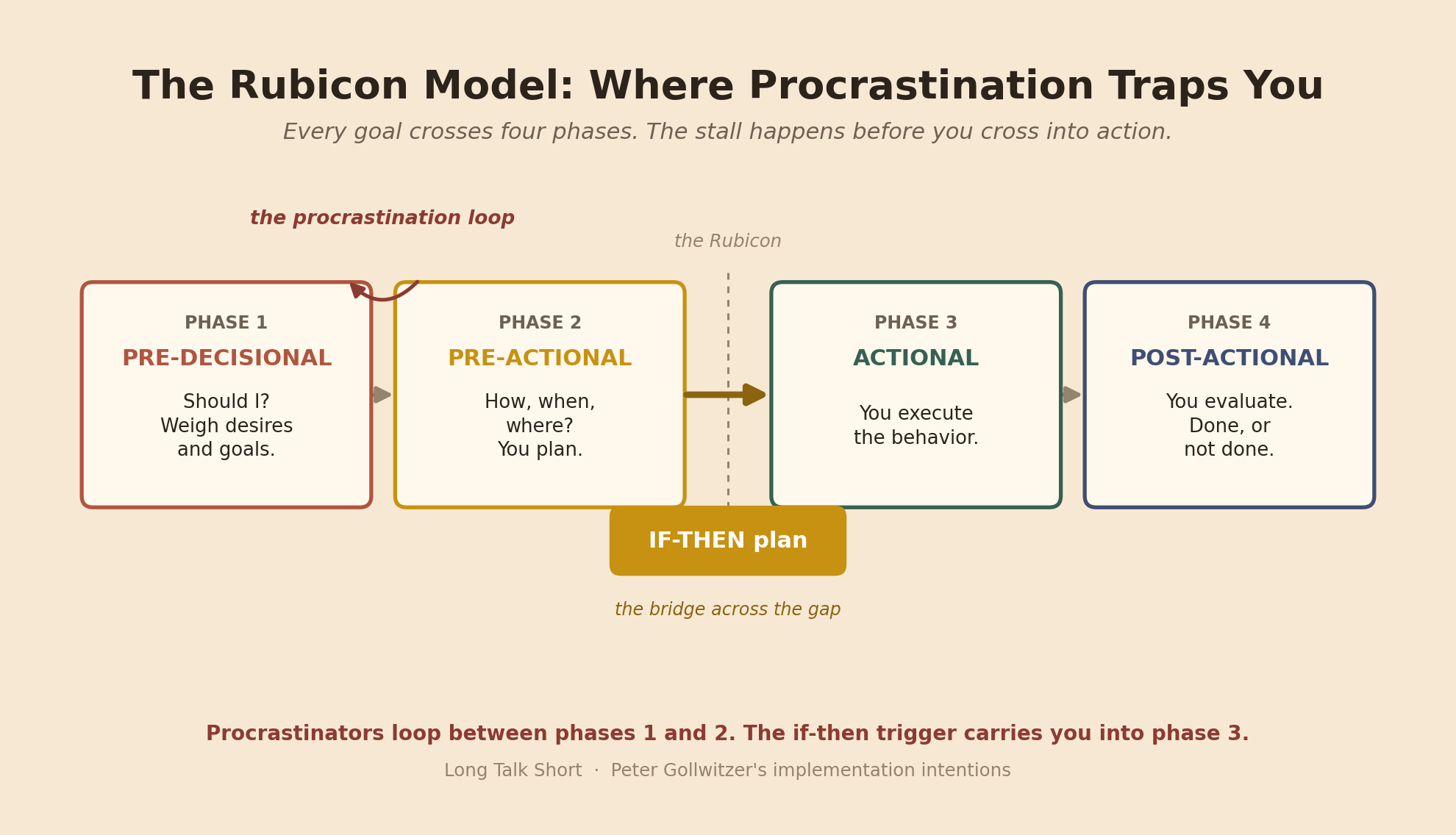
Gollwitzer's model, the Rubicon model of action phases, splits every goal into four stages:
- Pre-decisional: you weigh motivations, desires, expectations, goals. Should I?
- Pre-actional: you plan. How, when, where?
- Actional: you execute.
- Post-actional: you evaluate. "Good, I did it," or "I still haven't done my thing."
Most procrastinators live in an endless loop between the first two phases. They deliberate forever, plan vaguely ("I'll do it tomorrow"), and never cross into action. Implementation intentions are a bridge built specifically for that gap: they convert fuzzy pre-action into a concrete trigger the brain can actually fire on.
The two-minute technique
Strip it to its bones and the method is almost insultingly simple. Don't just decide what you'll do. Decide where, when, and how, in if-then form:
- If it's 2 PM tomorrow, then I'll open the laptop and start the report.
- If I finish lunch, then I'll put on my shoes and walk for twenty minutes.
That's it. Where. When. How. Written as a trigger, not a wish.
The genius move: rehearse the entire scene
But here's the part most people miss, the detail that separates this from ordinary time-management advice. Don't just plan the when. Visualize the entire scene.
Know what you'll do, how you'll do it, what you'll have with you, what you'll be wearing, what the temperature will be, whether you'll have music in your ears. Picture the table cleared before the laptop goes down. Picture the glass of iced tea beside it. See the whole movie, not just the opening frame.
Why does this work so well? Because for your brain, a vividly imagined scene already exists. You're not asking it to invent a future from scratch at the moment of action, you're asking it to replay something it has already "lived." The friction collapses. You just... begin. This isn't a productivity hack. It's beyond a hack, it's how the machinery actually runs.
So tonight, take the one thing you've been postponing and give it the full treatment. Not "I'll do it tomorrow." Instead: tomorrow, at 2 PM, at the kitchen table, cleared, laptop open, iced tea poured, playlist on, I start. See it. Then watch what happens when 2 PM arrives.
Six takeaways
- Implementation intentions, Gollwitzer's 1999 discovery, beat raw motivation: 75% vs 33% completion in the student study, and roughly half versus 100% in the cancer-screening study.
- The technique bypasses motivation entirely by installing an automatic if-then trigger; you decide once, calmly, instead of negotiating with yourself every time.
- Every goal crosses four phases, pre-decisional, pre-actional, actional, post-actional, and procrastinators stall between the first two; if-then plans are the bridge.
- The formula is minimal: decide WHERE, WHEN, and HOW, phrased as "if [cue], then [action]."
- The advanced move is full-scene visualization, clothes, temperature, music, objects, surroundings, so the brain treats the action as already real.
- Apply it tonight to one postponed task: a concrete time, a concrete place, a fully pictured scene, and let the trigger fire tomorrow.
Based on the implementation-intentions research of Peter Gollwitzer (1999).
Go deeper
- Rethinking Positive Thinking: Inside the New Science of Motivation, Gabriele Oettingen
Affiliate links, a small commission supports the blog at no cost to you.