The Six Needs That Run Your Life: Tony Robbins on the Science of Achievement and the Art of Fulfillment
They won the game and felt nothing. Tony Robbins' answer to why 'living the dream' can feel empty: six human needs. Any habit that meets three of them becomes an addiction, and the two most people starve, growth and contribution, are the ones that actually keep you alive.
Certainty, variety, significance, connection, growth, contribution. Tony Robbins' map of what drives every habit you have, why three needs make an addiction, and the two that decide whether achievement ever feels like fulfillment.
I know people who are living the dream, any way you'd define it. Money, status, the house, the title. And I have watched some of them slide into something that looks exactly like depression.
Not sadness. Emptiness. They won the game... and felt nothing.
Tony Robbins has spent forty years asking why. His answer comes down to six words, six human needs. And once you see them, you cannot unsee them.
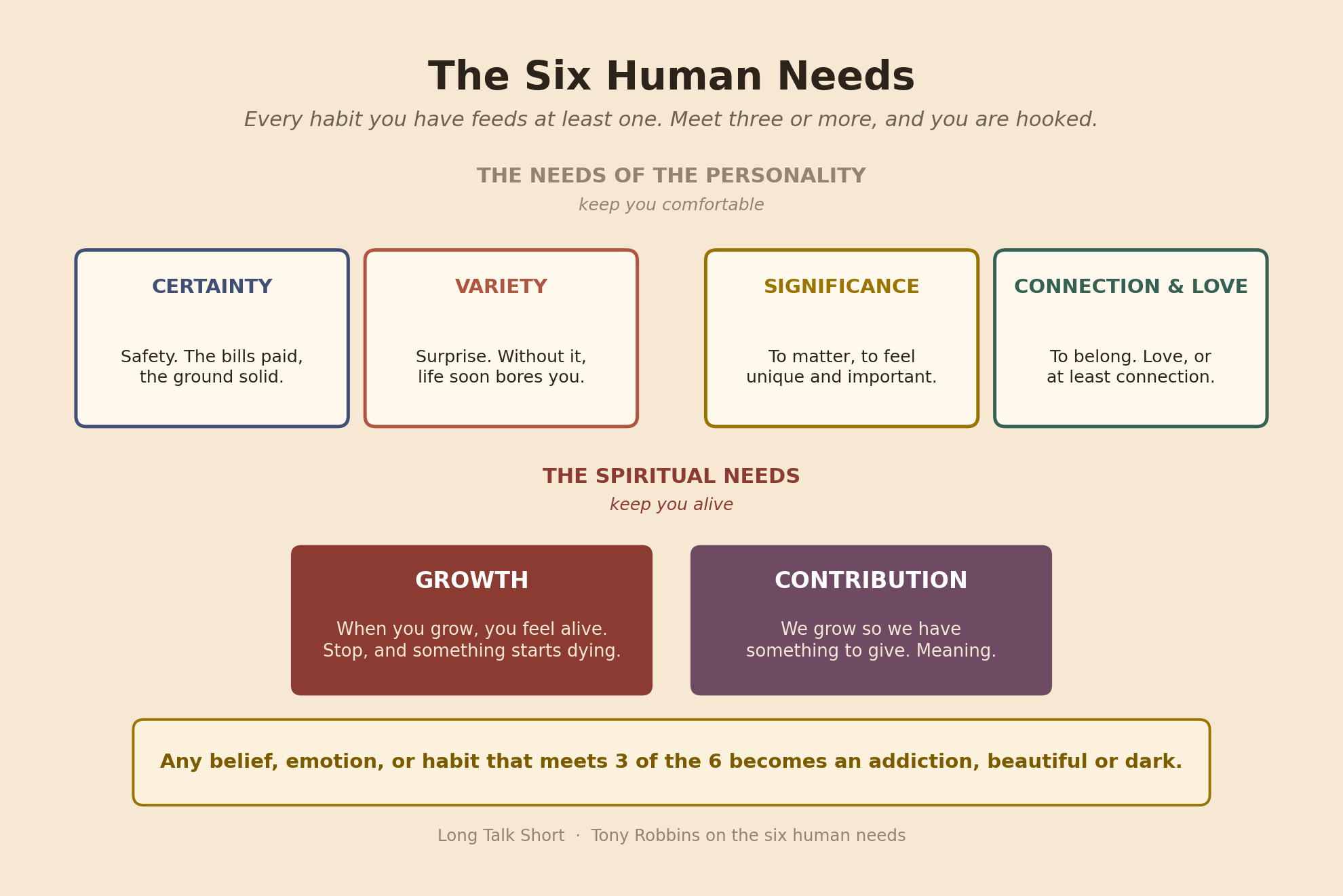
The first four: the needs of the personality
Certainty. You want to know the roof won't cave in, that you can pay the bills, that the ground beneath you is solid.
Uncertainty, variety. Here's the catch: if you knew exactly what everyone was going to say, exactly what would happen every moment of every day, it would be thrilling for about a week. Then you'd be bored out of your mind. So life keeps dealing you surprises, whether you order them or not.
Significance. Every one of us needs to feel unique, important, that we matter. People chase this a thousand ways, the clothes, the tattoos, the car, the title... or the opposite, by being the most generous person in the room. Same need. Different costume.
Connection and love. Everyone wants love. But most people, somewhere along the way, got hurt badly enough that they stopped reaching for it, and settled for connection instead. Connection has a million doors: a run at dawn where you feel plugged into something bigger, prayer, old friends, making love, a dog that greets you like you're the best thing that ever happened. But here's the trap: some people connect through their problems. Two friends, coffee in hand, trading miseries, "You think that's bad? Listen to mine." They're bonding over pain, fighting for significance while connecting through their suffering.
The addiction rule: three needs is the threshold
Here's the rule that changes everything. Any time a belief, an emotion, or a behavior meets at least three of these six needs, you become addicted to it.
Three needs, that's the threshold. It can be a beautiful addiction: training for a marathon feeds certainty, significance, and growth. Or it can be a dark one. Gossip feeds uncertainty, significance, and connection. Scrolling the outrage feed at midnight? Uncertainty, significance, connection. Three for three. No wonder you can't put the phone down. You're not weak. You're wired.
So the question isn't "What's wrong with me?" The question is: which three needs is this habit feeding, and is it feeding the last two?
The final two: the spiritual needs
Robbins calls the last two needs spiritual, not religious, spiritual.
Growth. When you're growing, you feel alive. When you stop growing, something inside you starts dying.
Contribution. We grow so that we finally have something to give. This is where meaning enters the story.
And here is the distinction that is the whole game: there is the science of achievement, and there is the art of fulfillment. Two different skills.
The science of achievement is about getting the thing, the promotion, the body, the bank account. You can master it completely and still feel empty. The art of fulfillment is about the needs, especially growth and contribution. If those two are missing, you will not feel fulfilled. Period. That's not a motivational slogan. That's the operating system.
Try it: the three-needs audit
Pick one habit that runs a big part of your week, not your favorite, your most automatic. The thing you do without deciding: the phone in bed, the overworking, the nightly glass of wine, the venting sessions, the endless planning that never becomes doing.
Now ask: which of the six needs does it feed? Certainty? Uncertainty? Significance? Connection? Growth? Contribution? Be ruthless. Count them.
If you land on three or more, you've found your wiring. You're not fighting a habit, you're fighting three human needs stacked on top of each other. That's why willpower keeps losing.
Then the two that matter most: does this habit feed your growth? Does it feed your contribution? If the answer is no to both, you've just diagnosed the emptiness. Your habit is loud on the first four needs and silent on the last two.
Don't try to kill the habit tonight. Just add one small act of growth and one small act of contribution to tomorrow. Growth can be tiny: ten pages of a book, one hard conversation, one new thing learned. Contribution can be tiny too: one genuine compliment, one message checking on a friend, one problem you solve for someone else without being asked.
Small. Daily. Non-negotiable. Do that for a week and watch what happens to the old habit. You won't have to fight it as hard, because you'll be feeding the deeper needs somewhere better. You're not breaking the addiction. You're outbidding it.
Stop asking only "How do I achieve more?" and start asking: "What am I growing, and what am I giving?" The first four needs keep you comfortable. The last two keep you alive. Feed them on purpose, every single day, and the dream you build won't feel empty when you arrive.
Six takeaways
- Six human needs run your behavior: certainty, uncertainty, significance, connection and love, growth, and contribution.
- Any belief, emotion, or behavior that meets at least three of the six needs becomes an addiction, positive or negative.
- Most people who wanted love settled for connection; some even connect through their problems, bonding over pain.
- Growth and contribution are the two spiritual needs: when you grow you feel alive; we grow so we have something to give.
- There is the science of achievement and the art of fulfillment, two different skills, and you need both for an extraordinary life.
- Run the three-needs audit on your most automatic habit, then outbid it: one small act of growth and one of contribution, daily.
Source: Is this the meaning of life?, Tony Robbins.
Go deeper
- Awaken the Giant Within, Tony Robbins
Affiliate links, a small commission supports the blog at no cost to you.