Unlock Superhuman Focus & Perfect Memory!
A UC Berkeley neuroscientist who studies attention for a living lays out how focus actually works, why your memory depends on it, and the five-step method her lab uses to roughly double deep-work output. The real science behind the superhuman headline, with the hype weighed honestly.
Attention and memory are the same muscle. Dr. Sahar Yousef on why multitasking is a myth, how your attention is engineered away from you, and the Focus Sprint that puts it back under your control.
Let us deal with the headline first, because it promises more than any human can deliver. There is no such thing as perfect memory, and "superhuman" is marketing, not neuroscience. What Dr. Sahar Yousef offers in her conversation with Steven Bartlett is better than the headline, because it is real. Yousef is a cognitive neuroscientist at UC Berkeley who runs the Becoming Superhuman Lab, and her field is the one most people quietly feel slipping: attention. Strip away the hype and her core message is a single, unglamorous law of the brain, and once you accept it, focus and memory stop being two separate self-improvement projects and become one.
The law that joins focus to memory
Here is the sentence to keep. You cannot remember anything you did not attend to in the first place. Attention is the doorway, and memory is the room behind it. If something never caught your focus, it was never encoded, and there is nothing to retrieve later. This is why "I have a terrible memory" is, for most healthy people most of the time, really "I have terrible attention." You did not forget where you put your keys. You never actually noticed putting them down, because half your mind was on your phone.
That is the quiet engine under the whole conversation. Every technique Yousef describes for sharpening focus is also, automatically, a technique for remembering more, because the two are the same muscle seen from different sides. Memory is just learning that stuck, and nothing sticks that you did not first attend to. So the honest version of the headline is this: you cannot unlock perfect memory, but you can stop sabotaging the attention that feeds it, and the gains there are large.
Multitasking is the thief
The fastest way to feel this is a test Yousef runs on people who believe they are great multitaskers. Write "I am a great multitasker" on one line, as fast as you can, then write the numbers 1 to 20 on the next. Time it. Now do the same letters and numbers again, but alternate: one letter, drop down, one number, back up, next letter. Same characters, same hand. On the podcast Bartlett went from 31 seconds to barely half the task in the same time, a drop of around 60 percent, and he described exactly the thing that matters: every time he switched lines he had to stop and find his place again.
That re-finding is the cost, and it has a name: attentional residue, or as Yousef prefers it, attentional baggage. When you switch tasks, a part of your mind stays snagged on the last one, so you arrive at the new task already carrying load and never fully arrive at all. This is where focus and memory bleed together again. The reason the alternating version felt so hard was that Bartlett kept losing track of where he was, his working memory wiped by each switch. Multitasking does not just slow you down. It prevents the encoding that memory is built from.
A caution on the number, because precision matters more than drama. A 60 percent slowdown on a contrived letters-and-numbers drill does not mean you literally lose 60 percent of every working day. It is a vivid demonstration of switch cost, not a measurement of your life. The well-supported finding underneath it is real and sobering enough on its own: the average knowledge worker now burns an estimated two hours a day simply bouncing between screens and tasks, paying the switch cost over and over. The fix is not heroic willpower. It is to close the loop on one thing before opening the next, what Yousef calls getting cognitive closure. Finish the thought, shut the tab, then move.
Your attention is being engineered away from you
None of this is a personal failing, and Yousef is emphatic that shame is the wrong response. Your attention is losing because it is up against people who were hired to take it. She studies strategic automaticity, getting a behavior to happen without deliberation, the way you brush your teeth half asleep, and she has been recruited repeatedly by technology companies she is legally barred from naming, once for four times her academic salary, to make their products stickier. She said no. Many in her field said yes.
She describes the playbook they use as the same one the food industry perfected, in three moves. Increase stimulation, through saturated color and endless short-form video, so the product lights up the brain harder than real life. Decrease friction, through infinite scroll and autoplay, so there is never a natural stopping point. Decrease satiation, through the illusion of connection, so you never feel full and keep reaching for more. Layered on top is the intermittent variable reward, the slot-machine schedule where you pull and sometimes win, which is the single most addictive reinforcement pattern known to behavioral science. You are not weak. You are up against a hundred experts and a brain they understand well.
The counter-moves are what Yousef calls digital hygiene, and they are mercifully concrete:
- Put the phone out of sight, not just face down. Out of sight genuinely lowers its pull, because an object you cannot see stops competing for attention. A phone on the desk taxes focus even while dark.
- Try grayscale. Her lab ran a three-week study in which switching the phone to black and white gave people back about an hour a day, roughly seven hours a week, by stripping out the color saturation that makes apps feel rewarding.
- Turn almost all notifications off, and build a VIP list. Filter so only the genuine fires reach you, a short list of people and keywords, and let the rest sit in a mailbox you check on your schedule rather than theirs.
- Favor long-form over short-form. A long video or a book asks your attention to stretch and hold. A feed of fifteen-second clips trains it to flinch away every few seconds, and that training transfers to everything else you try to focus on.
- Protect sleep first. Yousef calls sleep the foundation, with roughly seven hours a floor for most adults, and is blunt that chasing focus hacks on a sleep deficit is like redecorating while the car is on fire. Memory in particular is consolidated during sleep, so a short night is a direct tax on what you remember.
The Focus Sprint
For real cognitive work, Yousef's lab teaches a method it calls a focus sprint, and its research credits the method with letting people do up to twice as much while making fewer mistakes, and feeling better afterward rather than drained. There are five steps, and they map onto how attention and motivation actually run.
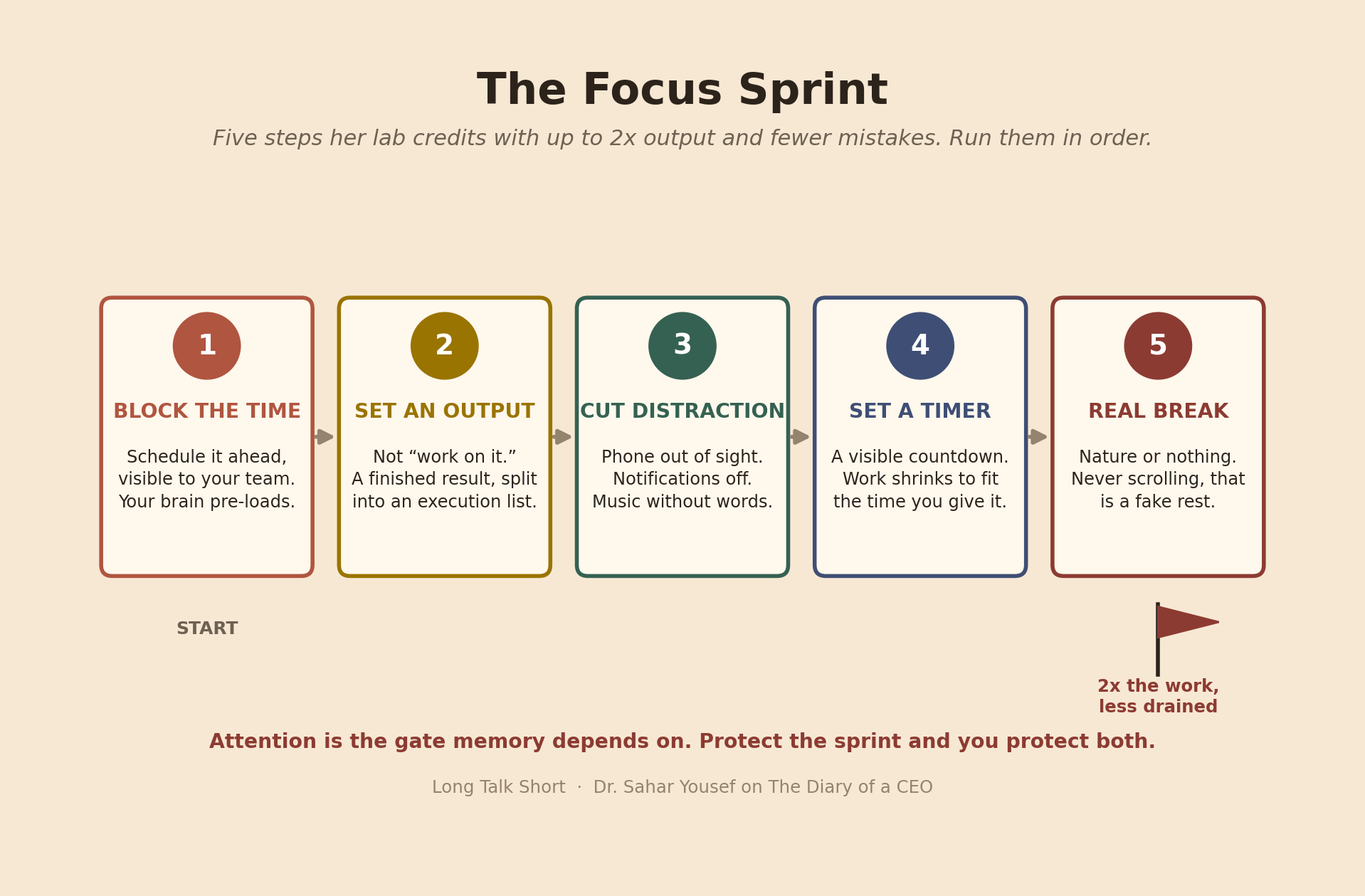
First, block the time in advance, on a visible calendar. Scheduling it ahead lets your brain's anticipatory networks prepare, the same quiet rise in cortisol and adrenaline you feel before a talk, so you arrive already primed. A public block also tells colleagues why you are, for once, not instantly replying.
Second, set the goal as an output, not an input. "Work on the deck" is an input, and it gives dopamine nothing to lock onto. "Finish slide three, send John the follow-up for slide seventeen's data, build the table" is an output broken into a granular execution list. Define each piece and roughly time-box it before you start, so that mid-sprint you are never stranded wondering what comes next. That moment of not-knowing is exactly where focus leaks out. Decide the moves before the game, then just play.
Third, cut the distractions. Phone out of sight, notifications off, and if you need sound, music with no lyrics or lyrics in a language you do not speak, so the verbal part of your brain stays free for the work. One useful trick: keep a single playlist you use only for focus, and over time your brain will treat it as a cue to drop in. Noise-cancelling headphones help, but she suggests capping them at a few hours a day so your hearing does not recalibrate to an unnaturally silent world.
Fourth, set a timer. Humans, like most mammals, speed up when they can see progress ticking by, which is why small children clean up faster to a song with a clear end. It is Parkinson's law made useful: work expands to fill the time you give it, so give it less. A visible countdown turns a vague afternoon into a sprint.
Fifth, take a real brain break, and understand what that means. A 2024 study compared ways of resting after focused work. Time in nature restored people best, doing nothing came next, and short-form scrolling was the worst, barely a rest at all. Scrolling on a break, Yousef says, is like resting between heavy sets by lifting lighter weights. The muscle never recovers. Reading the news does not count either, because that is still the same machinery working. A genuine break means stepping away from incoming information: a walk, daylight, or something absorbing with your hands.
Pick the right targets, and the right hours
A sprint is only as good as what you point it at. Yousef sorts tasks into MITs, most important tasks, and LITs, least important tasks. LITs, the quick emails and small errands, give fast dopamine and the satisfying feeling of crossing things off, but they rarely move your life. MITs are the slow-dopamine work that actually matters and that we therefore avoid. Her rule is to choose one to three MITs each morning by asking a simple question, what will my future self thank me for, and to spend your uninterrupted hours on those while the LITs fill the cracks between meetings.
If you cannot tell which task is the MIT, she says, step back further and find your Everest, the longer goal that makes today's priorities obvious. Her framing device is the deathbed: picture yourself at the end, and ask what you needed to have done to leave satisfied. It sounds morbid and is oddly clarifying, and it connects to a gentler idea Bartlett calls pedals over podiums. Do not stare at the summit. Focus on today's pedal stroke. The feeling of small, steady progress, the progress principle, is one of the most reliable sources of motivation there is, which is why breaking a big goal into a visible chain of small wins works where white-knuckling a huge one does not.
Then there is the question of when, and here Yousef adds something many productivity guides miss. People do not share one body clock. Your chronotype is genetic: roughly a quarter of people are morning-shifted and sharpest early, a smaller group are evening-shifted and peak late, and the majority are biphasic, up after a slow start, dipping hard in the early afternoon, then rising again. You are not the same thinker at 8am and 2pm. The practical move is to learn your own pattern and, as far as the world allows, aim your focus sprints and your most demanding work at your peak hours, not fight your biology out of habit or guilt.
Rest, rumination, and where ideas come from
Two more points worth keeping, both about what the mind does when you stop pushing it. The first is creativity. Yousef's account of insight is straightforward neuroscience: load the problem thoroughly, hold all its pieces in mind until you are genuinely stuck, then walk away. Do the dishes, take a shower, walk the dog. The step away lets the gridlocked networks loosen and lets unrelated ones connect, and the answer often arrives sideways, when you are not looking for it. Boredom, the thing Steve Jobs and others seemed to practice, is not wasted time. It is where connection happens.
The second is darker and more useful. The same wiring that deepens a skill through repetition also deepens a rumination through repetition. Every time you rehearse a grievance or replay a trauma in the same way, you strengthen that neural pathway, until the story becomes an identity. Her solution is not to suppress the feeling but to acknowledge it and then deliberately redirect attention elsewhere, because whichever networks you feed, with your time and your attention, grow stronger and louder. That is the attention-memory law again, pointed at your inner life: you are, in a real sense, practicing whatever you keep paying attention to.
How to read this
Most of what Yousef describes rests on solid ground: the reality of switch cost and attentional residue, the attention-memory link, the engineered addictiveness of modern apps, the primacy of sleep, chronotype differences, and the incubation effect behind creative insight are all well supported. The focus sprint is a sensible packaging of real principles, and the digital-hygiene steps cost nothing to try.
A few things deserve a cooler eye. The headline's "superhuman" and "perfect" are aspirational, not literal, and the "2x output" figure comes from her own lab rather than independent replication, so treat it as a promising claim, not a settled fact. Toward the end the conversation drifts toward manifestation, the idea that naming a goal daily will draw it to you. The defensible core there is attentional priming: tell your brain what matters and it does filter the world for relevant opportunities you would otherwise miss. That is real and worth using. But it tips easily into magical thinking, and a brain primed to find evidence for a belief will find it whether the belief is true or not, which is a bug as much as a feature. Prime your attention toward real goals, then do the work; do not expect the universe to deliver.
Her warning about a shrinking "thinking class," a future where a distracted majority stops thinking for itself, is a genuine fear from someone who has sat in those rooms, but it is a forecast, not a finding, and worth hearing as the former. And a note on incentives: Yousef, like most of us, has things to sell, from her institute's assessments to a paid workshop spun off this very episode. That does not make the science wrong. It is simply the standard reason to take any "assess your attention with us" pitch with the same measured skepticism you would bring to any product.
Hold all that lightly, and the takeaway is clean. You will not become superhuman. But attention is trainable, it is the gate memory depends on, and most of us have handed the keys to a feed. Taking them back is the whole game.
Long Talk Short
- Focus and memory are one muscle. You cannot remember what you never attended to, so most "bad memory" is really divided attention.
- Multitasking is a myth with a measurable cost. Switching tasks leaves attentional residue that both slows you and wipes the working memory that encoding depends on. Close one task before opening the next.
- Your attention is engineered away by a three-part playbook, more stimulation, less friction, less satiation, plus slot-machine rewards. The counters are digital hygiene: phone out of sight, grayscale, a VIP-only notification list, long-form over short-form, and sleep protected first.
- The Focus Sprint, in five steps: block the time, set an output goal broken into an execution list, cut distractions, set a timer, then take a real break in nature or doing nothing, never scrolling.
- Aim sprints at your MITs, the one to three tasks your future self will thank you for, and at your peak hours for your chronotype.
- Rest and stepping away fuel creative insight; repeated rumination deepens its own groove. Whatever you keep attending to, you are practicing.
Source: The Diary of a CEO, with Dr. Sahar Yousef. This is an independent distillation of that conversation, not affiliated with the podcast or the guest. Nothing here is medical advice; for concerns about attention, sleep, or memory, consult a qualified professional.
Go deeper
- Thinking, Fast and Slow, Daniel Kahneman
- Atomic Habits, James Clear
Affiliate links, a small commission supports the blog at no cost to you.