Man's Search for Meaning in 5 Minutes: Viktor Frankl on the One Freedom No One Can Take
Frankl lost his parents, brother and wife to the Nazi camps, then wrote a short book on what keeps people going. His answer: you can't always choose what happens, but you can choose how you answer. The core ideas, plus what history and research say.
Viktor Frankl survived nearly three years in Nazi ghettos and camps. His parents, his brother and his wife, Tilly, did not.
Within a year of liberation, the Viennese psychiatrist wrote a short book about what he'd learned. Its argument is simple and hard: we can't always choose what happens to us, but we can choose how we answer it.
That book, Man's Search for Meaning, became one of the most read books on psychology ever written. Here's what it says, and what holds up.
In short: the first half is a psychologist's memoir of camp life, from shock to apathy to the strange aftermath of freedom. The second half introduces logotherapy, built on the idea that our main drive is toward meaning, found through work, love and the stance we take toward suffering we cannot avoid.
1. A psychologist inside the camps
Frankl deliberately writes less about atrocities than about the inner life of an ordinary prisoner. He describes three phases:
- Shock on arrival, including a brief, absurd "delusion of reprieve."
- Apathy, an emotional numbing that protected people from daily horror but could harden into giving up.
- Release, when many found they could not feel joy at first, and some turned bitter or vengeful.
Across those phases, he watched who held on. That's where the book's real discovery begins.
2. Why some held on
Prisoners who lost all sense of a future, he writes, often declined quickly. Those who had something waiting, a person to see again or work to finish, had more to hold onto.
He held onto both: the image of his wife, whose fate he did not yet know, and a lost manuscript he meant to rewrite. He leans on a line from Nietzsche:
He who has a why to live can bear almost any how.
But a reason to live is not the same as control. Which brings us to the book's most famous passage.
3. The last of the human freedoms
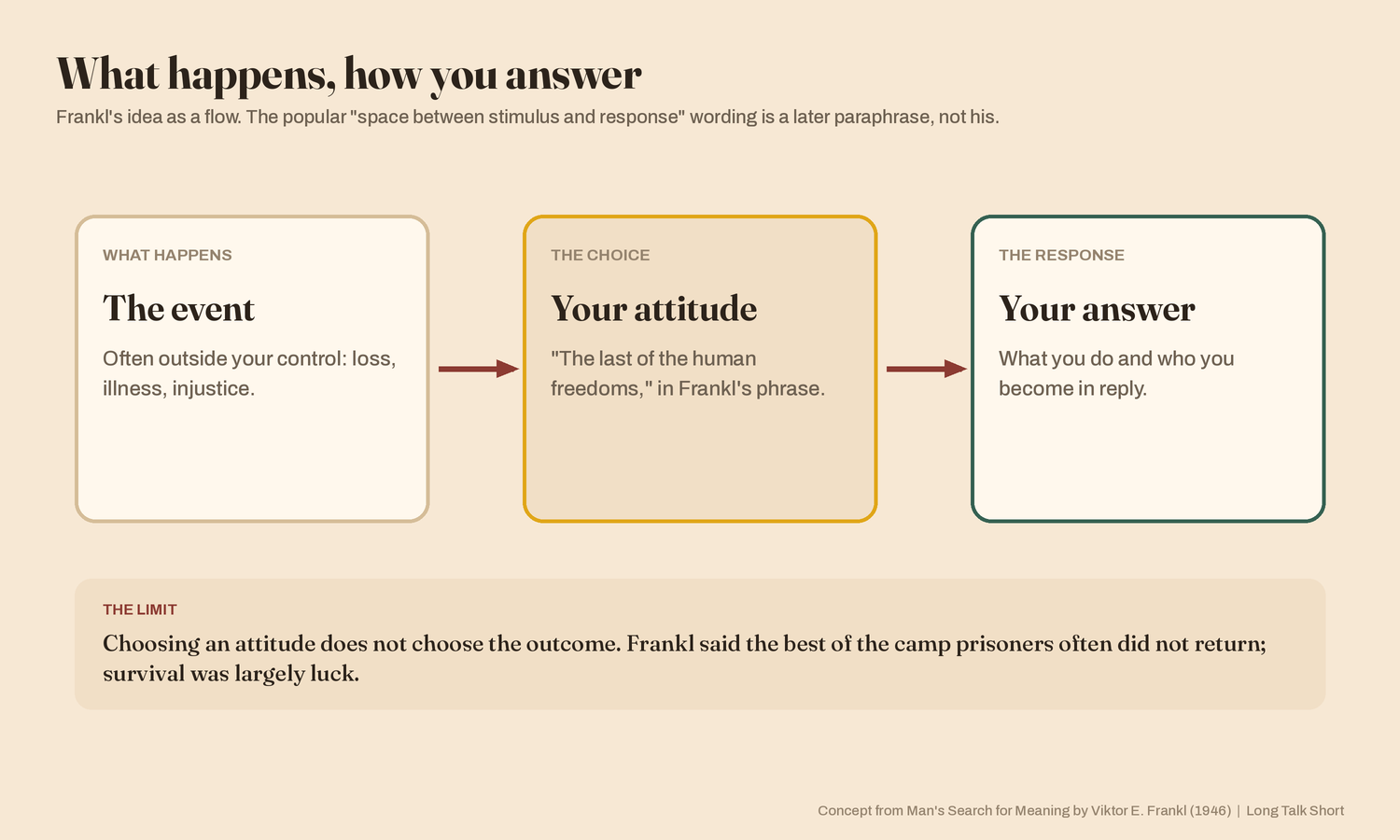
Everything can be taken from a man but one thing: the last of the human freedoms—to choose one's attitude in any given set of circumstances, to choose one's own way.
Frankl saw prisoners give away their last bread, and others turn on their fellow inmates. The camp shaped people, he argues, but did not fully determine them.
That is not the same as saying attitude saves you. Frankl is blunt that survival was mostly chance, and that "the best of us did not return."
His claim is narrower: even where outcomes are out of your hands, the way you meet them is still yours, and it can still carry meaning.
So where does that meaning come from? Frankl had an answer before the war even began.
4. Logotherapy: the will to meaning
Frankl had already developed logotherapy, from the Greek logos, "meaning." Freud, as Frankl summarized him, centered the will to pleasure, and Adler the will to power. Frankl proposed a will to meaning.
He treated an inner emptiness he called the "existential vacuum" as a modern problem, visible in boredom, addiction and despair.
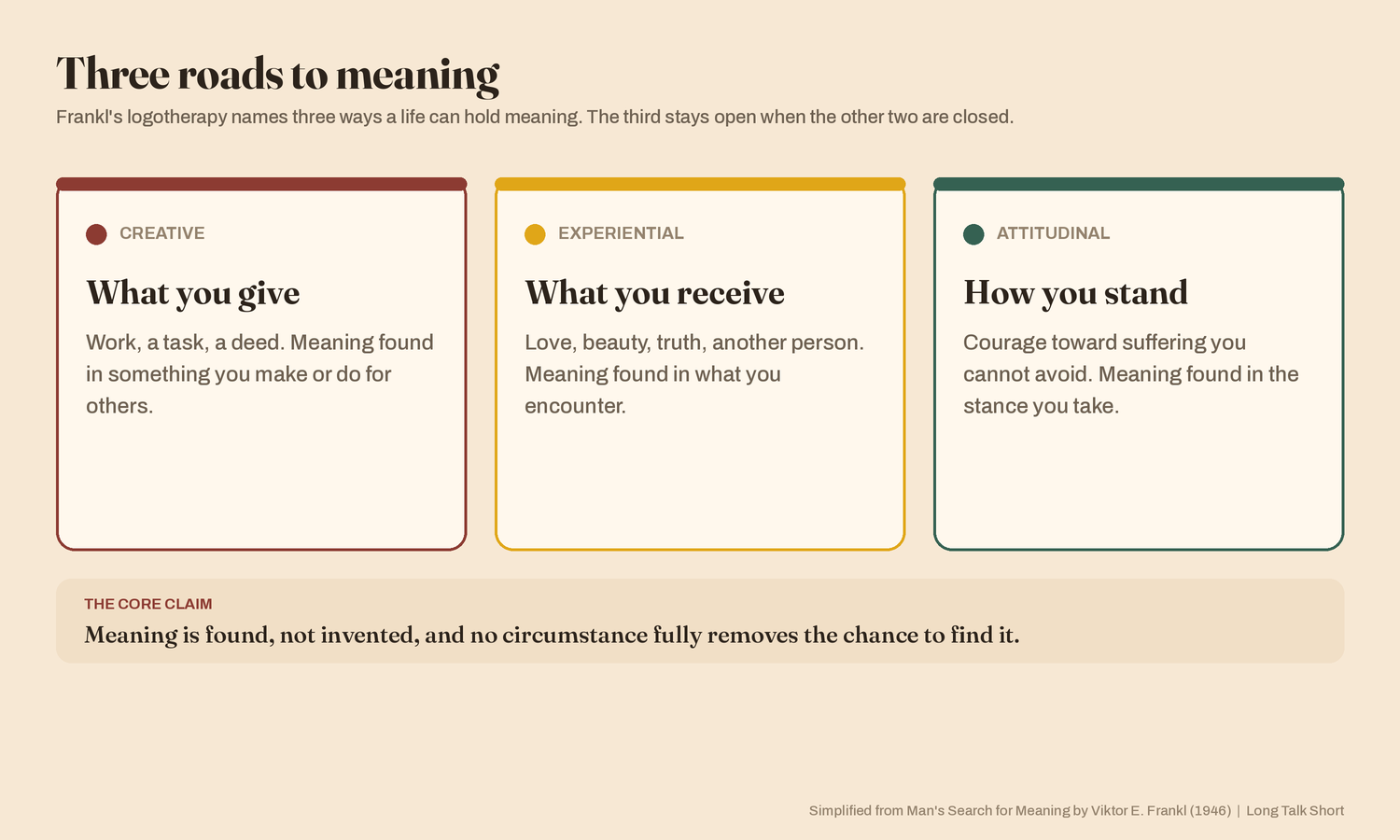
Meaning, in his view, is discovered rather than invented, and specific to each person and moment.
5. Three places to find meaning
- Creative. Doing a deed or creating a work: what you give to the world.
- Experiential. Experiencing something or someone, above all through love: what you receive from the world.
- Attitudinal. The stance you take toward unavoidable suffering. Suffering that could be removed should be; meaning lies in how you bear what can't.
He flips the usual question, too. Rather than asking what we expect from life, we should ask what life expects from us, and answer through action, not abstract reflection.
Later editions added the essay "The Case for a Tragic Optimism," about saying yes to life despite pain, guilt and death.
It's a powerful story. But the history behind it, and even its most shared quote, are not quite what most readers think.
Weighing it: what holds up
The camp history is often overstated. Frankl was deported to the Theresienstadt ghetto in September 1942. In October 1944 he was sent to Auschwitz, but prisoner records show he arrived at Kaufering III, a Dachau subcamp in Bavaria, on October 25, six days after leaving Theresienstadt. Frankl told an interviewer in 1991 he was in Auschwitz "only three or four days." Most of his ordeal was in Theresienstadt and the Dachau subcamps of Kaufering and Türkheim, where U.S. troops freed him on April 27, 1945.
Critics push harder. Historian Timothy Pytell argues the survival-through-meaning frame sits uneasily with the randomness of the camps, and documents that Frankl performed experimental brain surgeries on suicidal patients in Vienna in the early 1940s. Holocaust scholar Lawrence Langer objects that the uplifting arc can make survival look earned. Frankl's line about the best not returning partly anticipates that worry.
The famous quote isn't his. "Between stimulus and response there is a space. In that space is our power to choose our response" is everywhere attributed to Frankl. The Viktor Frankl Institute says it isn't his, and Quote Investigator traces it to Stephen Covey, who said he read it in a library book whose author he couldn't recall. Rollo May's 1963 essay is the likeliest source.
The psychology holds up better than the legend. A 2014 Psychological Science study of about 6,000 Americans found people with more purpose were less likely to die over 14 years, and a 2016 meta-analysis found the same pattern. Those are correlations, not proof. William Breitbart's meaning-centered psychotherapy, based on Frankl, has improved spiritual well-being and eased hopelessness in people with advanced cancer. Logotherapy as a stand-alone treatment has far thinner evidence.
Resilience research both supports and complicates him. George Bonanno's work shows steady resilience is the most common response to loss and trauma, so endurance is ordinary rather than heroic, but it draws on support, resources and temperament, not only meaning. "Post-traumatic growth," coined by Richard Tedeschi and Lawrence Calhoun in 1996, echoes Frankl. Yet a 2009 study by Patricia Frazier and colleagues found reported growth barely matched measured change; some may be coping rather than real change.
Long Talk Short
- You can't control every event, but your attitude toward it remains yours: the last of the human freedoms.
- A reason to keep going, a person or a task, helps people endure.
- Meaning comes from what you create, whom you love, and how you face suffering you can't avoid.
- Remove suffering when you can; meaning lies in bearing what can't be changed, not in seeking pain.
- Frankl spent only days in Auschwitz, and the "stimulus and response" quote isn't his.
- Purpose tracks with better health, but meaning is one support among many.
The one thing to remember: when you can't change what happened, ask what it asks of you, and answer with something you'd be willing to stand behind.
Source: Man's Search for Meaning by Viktor E. Frankl (first published in German in 1946; English edition by Beacon Press). This is an independent summary of the book, drawn from the book, the Viktor Frankl Institute, historical records and published research, and is not affiliated with the author's estate or the publisher.
This article is for general information only and is not medical or mental health advice. If you are struggling, please reach out to a qualified professional or a local crisis line.