You're Not Shy. You've Just Practiced It for Years: A Speaking Coach's Way Out
Shyness feels like who you are. Speaking coach Vinh Giang says it's a habit you've rehearsed for decades, and habits can be retrained. His method starts with one uncomfortable five-minute video. What works, and what needs caveats.
You're not shy. You've been practicing shy for 15 to 40 years.
That's speaking coach Vinh Giang's blunt answer to anyone who says they're "just not a talker." The way you speak, he tells Jay Shetty, isn't who you are. It's a set of habits. And habits can be retrained.
Giang should know. He's an Australian former magician who grew up with English as his third language. He has since coached CEOs.
His toolkit is simple: film yourself, fix one habit at a time, take up more room and use the pause. Most of it is solid coaching. A few of his explanations need a closer look, and one breathing tip needs a real warning.
In short: shyness and a "natural voice" are mostly habits. Giang says you can see yours by recording and reviewing yourself in three passes, then change them one at a time, accepting that new behavior will feel fake before it feels like you.
1. The voice you think is "you" was copied
Everything you see a great communicator do on stage... it's just a series of behaviors.
You lost your natural voice at two or three, Giang argues. What you have now is a habitual voice, borrowed from the people around you.
His favorite image is a piano. It has 88 keys. Most of us live on the five we know.
Anything outside those five feels "fake and phony." That label is the trap. Call it unfamiliar instead, and you keep exploring.
The awkward middle is what Shetty calls conscious competence: the new habit works, but it still takes effort. That's exactly where most people quit.
So how do you find out which five keys you're stuck on? You watch the tape.
2. The five-minute video you'll hate (and need)
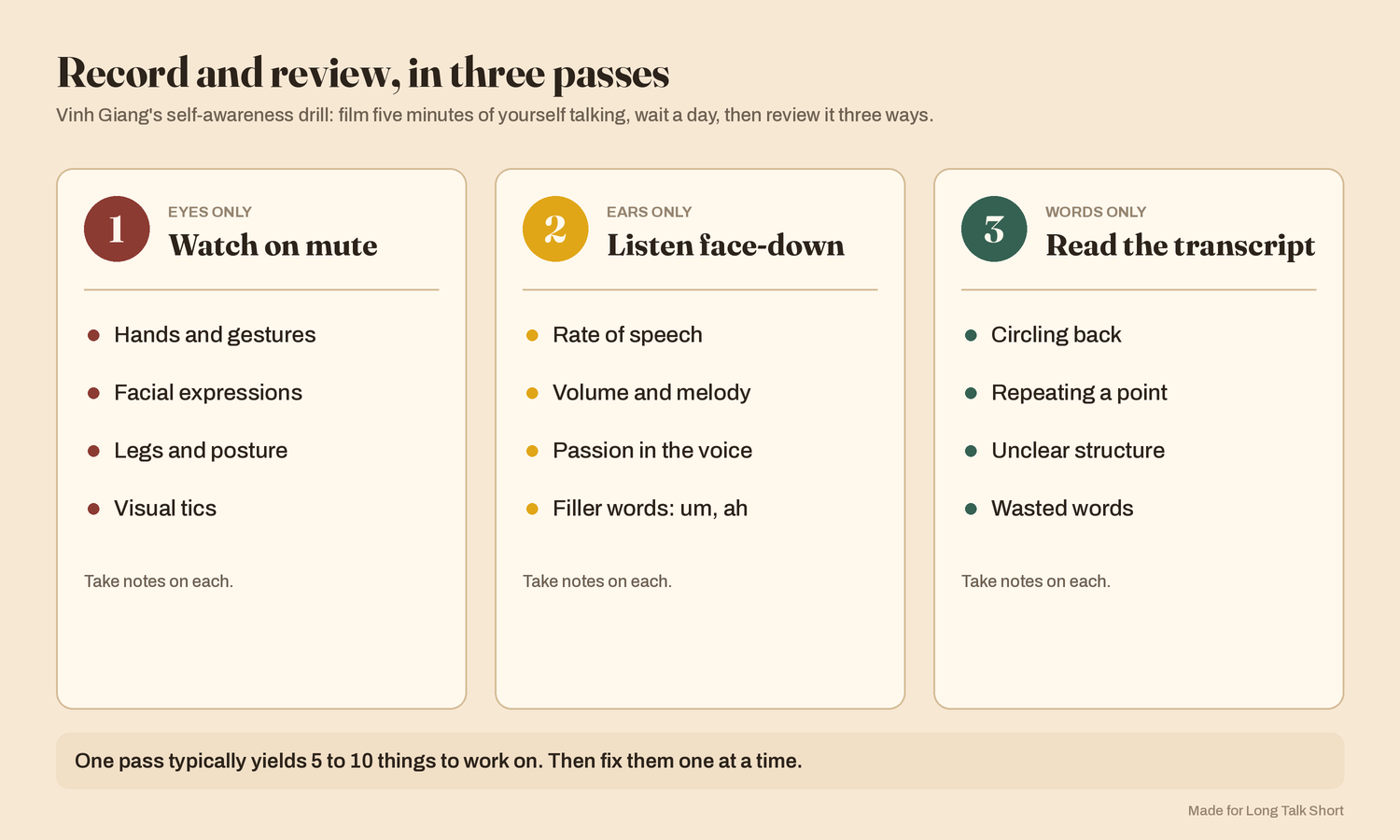
The spine of Giang's method is what he calls record and review:
- Record five minutes of yourself speaking. Then leave it for a day, so you judge it less harshly.
- Watch it on mute. Note your hands, face, legs, movement and any visual tics.
- Listen with the phone face-down. Note rate, volume, melody, passion and filler words.
- Read a transcript. You'll catch yourself talking in circles or repeating a point four times.
One pass, he says, gives you five to ten things to work on.
It's also why creators often become strong communicators without training, he argues: they watch themselves every day.
And the cringe? It's not just vanity. You hear your own voice partly through bone, which deepens it, and you know your face from a mirror that flips it. The cure is repeated exposure.
Watching is the easy part. Changing what you see is where the real trap lies.
3. Fix one thing. Just one.
Change is slower as you age, Giang says, because you have more years of repetition to undo. So adults should work on one behavior at a time.
When he coached CEOs, he spent four weeks on volume alone, with a video sent in every day.
How long does it take? Anywhere from six months, when the pain is sharp, to three or four years. This is a practice, not a hack.
4. Why you keep getting interrupted
The reason people interrupt you is because you're easy to interrupt.
People who get talked over in meetings, Giang says, usually have low vocal and physical presence: quiet voice, small gestures, seated and shrinking. His fix:
- Stand. "I've been sitting all day, do you mind if I stand for my part?"
- Speak up and use bigger gestures.
- Be as big as the room. Beginners almost always play too small, not too big.
But being bigger isn't the same as going faster. That's his next point.
5. Slow down: the pause isn't for you
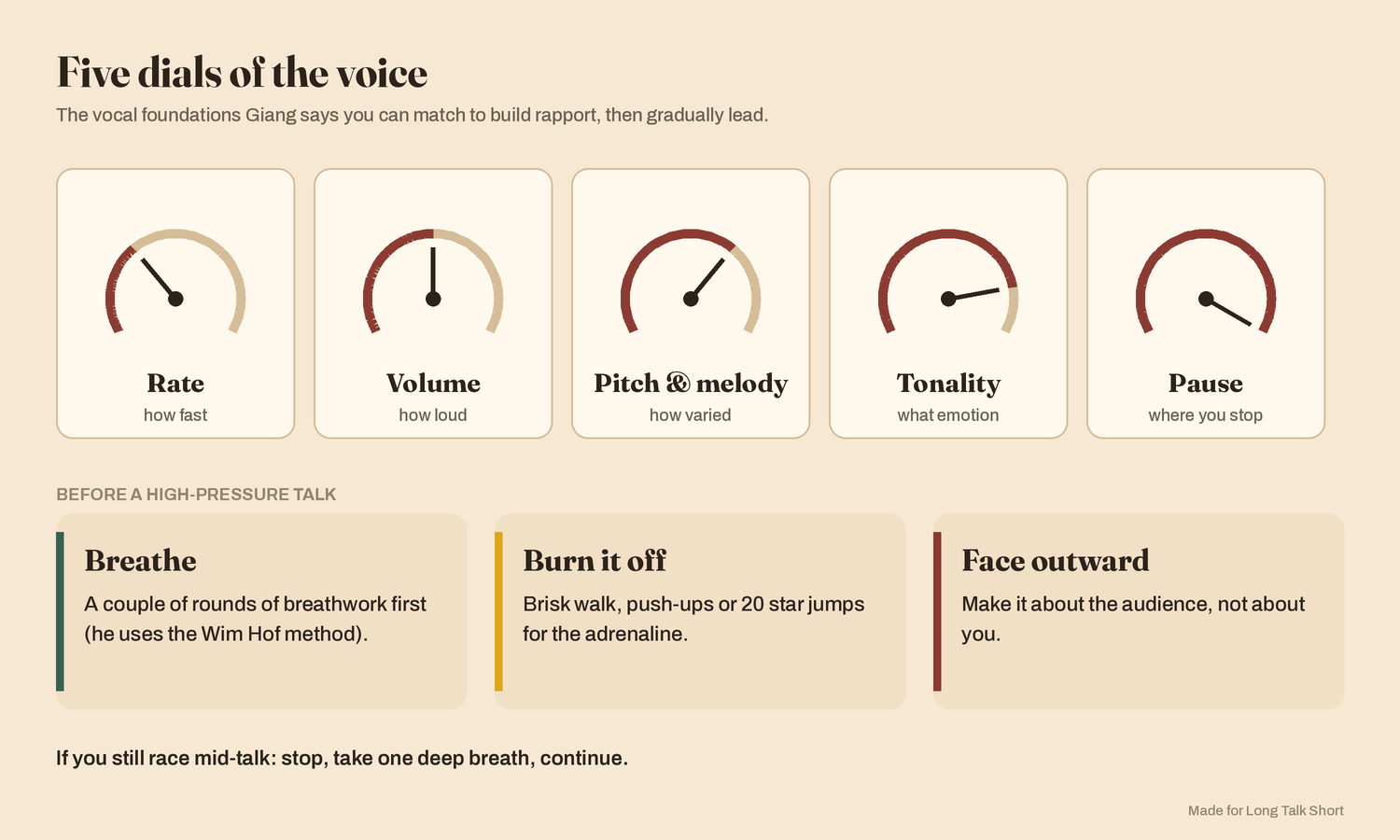
Giang treats talking too fast as a symptom of nerves, not a speech problem. Before a high-pressure moment:
- Breathe. He uses the Wim Hof method (see the caveat below).
- Burn off adrenaline with a brisk walk or 20 star jumps.
- Stop thinking about yourself. Feeling self-conscious means you're focused on you, not the audience.
Mid-talk and racing? Take one deep breath and carry on.
The pause is for the listener. It's the moment they process what you just said, like the silence after a crescendo.
6. Meet people where they are
Rapport isn't just mirroring body language, Giang argues. You can also match someone's voice on five dials: rate, volume, pitch and melody, tonality and the pause. Then lead them, gradually, where you want to go.
Accents aren't the problem. Articulation is. His drill: read aloud five minutes a day, exaggerating lip and tongue movements, ideally with a pen between your teeth.
And introverts? They differ in energy, not ability. They just have to choose when to play and how to recharge.
So how much of this survives a fact-check? Most of it, with some notable exceptions.
Weighing it: what holds up
The core advice holds up well. Reviewing your own recordings is a standard tool in speech coaching and presentation training, and the three passes neatly separate what you see, hear and say. The cringe explanation is right: bone conduction makes your voice sound lower to you, and the mirror effect is documented. In a 1977 study by Mita and colleagues, people preferred mirror images of their own faces while friends preferred the true image. Shifting focus to the audience is a mainstream anxiety tactic.
Some claims need context. The "75 percent of the world" who fear public speaking, quoted by Shetty, is a widely repeated figure without a solid source. Surveys vary widely, and the "number one fear" idea traces to a 1973 U.S. poll. Defining introversion by where you get energy is popular, but it is not how psychologists measure the trait. The idea that English needs far more jaw movement than European or Asian languages is Giang's impression, not established phonetics; Spanish and Italian use plenty of open vowels. The pen drill has little formal research behind it.
Wim Hof breathing needs the biggest caveat. Giang says it oxygenates the brain and slows you down. Its rapid breathing actually lowers carbon dioxide, which narrows blood vessels in the brain, and a 2014 study found the method raises adrenaline. That sits oddly next to his advice to burn adrenaline off. The breath holds have also been linked to fainting and to drownings when done in water, so never practice it while driving or in a pool. Standing to avoid interruption is plausible, but the related "power posing" research has largely failed to replicate.
Promotion is moderate. A paid ad for American Public University runs mid-episode, and Shetty points viewers to Giang's social channels, though Giang never pitches his courses. Despite the title, the talk covers communication skill and stage nerves, not social anxiety as a condition.
Long Talk Short
- Shyness and your "natural voice" are mostly habits, and habits can be retrained.
- Film five minutes, wait a day, then review it on mute, face-down and as a transcript.
- Change one behavior at a time, especially as an adult. Expect months, not days.
- New behavior feels fake at first. Call it unfamiliar and keep going.
- Be as big as the room. Most people play too small, which makes them easy to interrupt.
- Pause on purpose: it gives listeners time to process, and it slows you down.
The one thing to remember: you can't fix what you've never seen, so record five minutes of yourself and watch it all the way through. It's the most uncomfortable thing in this article, and the one that works.
Source: On Purpose with Jay Shetty, "#1 Communication Expert: If You Get Anxious Around Other People WATCH THIS!". This is an independent summary of that episode, featuring Vinh Giang, and is not affiliated with the show.
This article is for general information only and is not medical or mental health advice. Breathwork involving breath holds can cause fainting; do not practice it in water or while driving, and check with a doctor if you have a health condition. If anxiety around other people persists, please talk to a mental health professional.