Orcas Kill Blue Whales and Great Whites. So Why Has No Wild Orca Ever Killed a Human?
They ram blue whales to death and cut the livers out of great white sharks. Yet the wild record of orcas killing people stands at zero. The best explanation isn't gentleness. It's culture.
Orcas kill blue whales. They cut the livers out of great white sharks.
And in the wild, not one has ever been confirmed to have killed a person.
A narrated documentary from the small YouTube channel Primal Fase asks why. Its answer mixes solid science with a lot of storytelling. Pulling the two apart turns out to be the interesting part.
In short: the zero is real, and the best-supported reason is cultural. Orca populations eat what their elders taught them to eat, and humans were never on any menu. The video's other explanations, an echolocation mismatch and a deliberate "choice" to spare us, are guesses.
1. The zero is real (mostly)
The video's opening claim holds up. Deborah Giles, science and research director at the nonprofit Wild Orca, told Newsweek in 2022:
There's certainly been ample opportunity for killer whales to kill humans and they just haven't. It's perplexing.
But "zero" doesn't mean "never touched."
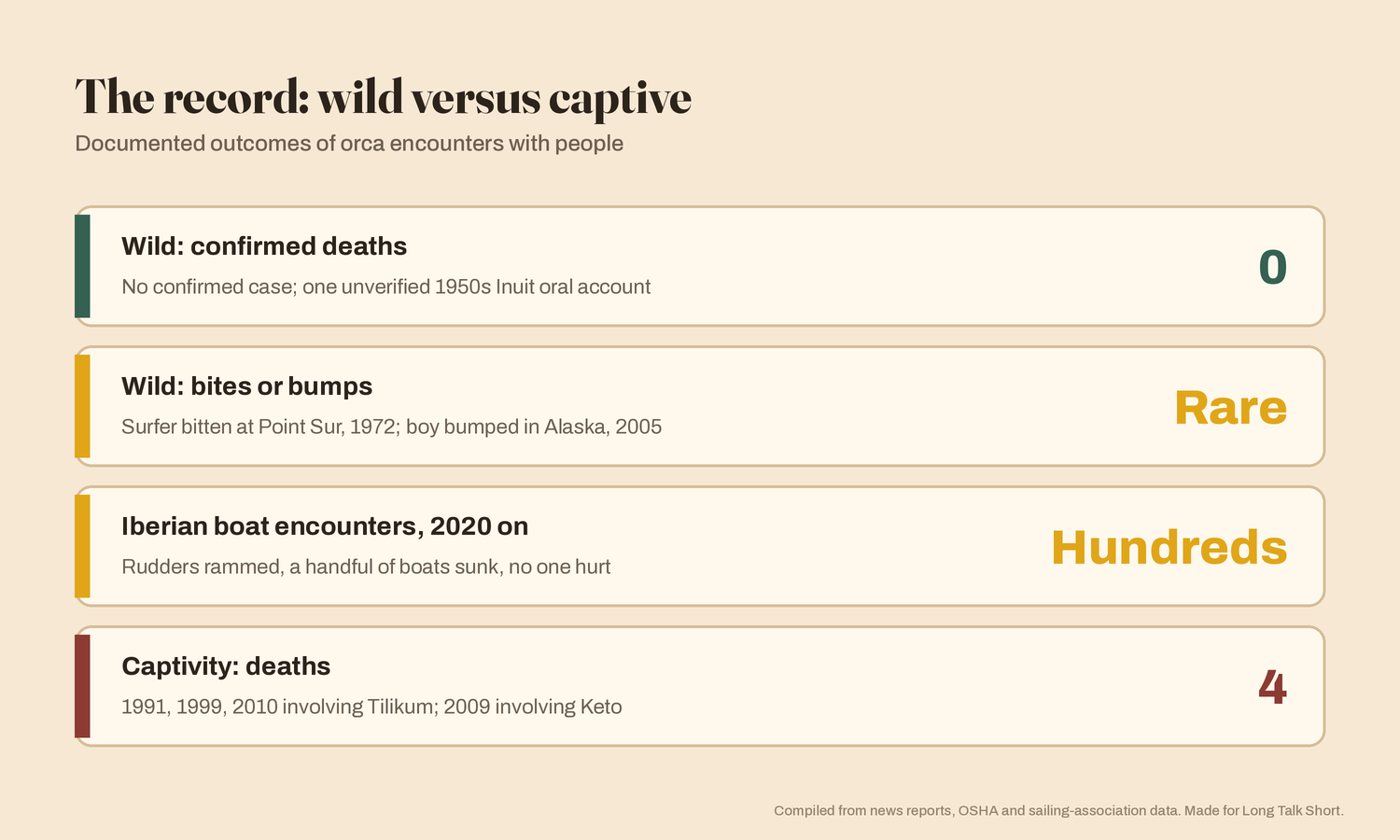
- 1972, Point Sur, California: a surfer was bitten and needed stitches. It's usually cited as the only well-documented wild bite.
- 2005, Helm Bay, Alaska: a transient orca rushed a 12-year-old boy swimming, bumped his shoulder and turned away.
- 1950s, Foxe Basin, Canada: an Inuit oral account tells of an ice-trapped orca killing a young man. The researchers who recorded it couldn't confirm it.
To see why that record is so strange, you have to see what orcas do to everything else.
2. A dolphin that hunts whales
The orca is the largest member of the oceanic dolphin family. NOAA lists it at up to 32 feet and 11 tons. Females typically live about 50 years and can reach at least 90.
In March 2019, off Bremer Bay in Western Australia, 12 to 14 orcas killed a healthy adult blue whale estimated at 18 to 22 meters. Most attackers were adult females, ramming its flank and forcing it under.
It was the first of three blue whale kills described in a 2022 paper in Marine Mammal Science; the other two were a calf and a juvenile. Co-author Robert Pitman of Oregon State University called it "the biggest predation event on this planet."
Sharks fare no better:
- At California's Farallon Islands in 1997, an orca held a white shark upside down at the surface, possibly in tonic immobility, then ate its liver.
- In South Africa, orcas have removed shark livers with precision, and great whites left the area for weeks to months.
- At the Farallones, after one 2009 visit, 16 of 17 tagged sharks didn't come back until the next season.
So an animal that can do all that leaves us alone. The best explanation starts with what its mother fed it.
3. Orcas eat what Mom taught them
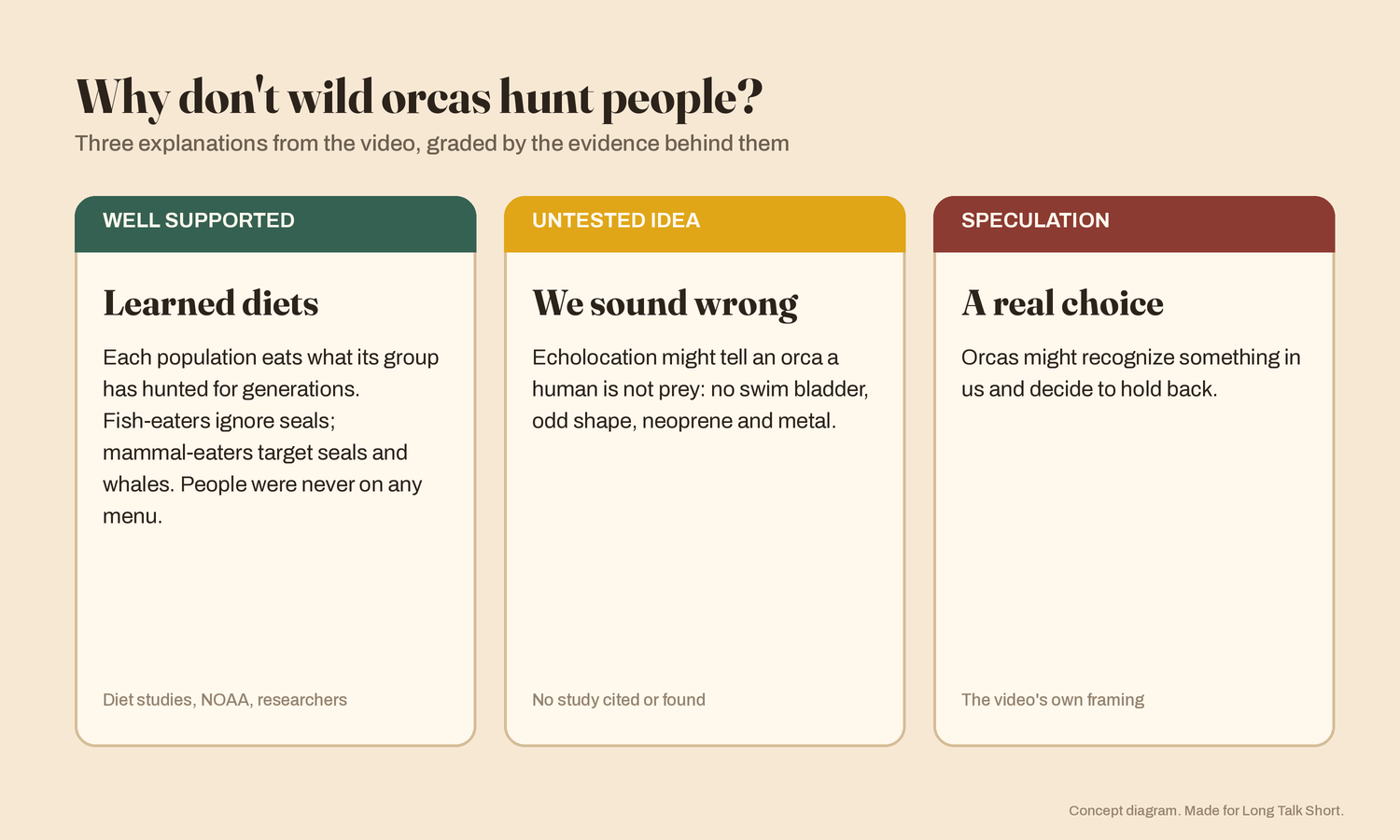
This is the video's central argument, and its strongest.
In the North Pacific, researchers recognize distinct ecotypes:
- Residents eat fish, chiefly Chinook salmon.
- Transients (Bigg's killer whales) hunt seals, sea lions, porpoises and whales.
- Offshores are thought to feed mainly on sharks and rays.
They share waters but keep separate diets, vocal traditions and social lives. Giles puts it plainly:
They learn to eat what their mothers teach them to eat, and humans have never been part of that diet.
The proof of how strong that tradition is: the salmon-eaters are endangered and short of Chinook, yet they haven't been recorded eating seals. Their food traditions hold even when prey is scarce.
Take orcas out of that culture, though, and the record changes completely.
4. Captivity tells a darker story
Four people have been killed by orcas, all in captivity.
Tilikum, captured off Iceland in 1983 at about two years old, was involved in three of the deaths:
- Trainer Keltie Byrne, in 1991.
- Daniel Dukes, who entered his tank after hours, in 1999.
- Trainer Dawn Brancheau, 40, in 2010. Her body was recovered after about 45 minutes.
The fourth, which the video leaves out, was trainer Alexis Martínez, killed by the orca Keto at Loro Parque in Spain in 2009.
Following the documentary Blackfish, the video argues that confinement and broken social bonds explain the aggression. Many critics of captivity agree. But experts still disagree on whether the deaths were accidents, play gone wrong or deliberate. That part is argument, not settled science.
Culture explains the fish-eaters. But what about the orcas that do hunt warm-blooded prey?
5. Two guesses and a population in trouble
For the mammal-eaters, the video suggests humans simply sound wrong to echolocation: no swim bladder, the wrong density, neoprene and metal. Plausible, but the video cites no research, and none turned up in checking.
Its final idea, that orcas make a "genuine decision" to spare us, is speculation, presented as such.
It ends on conservation. The Southern Resident population, hit hard by live captures in the 1960s and 1970s and short of Chinook salmon, stood at 74 in the July 2025 census and 76 in July 2026. It is still listed as endangered.
Weighing it: what holds up
The core facts check out. No confirmed wild killings, the Giles quotes, the Bremer Bay blue whale kills, sharks deserting feeding grounds, liver removal and the ecotype diets all match the record. So do the Tilikum timeline and the circumstances of Brancheau's death.
Some details are off. "Four deaths" is right, but three, not four, involved Tilikum, and Keto goes unmentioned. Big males can weigh nearly twice the video's 6 tons. Its Pitman line, "we haven't seen things like this since the dinosaurs," is a paraphrase. Claims that sharks show stress hormones "elevated for weeks," and that a tail strike creates a "vortex" that flips the shark, couldn't be confirmed.
The brain claim overreaches. The video says orcas have a paralimbic lobe "that doesn't exist in human brains." Lori Marino's 2004 MRI study describes limbic and paralimbic cortex in the orca brain, laid out differently from ours, but it doesn't show orcas feel more than other animals.
The biggest omission supports the thesis. Since 2020, a small group of orcas off Spain and Portugal has rammed hundreds of sailing boats, mostly at the rudder, and sunk a handful. No one has been hurt. Researchers mostly read it as a learned, playful fad, not aggression. It's the clearest modern test of the culture idea, and it passes.
About the video itself. Its narration is heavily dramatized, with repeated phrases and no on-screen sources. It may be AI-assisted, but that couldn't be confirmed. Its strongest claims are accurate; its interpretations deserve caution.
Long Talk Short
- No wild orca has been confirmed to have killed a human; a few bites and bumps are on record.
- Orcas kill blue whales and take great white livers, and sharks flee where orcas hunt.
- Diet is cultural: each ecotype eats what its elders taught it, and humans were never on the menu.
- All four known orca-caused deaths happened in captivity, three involving Tilikum.
- The echolocation idea is untested; the "choice" idea is speculation.
- Iberian orcas have damaged boats since 2020 without injuring anyone.
The one thing to remember: it's culture, not gentleness, that keeps us off the menu. The safest predator is one whose traditions were passed down without us in them.
Source: "Why The Deadliest Predator in Every Ocean Refuses to Kill Humans?", Primal Fase (YouTube). This is an independent summary and is not affiliated with Primal Fase.
This article is for general information only. Quotes from the video are taken from its automatic captions and may contain small transcription errors. Wild orcas are protected; keep the legal distance and never approach them.