You Are Energy, Not a Machine
Neuroscientist Martin Picard has spent his life inside the mitochondria, the tiny engines that make you alive. His claim is radical and strangely freeing: you are not your body, you are the energy flowing through it, and almost everything that drains you, ages you, or sickens you is one problem
Based on Dr. Martin Picard's conversation on The Diary of a CEO with Steven Bartlett. Picard runs a mitochondrial research lab at Columbia University. This distills his 'energy' framework and the practical ideas that follow from it. It is a summary of his views, some of which are an emerging perspective rather than settled consensus, and it is not medical advice. Anything involving illness, medication, or extended fasting belongs with your doctor.
Ask most people what they are and they will point at their body, the bones and organs and genes they got from their parents. Dr. Martin Picard, who has run a mitochondrial research lab at Columbia University for a decade, wants to move that line. On The Diary of a CEO, he makes a claim that sounds like mysticism until you follow the biology: you are not your body, you are the energy flowing through it. A living, thinking person and a cadaver are made of the same stuff. The only difference is the flow. And once you see yourself that way, he argues, almost everything that drains you, ages you, or makes you sick turns out to be one problem wearing many masks.
Three things to hold first
Picard builds the whole framework on three foundations. The first is the reframe above: you are the energy that flows and transforms through this body. The expression on your face, the thought in your head, the beat of your heart, all of it is energy moving. Stop the flow and "you" are gone.
The second is that you run on a fixed energy budget. You cannot simply pour in more. This is the mistake we all make, treating the body like a car: low on energy, add fuel. But eat more, especially more sugar, and you do not feel better, you feel worse, because you have overloaded a system that was already balanced. Picard's electrical analogy runs through the whole conversation: jack up the voltage on a circuit that cannot handle it and the thing overheats. In the body, that overheating has a name, inflammation.
The third is the strangest and most important: life requires resistance. For energy to transform into anything meaningful, it has to meet a constraint. A photon stays a photon forever, hurtling through space, until it hits a green leaf, and only then, stopped, resisted, does it become food. A life with zero friction would never change or grow. Which means stress and challenge are not simply the enemy. They are the thing that lets energy become something.
The engines, and where they came from
All of this runs through the mitochondria, roughly a thousand in every cell, about five thousand trillion in you. Their famous job is to take the food you eat and the oxygen you breathe, strip the electrons off the food, and flow them like a tiny electrical circuit toward that oxygen, which becomes water. That flow is what keeps you alive, and the heat it throws off is literally why your body is warm. When you shake someone's hand and feel their warmth, you are feeling their mitochondria.
But Picard's deeper point is that mitochondria do far more than make energy. They sense, they signal, they talk to each other, a kind of distributed brain inside the cell, constantly reading whether there is enough energy, whether a stress hormone has arrived, whether danger is near. And they were not always ours. Around 1.5 billion years ago, one bacterium ended up inside another, and the arrangement handed the host cell a surge of energy and, in Picard's favored reading, a new way to perceive the world. Cells that had been selfish and solitary could suddenly cooperate. One would specialize in getting energy, another in moving, and from that bargain came division of labor, bodies, organs, us. Sociality itself, he suggests, may have started with the mitochondria.
The one principle underneath everything
The master idea is what Picard calls energy resistance, and it is simple arithmetic: how much energy is being demanded, divided by how much can actually flow. Picture water heading toward a dam. If the dam has open floodgates, the flow becomes useful work, electricity, movement. If it is sealed, water piles up behind it, pressure climbs, and eventually it floods and damages everything around it. Demand too much from a system that cannot flow it, or push too much energy into one that does not need it, and resistance goes through the roof.
That one imbalance, he argues, sits under a remarkable range of disease. The clearest case is insulin resistance and diabetes. Flood the blood with sugar and you are shoving electrons onto cells that cannot handle them; to protect themselves, the cells pull their insulin receptors inside and go deaf to the signal. Blood glucose climbs, the body starts stashing the excess as fat, and obesity, in his framing, is not the root problem but a protection mechanism against too much energy with nowhere to go.
He extends the same lens, more speculatively, to cancer. Cancer cells, he notes, ditch their mitochondria and revert to an ancient, selfish, oxygen-independent way of making energy, the Warburg effect, breaking the social contract every other cell keeps. And to Alzheimer's, where he takes a position worth flagging as contested: he argues the long-dominant idea that amyloid plaques drive dementia cannot be the whole truth, because some people have brains full of plaques and perfectly normal memory, while others have dementia with no plaques at all. His alternative is that Alzheimer's is fundamentally a disorder of brain energy, which is part of why some now call it "type 3 diabetes." Mainstream neurology still treats amyloid as central, so hold this as his energetic reframe rather than settled fact, but the paradox he points at is real and increasingly discussed.
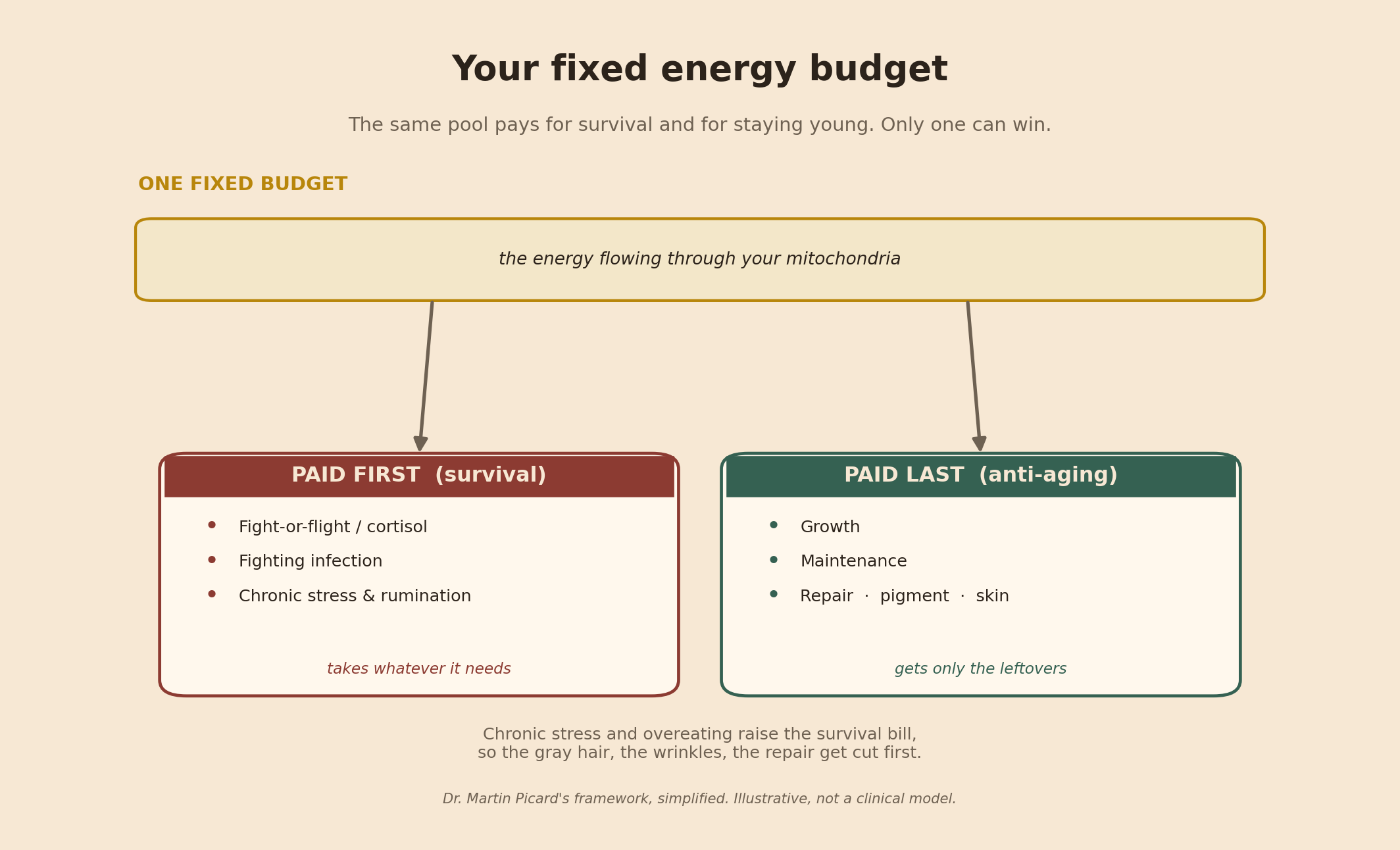
Picard's picture of the body as a fixed energy budget: survival and the stress response get first claim, and the slow work of growth, maintenance and repair, the anti-aging processes, gets whatever is left. Chronic stress quietly shifts the split. His framework, simplified.
Why your hair goes gray, and why it can come back
The most striking evidence Picard offers is about gray hair, and it overturns the idea that aging is a one-way street. A hair is like a tree ring: it records your biology as it grew, so a single strand can be dark at the tip and white nearer the root, young becoming old. His lab went hunting for the rarer thing, hairs that reversed, white going back to dark, and found them, on heads, beards, everywhere. He was a subject in his own study and found five such hairs. When they lined the reversals up against his life, the color came back during a week of vacation, when he did nothing but bike, eat and sleep.
Reading the white segments, they expected to find fewer mitochondria. They found more. A graying hair is not a follicle giving up; it is a follicle struggling, burning extra energy trying to compensate, much the way a stressed cell does. A mathematical model suggested a "window of opportunity": a hair slowly accumulates damage and grows less efficient until it crosses a threshold and loses color, but if something changes while it is near that line, a vacation, a period of less stress, more energy becomes available and the color can return. Wait too long, let the follicle drift far past the threshold, and it is gone for good. Which is why a seventy-year-old with a full head of gray will not get it back, but a few weeks of flare-up in your thirties might.
It is not the stress that burns you
This is Picard's most practical reframe. Stress itself is not the problem, your response to it is. His lab put cells in a dish and asked a precise question: how much energy does it cost to worry? They gave the cells the equivalent of cortisol, the hormone your body releases when it reads danger, and measured. The stress signal raised the cost of living by sixty percent. In a whole human, buffered by a hundred systems, the real-world number is smaller, but the direction is the fact that matters.
Trace the chain. A bad email arrives. You read a story into it about your future. That story triggers cortisol, which reaches your cells and makes your mitochondria work harder, your heart beat faster, your shoulders tense, your mind ruminate, and every link burns energy you have a finite supply of. The gift in seeing it as a sequence is that every link is a place to intervene: don't open the laptop, get better at bad news, or simply become aware of the reaction as it rises, which is exactly what meditation and somatic practices train. Acute stress, the spike that passes in five minutes, is fine and even useful, the same way a hard workout is. It is chronic stress, the same dread every morning for weeks, that does the damage.
There is a messenger in the middle of this worth naming. When energy runs short anywhere in the body, cells release a stress signal called GDF-15, a cytokine, the same kind of molecule the immune system makes when you are sick. It travels to a spot in the brainstem whose other job is nausea, and the brain reads it as "something is running out of energy." So it does two things, both of which you have felt during flu: conserve energy, which lands as low motivation, low mood, no desire to move or see anyone, and mobilize energy, dumping glucose and fat into the blood, which, when the rest of the body does not use it, gets stashed as belly fat. People with chronically high GDF-15 are more likely, years later, to develop depression, heart disease, and worse. It is, in effect, a readout of how hard your life is on your cells.
Aging is an energy budget problem
Put the budget and the stress together and you get Picard's theory of aging. The body allocates its fixed energy like a business deciding where to spend, and there is a hierarchy, much like Maslow's: survival and the stress response come first, and the slow background work he calls growth, maintenance and repair, the actual anti-aging machinery, comes last. Hair color sits very low on that list. So when a lion is chasing you, or your nervous system believes one is, the body says, in effect, we are not going to repair the skin by your eyes or keep the pigment in your follicles right now, we have somewhere more urgent to spend. You come out looking older. It is why presidents walk in with dark hair and leave gray, why football managers seem to age a decade in two seasons.
Which hands us the only real anti-aging secret he will offer: the proper allocation of energy. Stop bleeding it into the future and the past, spend more of it in the moment, react less, and more of that precious budget flows to repair. And the hard truth underneath: you cannot top up the budget by eating more. You can only become more efficient.
How to actually become more efficient
Efficiency, it turns out, is trainable, and exercise is the clearest example. When you train hard, you create a shortage, your muscles demand more energy than your mitochondria can flow, resistance spikes, it burns, it is uncomfortable. The benefit does not come during the workout; it comes in the recovery, when the cell, having felt the strain, decides to be ready next time and builds more mitochondria. Go from couch to marathon training and you can double the mitochondria in your muscles. That is where the feeling of "more energy" comes from, not more energy in the tank, but the same energy flowing more smoothly. For what to actually do, he keeps it humble: anything that makes you breathe harder, not too long if you are untrained, and tuned to your own capacity, which he calls "mitoception," feeling into what is sustainable. He himself just runs twenty minutes every other day.
On food, his rule is to stop eating like a machine and start eating from the perspective of your mitochondria. Most of us overeat, and overeating has clear costs, more friction, more inflammation, less energy. Undereating, for most people, is nearly harmless, because the body has weeks of fuel stored. So a shorter eating window helps many people feel dramatically more energetic, not because they are taking in more, but because the energy flows better and the body periodically enters a state of "I must be efficient," clearing out worn mitochondria to make better ones. He is blunt that the "breakfast is the most important meal" idea traces to a cereal marketing campaign, and that ketones, which the liver makes from fat, reach the brain's mitochondria by a much shorter path than glucose, which is why many people report more mental energy on a ketogenic diet and why it is being studied seriously in "metabolic psychiatry" for treatment-resistant mental illness. All of this is individual, he stresses, and anyone with a health condition or a history of disordered eating should bring it to a doctor rather than a podcast.
Purpose, focus, and the laser
Here the science turns almost philosophical. A striking study of donated brains found that people who reported more sense of purpose before death had more efficient mitochondria in the prefrontal cortex. The arrow runs both ways: how you feel can change your mitochondria, and your mitochondria can change how you feel. Picard's hunch is that much of what we call depression is a loss of coherence, and that purpose works because it focuses scattered energy.
His metaphor is light. A regular bulb and a laser can hold the same amount of energy, but the laser's photons are all in phase, coherent, and that coherence is what lets it cut and travel. A scattered mind is the bulb; a focused one is the laser. It is why, he suggests, the most effective people seem to bend reality around them. The engineers who worked with Steve Jobs called it his "reality distortion field," and Picard reframes it as resonance: hold an energy pattern strongly enough, in your voice, your attention, your conviction, and other people fall into phase with it. Focus is not something you decide on Monday; it is saying no, every hour, to things you genuinely believe are good ideas, so that everything you have can go to the one that matters.
The honest notes: supplements, red light, and the illnesses with no easy answer
Picard is refreshingly skeptical of shortcuts. On the supplements people ask about, methylene blue, NAD+, urolithin A, he grants some have real signals (NAD+ and urolithin A both relate to how electrons flow and how worn mitochondria get cleared), but he takes none of them, wary of each new compound promising to fix "mitochondrial dysfunction," a term so broad it means little. He trusts the wisdom of the body over the pharma company trying to sell the pill, while admitting that living in "dark bunkers" out of our natural environment is itself a reason some people genuinely need things like vitamin D.
On red light therapy, the mechanism is real in principle: a component of the mitochondria can act as an antenna for red and infrared light, and one study found red light on the back blunted a glucose spike. But he flags a bell curve that applies to almost everything in biology, including exercise and light: too little does nothing, the right dose helps, and too much tips into harm, flooding cells with oxidative stress. More is not better.
And he handles the illnesses his audience most wanted answered, ME/CFS, long COVID, fibromyalgia, with appropriate humility. Millions suffer, often dismissed, and the cruel catch is that the standard advice, exercise, can crash them, driving the post-exertional malaise that defines the conditions. The best study found their muscle mitochondria genuinely cannot flow energy the way they should. Why, nobody yet knows. He offers no cure, only the real finding and a reason for hope, cases that defy the odds, and the one near-universal theme among people who do best even with damaged mitochondria: a supportive environment and something they love. This is not medical advice, and anyone living with these conditions deserves care from clinicians who take them seriously.
Slow down
Asked for the hardest thing he has overcome, Picard goes quiet, and then shares that a year ago he and his fiancée lost a pregnancy at three months, a miscarriage they went through at home, devastating and rarely spoken about, as it is for the roughly twenty million people a year it happens to. Sitting in the grief, he asked what there might be to learn, and a clear answer came: slow down. He had moved fast his whole life, and fast had cost him sensitivity to the people who do not move at his pace. The loss sharpened the contrast on the canvas, he says, made the things that truly mattered clearer and the obligations he had said yes to dimmer.
It is the human form of his entire science. You are a finite flow of energy, shaped by what you spend it on and the people you spend it with. You cannot make more. You can only aim it well, protect it from the slow leak of chronic stress, and point it, like a laser, at what is actually worth your life.
Long talk short: Picard's reframe is that you are not a machine that you refuel, you are a flow of energy, and that flow runs on a fixed budget through trillions of tiny engines called mitochondria. When too much energy is demanded, or too little can flow, you get 'energy resistance,' and that single imbalance, he argues, sits under fatigue, stress, visceral fat, insulin resistance, and much of aging itself. You cannot pour in more energy by eating more; you can only become more efficient. The levers are unglamorous and familiar: move enough to make your body build more mitochondria, stop overeating and give your system a rest, protect your sleep, and above all stop bleeding energy into chronic stress, because it is not the stressor that drains you, it is your reaction to it. And the quiet multiplier underneath all of it is coherence: a life with purpose and focus spends its energy like a laser instead of a scattered bulb.
Further reading
- Power, Sex, Suicide: Mitochondria and the Meaning of Life, Nick Lane
- Brain Energy, Christopher Palmer
- Lost Connections, Johann Hari
Affiliate links, a small commission supports the blog at no cost to you.