A Cell Is Not a Gadget
Adam Frank argues that a cell is not a gadget, and that telescopes may, in 10 to 30 years, give us the data to say whether life is common or rare. That date is a forecast, not a promised detection.
A cell is not a gadget. If you have been taught to picture a living cell as a very clever machine — and a human being as a “meat computer” that silicon will eventually copy — Adam Frank wants that metaphor to feel less obvious than it did in high-school biology. The University of Rochester astrophysicist and astrobiologist argues that the most important unsolved problem in 21st-century physics is not quantum gravity. It is why a cell is different from a rock. The same confusion, he thinks, is feeding a story about AI that treats mimicry as the same thing as life.
Big Think interviewed Adam Frank in “In the next 3 decades we’ll know if we’re alone in the universe,” at youtube.com/watch?v=nXsSG6tnx_Y. An official transcript is at bigthink.com/series/full-interview/life-machine-frank/, and is the source this article follows. Frank teaches at the University of Rochester, wrote The Little Book of Aliens, co-authored The Blind Spot, and writes the newsletter Everyman’s Universe. The YouTube title is punchier than his claim: in the next 10, 20, or 30 years we will have the data to say whether life is common or rare.
In short: a cell, in Frank’s account, is a self-creating organization, not a gadget. QBism and Rosen’s non-computability claim are argued positions, not settled findings. The 10-to-30-year line is a forecast about data, not a promised detection.
He starts with René Descartes, who, in a grim anecdote Frank retells, treated a living dog’s cries as the noises of a machine. That picture, he says, still sits under a lot of modern talk about AI. Living things are self-creating, self-repairing, and they decide what matters to them. He calls current AI an “artificial mimic” rather than an intelligence. He is not saying a machine that did what life does could never be built — only that the usual computational story skips the thing that needs explaining.
1. Agency, autopoiesis, and a different reading of quantum theory
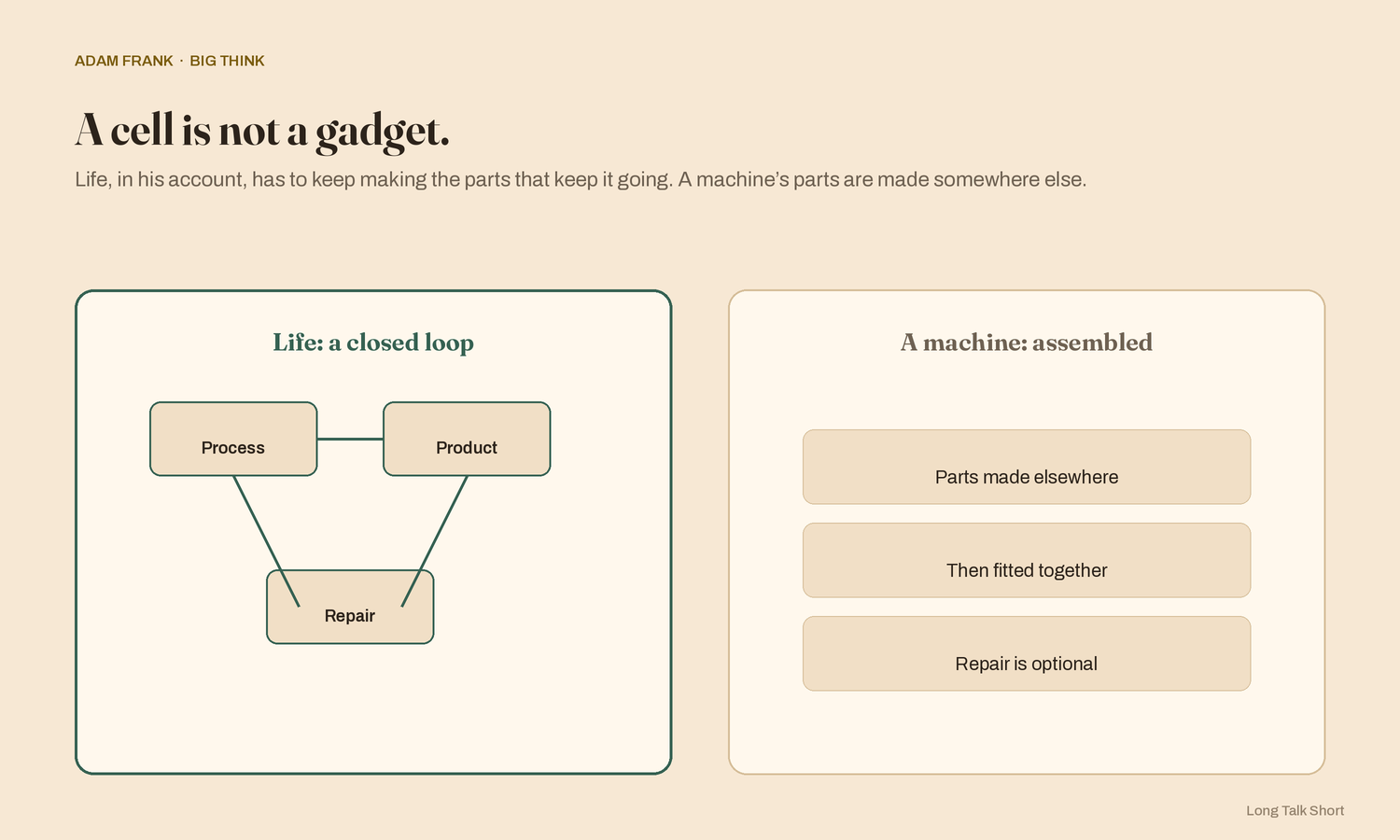
The technical word he leans on is autopoiesis — self-creation — from the Chilean biologists Humberto Maturana and Francisco Varela. A cell membrane lets the cell exist, and the cell has to keep the membrane working. Process and product loop. The theoretical biologist Robert Rosen called this organizational closure: a network of relations that always refers back to itself. Frank also likes the older label of a “Kantian whole.” Rosen offered a controversial proof, using category theory, that such systems would not be Turing-computable — that you could not fully simulate an autopoietic, experiencing system. Frank is careful: some people think the proof holds, some do not, and he and colleagues are only beginning work to probe it. The point he wants is the question, not a settled no to machine life.
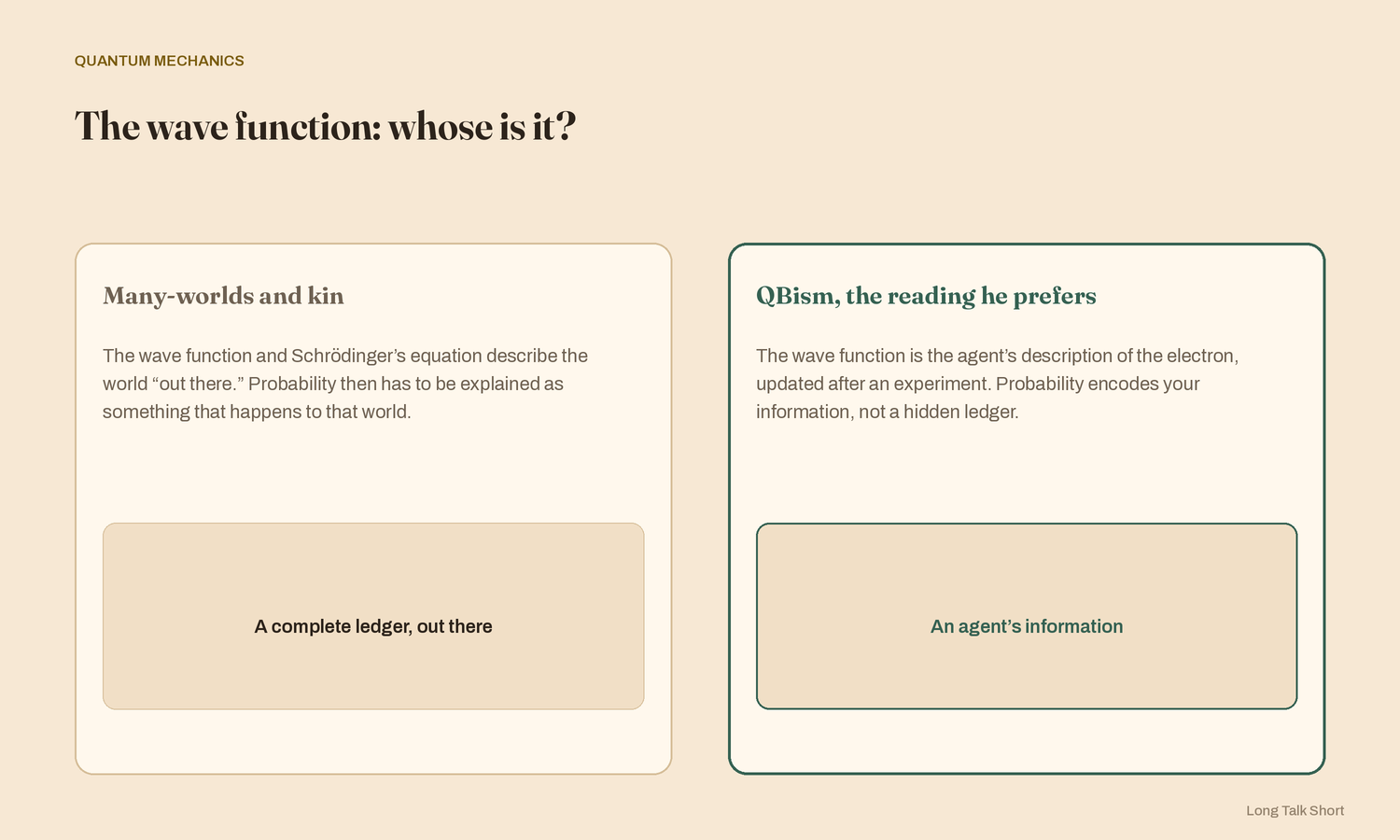
From there he turns to quantum mechanics. One popular family of readings, including many-worlds, treats the wave function and Schrödinger’s equation as a complete description of the world “out there,” and then has to explain why measurements look like probabilities. The alternative he prefers is QBism, or quantum Bayesianism, developed by Chris Fuchs and collaborators. In that view, the wave function is not the electron’s private property. It is the agent’s description of the electron, updated after you poke the world with an experiment. Probability, in the sense Thomas Bayes meant, encodes your information, not a hidden ledger in the universe. Frank presents this as a deeper claim about science: you cannot take the measurer out of the picture and still pretend you have a view from nowhere.
2. The blind spot, and a search that is finally about data
That “view from nowhere” is what he and his co-authors call science’s blind spot: telling a story in which the world is fully described without the living agents who do the describing. He is not, he says, attacking science. The method still works. The trouble comes when its success is turned into a complete metaphysics — a dead universe of parts, with life and mind added later as puzzles. He traces the habit through a Newtonian picture that made sense for planets, and through Alfred North Whitehead’s warning about the “bifurcation of nature”: splitting a measurable, colorless world from the world we actually inhabit. Going beyond the blind spot, he admits, does not yet have a finished shape.
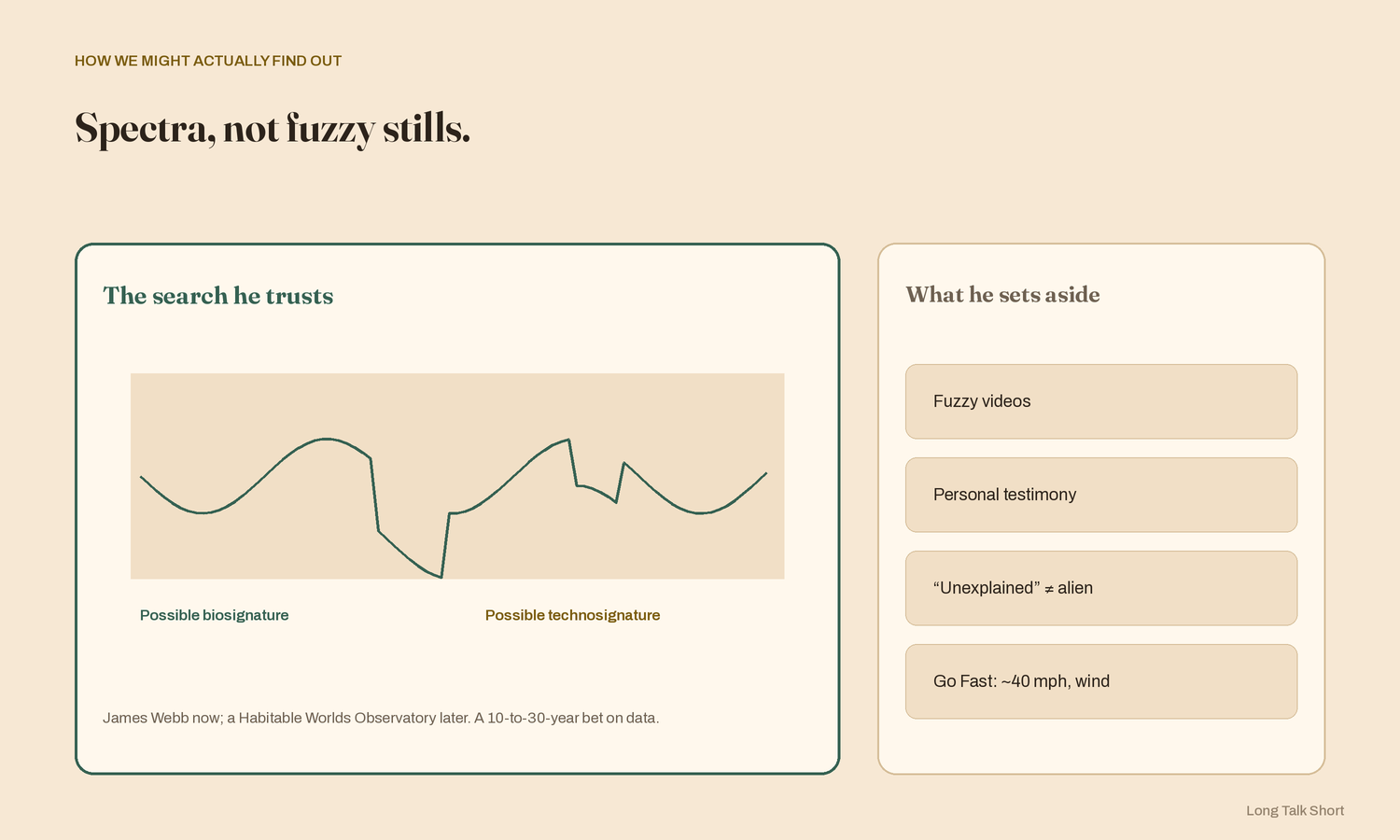
On aliens, he is cooler than the title might suggest. UFOs, often called UAPs, are “just not really good evidence” of extraterrestrial life: decades of fuzzy videos and personal testimony, a weak form of evidence even when the witnesses are sincere. Since the modern wave around the 2017 New York Times story on a Pentagon program, he says about 95 percent of reports can be explained, and of the rest many simply lack enough information. Unexplained is not the same as alien. He cites the “Go Fast” video as a case that, once you use the numbers on the screen, looks like something moving at about 40 miles an hour with the wind — “there’s a word for that. It’s called a balloon.” Those figures are his retelling of later work.
The search he is excited about is slower and, in his view, much better: biosignatures and technosignatures in the atmospheres of other planets. James Webb, he says, is already “on the hairy edge” of this work. He mentions K2-18b, a proposed “Hycean” world where some researchers claimed a hint of dimethyl sulfide, a gas algae produce on Earth. “In the end nobody believed it,” he says, “and that’s fine” — the burden of proof should be high. What mattered was that an instrument could finally deliver a spectrum worth arguing about. The next flagship he names is the Habitable Worlds Observatory. “That’s why I say in the next 10, 20, or 30 years, we’re really going to have the data to tell us whether life is common or whether it’s rare.” If we found a living world, he thinks it would change us without requiring a radio conversation; the distances are too large for chat to be the main prize. What makes us special, he says, is that we are life, not that we are the only example.
Weighing it: what holds up
This article follows Big Think’s official transcript. Frank is arguing a position, not reporting a discovery. Autopoiesis and QBism have critics; Rosen’s non-computability proof is, as Frank says, contentious. The YouTube title (“we’ll know if we’re alone”) is stronger than his spoken claim that we will have the data to judge whether life is common or rare — a forecast that still depends on telescopes being built and on how messy the first spectra prove to be. His 95 percent figure for explained UAP reports, the Go Fast “balloon” reading, and the dismissal of the K2-18b claim are his summaries of other people’s analyses.
He has books and a newsletter in the background. The useful tension is the one he names: science works, and it still has a blind spot about the living observers who do it. The useful caution is not to turn a 30-year observing program into a closing date.
Related reading: Growth in a jar, not on Mars · Origin mysteries physics can’t yet explain
Long Talk Short
- Frank’s core claim is that life is a self-creating, self-repairing organization, not a machine — and that current AI, on that definition, is a mimic rather than a living intelligence.
- He prefers QBism, in which the wave function is an agent’s information, and he calls the “view from nowhere” science’s blind spot, not a reason to abandon the method.
- He does not treat UFO videos and testimony as good evidence of aliens. The search he trusts is atmospheric biosignatures and technosignatures.
- The “30 years” line is his forecast that upcoming telescopes, including a planned Habitable Worlds Observatory, will give us the data to say whether life is common or rare — not a guarantee of a detection by a set date.
The one thing to remember: Keep the life-as-machine metaphor in probation, and treat the next few decades of planetary spectra — not the latest blurry clip — as the test of whether we are alone.
Independent summary; not affiliated with Adam Frank or Big Think.
Source: Adam Frank on Big Think, on YouTube, with the official transcript on the Big Think page. Independent summary; not affiliated with Adam Frank or Big Think.