Growth in a Jar, Not on Mars
Haloferax volcanii grew for 160 days in a thin CO₂ brine with nitrate or perchlorate. What the Mars-pressure lab study showed — and the authors' warning that it is not evidence of life on Mars today.
Growth in a jar is not a discovery on Mars. Robinson and colleagues grew an Earth salt-loving archaeon for 160 days in a thin carbon-dioxide atmosphere with nitrate or perchlorate instead of oxygen. The result supports a narrow habitability claim about localized brines — and the authors themselves say it is not evidence of life on Mars today.
In short: researchers grew Haloferax volcanii for 160 days at 24 millibar in carbon dioxide, with nitrate or perchlorate instead of oxygen, in water about seven times saltier than seawater. Growth was real but slower than at Earth pressure. Biofilms appeared mainly under the low pressure. The authors say this supports possible habitability of localized brines, not evidence that anything lives there now.
1. What they did
The paper, in Applied and Environmental Microbiology, is by Adam Robinson (University of Florida Space Life Sciences Lab and St. Petersburg College), Shannon McQuaig-Ulrich and Tyler Dondero (St. Petersburg College), and Aaron Celestian and Scott M. Perl (Natural History Museum of Los Angeles County; Perl also lists Blue Marble Space Institute of Science).
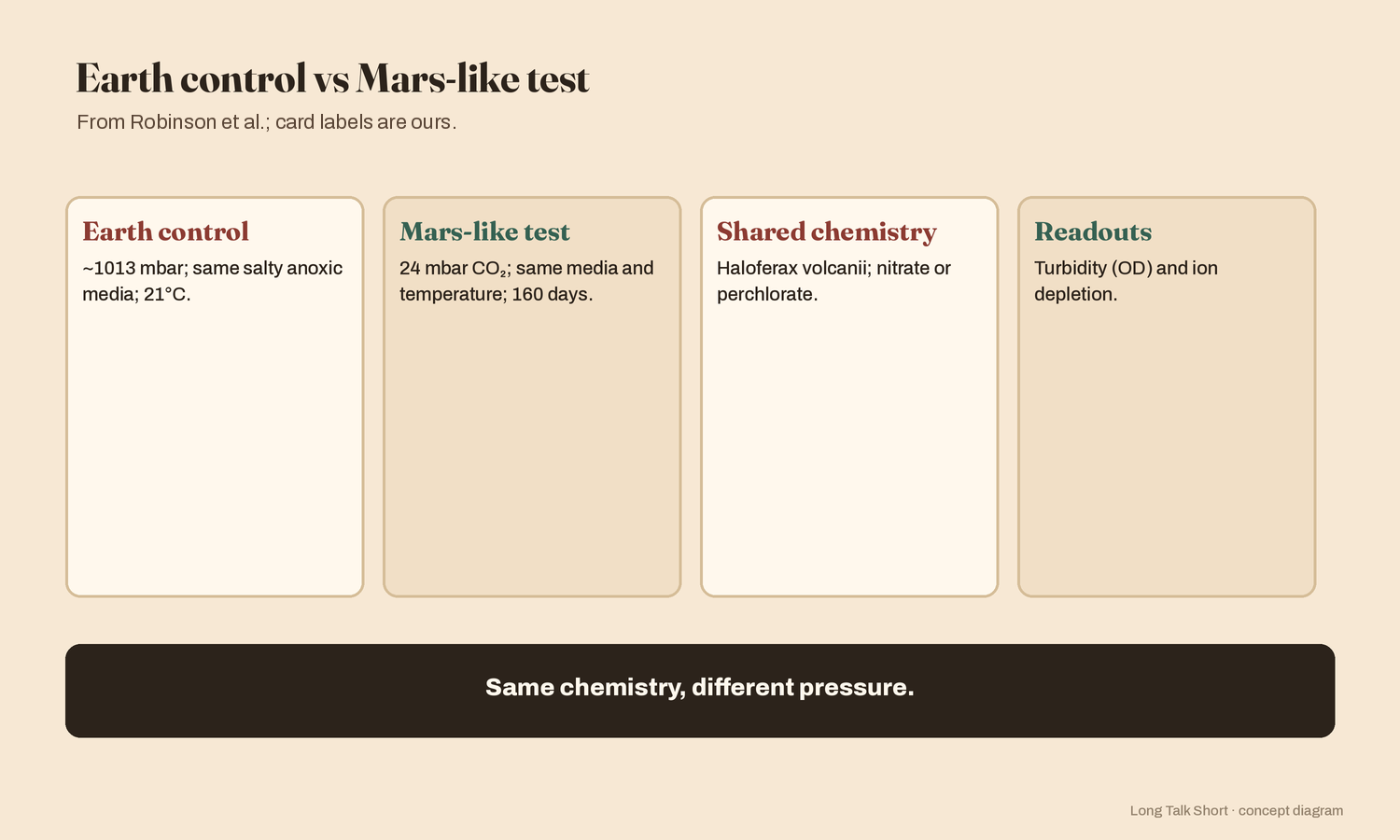
A halophile is an organism that needs high salt. Haloferax volcanii is a model archaeon — a single-celled lineage separate from bacteria — often studied in Dead Sea–like brines. Here the medium held 225 grams of salt per liter. A millibar (mbar) is a pressure unit; Earth's sea-level air is about 1,013 mbar. Mars's surface air is only a few to about 10 mbar. The team used 24 mbar of mostly carbon dioxide, which they treat as a stand-in for a sealed salty pocket roughly 20 centimeters or more below the surface, following prior work they cite on shallow subsurface pressure niches.
Perchlorate is a chlorine-and-oxygen salt found widely in Martian soil; it can act like a harsh oxidizer but some microbes can "breathe" it instead of oxygen. The cultures got nitrate or perchlorate at 20 or 100 millimolar, with no free oxygen. Temperature was held at 21°C (about 70°F) for 160 days inside a vacuum chamber flushed with carbon dioxide. Earth-pressure anoxic controls used the same salty recipes so pressure, not chemistry, was the main contrast. Prior work by some of the same authors had seen survival without growth at lower salt; raising salt to 225 grams per liter was part of making anaerobic growth possible.
2. What they measured
Growth showed up as rising cloudiness (optical density at 630 nanometers) and as drops in nitrate or perchlorate measured with ion-selective electrodes. Cultures without those electron acceptors stayed alive in follow-up tests but did not show the same growth signal, which helped separate mere survival from reproduction under the test conditions. Growth under 24 mbar was statistically significant and still clearly lower than matched anoxic cultures at Earth pressure. Nitrate supported more growth than perchlorate at both pressures.
Under the low-pressure runs that grew, scanning electron microscopy showed dense biofilms — cells stuck in a shared matrix — that were not seen in Earth-pressure cultures or in low-pressure tubes that failed to grow. Water loss from the 10-milliliter tubes stayed under 4% in every treatment (highest about 3.8% in a dissolved-oxygen control). Raman spectra still showed carotenoid pigment peaks after 160 days, though weaker than in oxygen controls, especially when perchlorate was the electron acceptor. Those pigments are of interest as possible biosignatures, which is why the team checked whether they survived the run.
3. Why they mention Viking and containment
The introduction revisits NASA's 1976 Viking Labeled Release experiment, which sparked a long debate over whether it saw metabolism. The authors' point is practical: survival studies are common; active growth under combined Mars-like stresses is rarer. They also discuss forward contamination — Earth microbes hitchhiking on spacecraft — and argue that if samples ever look biologically interesting, cultivation attempts may need high-containment thinking akin to biosafety level 3 and 4 labs, because low pressure can promote boiling and aerosols from wet samples.
Weighing it: what holds up
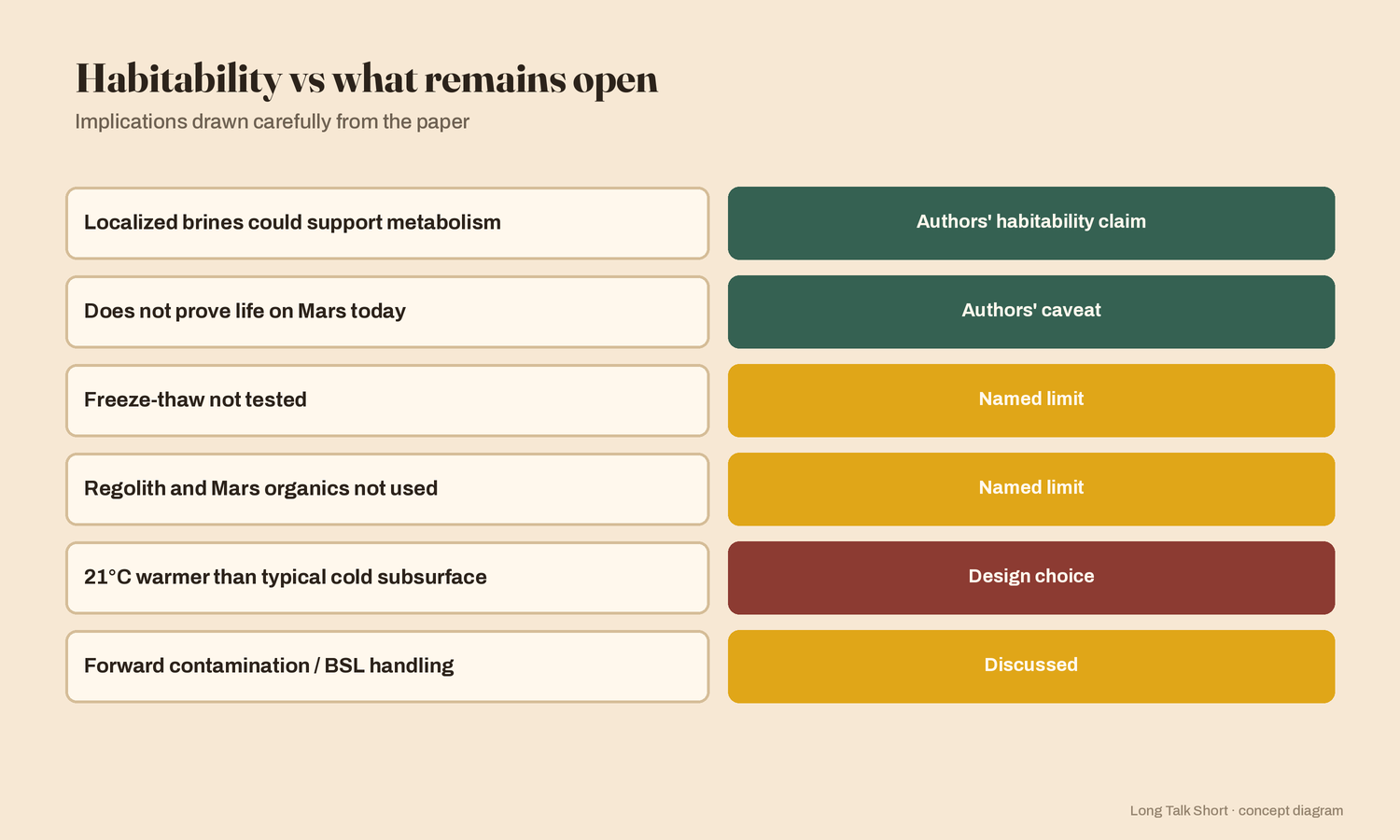
Authors' own caveat. They write plainly that the results "do not imply that microbial life exists on Mars today." The niche they mimic — a sealed hypersaline inclusion at about 20 centimeters depth — is theorized, not confirmed in place.
Checked against the paper. Active growth of Haloferax volcanii; 160 days; 24 mbar CO₂-rich anoxia; 21°C; nitrate and perchlorate use; optical-density rise plus ion depletion; slower growth than Earth-pressure controls; biofilms tied to low-pressure growth; water loss under 4%; persistent carotenoid Raman peaks; Viking framing; forward-contamination and BSL-3/4-style containment discussion; author list and affiliations; statement of no specific external grant.
Limits they name or that follow from the design. No freeze–thaw cycles; no Martian regolith simulant in this run; media include yeast extract and casamino acids, not a Mars-like organic menu of sparse compounds; surface-style UV radiation was not part of the chamber protocol. Temperature is a teaching point: 21°C is far warmer than typical cold Martian subsurface averages. The authors chose it so this organism could grow, and they argue it falls in a range of transient warm equatorial conditions cited from prior climate work; that does not make 21°C a typical underground Mars climate.
Access note. The publisher PDF at journals.asm.org returned a block (HTTP 403) to our fetch. Claims above were verified against the matching bioRxiv full text (DOI 10.64898/2026.07.11.737928) and the Crossref record for the Applied and Environmental Microbiology article (10.1128/aem.01749-26). Treat line-level wording as matching the preprint we read.
Sources. ASM article DOI, bioRxiv full text, University of Florida / EurekAlert summary.
Related reading: Paul Davies on origin mysteries · AI Snake Oil: does the claim actually work?
Long Talk Short
- Haloferax volcanii grew for 160 days in a 24 mbar, CO₂, high-salt brine using nitrate or perchlorate instead of oxygen.
- Growth was real by turbidity and ion use, but slower than in the same chemistry at Earth pressure.
- Dense biofilms showed up mainly when cells grew under the low pressure; water loss stayed under 4%.
- The authors say this backs possible habitability of localized shallow brines — not that Mars hosts life now.
- Cold cycles, real dust chemistry, sparse organics and radiation were outside this experiment; 21°C is a lab compromise.
The one thing to remember: A growing Earth microbe in a Mars-like brine jar shows pressure and salt alone need not kill metabolism — it still is not evidence of life on Mars today.
This summary is for general information only and is not scientific advice, astrobiology guidance or a claim about life on Mars. It is an independent reading of a lab study and is not affiliated with the authors, ASM or NASA.
Source: Robinson et al., "Cultivation of halophilic archaea in shallow subsurface Martian conditions has implications for extant life on Mars," Applied and Environmental Microbiology (doi:10.1128/aem.01749-26). This is an independent summary and is not affiliated with the authors, ASM, or NASA.