A Lead, Sitting in a Warehouse
Tom Bilyeu argues America is losing the AI race to itself: public hostility, unplugged chips, and a slow grid, against China’s classrooms and power build-out. Some headline survey numbers check out; several big figures stay his. Not investment advice.
A lead, sitting in a warehouse. If you have been treating the AI race as a story about who trains the better model, Tom Bilyeu wants the argument somewhere more uncomfortable: a country can spend more, invent more, and still lose if its public hates the build-out, its grid cannot power the chips it already bought, and its rival is teaching the technology in first grade. His claim is not that China has already won. It is that the United States is doing the losing to itself.
Tom Bilyeu made the case in “America Is Losing the AI Race to China (And We’re Doing It to Ourselves),” at youtube.com/watch?v=a08xOil4TC0. This article follows a third-party rendering of the YouTube auto-captions; wording is close, not line-perfect. The episode is sponsored by HeyGen and ButcherBox, and includes a mid-roll for HeyGen. Bilyeu’s cultural diagnosis — debt, welfare, “national character” — is his, not a finding. This is not investment advice, and it is a different argument from the rate-hike warning in A Hike Into Softness?.
In short: the Gallup attitude gap and Nadella’s remark about unplugged inventory check against published sources. The “below Afghanistan” ranking is Bilyeu’s wording, not confirmed in Gallup’s published table. Several large infrastructure and spend figures stay his. This is not investment advice.
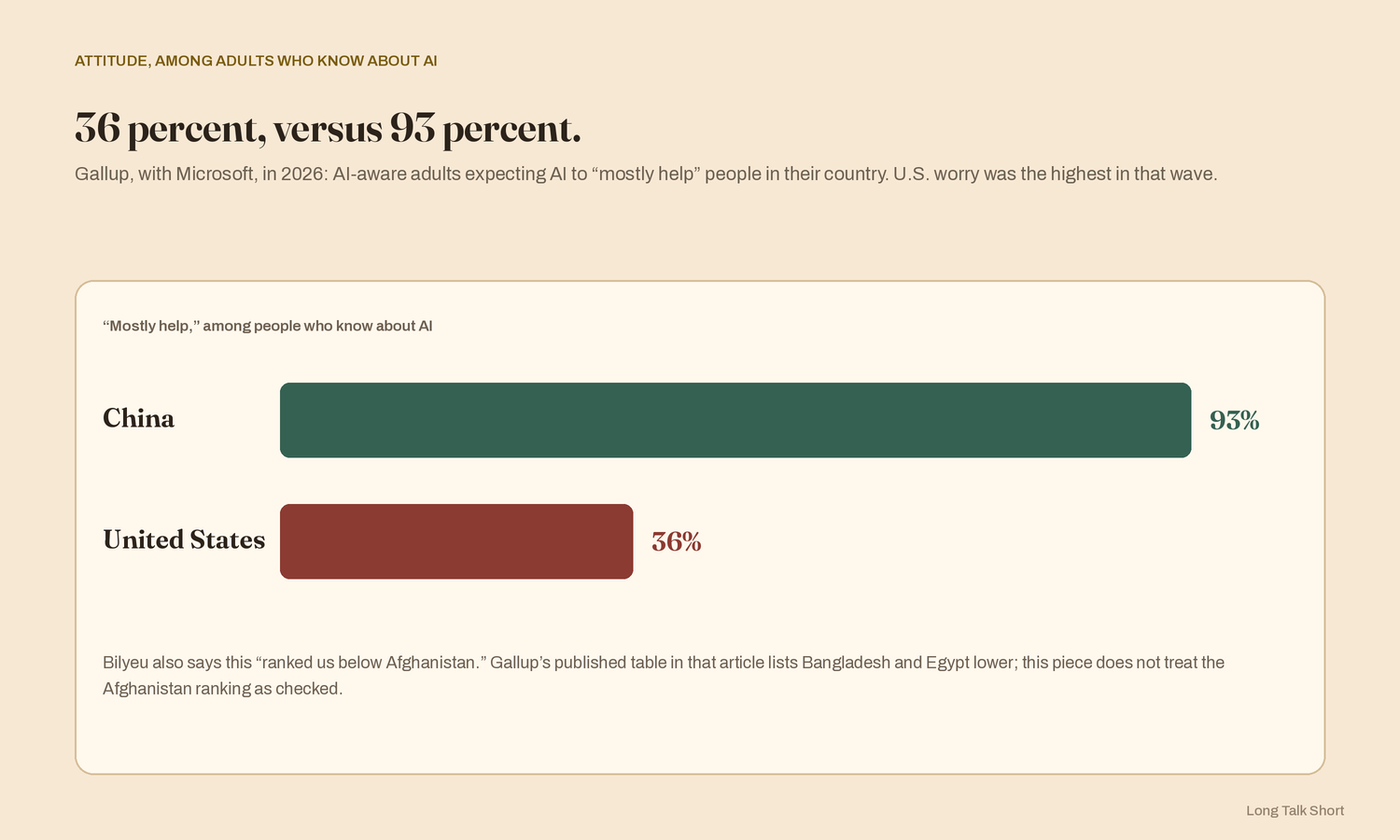
He starts with attitude, and the headline numbers he cites can be checked, with a caveat. In a 2026 Gallup survey, conducted with Microsoft and reported in September, 36 percent of AI-aware adults in the United States said AI would “mostly help” people in their country, versus 93 percent in China — shares among people who know about AI, not among all adults. Seventy-four percent of AI-aware adults in the United States said AI made them feel worried, the highest worry figure Gallup listed in that 37-country wave. Bilyeu also says the 36 percent “ranked us below Afghanistan.” Gallup’s published table in that article puts Bangladesh at 34 percent and Egypt at 35 percent, with the United States at 36 percent; Afghanistan is not in that lowest-three list. This article does not treat the Afghanistan ranking as checked.
1. Chips in the warehouse, and a fight over the plug
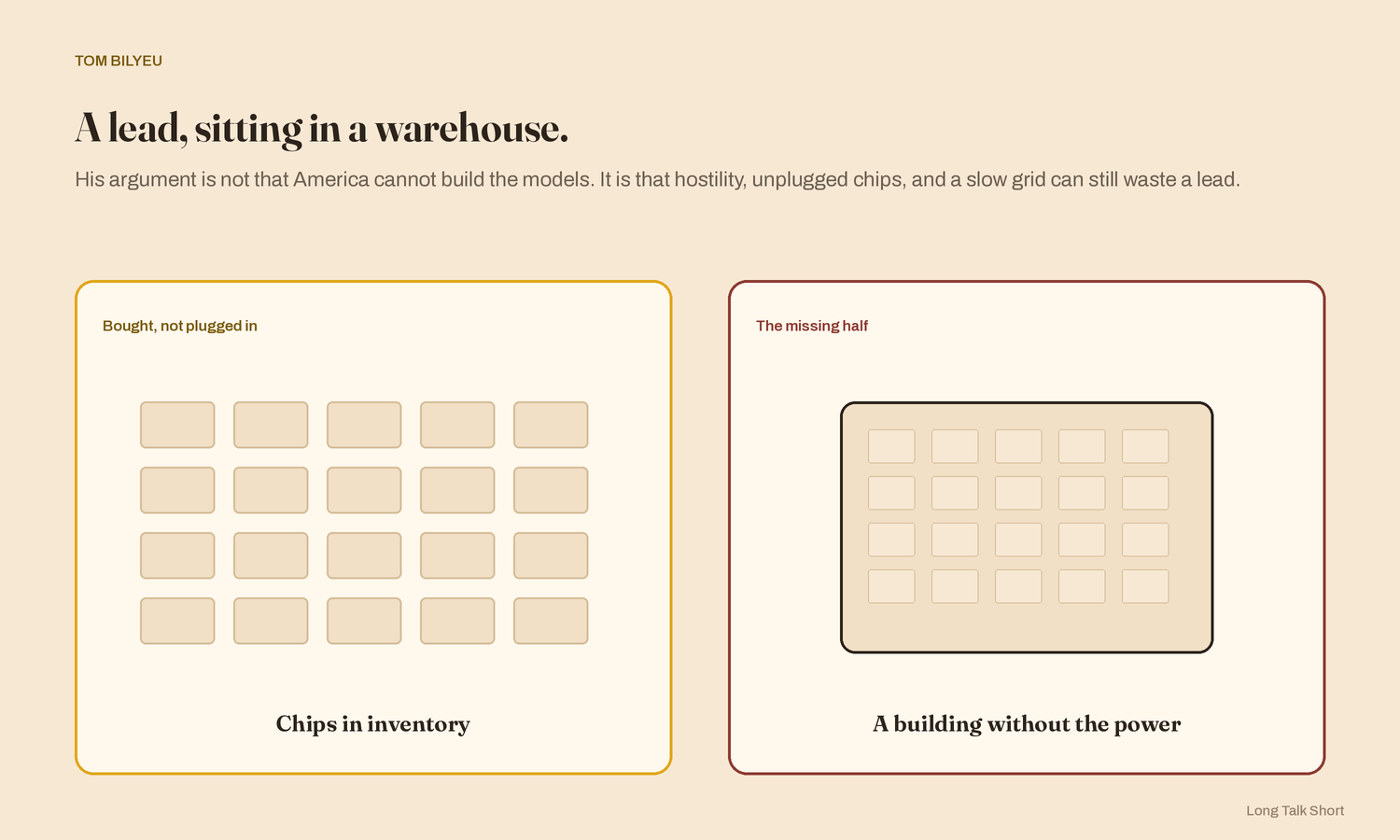
The infrastructure half of his argument is that America is buying capacity it cannot turn on, and then watching communities vote it down. He says “over $230 billion worth of AI chips” are sitting unused, “partly because data centers lack power,” and that Microsoft’s Satya Nadella “admitted” that his problem isn’t a shortage of chips, it’s chips sitting in inventory that he can’t plug in. The Nadella line is a real November 2025 remark, widely reported, about GPUs waiting on powered data-center space. The $230 billion inventory total is Bilyeu’s figure, not one verified here. He also says local opposition “blocked or delayed nearly $200 billion in data center projects in the first half of the year,” and that “40 of the 41 local initiatives around throttling AI data center buildouts passed.” Those tallies stay with him.
He stacks that against a grid he describes as already strained: U.S. electricity prices up 5.9 percent in a year, “faster than inflation overall,” and an 11 percent rise in Virginia; a Department of Energy warning that, if retired plants are not replaced in time, blackouts could rise to “more than 800 hours a year”; an interconnection queue of “more than 2,000 gigawatts,” with waits of more than five years. Those energy and queue figures are his recap, not a line-by-line audit here. The binding constraint, in his telling, is power and permission, not a shortage of ambition in the labs.
2. China’s classrooms, and an expensive lead
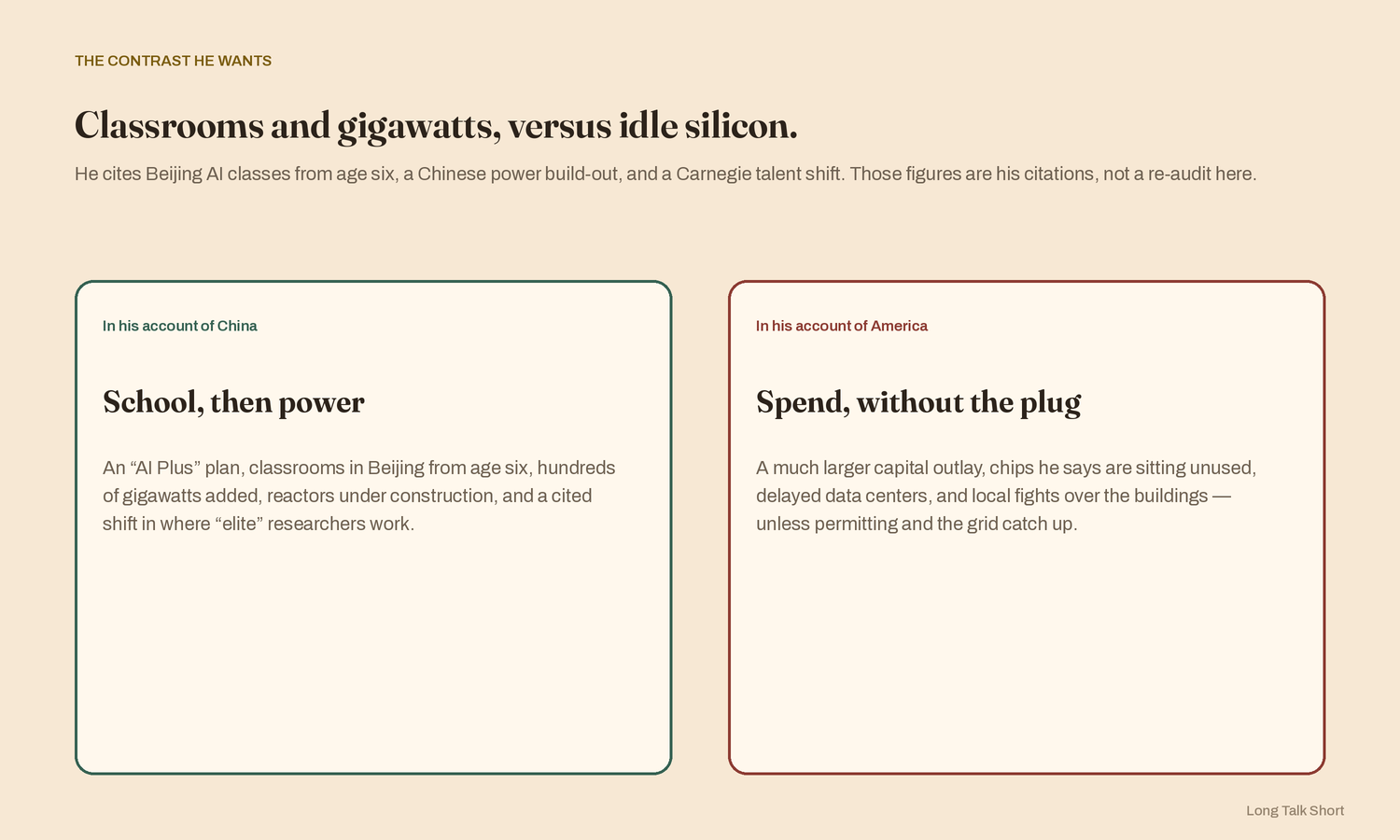
The contrast he wants is not a mysterious Chinese model. It is a state that, in his account, is wiring the technology into school and into the grid. He says China launched an “AI Plus” plan in August 2025 aimed at putting AI into more than 70 percent of the economy by 2027, and that “since September of 2025, every school in Beijing has had to teach AI starting at age six.” He cites a “September 2026 Carnegie study” for a talent shift: China “employs 41 percent” of “elite” AI researchers, America 34 percent, a reversal from 46 and 27 percent three years earlier. He says China added “roughly 540 gigawatts” of power capacity in 2025 and has dozens of nuclear reactors under construction. All of that is his citation of other people’s work, not a finding re-derived here.
On money, he says America’s four biggest tech firms are “on track to spend about $740 billion” on AI this year, versus about $140 billion for China’s largest firms, “according to Moody’s” — “6x as much to stay only about seven months and a tiny percentage ahead.” That is a cited snapshot, not a verdict on the year ahead. His prescription is blunt: permitting reform “measured in months rather than decades,” nuclear at scale, faster grid connections, and a public story in which AI lowers costs instead of only raising bills.
Weighing it: what holds up
The Gallup attitude gap, the high U.S. worry number, and Nadella’s remark about unplugged inventory are checked against published sources. The $230 billion in idle chips, delayed data-center totals, local-vote counts, electricity and blackout figures, 540 gigawatts, Carnegie talent shares, and the $740 billion versus $140 billion spend are reported as Bilyeu stated them, or as the studies he named. His causal story — that debt and weak storytelling produced hostility, and hostility plus slow permitting produced a power crunch — is his diagnosis. A midterm “blue wave” and a lecture on national character are political framing, not evidence that a race is already lost.
Related reading: A hike into softness? · Who pays for the chips?
This episode is distinct from A Hike Into Softness?, his earlier argument about a possible Fed hike after a hotter CPI print.
Long Talk Short
- Among adults who know about AI, Gallup found 36 percent in the United States — and 93 percent in China — expecting AI to mostly help their country. U.S. worry was the highest in that wave. The “below Afghanistan” ranking is Bilyeu’s wording, not confirmed in Gallup’s published table.
- His infrastructure claim is that America is buying chips it cannot power and facing local revolts against data centers. Nadella did talk about GPUs stuck for lack of electricity; the $230 billion warehouse total is Bilyeu’s.
- He contrasts that with Beijing classrooms teaching AI from age six, a Chinese power build-out, and a Carnegie-cited shift in where “elite” researchers work — cited, not re-checked here.
- The spend comparison he cites is roughly six times as much American capital for a lead he puts at about seven months. His fixes are faster permitting, nuclear, and a better public story.
The one thing to remember: A lead in models can still erode if the chips sit in a warehouse, the grid is the bottleneck, and the public is asked to host the buildings without a story about why they should.
Independent summary; not affiliated with Tom Bilyeu or Impact Theory. This is not investment advice.
Source: Tom Bilyeu, “America Is Losing the AI Race to China (And We’re Doing It to Ourselves),” on YouTube. Independent summary; not affiliated with Tom Bilyeu or Impact Theory. This is not investment advice.