A Hike Into Softness?
Tom Bilyeu argues the Fed may hike into a weak economy after a hotter October CPI, and reaches for the ECB’s 2008 energy-shock increase. The print is real; the 2008 rhyme is his argument. Not investment advice.
A hike into softness? If you have been staring at a hotter inflation print and hearing talk of a December rate hike, you already know the uneasy pairing: prices that are not cooling as hoped, and an economy that does not feel strong enough to take another tightening in stride. Tom Bilyeu’s argument is that this is the kind of mistake a central bank has made before — and that the precedent worth studying is not 2022. It is Jean-Claude Trichet’s European Central Bank in the summer of 2008.
Tom Bilyeu took up the Fed thesis in the opening of a longer live show on his Impact Theory channel, at youtube.com/watch?v=2uVyP7qCP0c. This article follows that opening only, using YouTube auto-captions. Bilyeu is joined by a co-host he addresses as Drew; the captions do not give a last name, so this piece does not invent one. Nothing here is investment advice, and a historical parallel is not a forecast.
In short: the October 2026 CPI print and the July 2008 Trichet hike are checked against official or well-documented sources. The 2008 rhyme, the 3.7 percent “fastest of the year” claim, and several supporting figures stay his. This is not investment advice.
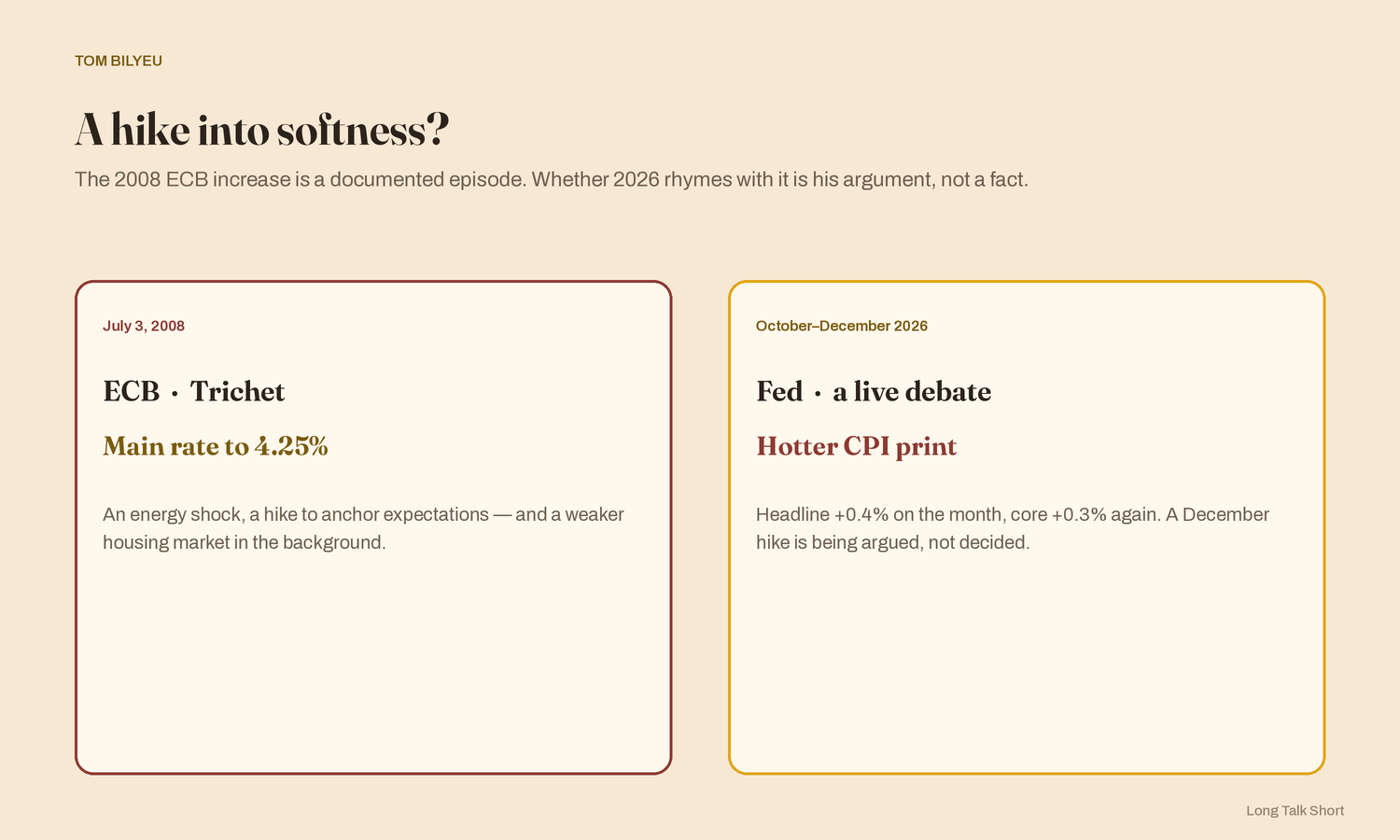
Bilyeu’s hook is a hotter October consumer-price report and a Federal Reserve that, in his telling, is weighing a December increase — possibly a large one — “into a weak economy.” Official data backs the direction of the print, if not every flourish around it. The Bureau of Labor Statistics’s October 2026 CPI, released November 10, showed a 0.4 percent month-over-month rise in the headline index, hotter than many forecasts. Core CPI, which excludes food and energy, rose 0.3 percent for a third straight month. Because of the prior year’s government shutdown, the BLS did not publish the usual year-over-year headline comparison. Bilyeu, and the show’s description, go a step further: if you look at the last three months, he says, core inflation ran at a 3.7 percent annual pace, “the fastest of the year.” That 3.7 percent figure is his (or his source’s) annualized reading of those monthly core prints. This article does not independently rank every three-month window in 2026 to confirm the “fastest of the year” claim.
1. A hotter print, a December decision, and a 50-basis-point scare
The policy question Bilyeu wants you to sit with is whether the Fed should answer that print with another hike, and how large. He says “some are saying we might need a 50 basis point hike.” That is not a decision the Fed has taken. Before the release, Fed Governor Christopher Waller had said a half-point increase should be considered if core came in around 0.3 percent. After the print, contemporaneous market coverage generally priced a quarter-point move as the more likely December outcome, with a half-point hike as a smaller, still-live risk. Bilyeu is arguing about that risk into what he sees as a weak backdrop, not announcing a path the Federal Open Market Committee has chosen.
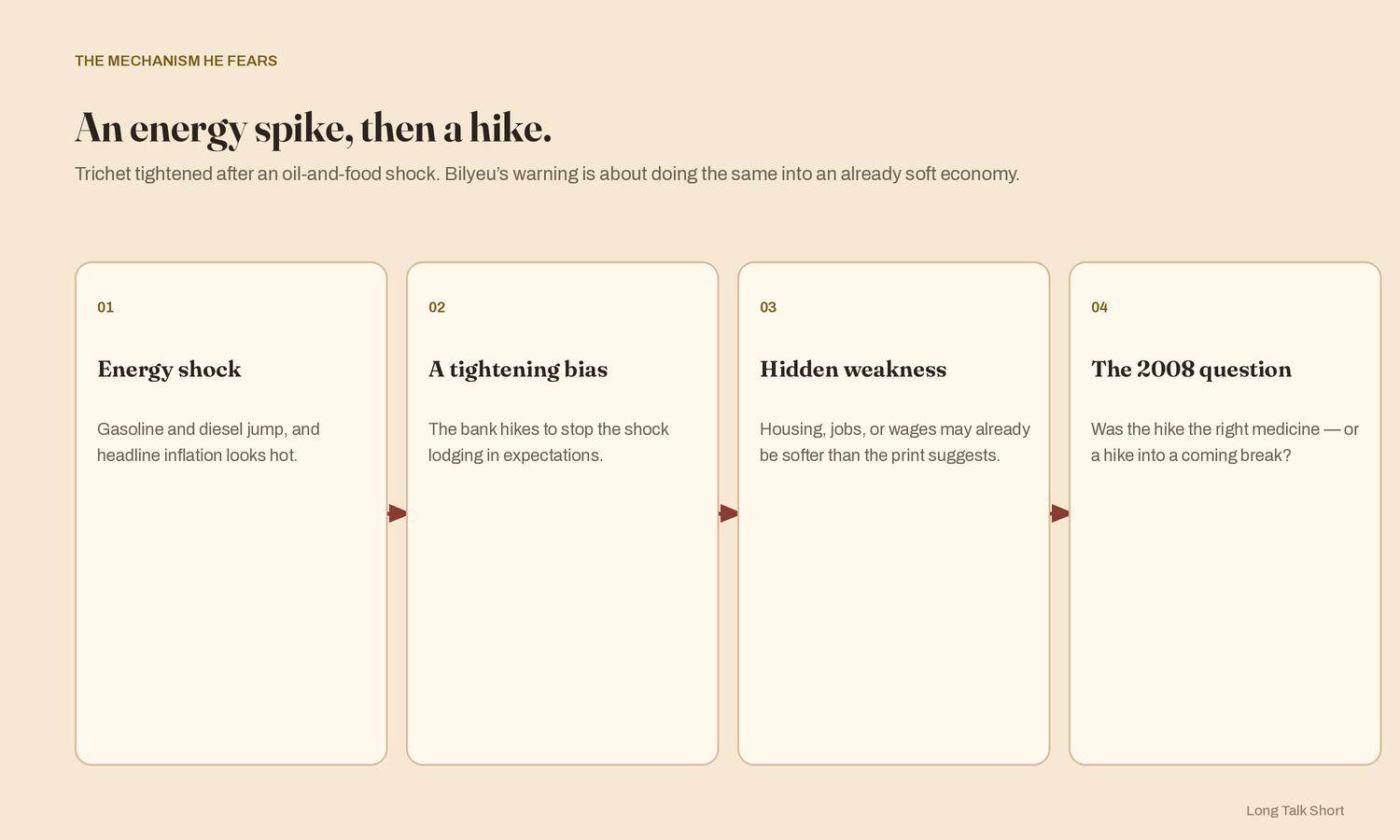
He also spends time on the composition of the print, and those details should stay with him unless they have been re-checked. He describes the September spike as “basically a gas story,” tied in his telling to Iran, and cites a 9.1 percent jump in gasoline that month and a further 1 percent in October. He puts diesel at a record above $6.50 a gallon in September and about $6.25 in October, “roughly $2.50 more than a year earlier,” and says trucking costs were “up 19% by September.” He notes services excluding food, housing, and energy up 0.4 percent, pushed by transportation, medical care, and insurance. Those figures are his recap, not a line-by-line audit of the BLS tables.
2. The 2008 parallel — a real hike, a debated lesson
The historical move he wants in the room is real. On July 3, 2008, the ECB, under President Jean-Claude Trichet, raised its main refinancing rate to 4.25 percent. The stated aim, at the time, was to keep an oil-and-food shock from lodging in inflation expectations. Bilyeu’s reading is that core European inflation excluding food and energy was already under 2 percent, that housing-market weakness was hiding in the background, and that the tightening came into an economy that was more fragile than the headline inflation fight suggested. He starts to say “just 10…” and does not finish the clause; Lehman Brothers failed that September. Once, in the captions, he says “cut” when he means a hike. The July 2008 decision, and the later criticism of it, are a well-documented episode. The claim that the current Federal Reserve is about to “repeat a 2008 mistake” is his analogy, not a finding that 2026 is 2008.
The “weak economy” half of his pairing is a collage of indicators and commentary, and it is thinner, as evidence, than the CPI print itself. He cites “the Kobeissi Letter” for the claim that inflation has “wiped out all of US consumer wage gains since the 2020 pandemic.” That wipeout line is the letter’s, as seconded on the show — not a result re-derived here from BLS real-earnings tables. The latest official real average weekly earnings figures were essentially unchanged from September to October; this article is not treating them as a verified 2020-to-2026 wipeout. He also mentions a poll in which fear of a long job search was “highest since April 2020,” and argues that unemployment “looks low partly because people leave the workforce.” Those are his citations and his interpretation, not numbers checked against the official labor-market release in this piece.
Weighing it: what holds up
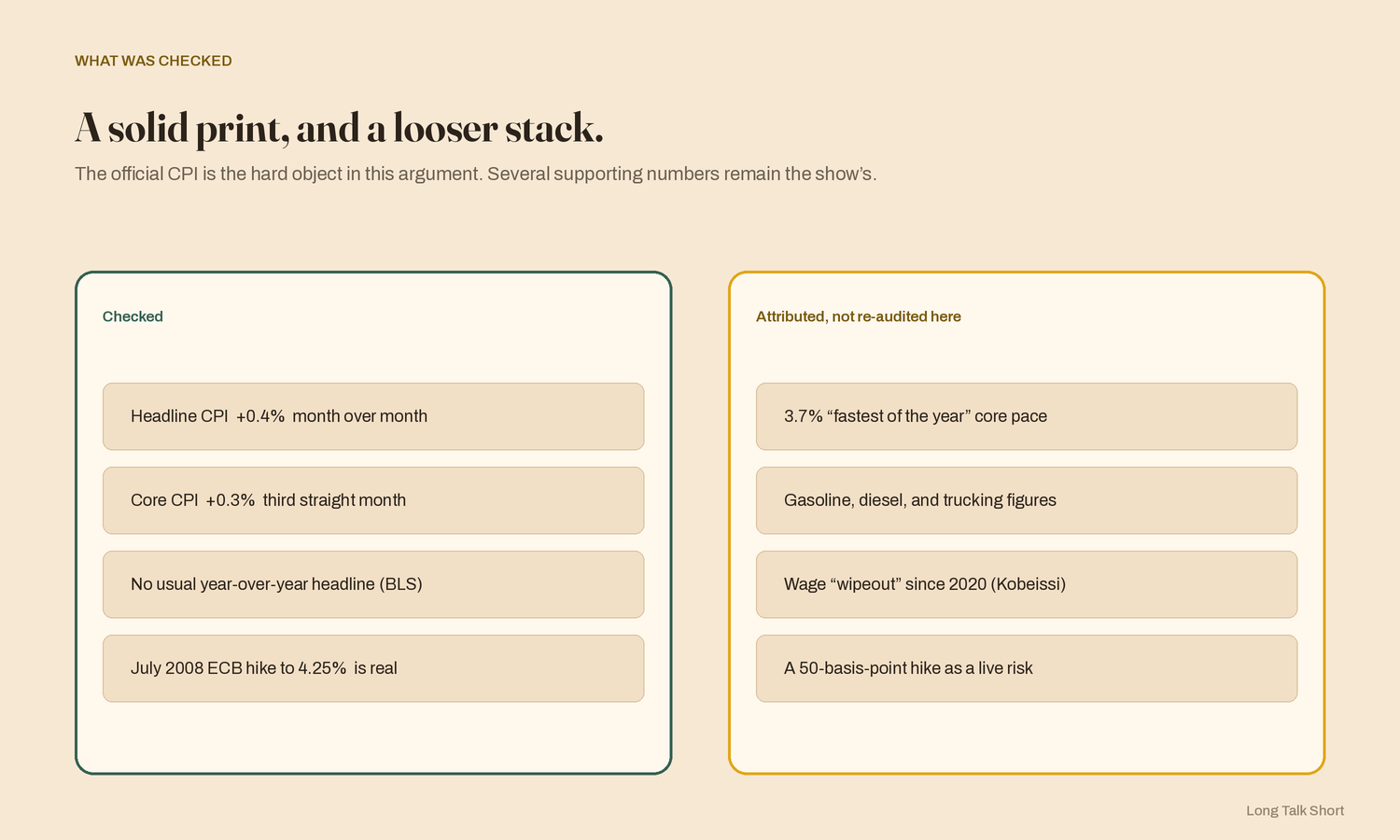
This article follows YouTube auto-captions of a live show, which can slip on names and wording; “Trichet” and a few figures should be read as close, not line-perfect. The October CPI’s 0.4 percent headline and 0.3 percent core, the missing year-over-year comparison, and the July 2008 Trichet hike are checked against official or well-documented sources. The 3.7 percent “fastest of the year” core pace, the gasoline, diesel, and trucking numbers, the wage-wipeout claim, and the job-search poll stay attributed. Markets after the print were not uniformly pricing a 50-basis-point hike; Bilyeu is flagging a risk, not reading a decision. A 2008 rhyme can be clarifying, and it can also smuggle in a crash that has not arrived. This is not a recommendation about bonds, stocks, or cash.
Related reading: Borrowed resilience · The rally call, weighed
Long Talk Short
- October CPI came in hotter than expected: headline prices up 0.4 percent on the month, core up 0.3 percent for a third straight month. The BLS did not publish the usual year-over-year headline figure.
- Bilyeu’s policy warning is a December hike — possibly 50 basis points, in the chatter he cites — into an economy he reads as weak. A half-point move had been floated as a contingency; it is not a decision the Fed has made.
- The 2008 precedent he reaches for is real: the ECB, under Trichet, raised its main rate to 4.25 percent in July 2008 in the face of an energy shock. Whether that is the right map for 2026 is his argument.
- Several supporting claims — a 3.7 percent “fastest of the year” core pace, energy and trucking figures, and a wage “wipeout” since 2020 sourced to the Kobeissi Letter — are not independently verified here.
The one thing to remember: A hotter print can tempt a central bank to tighten into softness, and 2008 is a serious warning about that temptation — but a rhyme is not a forecast, and a podcast is not a policy path.
Independent summary; not affiliated with Tom Bilyeu or Impact Theory. This is not investment advice.
Source: Tom Bilyeu on Impact Theory, on YouTube. Independent summary; not affiliated with Tom Bilyeu or Impact Theory. This is not investment advice.