Does It Actually Work? AI Snake Oil and How to Spot AI That Can't Deliver
Software is quietly deciding who gets hired, insured or released on bail, and much of it barely beats chance. Narayanan and Kapoor's AI Snake Oil separates real AI progress from hype, and gives you the questions to ask.
You apply for a job and are asked to record a 30-second video. Software scores your personality and decides whether a human ever sees your application. You will never learn how it judged you.
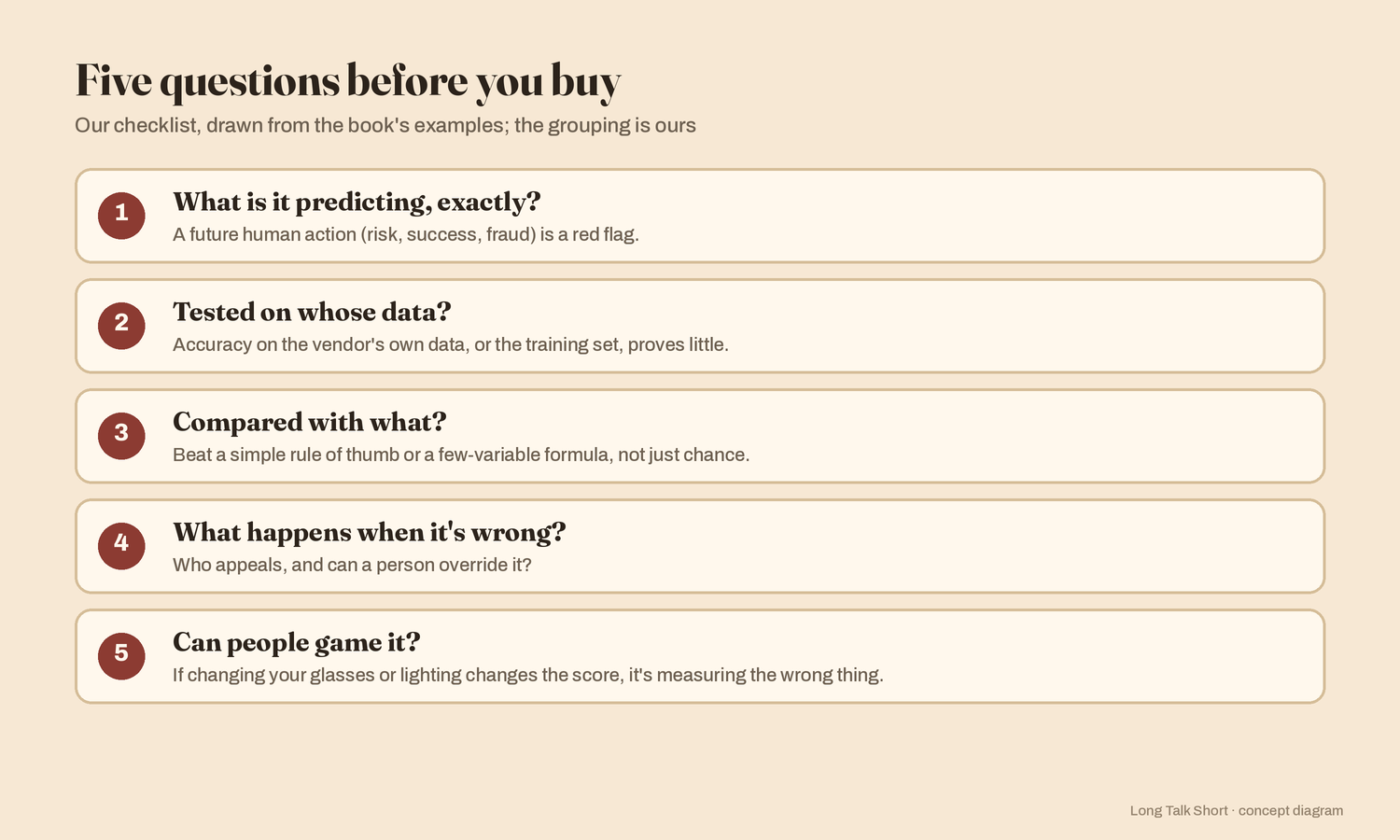
The vendor has published no independent evidence that its scores predict job performance. When German journalists tested one such tool, the scores shifted when an applicant put on glasses or a headscarf, or sat in front of a bookshelf. This is the kind of product Arvind Narayanan and Sayash Kapoor have in mind in AI Snake Oil: AI that doesn't work, and probably never will.
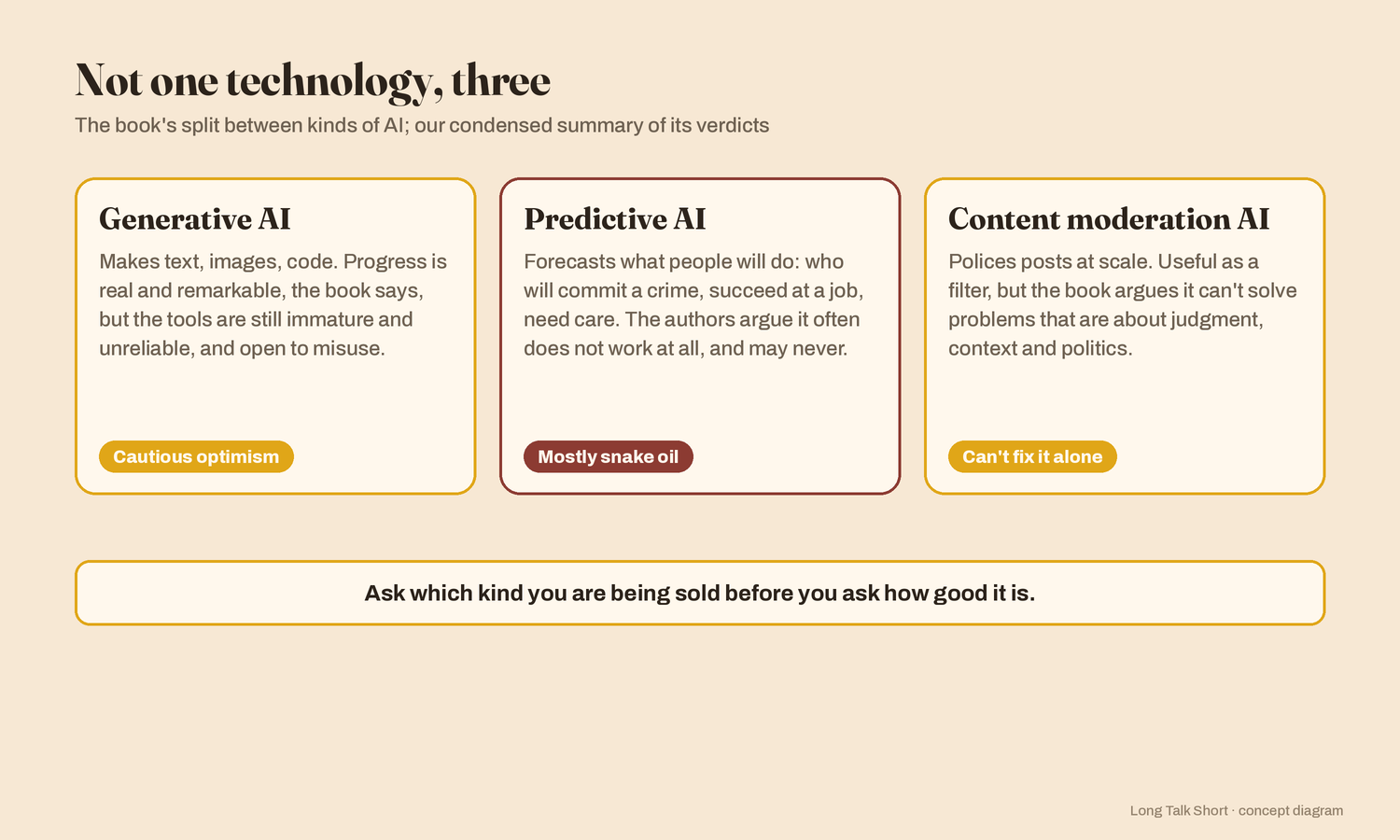
In short: "AI" is an umbrella term, like "vehicle," covering technologies that have little in common. Generative AI, the kind behind chatbots, is genuinely improving but still unreliable. Predictive AI, which claims to forecast what people will do, often barely beats chance, yet it is quietly deciding who gets hired, insured, released on bail or sent home from hospital. The first question to ask about any AI product is which kind it is.
1. One word, many technologies
Narayanan is a computer science professor at Princeton and directs its Center for Information Technology Policy. Kapoor, a former Facebook engineer who worked on content moderation, wrote the book while a Princeton PhD student. Their starting point: public debate about AI is muddled because one word covers so much. Talking about "AI" in general, they argue, is like talking about "vehicles" when you mean bicycles, cars and rockets at once.
So they split it up:
- Generative AI produces text, images and code. Its progress, they write, is "genuine and remarkable," but it is still immature, unreliable and prone to misuse. They are "cautiously optimistic" about it.
- Predictive AI uses past data to forecast what an individual will do: commit a crime, succeed in a job, default on a loan, recover from an illness. Here they are blunt.
- Content moderation AI gets its own chapter, on why it can't fix social media.
Their verdict on predictive AI:
often does not work at all
That is a strong claim. The evidence they bring for it is the heart of the book.
2. When software decides about people
The examples are sobering:
- Health insurance: a Medicare insurer's algorithm judged that an 85-year-old patient would be ready to leave care in 17 days. Her payments stopped on schedule, even though she still couldn't walk unaided.
- Car insurance: in Maryland in 2013, regulators found that Allstate's pricing model effectively charged loyal customers more if they were unlikely to shop around, producing what critics called a "suckers list" weighted toward people over 62. Maryland rejected it; the authors say similar approaches were used in at least 10 other states.
- Bail: pretrial risk tools that help decide who stays in jail before trial, they argue, are only slightly more accurate than guessing.
3. Why predicting people is so hard
The authors give three reasons.
The future is genuinely hard to predict. In the Fragile Families Challenge, 160 teams of researchers had access to thousands of data points about children's lives and tried to forecast outcomes such as their school grades. The best models explained only about a fifth of the variation, and were only modestly better than a simple formula using four variables chosen by experts.
The tools are tested badly, often on the same data they were built from.
People adapt. Once a score determines who gets something, people learn to game it, and the score stops measuring what it was meant to.
If the products are this weak, why do so many people believe in them?
4. Hype has a supply chain
The authors don't just blame vendors. They trace how hype spreads: companies overclaim, researchers publish results that don't reproduce, and journalists repeat press releases, illustrating stories with glowing robot brains.
They also push back on the loudest warning of all. In their view, the idea that AI will soon become a superintelligence that wipes us out distracts from the harms already happening. The danger they worry about is less what AI might do on its own than what people and institutions do with it.
Weighing it: what holds up
Holds up: we checked several of the book's key cases. The Medicare, Allstate, hiring-video and pretrial examples match the authors' published excerpt, and The Markup's 2020 reporting on Allstate's Maryland filing matches the "suckers list" account. The Fragile Families Challenge, published in PNAS in 2020 by Matthew Salganik and colleagues, matches: 160 teams, a best R² of about 0.2 for grades and material hardship, and much lower for other outcomes. An outside example fits the argument too: a 2021 study in JAMA Internal Medicine by Andrew Wong and colleagues found that Epic's widely used sepsis prediction model had an AUC of 0.63 and missed two-thirds of sepsis cases. The video-interview test was reported by Bayerischer Rundfunk in 2021. Nature named the book one of its best books of 2024.
Overstated: the broad claim that predictive AI rarely works rests on a selection of high-profile failures. A vendor would point to systems that do outperform people, such as some fraud detection and credit scoring tools. The authors would reply that the burden of proof belongs on the vendor, which is fair, but "often does not work" is a judgment about a field, not a measured rate.
Disputed: at least one academic review argued the book's critique of journalism is too sweeping. Several of the failures it describes first came to light through investigative reporting, such as The Markup's work on Allstate.
May date: in our view, the generative AI chapters are the most likely to age quickly, given how fast the models change. The authors later extended their argument in an essay, "AI as Normal Technology" (2025), which predicts AI's effects will unfold over decades, like electricity, rather than in a sudden leap.
Not checked: the book's claims about content moderation or existential risk. The checklist in our second figure is our distillation, not theirs.
Related reading: for a far more alarmed view of where AI is heading, see Mustafa Suleyman's The Coming Wave; on testing AI yourself rather than trusting the pitch, see Satya Nadella on owning your AI evals; and on AI and democracy, Yuval Noah Harari's Nexus.
Long Talk Short
- "AI" covers very different technologies; judge each one separately.
- Generative AI is improving fast but still makes things up; use it where you can check the output.
- Predictive AI that forecasts individual behavior often barely beats chance or a simple formula, yet it is used in hiring, insurance, bail and healthcare.
- Be suspicious of accuracy figures tested on a vendor's own data, and of any score people can game.
- Hype spreads through companies, researchers and the media together, and fear of superintelligence can distract from present harms.
The one thing to remember: when someone sells you AI that predicts people, ask for independent evidence that it beats a simple rule, and what happens to the person when it is wrong.
Source: AI Snake Oil: What Artificial Intelligence Can Do, What It Can't, and How to Tell the Difference by Arvind Narayanan and Sayash Kapoor (Princeton University Press, 2024). This is an independent summary and is not affiliated with the authors or publisher.