Anthropic's Numbers Are Real. So Is the Bill: All-In on Who Pays for the AI Build-Out
Anthropic's S-1 shows $16.3 billion of first-half revenue and a mostly non-cash loss, while Google lost $500 billion in a day over AI costs. The All-In hosts argue over who pays for the build-out. We check the numbers and the hosts' ties.
Is AI a bubble? Two hard data points pull in opposite directions. Anthropic filed to go public and showed revenue growing faster than almost any company on record. Then Alphabet, which owns roughly 14% of Anthropic, lost about $500 billion of market value in a single day because its AI spending is eating its cash.
The All-In hosts spent most of an episode arguing over what those two facts mean together. Nobody called it a bubble. The fight was over something more useful: who pays for the build-out.
In short: the hosts agree Anthropic's numbers are real. They disagree about whether the cost of building AI, in chips, power and borrowed money, is a problem for the companies or for everyone else.
1. The numbers the bulls lean on
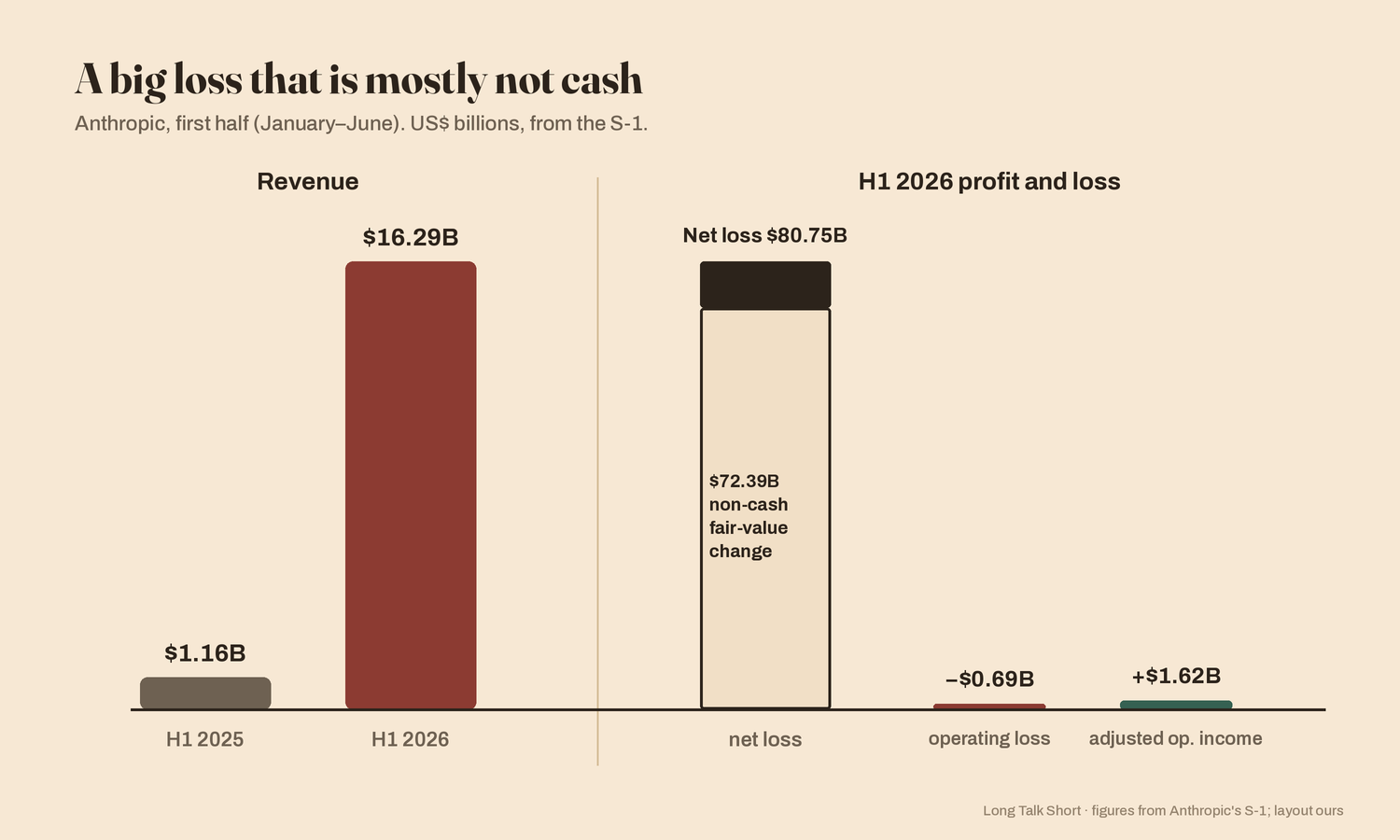
Anthropic's S-1 reports $16.3 billion of revenue in the first half of 2026, against $1.16 billion in the first half of 2025. David Sacks, who has long predicted Anthropic would be "the greatest business ever," went after the headline loss of $80.7 billion:
basically a fake number
He is mostly right about what it is. $72.4 billion of it is a non-cash change in the value of convertible notes and similar instruments, which grew as Anthropic's valuation rose. The operating loss was $693 million, and on the company's adjusted measure it made $1.6 billion. It is still a real accounting loss, just not cash leaving the building.
David Friedberg pointed to the customer list. Customers spending more than $100,000 a year went from about 200 at the end of 2024 to roughly 1,500 a year later and about 11,900 by September. By his rough count, about a million businesses worldwide could spend $100,000 at under 1% of their budget, so Anthropic is "only 1% penetrated." He also cited an incremental gross margin of about 85% and argued that every link in the chain, from Nvidia's chips to the model makers to the customers, is making money.
So if the revenue is real, what is the worry?
2. The risk is compute, not customers
Chamath Palihapitiya called it "the most incredible business I've ever seen" and then spent his time on the risks. His team sorted the words in the filing's risk factors by topic. Compute came first, meaning data centres, chips and power, with regulation a close second. Customer demand barely features. His reading: management worries mainly about getting enough capacity to serve demand it already has.
That capacity is paid for with capital. Anthropic had about $131.7 billion in cash and short-term investments at the end of June and is aiming to raise around $100 billion in the IPO, which would be the largest ever.
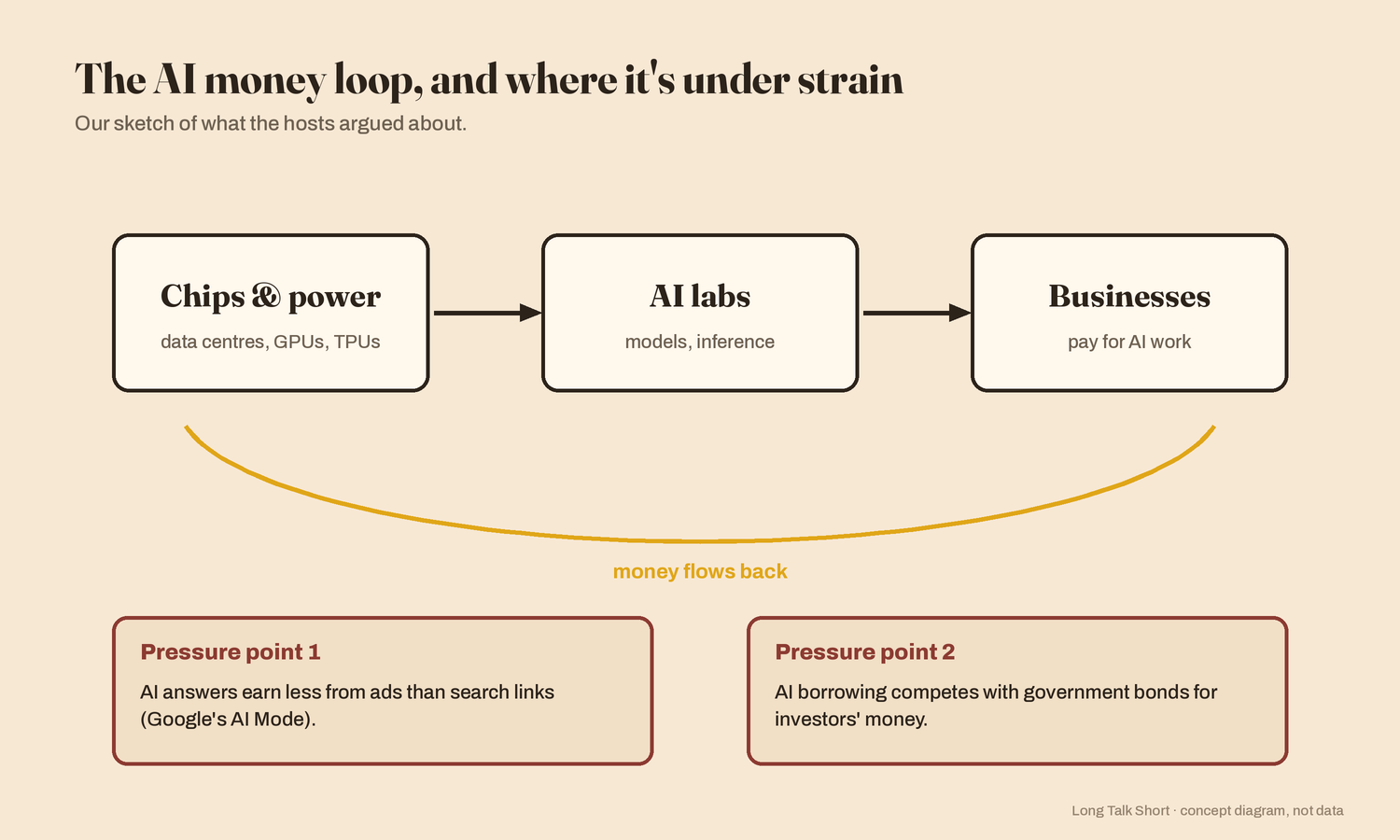
His bigger worry is the whole AI complex. A handful of companies borrow on a scale that competes with governments, he argued. Either AI debt pays higher interest, which flows down to smaller cloud providers and raises the risk of defaults, or the US Treasury pays more, which raises borrowing costs across the economy. He called these firms "too big to fail."
For a picture of what the bill looks like, the hosts turned to Google.
3. Google: the other side of the same trade
Alphabet's shares fell about 13% after its third-quarter report, their worst day ever, wiping out about $500 billion. Search revenue rose 12% to $63.4 billion, short of forecasts, and free cash flow was negative $9.1 billion as full-year capital spending stayed on course for $195 billion to $205 billion. Google's business chief, Philipp Schindler, said its AI Mode earns less from ads than classic search.
Sacks argued the panic was overdone. Search is still growing, and it fell below half of Alphabet's revenue mainly because Google Cloud doubled. Friedberg called it "complicated": a strong cloud business on one side and, on the other, a core ad business that has to be replaced by something AI-shaped before it shrinks.
Chamath picked up claims circulating on X that Google had quietly changed how its ad auctions charge advertisers. Google hasn't confirmed this, and its own help pages still describe charging only what is needed to beat the next ad. His advice to Google was blunt: refute it, and keep Demis Hassabis.
4. Bubble or not?
The split is between Sacks and Friedberg, who see a value chain making money at every step, and Chamath, who sees a sound business inside a financing system never tested at this size. Jason Calacanis added that growth appeared to slow in the third quarter. Reported figures support him: quarter-on-quarter revenue growth slowed to about 47%. That is still very fast.
Sacks then turned to politics. He repeated that Anthropic is seeking "regulatory capture" and said it is racing faster than anyone towards AI that improves itself, citing an Anthropic chart he said showed 26% of model-building tasks used its own models. The episode closed with midterm predictions, which we've left out.
Weighing it: what holds up
Holds up: the S-1's revenue for both first halves, the net loss and its non-cash part, the operating loss, adjusted operating income, cash and customer counts, and the third-quarter slowdown. Also Alphabet's record one-day fall, the search, free cash flow and capex figures, Schindler's comment, Google Cloud's doubling to $30.7 billion and Google's roughly 14% stake in Anthropic.
Overstated: "fake number" goes too far. Most of the loss is non-cash, but it is still a real accounting loss.
Not checked: Friedberg's 85% incremental margin and million-customer estimate, Chamath's net-burn, debt-facility and borrowing figures, the ad-auction claims and Sacks's 26% figure. Treat these as the hosts' claims.
Conflicts: an industry database lists Sacks's Craft Ventures as an investor in Anthropic's April 2026 round, and he has been described on the show as an Anthropic investor; we couldn't confirm the stake in the S-1. He was the White House AI and crypto czar, co-chairs the President's science council and has publicly feuded with Anthropic over regulation. Chamath runs Social Capital, Friedberg runs Ohalo and Calacanis runs LAUNCH, all tech investors. We didn't check whether any host holds Alphabet shares.
Bottom line: the revenue is real. The open question is the financing, and that is where the hosts' own figures are least checked.
Related reading: for how the build-out's funding is shifting, see Who Pays for the Chips?; for the debt case in full, see AI Isn't the Bubble. The Debt Behind It Might Be.
Long Talk Short
- Anthropic's revenue is real and growing fast; most of its $80.7 billion loss is a non-cash accounting change.
- Its biggest stated risk is compute, not customers.
- Google shows the bill: AI answers earn less than search ads, and capex pushed free cash flow negative.
- Chamath's worry is systemic: AI borrowing on a scale that competes with governments.
- Growth slowed in the third quarter, from very fast to merely fast.
The one thing to remember: the AI debate has moved from whether anyone will pay to who pays for the build-out, and at what interest rate.
Source: "Anthropic S-1 Shocker, Greatest Business Ever? Google's $500B Wipeout, Midterm Predictions", All-In Podcast (YouTube). We worked from a machine transcript, so some figures are rounded. This is an independent summary and is not affiliated with the podcast or its hosts.
This article is for general information only and is not investment advice.