More Pleasure, Less Joy: Anna Lembke's Dopamine Nation on Why Easy Hits Leave You Flat
A psychiatrist's case that endless easy pleasure tips the brain toward pain, her 30-day reset, and why the famous dopamine numbers come from rats.
You finish the episode and the next one starts before you decide. You check your phone, put it down, and check it again a minute later without remembering why. Each hit feels a little good, and afterwards you feel a little flat, so you reach for another. Anna Lembke, a psychiatrist who runs addiction medicine at Stanford, thinks that flat feeling is the key. In Dopamine Nation she argues that a world of cheap, endless pleasure is quietly tipping many of us toward pain, and that the way back runs through doing less, not more.
In short: the brain treats pleasure and pain like two sides of a balance and works to keep it level. Every high is followed by a low, and with heavy use the lows grow. Lembke's answer is to stop for about a month, then put deliberate distance between yourself and the thing. The core idea is well grounded. Some of the book's most quoted numbers come from rats, and the author has a financial interest worth knowing about.
1. A seesaw in your head
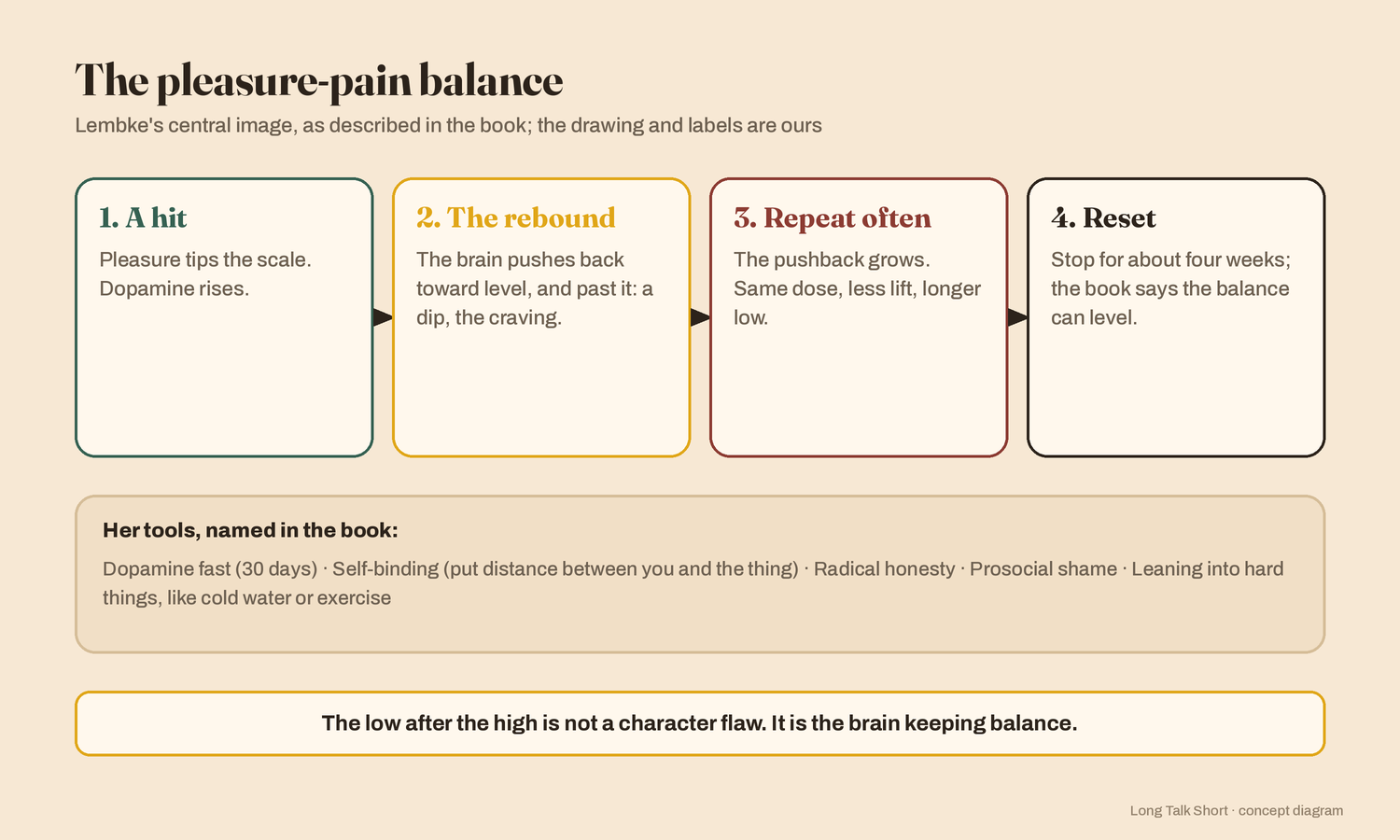
Lembke's central image is a balance, or seesaw. When you do something pleasurable, the balance tips toward pleasure, and dopamine, a brain chemical tied to reward and motivation, rises. Then the brain pushes back to get level again, and it doesn't stop at level. It tips a little past, toward pain. That small dip is the craving, the urge to have one more.
Do it once and the dip passes. Do it over and over and, Lembke argues, the brain adapts by loading the pain side for the long term. The same dose brings less lift, the low lasts longer, and you need the thing just to feel normal. That is tolerance, and it is how she explains addiction to drugs, but also to food, shopping, social media, pornography or gaming. She calls the smartphone "the modern-day hypodermic needle", delivering digital dopamine around the clock. If the problem is a balance tipped too far, the fix is to let it swing back.
2. How to tip it back
The first step is what she calls a dopamine fast: give up your drug of choice, whatever it is, for 30 days. She describes the early days as usually the hardest, and says it takes about three to four weeks for the balance to come back toward level. Many of her patients, she reports, find that their anxiety or low mood eases once they stop, which suggests the habit was feeding the problem rather than treating it. The month also gives you a clear view of how the thing was affecting you.
After the fast comes self-binding: putting barriers between you and the thing so you don't have to rely on willpower. That might be physical distance, like keeping the phone in another room, time limits, or category rules such as no sugar on weekdays. She also writes about radical honesty, telling the truth about small things as well as large ones, which she sees as part of recovery, and prosocial shame, shame that brings you back into a community that holds you to account rather than pushing you to hide.
3. The surprising part: a little pain
The last idea is the most counterintuitive. If pleasure tips you toward pain, she argues, deliberately seeking small amounts of pain, such as cold water or hard exercise, can tip you the other way, with the brain's rebound bringing a lift afterwards. She is careful to say this can be overdone, and that it is not a licence for extreme stunts. Neat. But how much of the machinery behind it has been measured in people?
Weighing it: what holds up
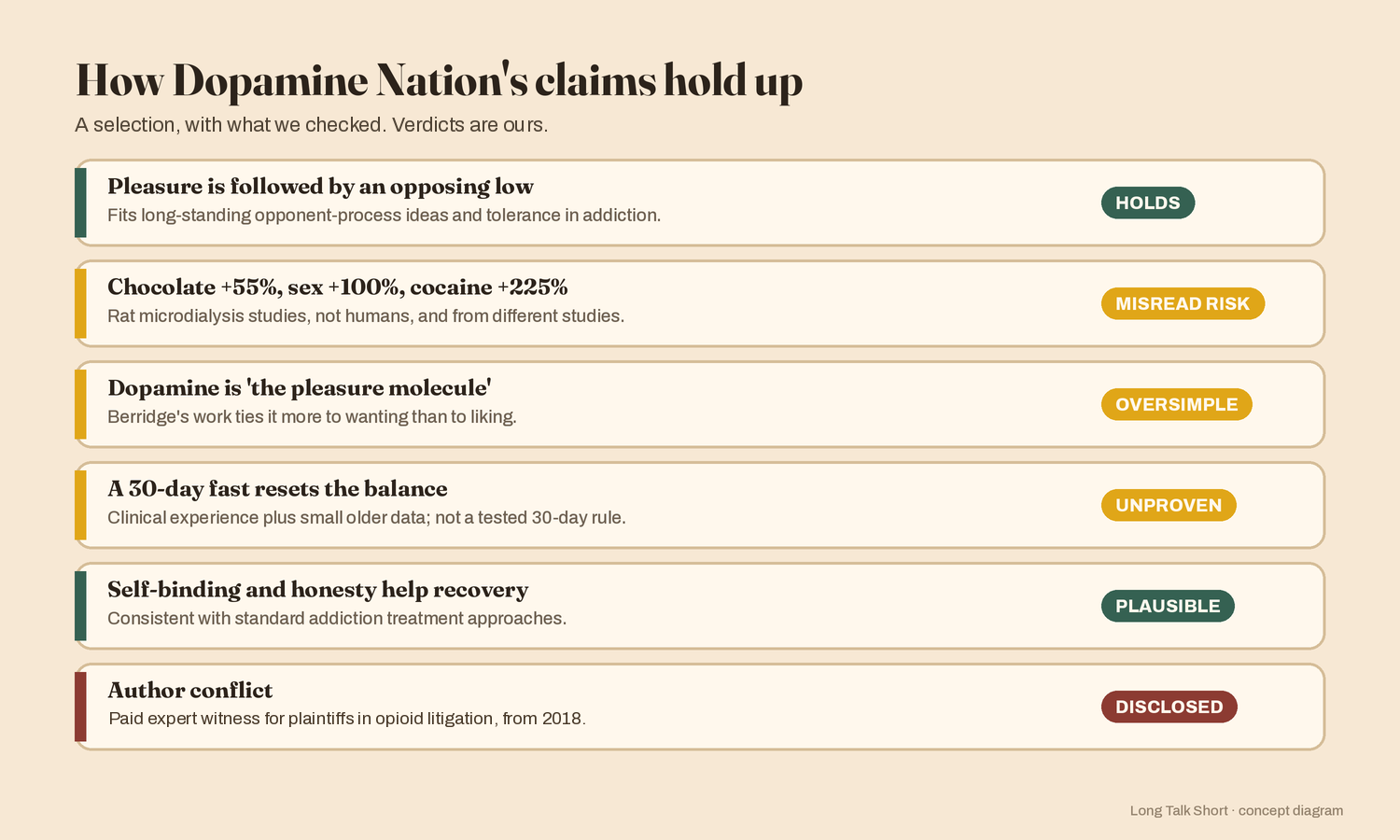
Holds up: The basic pattern, that a high is followed by an opposing low and that repeated use builds tolerance, fits long-standing ideas in addiction science. The seesaw is a simplified way of describing homeostasis, the body's general habit of correcting any push away from its set point, and as a teaching image it works well. Barriers that make a habit harder to reach are a standard and sensible strategy.
Easy to misread: The book gives a striking list: for a rat in a box, chocolate raises dopamine by 55 percent, sex by 100 percent, nicotine by 150 percent and cocaine by 225 percent, with amphetamine at about 1,000 percent. Figures like these come from rat studies that measured dopamine in one brain region, such as the 1988 work by Di Chiara and Imperato in freely moving rats. They are animal measurements from different experiments, so they don't tell you what happens in your head and aren't strictly comparable with one another. The book says "for a rat", but the numbers travel online without that qualifier.
Oversimple: Popular writing often calls dopamine the "pleasure molecule". Research led by Kent Berridge, which we checked in outline, suggests dopamine is tied more to wanting, the pull toward something, than to the liking you feel when you get it. That fits her picture of craving, but it is a reason not to read the book as a precise brain map. The 30-day fast is drawn from her clinical experience and some older research; we found no trial testing 30 days as a rule, so treat the length as a reasonable rule of thumb.
Conflict of interest: A 2022 court declaration we checked has Lembke stating she has been a paid expert witness for plaintiffs in opioid litigation from January 2018, at $500 an hour and $800 an hour for testimony. Nothing we found suggests the testimony shaped the book's advice, but it is a financial interest in the wider argument worth disclosing.
Not checked: We didn't verify the patient stories, which are anonymised, or the specific claims about her patients' mood improving after a fast. The verdicts in the table are ours.
Bottom line: A clear, humane framework for noticing your own habits, built on a sound idea, with numbers and a 30-day rule that deserve lighter weight than the book gives them.
Related reading: You'll Survive the Change You Fear. That's Also Why Your Life Stopped Sparkling · When Words Aren't Enough: The Body Keeps the Score, Checked
Long Talk Short
- Your brain balances pleasure and pain, and every high tends to be followed by a low that drives craving.
- Repeated hits load the pain side, so you need more to feel normal; that applies to phones and food as well as drugs.
- Lembke's reset is about 30 days off, then self-binding: barriers that do the work willpower can't.
- The famous dopamine percentages come from rat studies, not people, and shouldn't be compared like a league table.
- The author has been a paid expert witness in opioid lawsuits, which is worth knowing as you read.
The one thing to remember: if something you do for pleasure keeps leaving you flatter than before, try a month without it and judge the habit by how you feel at the end.
Source: Dopamine Nation by Anna Lembke (Dutton, 2021). This is an independent summary and is not affiliated with the author or publisher.
This article is for general information and is not medical advice. If you have a serious dependence on alcohol, benzodiazepines or opioids, stopping suddenly can be dangerous, so talk to a doctor before any "fast". If you are struggling with addiction or your mental health, or thinking about harming yourself, call or text 988 (the Suicide & Crisis Lifeline in the US) or contact local emergency services.